
Joseph’s hills and valleys
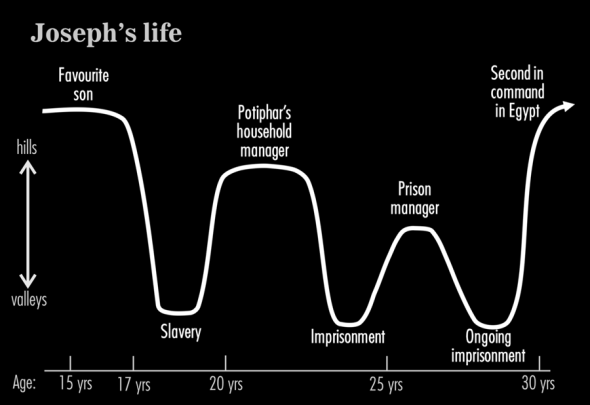 Joseph was born about 3,900 years ago. There is an account of his life in Genesis 30-50 of the Bible. The hills and valleys in the first 30 years of his life are shown in the graph, which goes up for hills and down for valleys.
Hill: As Jacob’s favorite son, Joseph was given a richly ornamented robe (Gen. 37:3). So, life would have been good for him as a child. The robe was a mark of Jacob’s favoritism, but this made his other brothers jealous, and they hated him.
Valley: When Jacob sent Joseph to visit his brothers who were grazing their flocks about 100 km away, they wanted to kill him. So, his life was threatened. Instead, they put him in a pit and then sold him as a slave to some traders who were travelling to Egypt, where he was sold to Potiphar the captain of Pharaoh’s guard. What a change from being his father’s favorite to being a slave in a foreign country! That’s why later on he was glad to forget his family (Gen. 41:51).
Hill: Because God was with Joseph, he was put in charge of Potiphar’s household, which would have been one of the most respected households in Egypt apart from the palace (Gen. 39:2-4).
Valley: When Potiphar’s wife tried to seduce him, Joseph ran out of the house. As a result of this, he was accused of attempted rape and Potiphar was angry, putting Joseph into prison (Gen. 39:20a). So now Joseph was in prison in a foreign country!
Hill: As God was still with him, Joseph was put in charge of all the prisoners (Gen. 39:20b-22).
Valley: God helped Joseph interpret two of the prisoner’s dreams and Joseph asked the cupbearer, who was to be released, to remember him and help him get out of prison (Gen. 40:14-15). But Joseph was forgotten in prison for another two years (Gen. 40:23 – 41:1a). That’s why he called Egypt, “the land of my suffering” (Gen. 41:52NIV). God allowed this—he was there because he didn’t compromise his integrity in Potiphar’s house.
Hill: When Pharaoh had two dreams, the cupbearer finally remembered Joseph and he was released from prison. After being told that the dreams meant that there would be 7 years of abundant harvests followed by 7 years of famine and that they should store up food for the famine, Pharaoh put Joseph in charge of Egypt (Gen. 41:40-43). So, at the age of 30, Joseph was second-in command over all Egypt! He was given a wife and he had two sons.
Later on, his extended family moved to Egypt to survive the famine and Joseph lived for another 80 years in Egypt. The main hill in this period was the reunion with his father Jacob (Gen.46:28-30).
And the main valley was Jacob’s death (Gen. 49:33).
So Joseph had plenty of hills and valleys.
Lessons for us
Joseph set the pattern of his life when he told Potiphar’s wife that to give in to sexual temptation would be to sin against God (Gen. 39:9). He knew what God had instructed and commanded. This shows that remembering God’s instructions and commands can promote resilience. How well do we know the instructions and commands in the Bible for godly living?
And in hindsight, Joseph could see the big picture of what God was doing – God intended his valleys in order to save many lives in the 7-year famine (Gen. 50:20). Do we remember the big picture of what God is doing? In future justice will be done, all evil will be punished, and believers will be with the Lord forever. Do we remember “that God causes everything to work together for the good of those who love God and are called according to His purpose for them” (Rom. 8:28)?
Joseph was also humble in acknowledging that it was God who interpreted dreams, not himself (Gen. 40:8; 41:16, 25, 28, 32). And when his brothers bowed down before him, he didn’t want to get the recognition that only God deserved (Gen. 50:19). So, he remembered God in the hills of life, whereas people often forget God in the good times when they feel self-sufficient.
Written, July 2023





 George's Journal
Leave a comment