Moses’ hills and valleys
 After about 200 hundred years in Egypt, the Israelites multiplied so greatly that the Egyptians felt threatened and put slave masters over them and used them as laborers. Pharaoh issued an order that every Hebrew boy that was born was to be drowned in the river Nile. It was a dangerous time for Moses to be born. Moses lived in the 15th century BC. There is an account of his life from Exodus 2 to Deuteronomy 34 of the Bible. The hills and valleys in the first 80 years of his life are shown in the graph.
Valley: Moses was under the death threat as a baby. When his mother could hide him no longer at home, she hid him in a basket among the reeds of the Nile.
Hill: When Pharaoh’s daughter went to the river to bathe, she saw the basket and opened it and felt sorry for the baby (Ex. 2:6). As a result, she adopted him and he was brought up in the palace, receiving the best education in Egypt and having all the privileges of royalty (Acts 7:22).
Valley: When he was grown up, Moses saw an Egyptian beating a fellow Hebrew and as no one was around, he killed the Egyptian. But the news got out and Pharaoh tried to kill him (Ex. 2:15). As his life was in danger, Moses escaped Egypt as a fugitive. He fled the palace to live with sheep herders.
Hill: Moses lived in Midian for about 40 years where he married and had children.
Valley: Much later, God gave Moses the task of leading the Israelites from their slavery in Egypt to the promised land of Canaan (Ex. 3:10). But Moses was reluctant and doubted that he could lead the Jews and that they would follow him (Ex. 3:11; 4:1, 10, 13). He thought they would not believe him or listen to him, and he was a poor speaker. So, he asked God to send someone else.
Hill: God gave him his brother Aaron to speak on his behalf, and miraculous signs that convinced the Jewish people that God was going to rescue them from slavery.
Valley: But when they asked Pharaoh permission to travel into the wilderness, he reacted by making the Israelites work harder (Ex. 5:1-23). So, the Israelites hated Moses and Aaron. It took 10 plagues to get out of this valley: the river changed into blood, there were plagues of frogs, gnats, flies, the livestock died, there were boils, a hailstorm, locusts, darkness, and all the first-born sons and firstborn livestock died.
Hill: Finally, the Egyptians wanted the Jews to leave Egypt and Pharaoh relented. The exodus of about 2 million Jews was a great victory. They were led by a pillar of cloud by day and a pillar of fire by night (Ex. 13:21-22). God caused Pharaoh to send his army out to bring them back, but they were drowned in the Red Sea (Ex. 14:28). Moses led the Jews in singing about God’s great victory over their enemy. The Jews celebrate this deliverance each year with the Passover Festival.
During the exodus
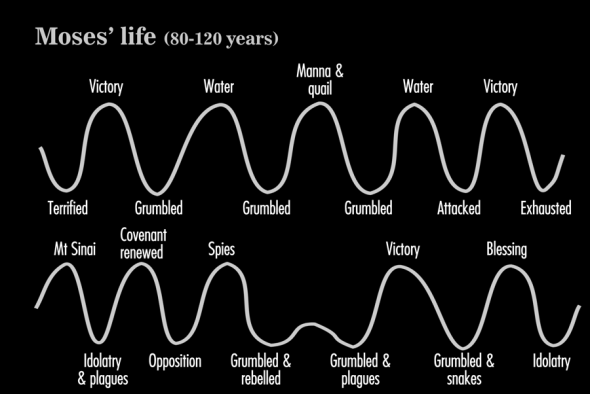 This graph shows that there were many hills and valleys during their 40-year journey to Canaan – the lower graph follows the upper one. The hills included: receiving the ten commandments at Mt Sinai; being provided with manna, water and quail; and victories over enemies (Appendix). The valleys included: the complaints, criticism and grumbling of the people; idolatry; rebellions; enemy attacks; and deaths due to God’s judgement.
So, Moses had plenty of hills and valleys.
Lessons for us
The writer of Hebrews says, “By faith Moses, when he had grown up, refused to be known as the son of Pharaoh’s daughter. He chose to be mistreated along with the people of God rather than to enjoy the fleeting pleasures of sin. He regarded disgrace for the sake of Christ as of greater value than the treasures of Egypt, because he was looking ahead to his reward. By faith he left Egypt, not fearing the king’s anger; he persevered because he saw him who is invisible. By faith he kept the Passover and the application of blood, so that the destroyer of the firstborn would not touch the firstborn of Israel” (Heb. 11:24-28NIV). Moses refused the fame, wealth, political power and privileges of royalty and he refused Egyptian idolatry. And then he persevered for 40 years in Midian. He believed that God would fulfill His covenant to Abraham (Ge 12–17). Moses decided to follow the Lord no matter what might come. He would rather accept an eternal reward than a temporal reward. Moses shows that looking forward to an eternal reward can promote resilience.
Moses obeyed God. He returned from Midian to Egypt, and he led the Israelites from Egypt to Canaan (Acts 7:34-36). And he was faithful to God despite being rejected by many of the Israelites (Heb. 3:1-19).
The basis for our choice to live by faith is the reward God has for us. Eternal values far transcend temporal values (2 Cor. 4:17, 18; 12:9-10).
Appendix: Hills and valleys during the Exodus
After the ten plagues, Pharoah told the Israelites to leave Egypt and God guided them by a pillar of cloud by day and a pillar of fire by night. But Pharaoh changed his mind and commanded the Egyptian army to return them to Egypt.
Valley: The Israelites were terrified of the Egyptian army coming after them (Ex. 14:10).
Hill: But God caused the Egyptian army to be drowned in the Red Sea (Ex. 14:28). So, the Israelites praised God.
Valley: Then the Israelites grumbled because the water at Marah was bitter (Ex. 15:23-24).
Hill: God purified the water and provided more water at Elim.
Valley: Then the Israelites grumbled because of the lack of food in the desert (Ex. 16:2-3).
Hill: God provided manna and quail to eat (Ex. 16: 4-36).
Valley: Then the Israelites grumbled because of the lack of water at Rephidim (Ex. 17:3).
Hill: God provided water at Massah and Meribah (Ex. 17: 6-7).
Valley: Then Amalekites attacked the Israelites at Rephidim (Ex. 17:8).
Hill: The Amalekites were defeated (Ex. 17: 13).
Valley: Moses was wearing himself out settling disputes between the Israelites (Ex. 18:18).
OMIT Hill: Jethro told Moses to delegate the simple disputes to other men (Ex. 18: 21-22).
Hill: At Mt Sinai God made a covenant with the Israelites giving them promises, commandments instructions about the tabernacle, priests and offerings (Ex. 19 onwards).
Valley: While Moses was on Mt Sinai for 40 days, the Israelites began to worship a golden calf (Ex. 32:1-35). When God punished them about 3,000 people died and others were struck with a plague.
Hill: God appeared to Moses and renewed His covenant with the Israelites (Ex. 33:18 – 34:35).
Valley: Miriam and Aaron opposed Moses (Num. 12:1-35). Miriam was punished for her jealousy.
Hill: At Kadesh 12 men were sent to explore the promised land and reported that it was fertile and productive (Num. 13:1-27).
Valley: But most of the spies said that the people were too strong for the Israelites to defeat (Num. 13:31-33). So, the Israelites grumbled and rebelled against Moses (Num. 14:1-4; Dt. 1:26-28). They doubted God’s power. The punishment was that they would wander another 38 years in the wilderness so that all those above 20 years in age (about 600,000 men), except Joshua and Caleb, would die before they reached the promised land.
Valley: A group of 250 mean opposed Moses opposed Moses (Num. 16:1-3). God destroyed them and their families. Then the Israelites grumbled against Moses and 14,700 died in a plague.
Valley: Near the end of their wandering in the wilderness there was no water and the Israelites grumbled against Moses (Num. 20:1-13). God told Moses to speak to a rock to obtain water, but he struck is twice with his staff. Because of his disobedience Moses died before they reached the promised land.
Hill: At Hormah the Israelites defeated the Canaanites who attacked them (Num. 21:1-3).
Valley: The Israelites complained about the lack of water and the miserable food (Num. 21:4-9). God sent venomous snakes, and many died. After they confessed their sin, God told them to look at a bronze snake to be healed of the snake bite.
Hill: When the Amorites and the people of Bashan attacked, God gave the Israelites the victory and they occupied their lands (Num. 21:21-35; Dt. 2:24 – 3:11).
Valley: At Shittim the Israelites were enticed into sexual immorality and idolatry (Num. 25:1-3). As a result of this sin 24,000 died in a plague. And God told the Israelites to attack the Midianites and to take their possessions (Num. 31:1-54).
Hill: Moses blessed the tribes of Israel (Dt. 33:1-29).
Valley: Moses died outside the promised land after he viewed it from Mount Nebo (Dt. 34:1-7)
Written, July 2023





 George's Journal
Leave a comment