How to develop resilience
 Last Friday was Bastille Day – the National Day of France. It was also the day when the Tour de France climbed Grand Colombier in the Jura Mountains. This is a brutal climb of over 1,240 m in elevation over 17.4 km at a gradient of 7.1%. The final 3.4 km rises at 9.2%. When we visited there last year, they were filming a promotional video for the Tour.
 The Tour de France has many hills and valleys which reminds me of life, with the hills being like when times are good and the valleys like when times are tough with difficulties, struggles and suffering.
In this post we will look at a similar pattern in the lives of characters in the Bible. We will see that God has provided the resources we need for resilience to get through the valleys of life.
Abraham’s life
Abraham lived in the Middle East about 4,000 years ago. There is an account of his life in Genesis 11-25 of the Bible. God gave him four great promises: a promised son (Isaac), a promised people (the Jews), a promised land (Canaan), and a promised blessing for all people (Jews wrote the Scriptures; Jesus Christ was Jewish).
Part of Abraham’s life is summarized in the graph in terms of whether he was trusting God’s promises or doubting them. It goes up when he trusted the promises and down when he doubted them.
Trust: At the beginning of Abraham’s journey of faith he obeyed the Lord and left Ur and travelled to Haran on the way to Canaan (Gen. 11:31).
Doubt: But Abraham and his family stopped and settled in Haran, about half-way to Canaan. He did not trust God as he had not yet left his family.
Trust: After God intervened and his father died, Abraham, travelled to Canaan, the Promised Land (Gen. 12:4-8; Acts 7:4). He was not afraid even though the land was occupied by the Canaanites. After God renewed His promise, Abraham built an altar and worshiped. When his faith was strong, he built a new altar each time he moved to a new locality.
Doubt: Later, when he visited Egypt, Abraham doubted God and forgot His promises which couldn’t be fulfilled unless he was alive to father a child (Gen. 12:10-20). He feared that Pharaoh would kill him to take his beautiful wife for his harem. Rather than seek God’s protection, Abraham took matters into his own hands and deceived Pharaoh. But God intervened and Abraham and his household were cast out of Egypt.
Trust: After this, Abraham worshiped the Lord again and the promises were renewed (Gen. 13:4,14-18). The Lord told him to explore the Promised Land, and this gave him a vision of God’s provision.
Doubt: Abraham, still childless, thought his servant Eliezer would be his heir as this was the law at the time (Gen. 15:1-3). He had forgotten God’s promise of numerous descendants; he was living by sight not by faith.
Trust: After God promised him a son and repeated the other promises, Abraham “believed the Lord, and He credited it to him as righteousness” (Gen. 15:6). God accepted Abraham because he believed His promises: he trusted God. God then confirmed the promises unconditionally in a covenant.
Doubt: Sarah, unable to have any children, persuaded Abraham to father a child by her servant, Hagar (Gen. 16:2). The child was Ishmael, the ancestor of the Arabic people. It was 11 years since Abraham heard the promise of many descendants and a great nation. They lacked faith and took matters into their own hands again.
Trust: Thirteen years later the promises were repeated by God (Gen. 17:1-16). As a sign of the promises, they were instructed to circumcise every male in their household. Abraham’s faith was renewed, and he worshiped because of these reminders of the covenant.
Doubt: When they were told that Sarah would have a son, Abraham worshiped and laughed in amazement, while Sarah laughed in disbelief as she was past the childbearing age (Gen. 17:17-18; 18:9-15). In this case Sarah doubted and needed to hear, “Is anything too hard for the Lord?”
Trust: God responded to Abraham’s request and said that Ishmael would be blessed and have many descendants, and on that day Abraham circumcised all the males in his household (Gen. 17:18-27). This obedience indicates that his faith was strong.
Doubt: Later, Abraham doubted God again because he thought he would be killed by King Abimelech of the Philistines, because of his wife’s beauty (Gen. 20:1-18). This was a repeat of his failure in Egypt 20 years earlier. It shows how prone we are to sin. Fortunately, God intervened again to rescue Abraham and Sarah.
Trust: The miraculous conception and birth of Isaac to parents aged 100 and 90 was a pinnacle in the life of Abraham and Sarah (Gen. 17:17; 21:1-7). This happened “at the very time God had promised.” Abraham circumcised Isaac, and Sarah acknowledged God’s miracle. This was the only promise fulfilled in their lifetime; it strengthened their trust in Him.
Trust: After 40 years, Abraham’s faith was tested when God ordered him to offer Isaac as a burnt offering (Gen. 22:1-14; Heb. 11:17-19). Isaac was the promised son through whom the other promises were to be fulfilled! But Abraham obeyed God even though it looked like the death of Isaac. He had learned his lesson to trust without doubting. He believed God could bring Isaac back to life to fulfill His promises. He passed the test, being confident in God, while God stopped it before harm could come to Isaac. Surely, Isaac remembered this incident all of his life! God then encouraged Abraham’s faith by repeating His promises (Gen. 22:15-18).
Valley: About 20 years later Abraham mourned the death of his wife Sarah (Gen. 23:1-2). That would have been a difficult time for him as they had been married for over 100 years.
Hill: Soon afterwards Abraham and Isaac were comforted when Isaac married Rebekah and Abraham married Keturah (Gen. 24:66- 25:1).
So, there were plenty of hills and valleys in the life of Abraham.
Joseph’s Life
Joseph was born about 3,900 years ago. There is an account of his life in Genesis 30-50 of the Bible. The hills and valleys in the first 30 years of his life are shown in the graph, which goes up for hills and down for valleys.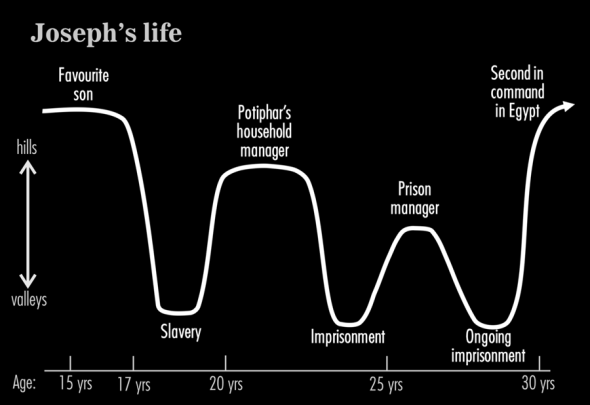
Hill: As Jacob’s favorite son, Joseph was given a richly ornamented robe (Gen. 37:3). So, life would have been good for him as a child. The robe was a mark of Jacob’s favoritism, but this made his other brothers jealous, and they hated him.
Valley: When Jacob sent Joseph to visit his brothers who were grazing their flocks about 100 km away, they wanted to kill him. So, his life was threatened. Instead, they put him in a pit and then sold him as a slave to some traders who were travelling to Egypt, where he was sold to Potiphar the captain of Pharaoh’s guard. What a change from being his father’s favorite to being a slave in a foreign country! That’s why later on he was glad to forget his family (Gen. 41:51).
Hill: Because God was with Joseph, he was put in charge of Potiphar’s household, which would have been one of the most respected households in Egypt apart from the palace (Gen. 39:2-4).
Valley: When Potiphar’s wife tried to seduce him, Joseph ran out of the house. As a result of this, he was accused of attempted rape and Potiphar was angry, putting Joseph into prison (Gen. 39:20a). So now Joseph was in prison in a foreign country!
Hill: As God was still with him, Joseph was put in charge of all the prisoners (Gen. 39:20b-22).
Valley: God helped Joseph interpret two of the prisoner’s dreams and Joseph asked the cupbearer, who was to be released, to remember him and help him get out of prison (Gen. 40:14-15). But Joseph was forgotten in prison for another two years (Gen. 40:23 – 41:1a). That’s why he called Egypt, “the land of my suffering” (Gen. 41:52NIV). God allowed this—he was there because he didn’t compromise his integrity in Potiphar’s house.
Hill: When Pharaoh had two dreams, the cupbearer finally remembered Joseph and he was released from prison. After being told that the dreams meant that there would be 7 years of abundant harvests followed by 7 years of famine and that they should store up food for the famine, Pharaoh put Joseph in charge of Egypt (Gen. 41:40-43). So, at the age of 30, Joseph was second-in command over all Egypt! He was given a wife and he had two sons.
Later on, his extended family moved to Egypt to survive the famine and Joseph lived for another 80 years in Egypt. The main hill in this period was the reunion with his father Jacob (Gen.46:28-30). And the main valley was Jacob’s death (Gen. 49:33).
So Joseph had plenty of hills and valleys.
Moses’ life
After about 200 hundred years in Egypt, the Israelites multiplied so greatly that the Egyptians felt threatened and put slave masters over them and used them as laborers. Pharaoh issued an order that every Hebrew boy that was born was to be drowned in the river Nile. It was a dangerous time for Moses to be born. Moses lived in the 15th century BC. There is an account of his life from Exodus 2 to Deuteronomy 34 of the Bible. Moses compiled and wrote the first five books of the Bible. The hills and valleys in the first 80 years of his life are shown in the graph.
Valley: Moses was under the death threat as a baby. When his mother could hide him no longer at home, she hid him in a basket among the reeds of the Nile.
Hill: When Pharaoh’s daughter went to the river to bathe, she saw the basket and opened it and felt sorry for the baby (Ex. 2:6). As a result, she adopted him and he was brought up in the palace, receiving the best education in Egypt and having all the privileges of royalty (Acts 7:22).
Valley: When he was grown up, Moses saw an Egyptian beating a fellow Hebrew and as no one was around, he killed the Egyptian. But the news got out and Pharaoh tried to kill him (Ex. 2:15). As his life was in danger, Moses escaped Egypt as a fugitive. He fled the palace to live with sheep herders.
Hill: Moses lived in Midian for about 40 years where he married and had children.
Valley: Much later, God gave Moses the task of leading the Israelites from their slavery in Egypt to the promised land of Canaan (Ex. 3:10). But Moses was reluctant and doubted that he could lead the Jews and that they would follow him (Ex. 3:11; 4:1, 10, 13). He thought they would not believe him or listen to him, and he was a poor speaker. So, he asked God to send someone else.
Hill: God gave him his brother Aaron to speak on his behalf, and miraculous signs that convinced the Jewish people that God was going to rescue them from slavery.
Valley: But when they asked Pharaoh permission to travel into the wilderness, he reacted by making the Israelites work harder (Ex. 5:1-23). So, the Israelites hated Moses and Aaron. It took 10 plagues to get out of Egypt: the river changed into blood, there were plagues of frogs, gnats, flies, the livestock died, there were boils, a hailstorm, locusts, darkness, and all the first-born sons and firstborn livestock died.
Hill: Finally, the Egyptians wanted the Jews to leave Egypt and Pharaoh relented. The exodus of about 2 million Jews was a great victory. They were led by a pillar of cloud by day and a pillar of fire by night (Ex. 13:21-22). God caused Pharaoh to send his army out to bring them back, but they were drowned in the Red Sea (Ex. 14:28). Moses led the Jews in singing about God’s great victory over their enemy. The Jews celebrate this deliverance each year with the Passover Festival.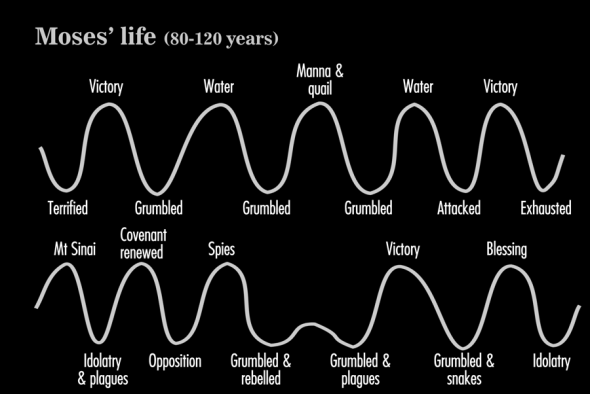
This graph shows that there were many hills and valleys during their 40-year journey to Canaan – the lower graph follows the upper one. The hills included: receiving the ten commandments at Mt Sinai; being provided with manna, water and quail; and victories over enemies (Appendix). The valleys included: the complaints, criticism and grumbling of the people; idolatry; rebellions; enemy attacks; and deaths due to God’s judgement.
Joshua’s life
Joshua assisted Moses during the exodus of the Israelites from Egypt to Canaan (Ex. 24:13; 33:11; Num. 11:28). So during this time period he experienced the same hills and valleys as Moses (see above). When Moses died outside the promised land after he viewed it from Mount Nebo (Dt. 34:1-7), Joshua replaced him as the leader of the Israelites (Dt. 31:1-8). Joshua lived in the 15th century BC. There is an account of his life from Exodus 17 to Joshua 24 of the Bible.
Joshua led the Israelite army in their first victory (Ex. 17:8-13). And he was one of the 12 men who explored Canaan. But 10 of these men said that the cities were too strong for them to defeat. As only Joshua and Caleb said that they could possess the promised land, they were the only ones older than 20 years of age that lived long enough to enter Canaan. The rest died during the 38 years that they wandered in the wilderness. So Joshua believed that God was stronger than their enemies.
The main hills and valleys when he was in the promised land are shown in the graph.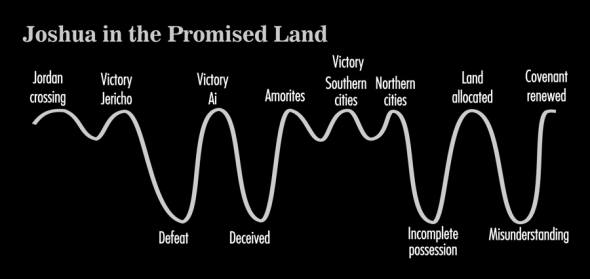
Hill: They miraculously crossed the Jordan river when it was in flood (Josh. 3).
Hill: They circumcised the males who had been born in the wilderness and celebrated the Passover. Then God gave them victory over the city of Jericho after they had marched around it 13 times over seven days (Josh 6).
Valley: But because of Achan’s sin, they were defeated at Ai (Josh. 7).
Hill: After the sin was punished, God gave them victory over Ai (Josh. 8). And the covenant was renewed.
Valley: They were deceived into agreeing to a peace treaty by the Gibeonites, who became servants to the Israelites (Josh. 9). Such treaties were only to be made with cites outside Canaan (Dt. 20:10-18).
Hill: God gave them victory over the Amorites, the southern cities and the northern cities (Josh. 10-11).
Valley: When Joshua was old there were still very large areas of the promised land to be taken over (Josh. 13).
Hill: Portions of the promised land were allocated to each of the tribes of Israel (Josh. 13-21).
Valley: There was a misunderstanding about an altar built by the eastern tribes near the Jordan river (Josh. 22). There was a threat of war when the western tribes assumed it was a pagan altar. But this was averted when they were told that it was a monument to remind their descendants that both worshipped the same God.
Hill: Before Joshua’s death the covenant was renewed (Josh. 24:1-28).
So, Joshua had plenty of hills and valleys.
Samuels’ life
Samuel was God’s representative in Israel in the transition from the rule of the judges to that of the monarchy. He lived in the 11th century BC as a Nazarite (like Samson and John the Baptist) dedicated to serving the Lord (Num. 6:1-12; 1 Sam. 1:11). There is an account of his life in 1 Samuel 1-28 of the Bible. The main hills and valleys in his life are shown in the graph.
Hill: Samuel was born to a barren woman named Hannah, who fervently prayed for a son (1 Sam. 1:27). He served God in the tabernacle under Eli the high priest (2:11). As a boy he “continued to grow in stature and in favor with the Lord and with people” (2:26NIV).
Valley: But Eli’s sons were wicked (2). So a prophet predicted that they would die on the same day (2). God also gave Samuel a similar message about the coming judgment of Eli’s family (3).
Hill: All the people in Israel recognized that Samuel was a “prophet of the Lord” (3:20). He received messages and revelations from God throughout his life.
Valley: Israel was defeated by the Philistines and they captured the ark of the covenant (4). Eli’s sons died in the battle and Eli died on the same day after he fell over and broke his neck.
Hill: Because the Philistines were struck with a plague, they returned the ark to Israel (6).
Valley: Seventy Israelites died when they looked into the ark (6).
Hill: There was a spiritual revival (the Israelites turned from idolatry and repented of their sins) and victory over the Philistines (7).
Valley: Samuel’s sons were greedy for money – they accepted bribes and perverted justice (8).
Hill: Samuel anointed Saul as king (9-10).
Valley: In asking for a king, the people were rejecting God as their king (1 Sam. 8:7; 10:19; 12:12, 17, 19-20).
Hill: Victory over the Ammonites (11). In his farewell speech Samuel said, “If you fear the Lord and serve and obey Him and do not rebel against His commands, and if both you and the king who reigns over you follow the Lord your God—good! But if you do not obey the Lord, and if you rebel against His commands, His hand will be against you, as it was against your ancestors.” (1 Sam. 12:14-15). That’s how the covenant applied to the monarchy.
Valley: Because Saul disobeyed God’s command about burnt offerings given through Samuel, his kingdom would end and there would be no ongoing dynasty (13).
Hill: Saul had many military victories (14).
Valley: Because Saul disobeyed God’s command about destroying the Amalekites given through Samuel, God rejected him as king over Israel (15).
Hill: Samuel anointed David as king (16).
Valley: An evil spirit replaced a divine spirit in Saul (16).
Hill: David killed the Philistine giant Goliath (1 Sam. 17:50).
Valley: King Saul was “very angry” with David and attempted to murder him with a spear (1 Sam. 18:8). Saul tried to kill David again (1 Sam. 19:9-16). Then Saul pursued David across Israel and Samuel died (23-25).
Valley: Finally, because Saul disobeyed God’s command about destroying the Amalekites, Samuel made an appearance after his death to predict the death of Saul and his sons in a battle with the Philistines (28).
So, Samuel had plenty of hills and valleys.
David’s life
David lived in the Middle East about 3,000 years ago. There is an account of his life in 1 Samuel 16 to 1 Kings 2 and in 1 Chronicles 11-29 of the Bible. And David wrote many of the Psalms. The hills and valleys in his life are shown in the graph.
Hill: King Saul disobeyed God by making a burnt offering to God, something that only a priest was meant to do (1 Sam. 13:8-14). Because of this God had chosen a new king over Israel. The prophet-priest Samuel declared that David was the future king (1 Sam. 16:13).
Valley: David’s oldest brother “burned with anger at him” (1 Sam. 17:28).
Hill: David killed the Philistine giant Goliath (1 Sam. 17:50).
Valley: King Saul was “very angry” with David and attempted to murder him with a spear (1 Sam. 18:8, 29). Saul was David’s enemy until he died.
Hill: The king’s son Jonathan helped protect David from Saul.
Valley: Saul tried to kill David again (1 Sam. 19:9-16).
Then there were many valleys and hills not shown on this graph as Saul pursued David across Israel …..
Hill: David spared Saul’s life when he creeped into his camp and borrowed his spear (1 Sam. 26:1-25).
Valley: The Amalekites captured his town of Ziklag while David and his men were away (1 Sam. 30:1-6).
Hill: David destroyed the Amalekites and recovered what they had taken (1 Sam. 30:16-20). Soon after Saul was killed in battle and David was anointed king over Judah.
Valley: Then there was a long war between Saul’s army and David’s men (2 Sam. 3:1).
Hill: Then David became king over all Israel (2 Sam. 5:3). He captured Jerusalem and made it the capital. And God promised him a lasting dynasty and gave him victory over all his enemies (2 Sam. 7:11 – 8:14).
Valley: But David committed adultery with Bathsheba and had her husband killed in war. Then God disciplined him – the baby died (2 Sam. 12:13) and three of his sons died violently. It took two years for David to return to fellowship with the Lord via confessing his sin.
Hill: David had another son, Solomon who would build the temple in Jerusalem (2 Sam. 12:24). David prepared the plans for the temple (1 Chron. 28:1-21- 29:9).
Valley: David mourned after there was incest and murder in his family (2 Sam. 13:1-39).
Valley: David’s son Absalom conspired to take over the throne (2 Sam. 15). So, David escaped from Jerusalem. But Absolom died in the conflict. And David mourned the death of his son. David returned to Jerusalem, but the nation was still divided.
Hill: Before he died, David made Solomon king of Israel (1 Ki. 1:28 – 2:12).
So David had plenty of hills and valleys.
Elijah’s life
Elijah was a prophet to Israel from 900 BC to 849 BC. There is an account of his life in 1 Kings 17 to 2 Kings 2 of the Bible. The hills and valleys in his life are shown in the graph.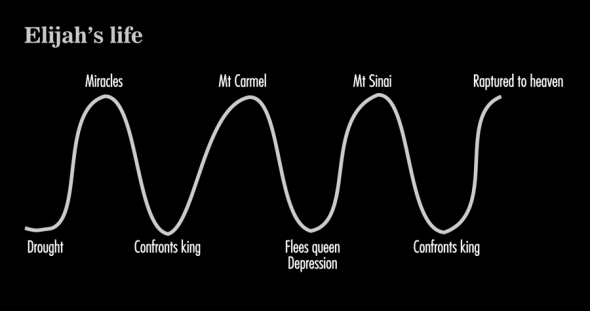
Valley: In a drought he was fed by ravens and by a widow in Zarephath (1 Ki. 17:1-16).
Hill: God enabled him to do miracles – the widow’s flour and oil were always replenished, and he resurrected her son (1 Ki. 17: 6-7).
Valley: The king blamed Elijah for the drought, but Elijah said it was caused by the king’s idolatry (1 Ki. 18:16-18). In those times it was risky to confront a king.
Hill: Elijah challenged the prophets of Baal and Asherah at Mount Carmel to see whose God would provide fire for a sacrifice (1 Ki. 18:19-40). The God of Elijah won the competition. And the false prophets were killed, and rain came to end the drought.
Valley: When queen Jezebel heard about the killing of the false prophets, she threatened to kill Elijah as well (1 Ki. 19:1-8). “Elijah was afraid and ran for his life”. In the wilderness near Beersheba, he was severely depressed and wanted to die. An angel gave him food and drink for his 40-day journey to Mount Sinai.
Hill: At Mount Sinai God appeared to him and gave him encouragement and instructions to follow (1 Ki. 19:9-18).
Valley: Elijah confronted king Ahab for having Naboth killed so he could claim his land (1 Ki. 21:17-29). Later wicked king Ahab was killed in battle.
Valley: Elijah told king Ahaziah that he would die of an injury (2 Ki. 1:1-17).
Hill: Elijah parted the Jordan river to cross on dry ground and was then taken to heaven in a whirlwind without dying (2 Ki. 2:1-12).
So Elijah experienced hills and valleys.
Elisha’s life
Elisha was the prophet to Israel after Elijah. He lived in the 9th century BC. There is an account of his life in 1 Kings 19 to 2 Kings 13 of the Bible. The hills and valleys in his life are shown in the graph.
Hill: Elisha desired to carry on Elijah’s ministry, and this was granted by God (2 Ki. 2: 9-14). Like Elijah, he parted the Jordan river to cross on dry ground.
Valley: When a group of boys from Bethel mocked and made fun of him, they were mauled by two bears (2 Ki. 2:23-24).
Hill: God did many miracles through Elisha: purified water at Jericho; multiplied a small amount of a widow’s oil to fill many jars; resurrected the Shunammite’s son; made poisonous stew edible during a famine; multiplied 20 loaves of bread to feed 100 men; healed Naaman of leprosy; and made an axe-head float on water (2 Ki. 2:19 – 6:7).
Valley: The king of Aram tried to capture Elisha because he was telling the king of Israel where the enemy was located (2 KI. 6:8-17). So, an army of horses and chariots surrounded Elisha in the city of Dothan.
Hill: When the army attacked, Elisha prayed and the enemy were blinded and they stopped raiding Israel (2 Ki. 6:18-23).
Valley: Sometime later the king of Israel blamed God for a siege and famine and planned to behead Elisha (2 Ki. 6:24 – 7:2). But Elisha predicted that the famine would end on the following day.
Hill: God “caused the Arameans to hear the sound of chariots and horses and a great army” so they left everything and “ran for their lives” (2 Ki. 7:3-20). The famine was over when the Israelites plundered the camp of the Arameans.
Hill: Elisha anointed Jehu as king of Israel. He was the best king of the northern kingdom of Israel. In fulfilment of a prophecy by Elijah (1 Ki. 21:21-22), he had queen Jezebel and the descendants of king Ahab killed. And he destroyed Baal worship in Israel.
Hill: A miracle was associated with Elisha after his death (2 Ki. 13:20-21)! When a man’s body touched Elisha’s bones, the man came back to life!
So Elisha experienced hills and valleys.
Peter’s life
Simon Peter lived in the Middle East between about 1 BC and AD 67. There is an account of his life in Matthew to John and Acts 1-15 of the Bible. Peter was the main preacher to the Jews in the early church. And he wrote the letters 1 Peter and 2 Peter in the New Testament. The major hills and valleys in his life are shown in the graph – the lower graph follows the upper one.
Hill: After Andrew told his brother Peter “we have found the Messiah”, Peter believed that Jeus was the promised Jewish Messiah (Jn. 1:40-42NIV).
Hill: After a miraculous catch of fish, they both stopped fishing and followed Jesus (Lk. 5:1-11). They were the first of the 12 disciples to be chosen by Jesus.
Hill: Jesus healed Peter’s mother-in-law of a fever (Mt. 8:14-15).
Valley: Jesus empowered Peter to walk on the sea of Galilee during a storm (Mt. 14:22-36). But when he became afraid of the storm he started to sink. Jesus rescued him and when they climbed into the boat the storm died down.
Hill: On behalf of the disciples, Peter said that Jesus was “the Messiah, the son of the living God” (Mt. 16:16).
Valley: After Jesus predicted His death and resurrection, Peter said “Lord this shall never happened to you!” (Mt. 16:22). Then Peter was rebuked because he was opposing God’s plan and being a hindrance to Jesus. Discipleship involves denial of self, cross-bearing and following Jesus (16:24). It includes a willingness to suffer for the Lord’s sake.
Hill: Peter, James and John witnessed the transfiguration of Jesus (Mk. 9:2-4).
Valley: But Peter treated Jesus like a Jewish prophet of equal standing to Moses and Elijah (Mk. 9:5-7).
Valley: When Jesus began to wash the disciples’ feet during the Last Supper, Peter said “you shall never wash my feet” (Jn. 13:8). He didn’t understand this lesson in humility. But he changed his mind when he realized that the external washing was symbolic of cleansing from sin.
Valley: After Jesus predicted that all the disciples would desert Him because of fear of association with Him, Peter said “I will never desert you” (Mt. 26:31-35NLT). Jesus replied, “I tell you the truth, Peter—this very night, before the rooster crows, you will deny three times that you even know me”. Then Peter declared, “Even if everyone else deserts you, I will never desert you”. He was overconfident.
Valley: When Jesus prayed in the garden of Gethsemane He told Peter, James and John to keep watch, but they fell asleep (Mt.26: 36-45). Then Jesus said, “Keep watch and pray, so that you will not give in to temptation. For the spirit is willing, but the body is weak!” (Mt. 26:41NLT).
Valley: When Jesus was betrayed by Judas and about to be arrested, Peter cut off the right ear of Malchus, the high priest’s servant (Lk. 22:50-51; Jn. 18:1-12). But Jesus healed the ear.
Valley: Before the religious trial of Jesus, Peter denied being His disciple (Jn. 18:15-18).
Valley: Before the civil trial of Jesus, twice Peter denied being His disciple (Jn. 18:25-27). And after this a rooster began to crow. Then Peter remembered what Jesus had predicted and he wept bitterly (Mt. 26:74-75). He was now humiliated. Conviction of sin is the first step towards restoration.
Hill: After Jesus rose from the dead, He appeared to Peter on resurrection Sunday before He appeared to the other disciples (Lk. 24:34; 1 Cor. 15:5).
Hill: When seven of the disciples were fishing on the sea of Galilee, Jesus provided breakfast and challenged Peter’s loyalty to Him (Jn. 21:1-17). Peter replied with three affirmations of his love for the Lord. Then Jesus restored him to ministry. He was reinstated to serve.
Hill: Peter and the rest of the disciples saw Jesus ascend back to heaven (Acts 1:9-11).
Hill: On the day of Pentecost, Peter was filled with the Holy Spirit and when he preached about 3,000 people decided to follow Jesus (Acts 2).
Hill: Soon afterwards, Peter healed a lame beggar (Acts 3).
Hill: When Peter preached another 2,000 people decided to follow Jesus (Acts 3-4).
Valley: Peter and John were imprisoned and interrogated by the Jewish religious leaders (Acts 4).
Hill: Because of their courage and the healing, Peter and John were released and warned not to preach about Jesus (Acts 4).
Valley: There was great fear in the church after Ananias and Sapphira died after lying to the apostles (Acts 5: 1-11).
Hill: The apostles performed many miracles (Acts 5:12-16).
Valley: Because the religious leaders were jealous, the apostles were imprisoned and interrogated and flogged (Acts 5: 17-18, 27-28, 40).
Hill: An angel released the apostles and Gamaliel convinced the Jewish leaders to let them go after they were warned not to preach about Jesus (Acts 5:19-20, 34-40).
Valley: False accusations were made against Stephen, and he was killed by the Jewish religious leaders (Acts 6-7).
Valley: The church was persecuted and scattered (Acts 8-9).
Hill: Peter did miracles at Lydda and Joppa (Acts 9:32-42).
Hill: Some Gentiles decided to follow Jesus after Peter visited Cornelius at Caesarea (Acts 10).
Valley: Peter was criticized by some Jewish believers because he associated with Gentiles (Acts 11). But they praised God when Peter told them what had happened at Caesarea.
Valley: The church continued to be persecuted – some were imprisoned, and the apostle James was killed (Acts 12). Peter was one of those imprisoned. But the church was praying for him.
Hill: An angel helped Peter escape from the prison (Acts 12). Despite the persecution, “the word of God continued to spread and flourish” (12:24).
Valley: When Peter came to Antioch “he ate with the Gentile believers, who were not circumcised. But afterward, when some friends of James came, Peter wouldn’t eat with the Gentiles anymore. He was afraid of criticism from these people who insisted on the necessity of circumcision. As a result, other Jewish believers followed Peter’s hypocrisy, and even Barnabas was led astray by their hypocrisy” (Gal. 2:11-13NLT). So, Paul “had to oppose him to his face, for what he did was very wrong” because Peter aligned himself with legalistic believers. This shows that sin can overtake anyone (even leaders like Peter and Barnabas) when they let their guard down. Fortunately, Peter took his rebuke from Paul with maturity.
Hill: The apostles and elders of the church met at Jerusalem to consider whether “Gentile converts must be circumcised and required to follow the law of Moses” (Acts 15NLT). Peter mentioned the conversion of Gentiles at Caesarea to support the truth that “we are all saved the same way, by the undeserved grace of the Lord Jesus” (15:11NLT). After listening to Barnabas, Paul and James, they agreed that Gentile converts didn’t have to be circumcised or required to follow the law of Moses.
So, Peter also experienced hills and valleys.
Paul’s life
Paul lived in the Middle East between about 5 BC and AD 68. There is an account of his life in Acts 7-28 of the Bible. And Paul wrote many of the letters in the New Testament. The major hills and valleys in his life are shown in the graph.
Valley: Paul was a Pharisee who was passionate about persecuting and imprisoning the early Christians (Acts 9:1-2). He approved the stoned of Stephen to death (Acts 7:58 – 8:1).
Hill: When a light flashed from heaven and God spoke to him, Paul changed his mind about Christianity and trusted that Christ had taken the punishment for his sin (Acts 9:3-19). So he changed from a persecutor to a preacher.
Valley: After Paul preached to Jews in Damascus that Jesus was the Son of God (Messiah), some of the Jews planned to kill him (Acts 9:20-30).
Hill: Paul’s first missionary journey was to Cyprus and southeast Turkey (Acts 13:1 – 14:28).
Valley: Paul had a sharp disagreement with legalistic Jews who travelled from Jerusalem to Antioch to advocate that male Gentiles needed to be circumcised to be saved (Acts 15:1-2).
Hill: At the Council in Jerusalem Paul reported about the miracles God had done among the Gentiles (Acts 15:12). The Council decided that circumcision was not necessary for salvation.
Valley: Paul had a sharp disagreement with Barnabas about not taking John Mark on their next missionary journey, so they went separate ways (Acts 15:36-39).
Hill: Paul’s second missionary journey was to Turkey and Greece (Acts 16:1 – 18:22).
Valley: Paul was imprisoned in Philippi (Acts 16:19-40). Some of the Jews caused Paul to flee Thessalonica and Berea, and he was opposed in Corinth.
Hill: Paul’s third missionary journey was to Turkey and Greece (Acts 18:23 – 21:26).
Valley: There was a riot after Paul preached in Ephesus (Acts 19:23-41).
Hill: At Troas, Paul raised Eutychus from the dead (Acts 20:7-12).
Valley: Paul was arrested in Jerusalem (Acts 21:27-36). Some Jews planned to kill him. Then he was transferred to Caesarea where he had trials before the Governors Antonius Felix and Festus. He also appeared before king Agrippa. Because he appealed to Caesar, he was shipped to Rome.
Hill: Despite his trials and imprisonment, Paul continued to evangelize by speech and writing and we have his legacy in his letters in the New Testament (Acts 20:7-12).
So Paul also experienced hills and valleys.
Lessons for us
An obvious feature of the lives of these men is that they all experienced lots of hills and valleys. Jesus said, “Here on earth you will have many trials and sorrows. But take heart, because I have overcome the world” (Jn. 16:33). Because we live in a sinful world, we all experience valleys from time to time when times are tough with difficulties, struggles and suffering. Let’s expect valleys and learn how to get through them.
But the valleys didn’t overwhelm them, and they kept experiencing hills. They were resilient. Rubber is resilient – after it is depressed, it can recover to its original position.
Abraham was given promises by God. When he forgot these promises, he failed and his faith was weak. When he remembered the promises, he obeyed God and his faith was strong. Hebrews says that Abraham, “embraced the promises” (Heb. 11:17). This shows that remembering God’s promises can promote resilience. This is like the old hymn called “Standing on the promises of God”. Are you doing that? How well do we know God’s promises to us in the Bible?
Joseph set the pattern of his life when he told Potiphar’s wife that to give in to sexual temptation would be to sin against God (Gen. 39:9). He knew what God had instructed and commanded. This shows that remembering God’s instructions and commands can promote resilience. How well do we know the instructions and commands in the Bible for godly living?
And in hindsight, Joseph could see the big picture of what God was doing – God intended his valleys in order to save many lives in the 7-year famine (Gen. 50:20). Do we remember the big picture of what God is doing? In future justice will be done, all evil will be punished, and believers will be with the Lord forever. Do we remember “that God causes everything to work together for the good of those who love God and are called according to His purpose for them” (Rom. 8:28)?
Joseph was also humble in acknowledging that it was God who interpreted dreams, not himself (Gen. 40:8; 41:16, 25, 28, 32). And when his brothers bowed down before him, he didn’t want to get the recognition that only God deserved (Gen. 50:19). So, he remembered God in the hills of life, whereas people often forget God in the good times when they feel self-sufficient.
The writer of Hebrews says, “By faith Moses, when he had grown up, refused to be known as the son of Pharaoh’s daughter. He chose to be mistreated along with the people of God rather than to enjoy the fleeting pleasures of sin. He regarded disgrace for the sake of Christ as of greater value than the treasures of Egypt, because he was looking ahead to his reward. By faith he left Egypt, not fearing the king’s anger; he persevered because he saw him who is invisible. By faith he kept the Passover and the application of blood, so that the destroyer of the firstborn would not touch the firstborn of Israel” (Heb. 11:24-28NIV). Moses refused the fame, wealth, political power and privileges of royalty and he refused Egyptian idolatry. And then he persevered for 40 years in Midian. He believed that God would fulfill His covenant to Abraham (Ge 12–17). Moses decided to follow the Lord no matter what might come. He would rather accept an eternal reward than a temporal reward.
Moses obeyed God. He returned from Midian to Egypt, and he led the Israelites from Egypt to Canaan (Acts 7:34-36). And he was faithful to God despite being rejected by many of the Israelites (Heb. 3:1-19).
The basis for our choice to live by faith is the reward God has for us. Eternal values far transcend temporal values (2 Cor. 4:17, 18; 12:9-10).
The Bible shows Joshua as a faithful and courageous leader who trusted God and obeyed His commands. His only recorded sin was that he and the Israelites “did not inquire of the Lord” when they made a peace treaty with the Gibeonites (Josh. 9:14). The Gibeonites tricked Joshua and the Israelites into making a treaty with them, even though God had commanded them not to make any treaties with the inhabitants of the land (Ex. 34:12, 15-16; Dt. 7:2; 20:10-18).
“Joshua read all the words of the law” “to the whole assembly of Israel, including the women and children, and the foreigners who lived among them” (Josh. 8:34-35). So he read the Scriptures which included God instructions and commands. And he urged the people to throw away their foreign gods (Josh. 24:23).
Joshua obeyed God’s instructions and commands. For example, he investigated Achan’s sin and ambushed Ai (Josh. 7:14-18; 8:1-23). And he resisted peer pressure when he didn’t follow the majority of the spies. This shows that obeying God’s instructions and commands can promote resilience. Whereas ongoing disobedience, like Solomon, destroys resilience.
Near the end of his life Joshua said, “as for me and my household, we will serve the Lord” (Josh. 24:15). He “followed the Lord wholeheartedly” (Num. 32:12).
Joshua had a good influence on the Israelites. The Bible says that “Israel served the Lord throughout the lifetime of Joshua and of the elders who outlived him and who had experienced everything the Lord had done for Israel” (Josh. 24:31).
Despite his privileged position, Samuel did not give in to the temptation of greed or sexual immorality like Eli’s sons or into greed and injustice like his own sons. He hadn’t cheated or oppressed anyone (12:1-5).
Samuel obeyed God’s instructions and commands. For example, after the people requested a king, he warned them and let them know what the king will claim as his rights (8). And he told king Saul of God’s judgment for his disobedience. This shows that obeying God’s instructions and commands can promote resilience. Whereas ongoing disobedience, like Solomon, destroys resilience.
When David was a fugitive hiding from Saul and his men, he still respected Saul as the king of Israel even though he had opportunities to kill him. This shows his humility and his strong trust in God. This humility and trust gave him resilience.
David committed adultery and murder. But he confessed his sins and repented and described the benefits of this in Psalm 32 and 51. Likewise, when the Jews were in a big valley after the Babylonian invasion, Jeremiah called them to confess and repent of their sin and rebellion against God (Lam. 3:40-42). Unconfessed sin affects our physical, mental and spiritual wellbeing. Whereas confession enables resilience.
David wrote, “Even when I walk through the darkest valley, I will not be afraid, for you are close beside me. Your rod and your staff protect and comfort me” (Ps. 23:4NLT). This pictures a shepherd taking his sheep through a dark ravine where predators might lurk. He acknowledged God’s protection as he “walks through” a difficult situation. Awareness of God’s protection enables resilience.
After fleeing for several days from queen Jezebel, Elijah was exhausted and depressed. He fell asleep near Beersheba. An angel woke him and gave him food and water and then he rested again. The angel came back and gave him more food and water. He needed physical strength for the journey. It gave him resilience. Food also fixed Hannah’s depression (1 Sam. 1:18). Do you take care of yourself to get through the valleys of life?
Elijah was also a man of prayer (Jas. 5:17-18). He prayed in God’s will, so God answered him.
When Elisha was surrounded by his enemies, he prayed to God. Prayer taps into God’s power and can give resilience. He didn’t feel alone but was aware of the support of God’s angels. Likewise, we can be aware of the support of the Holy Spirit.
Job lost everything except his life. When Job asked God to explain these deep valleys in his life and why good people suffer, God asked him 77 questions and Job couldn’t answer any of them. This shows that our understanding in limited. We need to be humble and recognize God’s sovereignty, supremacy and divine wisdom. It is often difficult to see God’s purpose in disciplining us (Heb. 12:7). The reason is that He is infinite, and we are finite. No Christian has the capacity to understand God’s universal plan for our lives. When we discipline young children, they do not grasp the long-term development that they need. They only see the immediate problem they face.
Peter was a follower of Jesus who failed many times. It shows that anyone can fail. He was corrected by God, Jesus, and Paul! But it didn’t stop him from being a leader in the early church. He was not rejected by Jesus. Peter was restored to service because of his conviction, confession and repentance. God used him mightily in the early church. His pride and self-confidence were replaced with humility and confidence in God and determination to serve Him.
Paul’s main purpose in life was, “I focus on this one thing: Forgetting the past and looking forward to what lies ahead, I press on to reach the end of the race and receive the heavenly prize for which God, through Christ Jesus, is calling us” (Phil. 3:13b-14NLT). God wants us to concentrate on His purpose for us. Paul pictures it as a race. Have you started the race? Are you living for the day you will meet the Lord?
Hebrews 12 says that the lives of such men testify to the power of faith in God’s promises. We should set aside anything that hinders our walk by faith (Heb. 12:1). Anything that interferes with Bible study or prayer would be a hindrance. The prize for Christians is not heaven but the reward in heaven for serving the Lord during the course of our lives.
Conclusions
Let’s develop resilience to get through the valleys of life by:
Being aware of what the Bible says about:
– God’s promises,
– God’s instructions and commands,
– God’s sovereignty/supremacy,
– God’s presence and protection, and
– The big picture of what He is doing.
And develop resilience by:
– Setting aside whatever hinders us,
– Praying regularly,
– Dealing with sin by confessing, then repenting, then forgetting and then pressing on ahead looking forward to an eternal reward,
– Being humble, and
– Maintaining our physical strength.
We have seen that God has provided the resources we need for resilience to get through the valleys of life. Paul pictures it as a race. Have you started the race? Are you using the resources?
Appendix: Hills and valleys during the Exodus
After the ten plagues, Pharoah told the Israelites to leave Egypt and God guided them by a pillar of cloud by day and a pillar of fire by night. But Pharaoh changed his mind and commanded the Egyptian army to return them to Egypt.
Valley: The Israelites were terrified of the Egyptian army coming after them (Ex. 14:10).
Hill: But God caused the Egyptian army to be drowned in the Red Sea (Ex. 14:28). So, the Israelites praised God.
Valley: Then the Israelites grumbled because the water at Marah was bitter (Ex. 15:23-24).
Hill: God purified the water and provided more water at Elim.
Valley: Then the Israelites grumbled because of the lack of food in the desert (Ex. 16:2-3).
Hill: God provided manna and quail to eat (Ex. 16: 4-36).
Valley: Then the Israelites grumbled because of the lack of water at Rephidim (Ex. 17:3).
Hill: God provided water at Massah and Meribah (Ex. 17: 6-7).
Valley: Then Amalekites attacked the Israelites at Rephidim (Ex. 17:8).
Hill: The Amalekites were defeated (Ex. 17: 13).
Valley: Moses was wearing himself out settling disputes between the Israelites (Ex. 18:18). Jethro told Moses to delegate the simple disputes to other men (Ex. 18: 21-22).
Hill: At Mt Sinai God made a covenant with the Israelites giving them promises, commandments, and instructions about the tabernacle, priests and offerings (Ex. 19 onwards).
Valley: While Moses was on Mt Sinai for 40 days, the Israelites began to worship a golden calf (Ex. 32:1-35). When God punished them about 3,000 people died and others were struck with a plague.
Hill: God appeared to Moses and renewed His covenant with the Israelites (Ex. 33:18 – 34:35).
Valley: Miriam and Aaron opposed Moses (Num. 12:1-35). Miriam was punished for her jealousy.
Hill: At Kadesh 12 men were sent to explore the promised land and reported that it was fertile and productive (Num. 13:1-27).
Valley: But most of the spies said that the people were too strong for the Israelites to defeat (Num. 13:31-33). So, the Israelites grumbled and rebelled against Moses (Num. 14:1-4; Dt. 1:26-28). They doubted God’s power. The punishment was that they would wander another 38 years in the wilderness so that all those above 20 years in age (about 600,000 men), except Joshua and Caleb, would die before they reached the promised land.
Valley: A group of 250 mean opposed Moses opposed Moses (Num. 16:1-3). God destroyed them and their families. Then the Israelites grumbled against Moses and 14,700 died in a plague.
Valley: Near the end of their wandering in the wilderness there was no water and the Israelites grumbled against Moses (Num. 20:1-13). God told Moses to speak to a rock to obtain water, but he struck is twice with his staff. Because of his disobedience Moses died before they reached the promised land.
Hill: At Hormah the Israelites defeated the Canaanites who attacked them (Num. 21:1-3).
Valley: The Israelites complained about the lack of water and the miserable food (Num. 21:4-9). God sent venomous snakes, and many died. After they confessed their sin, God told them to look at a bronze snake to be healed of the snake bite.
Hill: When the Amorites and the people of Bashan attacked, God gave the Israelites the victory and they occupied their lands (Num. 21:21-35; Dt. 2:24 – 3:11).
Valley: At Shittim the Israelites were enticed into sexual immorality and idolatry (Num. 25:1-3). As a result of this sin 24,000 died in a plague. And God told the Israelites to attack the Midianites and to take their possessions (Num. 31:1-54).
Hill: Moses blessed the tribes of Israel (Dt. 33:1-29).
Valley: Moses died outside the promised land after he viewed it from Mount Nebo (Dt. 34:1-7)
Also see:
God’s great and precious promises
God’s greatest promise
How to live a life that pleases God – Abraham: Trusting God’s promises
The hills and valleys of life – How to endure our circumstances
Written, July 2023





 George's Journal
Pingback: mid-week apologetics booster (7-27-2023) – 1 Peter 4:12-16