King Saul’s hills and valleys
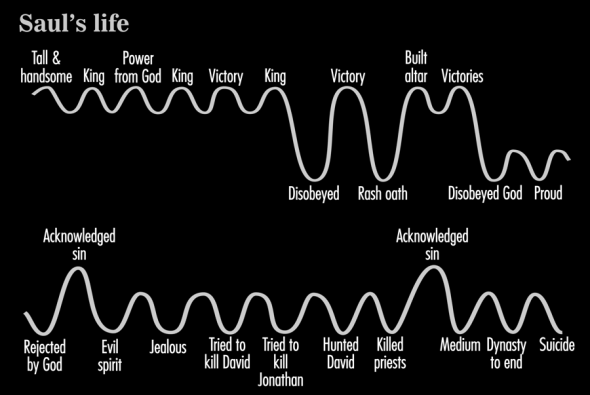 Saul was the first king over Israel. He lived in the 11th century BC. There is an account of his life in 1 Samuel 9-31 of the Bible. The main hills and valleys in his life are shown in the graph – the lower graph follows the upper one.
Hill: Saul was tall and good looking (1 Sam. 9).
Hill: Samuel anointed him privately as king (10).
Hill: Saul received power from God (1 Sam. 9).
Hill: Samuel anointed him publicly as king (10).
Hill: Saul led the Israelites in a military victory over the Ammonites (11).
Hill: Saul’s leadership over Israel was confirmed publicly (11).
Valley: Saul disobeyed Samuel and made a burnt offering (13). Because of this sin, Samuel said that Saul’s kingdom would not endure and he would have no dynasty.
Hill: Saul and his son Jonathan led the Israelites in a military victory over the Philistines (14).
Valley: Jonathan was threatened after Saul made a rash oath (11).
Hill: Saul built an altar the Lord (14:35).
Hill: Saul led the Israelites in many military victories (14). But he also broke the covenant with the Gibeonites (2 Sam. 21).
Valley: Saul disobeyed God when he didn’t totally destroy the Amalekites and all that belonged to them (15). He attempted to justify his soldier’s actions (15:15, 21). And he lied to Samuel (15:13, 20-21).
Valley: Saul was proud – he “set up a monument in his own honor” (15:12).
Valley: Because of his disobedience, God rejected his reign over Israel (15:23).
Small hill: Saul acknowledged his sin and worshipped the Lord (15). But his confession included an element of self-justification which was a weak excuse. And his greatest concern was to avoid a break with Samuel that would undermine his authority and honor in Israel. And he didn’t repent and turn to follow the Lord.
Valley: The Holy Spirit no longer empowered Saul to lead the nation as their king (16). Instead, an evil spirit tormented him and he experienced extreme mood swings like bipolar disorder.
Valley: Saul was jealous and hated David because of his many military victories and popularity (18).
Valley: Saul tried to kill David several times (18-19).
Valley: Saul tried to kill his son Jonathan for helping David escape from him (20).
Valley: Saul hunted David across the land of Israel (21-24).
Valley: Saul killed 85 priests of Nob who had helped David (22). The people in that town were also killed.
Small hill: After David spared his life twice, Saul acknowledged his sin (26). But he didn’t repent and turn to follow the Lord.
Valley: After Samuel died, Saul consulted a spirit medium (28). This pagan practice was outlawed under the Mosaic law (Lev. 19:31).
Valley: Saul was told that his kingdom would end and that he would die on the next day.
Valley: Saul killed himself after he was critically wounded in battle (31).
So, Saul had plenty of hills and valleys. But the many valleys in the second half his life show that he wasn’t resilient. Like Solomon, Saul backslid after serving God earlier in his reign.
Lessons for us
Saul turned away from God (1 Sam. 15:10). He focused on himself; and on how others viewed him. There was pride, jealousy, and selfish ambition. Saul disobeyed God many times. He didn’t confess his sins genuinely and repent like David did to restore fellowship with God.
As Saul often disobeyed the law of Moses, the consequence was that there was no lasting dynasty. Ongoing disobedience to God’s instructions and commands in the Old Testament prohibited resilience. Likewise, ongoing disobedience to God’s instructions and commands in the New Testament will prohibit resilience today.
Written, August 2023
Also see: Two life lessons from king Saul





 George's Journal
Leave a comment