
Can we change the climate?
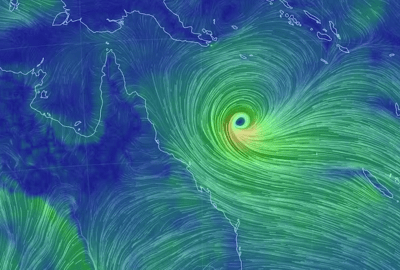 Recent floods in far north Queensland took everyone by surprise. It was quite scary, because it happened very quickly. Water started rapidly rising — seemingly out of nowhere. Most people thought that there may be a lot of rain when cyclone Jasper passed but there was no warning that there was going to be millions of litres of water tumbling down the Tableland hill, pushing houses and land to the side. Cars were floating past the house. It was mayhem.
People began to criticize the Bureau of Meteorology (BOM) for a lack of warning as rising water swallowed houses across the region, and more than a century of flood records were broken in rivers just outside Cairns and the Daintree.
The cyclone was initially expected to continue out to sea by Friday, westward to the Gulf of Carpentaria, taking the rain with it. But instead it stalled, opening the tap over north Queensland and ultimately leading to a major flood emergency. Despite the bureau stating on Saturday morning the heaviest rain had shifted inland, torrential rain returned to the coast through the afternoon. Cairns was hammered by 51mm in just one hour from 5:10 to 6:10pm, however a warning for flash flooding was not re-issued for the region until 9:42pm.
By Saturday morning, a significant rainfall and flood emergency was unfolding across a 360-kilometre swathe from Cooktown to Ingham. The ex-cyclone stalled just inland from the southeast Gulf of Carpentaria, creating a sweet spot for torrential rain known as a “stationary convergence zone”. Incredibly moist tropical winds collided over a narrow zone between Port Douglas and Innisfail. This effect converged with northerly winds from the Gulf of Carpentaria and southeast trade winds from the Coral Sea. Local mountain ranges created extra uplift. All this led to non-stop torrential rain for 48 hours.
The torrential rain continued on Saturday night, causing rivers to respond rapidly. By midnight the Daintree River at Daintree Village had passed its major flood thresholds, but a major flood warning was not issued until 3:58pm on Sunday. The Barron River at Myola, 30 kilometres inland from Cairns, reached its major flood level just before 6am Sunday but did not receive a major flood warning until 10:04am that morning.
Poor modelling
Climate scientists defended the bureau’s forecasts, saying meteorology was “not a perfect science”. The bureau mainly relies on radar, satellite and observations from weather stations to issue warnings during major weather events. It also looks at modelling, which involves meteorologists analysing forecast weather data from super computers run by numerous scientific originations.
 In the case of Cyclone Jasper, the models proved inaccurate throughout its lifetime. Initial forecasts for when Jasper made landfall on Wednesday evening, for example, showed a likely 48-hour interval before the system reached the Gulf of Carpentaria taking the rain with it. Calculations based off the bureau’s analysis charts show it ended up taking nearly triple that time. And on Friday night, modelling indicated flooding rain was unlikely to return to the coast through the weekend. But it was wrong!
The result was non-stop rain for two days. Over 2 metres of rain have fallen in some gauges in the Mossman Gorge region, and 1.9m of rainfall at the Kuranda Railway Station. The Bairds rain gauge saw 870 millimetres to 9am Monday, the third highest Australian 24-hour rain record, and the heaviest anywhere in Australia since 1958. Mossman South and Whyanbeel Valley both had over 700mm, which were all time records for the sites. Meanwhile Cairns has received over 600mm of rainfall over the course of the event.
The BOM reported, “For the 7 days to 9 am on Tuesday 19 December, the highest rainfall totals at Far North Queensland Bureau rain gauges were: 2252.0 mm at Bairds near the Daintree River; 2199.0 mm at Black Mountain; and 2102.0 mm at Whyanbeel Creek. A number of other gauges also recorded over 2000mm.” About 35 communities were isolated by floods and many were without electricity. The Daintree River rose to 14.85 metres, smashing the previous record of 12.6m, while the Barron River reached 4.4m, breaking the 1977 record of 3.8m.
So, meteorologists and supercomputer models can’t always predict the trajectory of cyclones over a period of a week. This is because the atmosphere is more complicated than the mathematical models used to make the predictions.
Weather modification
Attempts have been made to increase precipitation by seeding clouds with silver iodide, potassium chloride, calcium chloride, or sodium chloride. But the results of this have been inconclusive, although scientists claim to have measured the amount of snow produced through cloud seeding. Cloud seeding is done in parts of the USA, the Middle East, China, Australia and Europe. I was involved in cloud seeding in the Australian alps in the 1990s in an attempt to increase the runoff into the dams of the Snowy Hydroelectric Scheme. This cloud seeding program continues as it has been shown to increase winter precipitation by 14%. On the other hand, Hydro Tasmania ceased cloud seeding in 2016.
There is far more energy involved in synoptic weather systems than humanity has available that we could use to control even a modest storm system. This indicates that weather modification by humanity is problematic.
Microclimatology
Local topography and landscape can influence atmospheric conditions. Water bodies may cool the lower atmosphere while urban areas can warm it. Temperatures in an urban area can be a few degrees C warmer than its rural surroundings. This is known as the urban heat island effect.
This indicates that humanity can impact microclimatology to a small extent, but this is localized and tolerable.
Carbon dioxide
 Since 1992, the United Nations Framework Convention on Climate Change Conference of the Parties has convened Climate agreements to reduce emissions of carbon dioxide. The most recent was COP28 in Dubai. But the graph of the concentration of carbon dioxide in the atmosphere at Mauna Loa Observatory shows that these agreements have had no noticeable impact on the concentration of carbon dioxide in the atmosphere. These 30 years of regulations show no measurable climate impact. Climate agreements don’t slow the rise in carbon dioxide. This attempt at large-scale climate change has been a failure.
Discussion
Tropical cyclone Jasper showed that meteorologists and mathematical models can’t always predict the trajectory of cyclones a week ahead. And we can’t always predict the amount of tropical rainfall a few days ahead. But it is more difficult to predict the climate decades ahead. So, people (and computer models created by people) can’t always predict the weather accurately. Likewise, they can’t always predict the climate accurately. And we can’t change or control the large-scale weather or the large-scale climate. We can only change the climate in climate models, which are a simplification of reality!
The United Nations promote climate agreements in an effort to control the climate. But after 30 years of this approach, there is no evidence that these agreements have had any impact on the global climate. This is consistent with the finding that we can’t change or control the climate. Many of these climate change measures are a waste of money. There are more important things to address, like poverty, in order to promote human flourishing.
Most people today seem to assume that people are changing the global climate and that we can stop global warming. They think that humanity can control the climate by changing their behavior. But the evidence for this is flimsy. As shown above, we can influence the microclimate to a limited extent, but not the large-scale climate.
The atmosphere was designed, it didn’t form by random processes (Appendix A). So it is more complicated than we imagine. And I’m sure it was designed with negative feedbacks in order to be robust.
The global average temperature is said to have increased about 1.5 deg C (Appendix B) since 1850, which is a small amount compared to the typical diurnal and annual temperature range we all experience. Humanity has flourished during this time period with a large increase in the population, and in the standard of living, and in the productivity of the planet. As 1850 was near the end of the “Little Ice Age”, the temperatures in the 19th century would have been below “normal”. This means that our temperatures today would be closer to “normal” than those in 1850.
Conclusion
We can’t change or control the large-scale weather or the large-scale climate.
There is no evidence that the United Nations climate agreements have had any impact on the global climate.
Appendix A: Who controls the climate?
The Bible says, “The Lord [God] does whatever pleases Him throughout all heaven and earth, and on the seas and in their depths. He causes the clouds to rise over the whole earth. He sends the lightning with the rain and releases the wind from his storehouses.” (Ps. 135:6-7NLT).
God is in charge of all creation (or nature) because He created it. This means that He created the laws that control the atmosphere, weather and climate. So, God is in control of the weather and the climate. And He could intervene and direct it like sending a global flood to Noah’s generation and when Jesus calmed the storm on the lake.
God is good and sovereign, and Earth will be our habitat for as long as God desires it to be. “So we will not fear when earthquakes come and the mountains crumble into the sea. Let the oceans roar and foam. Let the mountains tremble as the waters surge!” (Ps. 46:2-3).
It seems arrogant to attempt to change the climate that God has provided for us, when we don’t have sufficient power. But I suppose that climate alarmism is another symptom of humanity’s sinfulness and rebellion against God.
Appendix B: Temperature perception
How accurately can you estimate the air temperature without using a thermometer? For most people it could be within 2-5 degrees C.
What about temperature changes? Most people could probably detect sudden temperature differences of 1-2 degrees C. But gradual temperature changes are more difficult to detect. If the temperature changes very slowly, then a person can be unaware of a 4-5 °C change in temperature, provided that the temperature of the skin remains within the neutral thermal region of 30-36 °C.
So an increase of 1.5 deg C in atmospheric temperature would usually be imperceptible. This is claimed to be how much the global atmosphere has warmed since 1850.
Acknowledgement
Most of the information about cyclone Jasper came from: Could the Bureau of Meteorology have warned of ex-cyclone Jasper’s torrential rain sooner?
Written, December 2023
Also see: Long-range weather prediction failure





 George's Journal
Leave a comment