
Prophecies about Jesus: He would be a suffering servant
 God told king David that his royal dynasty would endure forever (2 Sam. 7:16). And the prophets predicted that one of David’s descendants would bring justice and peace (Isa. 11:1-16; Jer. 23:5-6).
That’s why after the time of the Old Testament the Jews looked for a Messiah (anointed one) to lead them and to defeat their enemies.
Isaiah’s prophecy
The prophet Isaiah predicted the Babylonian invasion of Judah, their exile, and their restoration. He wrote about a servant who would bring justice, restore Israel and who would suffer (Isa. 42:1-4; 49:1-6; 50:4-9; 52:13 – 53:12). But the Jews didn’t understand how this fitted in with the promises about the Messiah who would conquer and rule.
The servant is described in Isaiah 53:5-9,
“But he was pierced for our rebellion,
crushed for our sins.
He was beaten so we could be whole.
He was whipped so we could be healed.
All of us, like sheep, have strayed away.
We have left God’s paths to follow our own.
Yet the Lord laid on him the sins of us all.
He was oppressed and treated harshly,
yet he never said a word.
He was led like a lamb to the slaughter.
And as a sheep is silent before the shearers,
he did not open his mouth.
Unjustly condemned, he was led away.
No one cared that he died without descendants,
that his life was cut short in midstream.
But he was struck down
for the rebellion of my people.
He had done no wrong
and had never deceived anyone.
But he was buried like a criminal;
he was put in a rich man’s grave.”
That’s a description of the death and burial of Jesus Christ.
A suffering servant is not what Israel was expecting. But Jesus said that He “came not to be served but to serve others and to give His life as a ransom for many” (Mk. 10:45NLT). The writers of the New Testament learnt that the Messiah would come to this earth twice, first as a suffering servant, later as a conquering King. They believed that Jesus was the Christ (the anointed one), who was the fulfillment of both expectations.
When Jesus told a large crowd not to tell others about His power to heal, it fulfilled Isaiah 42:1-4 (Mt. 12:15-21). Jesus was the promised servant. He demonstrated this when He washed the disciple’s feet (Jn. 13:2-17). Peter also called Jesus “God’s servant” (Acts 3:13, 26; 4:27, 30).
And Isaiah 52:13 – 53:12 is quoted in Mt. 8:17; Lk. 22:37; Jn. 12:38; Acts 8: 32-33; Rom. 10:16. Also the term “Lamb of God” (Jn. 1:29) reminds us of Isaiah 53:7. The fact that Christ died and us now interceding for us reminds us of Isaiah 53:12. And Christ’s sacrifice “to take away the sins of many (Heb. 9:28) reminds us of Isaiah 53:12. Christ’s suffering which has healed us spiritually, and the fact that He “bore our sins” after we had went astray like sheep (1 Pt. 2:21-25) reminds us of Isaiah 53:3-10.
A humble servant
In the New Testament, the Lord’s “servant” (Strongs #3816) means a devout worshipper of God, one who fulfils God’s will – like king David (Lk. 1:69; Acts 4:25).
The humility of Jesus, the Servant of the Lord, is seen in Philippians 2:7–8: “He gave up His divine privileges; He took the humble position of a slave [or servant] and was born as a human being. When He appeared in human form, He humbled Himself in obedience to God and died a criminal’s death on a cross” (NLT).
The overriding theme of the Gospel of Mark is that Jesus came to serve. He gave his life in service to mankind. He lived out His message through service, therefore, we can follow His actions and learn by His example. The ultimate purpose of the book is to reveal Jesus’ call to personal fellowship through daily discipleship.
 A servant’s task
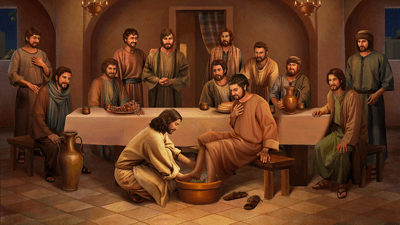
The night before He was crucified, Jesus served His disciples by washing their dirty feet (Jn. 13:1-17). This included Judas Iscariot, who Jesus knew would soon betray him. So, He washed the feet of both His friends and His enemy. This is love in action. The Son of God was a humble servant.
The foot-washing symbolized the saving act to follow. God loved people so much that Jesus willingly sacrificed His life on the cross to serve them, by cleansing them from sin and its eternal consequences. Jesus is the only way to forgiveness of sin and eternity with God, like He was the only way to clean feet for the disciples. This is love in action.
The foot-washing was also a model for Christian conduct. Rather than just looking after our needs, God wants us to serve others by helping to meet their needs as an example of love in action.
Prayer
Father God, we thank you that Jesus took the nature of a servant, coming as a man who willingly died on a cross! He was buried like a criminal and put in a rich man’s grave. Thanks that Jesus’ first coming was as our suffering Servant to liberate us from the slavery of sin by conquering sin, Satan, and death. He suffered and gave His life so we can have eternal life. In Christ’s name, Amen.
Written, February 2024





 George's Journal
Leave a comment