
Christianity survived persecution in Rome
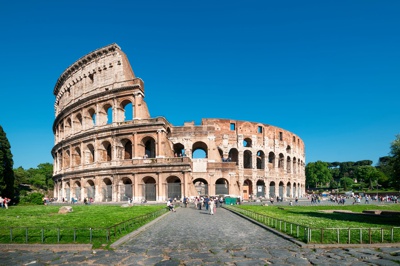 The city of Rome formed at the best place where the River Tiber could be forded between the Tyrrhenian Sea and a very distant locality upstream. This was at the island of Isola Tiberina.
Rome was the capital of the Roman Empire. Romans practiced polytheism and worshipped the emperor. Because Christians, believed in one God and refused to worship Roman gods or the emperor, they were viewed as subversive and even treasonous.
Arrival of Christianity
AD 30: There were Jews and proselytes from Rome in Jerusalem on the day of Pentecost (Acts 2:10-11). After the fall of Jerusalem and Judah in 586 BC, Jews dispersed across the eastern Mediterranean. “By the first century AD the widespread dispersion of the Jews had taken place and probably few coastal cities of the eastern Mediterranean, and few major inland cities, were without a community of permanently resident Jews “ (Smallwood, 2001). Like other foreigners, the Jews lived outside the city of Rome — across the river, in Trastevere (on the west bank of the Tiber River).
AD 49: When emperor Claudius expelled all Jews from Rome (Acts 18:2), Aquilla and Priscilla moved from Rome to Corinth. They would have told Paul about the Christians in Rome.
AD 54: Paul planned to visit Rome (Acts 19:21). But he didn’t know that it would be as a prisoner!
AD 57: The letter of Romans written to Christians in Rome described God’s plan of salvation (see Appendices). There were several house churches in Rome. Paul warned them of those who cause divisions within the church (Rom. 16:17-18). And he greeted several Christians in Rome (Rom. 16).
AD 59: After Paul was arrested in Jerusalem, God told Paul that he would testify about Jesus in Rome (Acts 23:11). At Paul’s trial he appealed to Caesar, so he was sent to Rome (Acts 25:11, 25). So, Paul sailed to Rome and was shipwrecked near Malta.
AD 60-61: Paul’s first Roman imprisonment (Acts 28:16-31). By this time Jews had returned to Rome as the decree of emperor Claudius had lapsed. Luke wrote, “When we got to Rome, Paul was allowed to live by himself, with a soldier to guard him” (Acts 28:16). Despite being under house arrest for two years. Paul preached and taught “with all boldness and without hindrance” (Acts 28:31). The book of Acts finishes abruptly as its purpose has been accomplished – it traces the message of the gospel from Jerusalem to Rome.
During this time in Rome, Paul wrote letters to the Ephesians, Philippians, Colossians, and Philemon.
Paul’s message
Here is an example of Paul’s message to the Jewish leaders in Rome in AD 60-61,
He [Paul] witnessed to them from morning till evening, explaining about the kingdom of God, and from the Law of Moses and from the Prophets he tried to persuade them about Jesus. 24 Some were convinced by what he said, but others would not believe. 25 They disagreed among themselves and began to leave after Paul had made this final statement: “The Holy Spirit spoke the truth to your ancestors when he said through Isaiah the prophet:
26 “‘Go to this people and say,
“You will be ever hearing but never understanding;
you will be ever seeing but never perceiving.”
27 For this people’s heart has become calloused;
they hardly hear with their ears,
and they have closed their eyes.
Otherwise they might see with their eyes,
hear with their ears,
understand with their hearts
and turn, and I would heal them.’
28 “Therefore I want you to know that God’s salvation has been sent to the Gentiles, and they will listen!” (Acts 28:23-28)
God promised a future kingdom for Israel. The kingdom of God included the death, resurrection, and coming kingdom of Christ on earth. Luke quoted a passage from Isaiah 6:9-10 to show that many Jews would not believe the gospel. They had callous hearts, dull ears, and closed eyes. Jesus had also quoted these verses because the Jews refused to believe in Him (Mt. 13:14-15; Mk. 4:12; Lk. 8:10), as did Paul (Rom. 11:8).
Isaiah prophesied the obstinacy of the Jews. In contrast to Jews, many Gentiles would respond to the gospel. Ministry to Gentiles is the climax of the book of Acts. Since the nation Israel rejected their Messiah, God used Paul to preach to the Gentiles. This is God’s plan until the full number of Gentiles comes to Christ and Christians are resurrected to be with the Lord (Rom. 11:19-26).
Paul quotes from Isaah 59:20-21 to say that after the rapture many Jews will trust in Jesus and be delivered from the tribulation and ushered into the millennial kingdom by the second advent of Christ (Rom. 11:25-26). At this time Jesus will establish the New Covenant with Israel (Jer. 31).
Persecution of Christians
In AD 64 emperor Nero accused Christians of starting the great fire of Rome. He initiated brutal executions—Christians were killed in public spectacles, torn by dogs, crucified, or burned alive to light up Roman streets at night. According to tradition, Peter also ministered in Rome and was martyred there under Emperor Nero. Today, tourists can see the catacombs where early Christians worshipped in secret, and the Colosseum where some were martyred.
AD 67/68: Paul’s second Roman imprisonment (2 Ti.4:6-8). During this time, Paul wrote the letter 2 Timothy. Then he was executed.
In AD 81-96 emperor Domitian targeted Christians who refused to honor the emperor’s cult. And Decius (AD 250) and Diocletian (AD 303-311) attempted to crush Christianity.
Christianity legalized
In AD 313 emperor Constantine officially ended state-sponsored persecution and legalized Christianity. Theodosius I (AD 380) declared Christianity the official religion of the Roman Empire. And eventually, Christianity became the dominant religion of the Roman Empire and this resulted in the Roman Catholic Church in the west (centred in Rome) and the Eastern Orthodox Church in the East (centered in Constantinople, now Instanbul).
Conclusion
The Christians in Rome were given the most comprehensive explanation of how salvation (reconciliation with God) only comes through trusting in the gospel (good news about Jesus).
They were also told that God will restore the nation of Israel again. After the rapture many Jews will trust in Jesus and be delivered from the tribulation and ushered into the millennial kingdom by the second advent of Christ.
And Christianity survived persecution in Rome.
Appendix A: Summary of Romans
The book of Romans is a letter from Paul to the Christians in Rome. At that time, Rome was probably the largest city in the world. Paul wrote the letter about the year AD 57. He probably wrote it while he was living in Corinth.
The book of Romans shows us how God can save us from the punishment for our evil deeds. And the book of Romans also teaches how we should live. Some of the important things we can learn from this book are:
- Everyone has done wrong things against God.
- God is angry about our evil deeds.
- God saves people who trust Him.
- We cannot save ourselves by our own good works.
- When Jesus died, He died for us.
- God’s Spirit helps us to do what is right.
- God always loves us.
- God shows us how to live.
As parts of Romans address Jews (Chapters 7, 9-11), Paul knew that there were Jews living in Rome at this time.
Appendix B: Topics addressed in Romans
According to MacDonald, in Romans Paul answers these main questions:
– What is the subject of the letter? (1:1, 9, 15- 16)
– What is the gospel? (1:1-17)
– Why do people need the gospel? (1:18-3:20)
– According to the gospel, how can ungodly sinners be justified by a holy God? (3:21-31)
– Does the gospel agree with the Old Testament Scripture? (4:1-25)
– What are the benefits of justification in the believer’s life? (5:1-21)
– Does the teaching of salvation by grace through faith permit or even encourage sinful living? (6:1-23)
– What is the relationship of the Christian to the Old Testament law? (7:1-25)
– How is the Christian enabled to live a holy life? (8:1-39)
– Does the gospel, by promising salvation to both Jews and Gentiles, mean that God has broken His promises to His earthly people, the Jews? (9:1-11:36)
– How should those who have been justified by grace respond in their everyday lives? (12:1-16:27)
References
Hawke G S, “What does Romans 9 teach?”.
MacDonald William (1989) “Believer’s Bible commentary”, Thomas Nelson Publishers, Nashville, Tennessee.
Richison G Verse by verse commentary: Acts 28:23-29; Romans 11:26-27.
Smallwood E M (2001), “The Jews Under Roman Rule: From Pompey to Diocletian : a Study in Political Relations”, Brill Academic Publishers, Boston, ISBN 0-391-04155-X, p. 122.
Written, August 2025





 George's Journal
Leave a comment