
Where does intelligence come from?
 Archaeologists have discovered ancient stone tools on the Indonesian island of Sulawesi, suggesting early humans were there more than a million years ago (assuming uniformitarian deep time). These stone artefacts and some fossils were found in sandstone sedimentary layers. And the finding was published in Nature (Hakim et al, 2025; Phiddian, 2025).
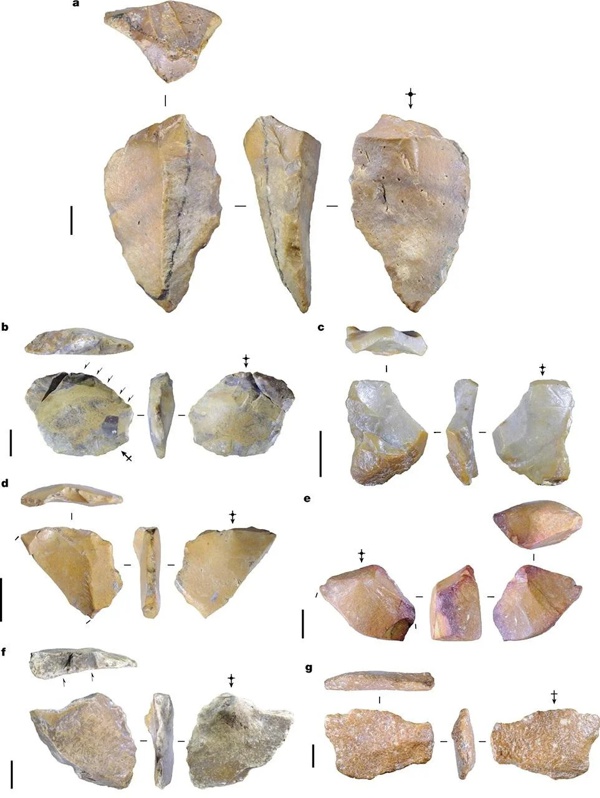
From 2019 to 2022, the research team found seven stone artefacts 1.4 meters into the soil alongside an ancient pig fossil. These artifacts, small sharp-edged stone flakes made from chert, were produced by the hard-hammer freehand percussion technique, where larger pebbles (likely sourced from nearby riverbeds) were struck to create tools. The tools were shaped in a way that suggested an intelligent craftsperson. They believe that a human intelligence produced these fractured stones. There’s no other type of creature that is able to reliably fracture stones by hitting them at the right angle and the exact amount of force required to induce that stone to fracture in a specific way.
The presence of ancient humans on all of these islands raised a “curious question”: how did these early humans get there? While they believe that Java was connected to the mainland at the time, thanks to lower sea levels during an ice age, Sulawesi and the other islands were still separated by deep water. They said, “We don’t think that early human species had the technology to make boats”.
 Discussion
The fossil beds of Sub-Unit A were estimated to be Late Pliocene to Early Pleistocene in age, which is late/post flood (ice age) on the Biblical timescale (Hawke, 2020). Fossils of extinct fauna occur at the bottom of Sub-Unit A. The stone artefacts were found in Sub-Unit B, a 18m thick layer above Sub-Unit A, which means that they were buried more recently than the extinct fauna. This stratum was probably formed during the ice age after the flood.
According to Walker’s geology transformation tool, these layers formed about 4,500 years ago, (Hawke, 2020), which is much more recent than the 1 million years assumed by the scientists.
If ancient stone tools suggest an intelligent creator (ancient humans), then ancient and modern humans should also suggest an intelligent creator. But why can’t many scientists follow this logic? How can an inanimate stone be produced by an intelligent being, whereas a more complex living person not be produced by an intelligent being? It’s amazing what humans can imagine and do, whereas a stone can just exist and be affected by outside forces.
The comment that, “We don’t think that early human species had the technology to make boats” is interesting. “Early human species” lived in the ice age soon after Noah’s flood. Noah built a barge that floated for about 150 days on a journey that lasted about 370 days (Gen. 6-8). So the technology to build boats did exist, but this knowledge could have been lost during the ice age when people scattered across the earth into nations that spoke different languages (Gen. 11:1-9). And the journey from Asia to Indonesia in an ancient boat would not take longer than a week.
Conclusion
Why do most scientists recognize that intelligence is required to produce a simple stone tool, but assume it is not required to produce a complex human being? They know where stone tools originate, but they don’t know where life and humans originated! In fact, they struggle to explain where intelligence comes from (see Appendix). As a human is more intelligent than a stone tool, the creator of life and humans is more intelligent than humans who can create stone tools.
It is likely that the stone tools found on the Indonesian island of Sulawesi were buried during the ice age after the flood.
Appendix: The scientific explanation
I asked AI (artificial intelligence) about the scientific explanation of where intelligence comes from. My comments are in italics.
According to Grok:
The scientific explanation for the origin of intelligence focuses on biological and evolutionary processes, primarily centered on the development and function of the brain. The human brain, with approximately 86 billion neurons and trillions of synaptic connections, forms complex neural networks that enable cognitive processes. Genetics and environmental factors play a significant role in intelligence (but they can’t explain the origin of intelligence). From an evolutionary standpoint, intelligence likely emerged through natural selection to enhance survival and reproduction (but they can’t explain the origin of intelligence). While science explains the mechanisms of intelligence, the origin of consciousness—why humans have self-aware, subjective reasoning—remains a “hard problem” (it can’t explain the origin of intelligence).
Perplexity says, “Evolutionary scientists believe intelligence developed as an adaptive response to challenges requiring problem-solving and social cooperation, giving humans a survival advantage” (But they can’t explain the origin of intelligence).
And Chat GPT says that “Intelligence is thought to have evolved as an adaptive trait. Evolutionary biologists believe that the degree and complexity of intelligence increased gradually over millions of years” (But they can’t give a materialistic origin of intelligence. Instead they assume that human intelligence developed from animal intelligence, despite the large differences between them).
References
Hakim, B., Wibowo, U.P., van den Bergh, G.D. et al. “Hominins on Sulawesi during the early pleistocene”, Nature (2025), 6 August 2025.
Hawke G, 2019, “Six reasons to be skeptical of the geologic time scale”.
Hawke G, 2020, “Converting ancient secular dates to biblical dates”.
Phiddian E, “Ancient stone tools suggest early humans inhabited Sulawesi more than a million years ago”, ABC News, 7 August 2025.
Written, August 2025





 George's Journal
Leave a comment