
Go for gold!
 Many of the world’s best athletes and sports competitors are striving for victory at Paris, after spending hours each day practicing and developing their skills and directing their minds to the task ahead.
Paul likened life to a race and urged us to emulate a winner by running “in such a way as to get the prize” (1 Cor. 9:24 NIV). It’s been said that “the Christian life is more like a marathon than a sprint.” The marathon runner has a series of goals, one for each stage of the race.
Of course, some don’t even participate in the race, so they can’t get a prize. This is like the unbeliever who comes up with all kinds of excuses for refusing the invitation (Lk. 14:16-21).
Goals are important for both individuals and teams in the “race of life,” as they provide purpose, hope and vision and give meaning to life. Two people who had clear goals and purposes in life were Jesus Christ and Paul.
Doing God’s will
Christ said that He had come to “save the (people of the) world” (Jn. 3:17), who were spiritually lost (Lk. 19:10). This purpose was announced before His birth (“He will save His people from their sins,” Mt. 1:21). He desired to preach as He said, “that is why I have come” (Mk. 1:38). And Christ claimed that His goal was to “do the will of Him [God the Father] who sent me and to finish His work” (Jn. 4:34). This work was to bring people to belief and eternal life (Jn. 6:38-40).
The key role of prayer is evidence of Christ’s dependence on God the Father. He “often withdrew to lonely places and prayed” (Lk. 5:16). This culminated in His prayer before the crucifixion of “not my will, but Yours be done” (Lk. 22:42).
Jesus was not distracted by Satan’s temptations (Mt. 4:1-11) or Peter’s impulsive behavior (Mt. 16:21-23, Jn. 18:10-11). This is in contrast to Peter whose progress was hindered when he was distracted by the circumstances of the storm about him (Mt. 14:30-31).
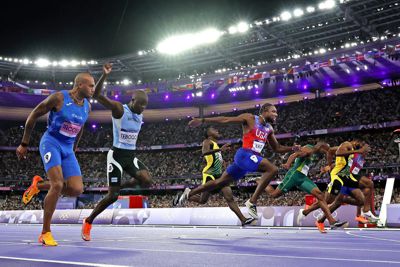 Striving for the prize
Paul was an enthusiastic competitor who had a clear vision of the prize ahead. He knew that “Everyone who competes in the (Olympic) games goes into strict training. They do it to get a crown (or medal) that will not last; but we do it to get a crown that will last for ever. Therefore I do not run like someone running aimlessly; I do not fight like a boxer beating the air. No, I strike a blow to my body and make it my slave so that after I have preached to others, I myself will not be disqualified for the prize.” (1 Cor. 9:25-27). So, the goal before him resulted in a life of clear direction, discipline, dedication and devotion.
This is evident in Paul’s ministry of evangelism when he made himself “a slave to everyone, to win as many as possible” (1 Cor. 9:19) and he became all things to all people so that by all possible means he might save some (v. 22). His ambition was to preach the gospel, particularly where Christ was not known (Rom. 15:20).
One of Paul’s goals was “to know Christ” and become more like Him (Phil. 3:10). In following this direction he forgot what was behind and strained towards what was ahead, claiming “I press on toward the goal to win the prize for which God has called me heavenward in Christ Jesus” (Phil. 3:14). The image is that of an athlete striving for victory.
Another of Paul’s goals was to please the Lord and be ready for the end of the race (2 Cor. 5:9-10).
Our Race
We are also competitors in the race of life who, like Christ and Paul, should have clear goals and direction.
Two conditions are given in Romans 12:1-2 for following God’s will. These are: offering ourselves to God (rather than following selfish ambitions); and being transformed by the renewing of our minds (allowing the Holy Spirit to guide our thoughts and actions, Mk. 13:11, Jn. 16:13, Rom. 8:5-6). The consequence of this is that “then you will be able to test and approve what God’s will is – His good, pleasing and perfect will” (v. 2).
Like Peter, we can be transformed if we follow Christ’s requests of “you must follow me” (Jn. 21:22) and “If any of you wants to be my follower, you must give up your own way, take up your cross, and follow me” (Mt. 16:24).
This includes fleeing from evil (2 Tim. 2:22), idolatry (1 Cor. 10:14) and sexual immorality (1 Cor. 6:18). So, “Let us throw off everything that hinders and the sin that so easily entangles. And let us run with perseverance the race marked out for us, fixing our eyes on Jesus” (Heb. 12:1-2). We need to keep Christ in mind, so that we don’t grow weary or give up (v.3) in an endurance race (v.7), that can involve pain (v.11).
Paul noted that interference by legalism had blocked progress in Galatia, although they had been “running a good race” (Gal. 5:7).
According to 1 Corinthians 3:8,12-15, believers are rewarded depending on how they run the race of life. It is encouraging to know that we are not alone as we participate in the divine nature together with other believers (2 Tim. 2:22, 2 Pet. 1:4).
Goals and Evaluation
Goals provide us with direction and enable evaluation of our progress. They can be short term or long term, general or specific. Shared goals can help us have common purposes in working together as a team in our families and our ministries (2 Cor. 6:14, 1 Cor. 3:8-9).
Christ and Paul were both aware of their progress near the end of their races. Christ prayed, “I have brought you glory on earth by finishing the work you gave me to do” (Jn. 17:4) and “It is finished” (Jn. 19:30). Paul’s main goal in life was to “finish the race and complete the task” the Lord had given him (Acts 20:24). Looking back over his life he could say, “I have fought the good fight, I have finished the race, I have kept the faith” (2 Tim. 4:7).
Applying this principle to our lives and ministries would mean evaluating our progress periodically in the race of life (such as daily, weekly, yearly). This is consistent with the requirement to test our own actions and not compare ourselves with others (Gal. 6:4). During such assessments we should confirm the goals and consider the methods used to achieve them and be willing to revise these after praying for God’s will to be done. For example, Paul was willing to change direction and go to Macedonia as a result of the Lord’s leading (Acts 16:9). He was ready to move on for God as soon as each task was finished.
We all need to know God’s will on a daily basis in our race of life and in our families and our ministries. This should be the basis of the goals that indicate the way ahead. We should be goal-driven, not activity-driven. By pursuing the Lord’s goals, we can look forward to “well done, good and faithful servant” at the finish line, rather than being accused of being a “wicked, lazy servant” (Mt. 25:21, 26).
Originally published, July 1996 (Atlanta, USA)
Updated, August 2024 (Paris, France)
Also see: Go for the gold!





 George's Journal
Wow this article displays a nice link between the Olympics, a topic everyone is talking about, to Paul’s teaching and ministry of evangelism to everyone. Thank you 🙂
LikeLike
August 9, 2024 at 6:35 am