
Relying on God at Ephesus
 Ephesus was one of the largest and wealthiest cities in the eastern Mediterranean area. It had an inland harbor that was connected to the Aegean Sea and a population of about 50,000 people. Because it was also at an intersection of major trade routes, Ephesus became a commercial center. The temple of the Greek goddess Artemis (completed around 550 BC) was located there. This temple was one of the Seven Wonders of the Ancient World. It was four times larger than the Parthenon. Ephesus was a city of idolatry and pagan superstition.
Paul at Ephesus
On his second missionary journey Paul left Priscila and Acquila there and they taught Apollos (Acts 18:19, 24-26). Paul reasoned with the Jews in the synagogue, and he promised to return. So, a church was established at Ephesus at about AD 51.
On his third missionary journey Paul visited Ephesus (Acts 19:1 – 20:1). He baptised some disciples of John. Paul spoke in the synagogue for three months but after being criticized, he moved to the lecture hall of Tyrannus and taught there for two years. During this time, he wrote the first letter to the Corinthians (1 Cor. 16:7-8). And he may have founded the seven churches of Revelation 2-3. It was a great opportunity for preaching and teaching and God did extraordinary miracles through Paul like healing diseases and driving out evil spirits. Many people trusted in Jesus and publicly renounced sorcery by burning their pagan books in a bonfire.
Paul stayed in Ephesus longer than any other city. During this time, he strengthened the church. He was so successful in his ministry that many people disowned sorcery and feared and honored Paul’s God instead.
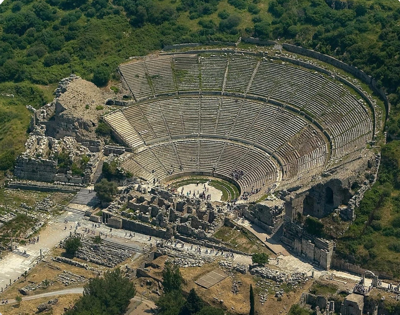
But there was also opposition as well. Paul’s enemies at Ephesus were as ferocious as wild beasts (1 Cor. 15:32). Because these new Christians gave up idolatry, those in the business of supplying miniature silver shrines of Artemis lost much of their business. So, the silversmiths launched a riot in the amphitheatre and this grew to involve the whole city. The amphitheatre had a capacity of about 25,000 people.
The life of Paul and his companions was threatened by the riot that went for more than two hours until it was settled by the city clerk. Paul seems to refer to this occasion in Corinthians, “We do not want you to be uninformed, brothers and sisters, about the troubles we experienced in the province of Asia. We were under great pressure, far beyond our ability to endure, so that we despaired of life itself. Indeed, we felt we had received the sentence of death. But this happened that we might not rely on ourselves but on God, who raises the dead. He has delivered us from such a deadly peril, and He will deliver us again. On Him we have set our hope that He will continue to deliver us, as you help us by your prayers” (2 Cor. 1:8-11NIV).
Then Paul left to travel through Macedonia and Greece. On his way back to Jerusalem he stopped at Miletus (56 km – 35 miles – from Ephesus) to farewell the Ephesian church elders (Acts 20:17-38). He warned them to protect the congregation from false teachers and committed them to God’s care. And he emphasised that he had worked to support himself and his colleagues while he was with them.
The church at Ephesus
Paul wrote the letter to the church at Ephesus while he was in prison in Rome. It was about 10 years after the church had been established. In it he summarized the gospel of salvation through grace alone and the role of the church on God’s eternal plan.
About 15 years after the church had been established in Ephesus, Paul told Timothy to stay there to combat false teachers and to instruct the church (1 and 2 Timothy). It is clear that false teachers were influencing the church in Ephesus at that time. But it looks like with the help of Timothy they were able to resist the false teachers as later they were commended for not tolerating wicked people (Rev. 2:2). However, they endured persecution during the reign of Emperor Nero (2 Tim.; Rev. 2:3).
About 45 years after it had been established, the church at Ephesus needed the warning of Revelation 2:1-7. They were commended for their hard work, perseverance, judgment of false teachers and endurance despite hardships. But they had abandoned their first love (Rev. 2:5). Jesus urged them to remember when they first came to Christ when their love for Him was fresh. This is the problem of second-generation Christians, who do not experience a vibrant fellowship with the Lord.
This was so serious that He said in the next verse that He would remove the church from existence if they did not deal with it. This eventually happened with the mass murder and expulsion of the country’s Christians (Armenians, Greeks, and Assyrians) between 1894 and 1924. Today there are almost no Christians left in Turkey. Similarly, thousands of churches disappear every year throughout the world.
Lessons for us
There are many lessons to be learnt from what has happened at Ephesus in the past 2,000 years.
Christianity leads to conflict because it undermines idolatry. And Christians will experience troubles and persecution (Jn. 16:33). But when trouble arises, we need to rely on God to deliver us and not only on ourselves. And our prayers for one another are important for enduring difficulties.
Churches need to be aware of false teachers and false teachings and to minimize their impact on the congregation.
Spiritual decline will lead to the demise of a church. Instead, put love for the Lord back at the center of your attitude.
Written, January 2025





 George's Journal
Leave a comment