
Godliness and wickedness at Beersheba
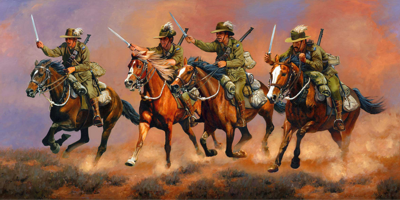 The city of Beersheba in Palestine was captured by the British-led Australian Light Horse in the Battle of Beersheba during World War I (Appendix A). It was the last successful cavalry charge in military history. Approximately 800 Australian soldiers with only horses and bayonets, charged the Turkish trenches, overran them and captured the wells.
Beersheba is 72 km (45 miles) southwest of Jerusalem. In Old Testament times it was in a low rainfall desert area called the Negev (2 Sam. 24:7). Semi-nomadic shepherding was the main occupation in the area. Beersheba was at the southern edge of permanent agricultural cultivation in ancient Palestine.
Beersheba was the southern boundary of the promised land—hence the phrase “from Dan [in the north] to Beersheba [in the south]” (Jud. 20:1; 1 Sam. 3:20; 2 Sam. 3:10; 17:11; 24:2, 15; 1 Kings 4:25; 1 Chron. 21:2; 2 Chron. 30:5NIV). It marked the southern boundary of the Israelite monarchy and the south boundary of Israel (2 Ki. 23:8; 2 Chron. 19:4).
Place of communication with God
When Hagar and Ishmael were sent away from Abraham and Sarah, they “wandered in the desert of Beersheba” (Gen. 21:14). Ishmael was crying and near death because of dehydration. But God responded saying that Ishmael will have many descendants and showing Hagar a well of water.
Disputes over water are common in arid lands. In about 1850 BC Abraham stayed at Beersheba near a well (Gen. 22:19). And Gerar nearer to the Mediterranean was the closest urban settlement where there was enough rainfall for agriculture. There was a dispute over water between Abraham and the Philistines. The place where Abraham made a treaty with the Philistines was named Beersheba, meaning “the well of the treaty”. Then Abraham “called on the name of the Lord (Appendix B), the Eternal God” (Gen. 21:33).
Like his father, there were disputes over water between Isaac and the Philistines. This caused him to move to Beersheba where God spoke to him repeating the covenant promise of many descendants (Gen. 26:23-33). Then Isaac “built an altar” and “called on the name of the Lord”. And He also made a treaty with the Philistines.
When Jacob and his household travelled to Egypt in about 1670 BC during a 7-year famine, they offered sacrifices to God at Beersheba (Gen. 46:1-5). That night God spoke to him repeating the covenant promise of many descendants and reassuring him not to be afraid to travel to Egypt.
In about 863 BC, Elijah passed through Beersheba on his way to Mt Sinai when he fled from queen Jezebel (1 Ki. 19:3-8). He went one day’s journey into the wilderness and was so depressed that he “prayed that he might die”. After he slept an angel woke him up and provided food and drink for the 40-day journey to Mt Sinai.
So Beersheba was a place of communication with God for the patriarchs and Elijah. They prayed to God and God spoke to them at Beersheba.
Place of wicked leaders
The Bible says that “When Samuel grew old, he appointed his sons as Israel’s leaders” (1 Sam. 8:1-3). They lead Israel from Beersheba in about 1050 BC. “But his sons did not follow his ways. They turned aside after dishonest gain and accepted bribes and perverted justice”. This led the Israelites to demand a king (1 Sam. 8:6–9).
So, a place of communication with God turned into a place of wicked leaders.
Place of false worship
In about 760 BC, the prophet Amos said that Beersheba was a place of idolatry (Amos 5:5; 8:14). It had shrines like Dan, Bethel and Gilgal (near Jericho). So, he warned the people of Israel not to go there.
So, a place of communication with God which turned into a place of wicked leaders, became a place of false worship.
Lessons for us
So, at different times Beersheba was a place of communication with God, a place of wicked leaders, and a place of false worship. Let’s develop places of communication with God rather than places of false worship.
The patriarchs “called on the name of the Lord”. And we can too when we pray to God in our time of need (Appendix C).
 Appendix A: The Battle of Beersheba
On 31 October 1917, the heavily fortified town of Beersheba was the scene of a historic charge by the men of the 4th Australian Light Horse Brigade.
Commencing around 5 pm, the brigade stormed the town, using their bayonets as swords in a highly unconventional charge. The momentum of the surprise attack carried them through the Turkish defences where they were able to secure the town before it could be destroyed by the retreating Turkish force.
While the 4th Regiment (from Victoria) dismounted at the trenches to confront the awed enemy (ultimately taking over 700 prisoners), the 12th Regiment (from New South Wales) further surprised the Turks by continuing their furious charge over the trenches and straight on to the town, capturing it before the Turkish forces could regroup or destroy the wells in a retreat.
31 men from the Light Horse lost their lives and an additional 36 were wounded. At least 70 horses also died and over 60 were wounded during the charge.
The campaign worked because of the shock value, and the sheer speed of the light horsemen’s approach on the town.
The battle was a turning point in the Palestine campaign of World War I, fought between British Empire forces and the Ottoman and German empires’ forces for control of the region, which was considered of great strategic importance because of the Suez Canal which linked the Red Sea with the Mediterranean.
Appendix B: What does, “called on the name of the Lord” mean in the Old Testament?
When Abraham travelled from Mesopotamia to Palestine he camped near Bethel. “There he built an altar to the Lord and called on the name of the Lord” (Gen. 12:8). This means that he publicly thanked God, praised His name, and sought His protection and guidance. Later He “called on the name of the Lord” once again at the same place (Gen. 13:4).
At Beersheba, Abraham “planted a tamarisk tree” and “called on the name of the Lord” (Gen. 21:33). Isaac also lived at Beersheba and “built an altar there and called on the name of the Lord” (Gen. 26:25).
So, in the context of the patriarchs, to call on the name of the Lord seems to mean public prayer and praise to the God of Abraham, Isaac and Jacob who created the universe and all that is in it. It is audible and involves saying His name aloud. It’s a public statement of trust in God by worshiping God and acknowledging His power and faithfulness.
Appendix C: What does, “called on the name of the Lord” mean in the New Testament?
Paul refers to believers as, people “everywhere who call on the name of our Lord Jesus Christ” (1 Cor. 1:2). Those that “call on” the Lord are believers (Acts 4:12). Peter preached, “everyone who calls on the name of the Lord will be saved” (Acts 2 :21). This is the gospel (good news about Jesus). So, to call on the Lord is to trust that the Lord Jesus Christ is the only way of salvation. And in prayer believers call on the Lord in times of need.
Written, July 2023
Also see other articles on places in the Bible:
Bethlehem, God’s solution to our crises
Gehenna – Where’s hell?
Where’s Zion?
Babylon, center of humanism and materialism
Lessons from Egypt
Lessons from Sodom
Massacres and miracles in Jericho
Rebellion and deception at Samaria
Worshipping God and idols at Bethel
Many battles at Megiddo
Outsiders became insiders at Damascus
Tyre reminds us that God keeps His promises
Nineveh experienced God’s mercy and justice
Jesus put Nazareth on the map
Good times and bad times at Shechem





 George's Journal
Leave a comment