
In the beginning. Part 2: The first marriage
What happened in the garden in Eden?
In the previous article we saw that at the beginning of time the universe was created by an intelligent and powerful God. He did it in six days followed by one day’s rest to give us the pattern for a seven day week.
Genesis is divided into ten main sections, each beginning with the phrase “the account of”. The next section begins: “This is the account of the heavens and the earth when they were created. When the LORD God made the earth and the heavens” (Gen. 2:4NIV). Moses would have written Genesis from oral history that had been handed down through the generations and God would have shown him how to edit and record this on papyrus[1]. Of course, as Moses’ birth is recorded in Exodus 2, he wrote the most of the second to fifth books of the bible from first hand experience. It this article we will look at Genesis 2:4-25.
Contradictory creation stories?
Because the creation story in Genesis 2 appears to differ from that in Genesis 1, some say that they were written by different people and not Moses. For example, in Genesis 1 God creates by simple command, but He used the ground in Genesis 2 (v.7,19). In Genesis 1 God is called “Elohim”, whereas in Genesis 2 He is called “Yahweh Elohim”. They say that these are conflicting versions of the same story. But what do we see when we look at the text?
Genesis 1 covers the creation of everything in the universe. It summarises the milestones of God’s creative work in the six days of creation and ends with a summary, “Thus the heavens and the earth were completed in all their vast array” (Gen. 2:1). The Hebrew word for God, “Elohim”, is mentioned 29 times in this chapter. It is written from God’s perspective.
Genesis 2:4-25 focuses on events in the Garden of Eden during the sixth day of creation. It gives more detail on the creation of mankind and the roles of Adam and Eve. The topics covered are: the Garden of Eden, the creation of Adam and Eve, and Adam’s and Eve’s roles. The Hebrew phrase “Yahweh Elohim”, is mentioned 11 times in this passage. It is written from Adam’s perspective.
“Elohim”, refers to God as the Creator of the universe, the ruler of nature, and the source of all life. “Yahweh” (or Jehovah) is the personal and covenant name of God. It is used to stress God’s personal relationship with His people and the fact that He keeps His promises. Both “Yahweh” and “Elohim” occur numerous times in the book of Genesis, together and separately.
Accordingly, Genesis 1 correctly used the name Elohim, for God’s role as Creator of the whole universe and of all living things is what the chapter teaches. The subject narrows immediately in Genesis 2-3 where it describes God’s personal relationship with Adam and Eve. God is depicted as walking and talking with Adam in the Garden of Eden. Apparently Adam knew God by His personal name from the beginning—his family worshipped Yahweh (Gen. 4:26). Therefore Yahweh is appropriately joined to Elohim to indicate that the Elohim of all creation is now the Yahweh who is intimately concerned to maintain a personal relationship with humanity.
The literary pattern of Genesis is to present a brief sketch with a broad subject matter and follow it up with a longer more detailed account of the things that are more important to the central theme of the Bible. For example: looking at the first four main sections of the book that begin with the phrase “the account of”. The first section, which covers the creation of the universe, is brief in length and broad in scope (Gen. 1:1-2:3). This is followed by a section on the creation of mankind and their fall into sin, which is longer and more detailed (Gen. 2:4-4:26). This begins the history of mankind and sets the stage for redemption, which are central themes of the Bible. The third section presents a genealogy from Adam to Noah and is brief and broad in scope (Gen. 5:1-6:8). This is followed by a section on Noah and the flood, which is longer and more detailed (Gen. 6:9-9:29). This shows the consequence of sin and the fact that God rescues and protects His people.
So Genesis 1 and 2 are not contradictory accounts. Genesis 2 is a more detailed account of the creation of Adam and Eve on the sixth day of creation. They are complementary, just like each of the four gospels is different, yet complementary. In fact when He answered the Pharisees question concerning divorce, Jesus quoted from Genesis 1:27 and 2:24, so He accepted both accounts (Mt. 19:4-5; Mk. 10:6-8).
Some think the biblical stories of creation originate from other creation myths. Actually it was probably the other way around; some of the myths are corrupted versions of the biblical account of creation. If we say that early Genesis is mythical or symbolic, where do we say that it begins to be accurate history? We have the same problem if we say miracles are myths. Once we start rejecting some of the biblical account how can we trust the rest?
The Garden in Eden
Everything in this section of Genesis relates to mankind. It begins by stating that cultivated plants were not present until there was a “man to work the ground” and until there was rainfall (v.5-6). It seems as though at the beginning water came from beneath the earth instead of by rain.
God planted a garden in Eden for Adam and Eve (v.8). This was probably prepared on the third day of creation when vegetation was created (Gen. 1:1-13). It was the first garden. The trees in this garden were beautiful and their fruit was useful for food (v.9). Two particular trees are mentioned in middle of the garden. The tree of life seems to have had the power to convey immortality (v.17). In the book of Revelation the tree of life appears as a symbol of the person of Christ. All true Christians will “eat from the tree of life, which is in the paradise of God” (Rev. 2:7). This is eternal life in heaven (Rev. 22;2, 14,19). The tree of the knowledge of good and evil was used by God to test the obedience of Adam and Eve (v.17).
A river watering the garden flowed from Eden and divided into four other rivers called the Pishon, Gihon, Tigris, and Euphrates (v.10-14). As the surface of the earth would have been different before the flood, we cannot compare this landscape with what exits today. Moses says it was east of Canaan (v.8). The present Tigris and Euphrates rivers were probably named after these original rivers. This is like names being transferred from one country to another. Many of the names in Australia come from United Kingdom because that is where many of the early settlers came from. For example my suburb is named after Ryde on the Isle of Wight and my state is called “New South Wales”.
Adam, the first man
The bible describes the origin of mankind: “the LORD God formed a man from the dust of the ground and breathed into his nostrils the breath of life, and the man became a living being” (v.7). God formed his body from the “dust of the ground” and then gave him the breath of life. So Adam was created from the ground, not from an ape. Here we have the creation of life from non-living matter. It was a miracle. Adam was a perfect man in a sinless world.
The first man was named “Adam” or “Man” (v.20). The Hebrew word for “Adam” means “of the ground” or “taken out of red earth”, and it is also used in Genesis for males and for mankind. He is mentioned eight times in the New Testament as the first human being on earth (Lk. 3:38; Rom. 5:14; 1 Cor. 15:21-22, 45; 1 Tim. 2:13-14; Jude 14).
One of the curses on Adam after he sinned was, “By the sweat of your brow you will eat your food until you return to the ground, since from it you were taken; for dust you are and to dust you will return” (Gen. 3:19). Upon death the body returns to the ground. It is interesting to note that the animals and birds are also said to have been made out of the ground (v.19). But Adam was different because he was made in the image of God.
Then “the LORD God took the man and put him in the Garden of Eden to work it and take care of it” (v.15). Adam cultivated the garden. So work was a part of ruling over the rest of creation before the fall into sin.
Then we see that God set up a test of man’s obedience. “The LORD God commanded the man, ‘You are free to eat from any tree in the garden; but you must not eat from the tree of the knowledge of good and evil, for when you eat of it you will certainly die’” (v.16-17). God made Adam and Eve with the power to make a choice contrary to their nature. He wanted creatures who loved him freely, even though it meant there was a possibility of evil. Real love must be free; it cannot be instinctive or compulsory. So they were commanded not to eat from the tree of the knowledge of good and evil. God gave them a choice and told them of the consequence. Now the penalty for disobedience was not 10 minutes in the sin bin! Is was death—instant spiritual death and progressive physical death. When Adam sinned he immediately cut himself off from the source of life, but the dying process took 930 years. There is also the possibility of eternal death (2 Th. 1:9).
Next, Adam named the animals and birds, which was another part of ruling over the rest of creation (v.19-20). A name to the Israelites was not just a label but a description of the essential character of the creature. In this instance Adam would have named the each animal according to its character and nature. Adam would have also noticed that the animals were male and female, each had a mate that was similar yet different. But he didn’t have a mate (v.20).
Eve, the first woman
Up until now everything about creation had been good. Now God says that something is “not good”—“It is not good for the man to be alone” (v.18). It was not good because we are social beings that are not made “to be alone” and God had not yet finished His work of creation. Adam needed a helper (v.18, 20). He was lonely and needed a companion. Eve was to be his helper and companion in the secure relationship of marriage (v.24).
The Bible describes the origin of woman: “the LORD God caused the man to fall into a deep sleep; and while he was sleeping, He took one of the man’s ribs and closed up the place with flesh. Then the LORD God made a woman from the rib He had taken out of the man, and He brought her to the man” (v.21-22).
God made Eve from one of Adam’s ribs. So Eve was created from a part of Adam, not from an ape. Cloning is a genetic copy of an existing person, but this is different as it includes a change in gender. Here we have the creation of life from other living matter. It was a miracle. Eve was a perfect woman in a sinless world.
Adam recognised that she was his companion when he said “This is now bone of my bones and flesh of my flesh” (v.23). Together they were called “man” (Gen. 1:26-27). “When God created mankind, He made them in the likeness of God. He created them male and female and blessed them. And He named them ‘Mankind’ when they were created” (Gen. 5:1-2). She was called “woman”, which means “taken out of man” (v.23). Later she was called “Eve”, which means “life” (Gen. 3:20).
This account teaches the unity of mankind. All people have a common ancestor in Adam—he’s at the beginning of the family tree.
 Marriage
Adam and Eve were the first husband and wife (v.25). I think they were married on the sixth day of creation. They had a perfect wedding, even though there were no other people there! It has the key elements of a marriage ceremony. God gave her to Adam; “He brought her to the man” (v.22). And God pronounced them husband and wife: the Creator said “That is why a man leaves his father and mother and is united to his wife, and they become one flesh” (v.24, Mt. 19:4,5). Adam and Eve were a perfect husband and wife in a sinless world.
Here God is establishing marriage as the basic institution of society. Jesus (Mt. 19:4-6; Mk. 10-6-9) and Paul (Eph. 5:31) quoted v.24 when they taught about the marriage of one man to one woman. Whenever Adam and Eve are mentioned together in the New Testament it is to illustrate the roles of husbands and wives in marriage (1 Cor. 11:8-9; 1 Tim.2:13-14).
Genesis 2 conveys four important aspects of marriage. Firstly,marriage is a new unity. The husband and wife are to leave their parents and start a new family unit and “become one flesh” (v.24, Gen. 29:14). They are bound together, not just individuals. What was once “his” and “hers” is now “ours” and “us”. One of the primary purposes of marriage is to provide companionship, a sharing of life together. As a “helper”, Eve shared Adam’s work and responsibilities as well. Husbands and wives were designed to work together. They should be a team and work together in bringing up their children. Marriage partners are dependent on each other—they are interdependent (1 Cor. 11:11-12). Divorce is painful because it is severing a unity that was once alive.
Secondly, marriage is a lifetime commitment. It is a permanent relationship that should not be broken until death (Rom. 7:1-3). The husband is to leave his parents and be “united to his wife” (v.24). The Hebrew word means to “cling” and “keep close”. It also conveys the idea of loyalty and devotion. Jesus said, “what God has joined together, let no one separate” (Mt. 19:6). Marriage partners are to be faithful to one another. Sexual immorality is a sin against God and against our own spouse (1 Cor. 6:15-18). God hates divorce, but 45% of marriages in Australia end in divorce (Mal. 2:13-16). What a sad lack of commitment. Jesus only allowed divorce in the case of adultery (Mt. 5:32; 19:9).
Thirdly, the husband is the head of the family. He is ultimately responsible before God for the nature and character of the home. In this passage Eve is described as a “suitable helper” for Adam (v.18,20). Paul shows that this responsibility applied before the fall into sin when he referred to Genesis 2, “For man did not come from woman, but woman from man; neither was man created for woman but woman for man” (1 Cor. 11:3,8-9). The “man” in this case is Adam and the “woman” is Eve. Here he mentions the order of their creation (Adam was first) and the purpose (Eve was to help Adam). The principle is that husbands should lead the family. Of course Paul also teaches husbands to love their wives as Christ loved the church (Eph. 5:25,28,33; Col. 3:19) and wives to submit to their husbands as to the Lord (Eph. 5:22; Col. 3:18). Paul also based the latter on the order of creation (1 Tim. 2:13).
Fourthly, there should be openness between husband and wife, with no secrets and nothing to hide—“The man and his wife were both naked, and they felt no shame” (v.25). This first marriage was unique because there was innocence before the fall into sin. Openness does not mean always agreeing or feeling the same. It means a readiness to share with one another, completely, without insisting that the other reflect the same attitude. There is to be a complete freedom of communication, one with the other. Adam and Eve were relaxed and felt at ease with each other. There was no strain in their marriage. Otherwise, communication breakdown can lead to marriage breakdown.
Application to us
Genesis provides the foundation of the Christian faith. We have seen that Genesis 2 explains the origin of humanity and of marriage. As God designed and made the first man and woman, He knows all about our needs and desires. In order to get the best out of life, we should follow His guidelines and lessons for us in the Bible. In particular, we should follow Jesus, the last Adam, who brings life to those who trust Him (1 Cor. 15:22,45).
When Jesus was asked about marriage He went back to Genesis. Because the meaning of marriage is based on Genesis. Our society is based on families and families are based on marriages. We should also follow God’s guidelines if we want our marriage and our family to work well.
[1] Papyrus is an early form of paper that was first used in Ancient Egypt. It was initially used as scrolls and was much more convenient for writing than clay tablets.
Written, July 2004
See the next article in this series:
– In the beginning. Part 3: The first sin
Share this:

In the Beginning. Part 1: The first week
 What happened at the beginning of time?
The best place to begin reading a book is at the beginning. It’s important to read the beginning in order to understand what happens later. This article begins a series that looks at the beginning of the bible. This helps us understand later events in the Bible, like when Jesus Christ came to earth.
Interpreting the Bible
As “all Scripture is God-breathed”, the original text contained no errors or mistakes (Prov. 30:5-6; 2 Tim. 3:15-17). The words in the original language were inspired by God as the human writers of the Bible were given the words by the Holy Spirit (2 Pt. 1:20-21). That is why it is often referred to as the Word of God. In fact Scripture is the only source of revelation that is not affected by sin (Gen. 3:17-19; Rom. 8:20-22). The Bible is our only reliable authority on the creation of the world—we have no other eye-witness account.
While Scripture is accurate, it is not exhaustive. However, it is sufficient to make us “wise for salvation” and “thoroughly equipped for every good work” (2 Tim. 3:15-17NIV). It is a concise book with no unnecessary detail. God gives us the important things that we need to know and we need to use our intellect to apply these to our situations in life.
God intended that ordinary people would be able to understand the Bible. For example, fathers were to teach the Scriptures to their children at home (Deut. 6:4-9; Eph. 6:4). Also, the Bereans “examined the Scriptures every day to see if what Paul said was true” (Acts 17:11). They only need the help of the Holy Spirit (1 Cor. 2:14).
The meaning of scripture is the meaning the inspired authors intended to convey to their generation. The only exception to this rule is prophecies which also have another meaning when they are fulfilled at a future time. So, it is important to find out how the original readers would have understood the words. After all, it was their language being used in their circumstances.
The Bible is a theological book. It contains the message of salvation from the penalty of our sin. But this theology is set in a world of history and science. It uses the physical world to illustrate and reveal spiritual truths. Although it is not a history book, the history in the bible is accurate. Although it is not a science book, the science in the bible is also accurate. What it says is exactly true. Because it is the inspired word of God, its language communicated accurately to its original readers and a good translation communicates accurately to us today.
The interpretation of scripture requires consideration of the text and the context in which it was written. This includes knowledge of the language, culture and history of that time. For example, is the text a literal narrative or is it poetic? It should be taken literally unless there is ample reason to believe the text was meant to be taken figuratively, such as metaphors, symbolism and parables. Also, other passages of scripture may help to confirm the meaning of a difficult passage.
The Context of Genesis
The book of Genesis was complied and written by Moses in the 14th century BC from oral history and revelation from God (Acts 7:22; 15:1; Genesis 17; 2 Peter 1:21). Moses wrote the first five books of the Bible. Until he was weaned, his mother would have taught him the history of the Hebrew people. When he was older, Moses was “educated in all the wisdom of the Egyptians and was powerful in words and action” (Acts 7:22).
Moses wrote the first five books of the bible while travelling between Egypt and Canaan. The people in both of these lands worshipped idols. The forces of nature were personified as pagan gods. These mythical beings included the sun god, the river Nile, and the golden calf in Egypt and sun, moon and stars, Baal – the god of the rain and storm, Asherah – the goddess of the sea and fertility in Canaan. The ten plagues were directed against the gods of Egypt. On the way to Canaan they moved through lands where people tried to seduce them into idolatry and immorality. Middle Eastern creation myths usually involve how one of the gods triumphs in a mighty battle against the forces of chaos and then reigns over the other gods and creates order out of chaos.
Genesis was written to these Israelites to educate them about the true God and protect them from idolatry. Moses is declaring that God has revealed Himself in creation and in history; Baal is not the true god. The New Testament affirms this as real history. Jesus quotes v.27 in Mt 19:4 and Mk. 10:6 and Adam and Eve are mentioned several times (Lk.3:38; Rom. 5:14; 1 Cor. 15:22, 45; 1 Tim. 2:13-14; Jude 14).
Genesis is the foundation of the Bible. It is a book of beginnings; containing a selective history according to God’s purposes. The word “Genesis” comes from the Greek word meaning “origin” or “beginning”. The Hebrew name for this book was “in the beginning”. So Genesis describes the beginning of the universe, the earth and all its inhabitants of human beings, marriage, family, society, civilization, sin and redemption and how God relates to His creation. It contains the original and true account of creation and shows who God is, who we are, what our basic problem is and God’s solution to that problem. In this article we look at Genesis 1:1-2:3.
 God is the Creator
The bible begins by saying, “In the beginning God created the heavens and the earth” (Gen 1:1). So the answer to the question of the origin of the universe and of life is given in the first verse of the bible. The fact that God refers to Himself as “us” seems to be a reference to the trinity (Gen. 1:26; 3:22). This is confirmed in the New Testament, which says that Jesus created everything (Jn. 1:3; Col. 1:16).
How did God Create?
God created the universe in a series of creative acts over six days (Gen. 1:1-31). “God said” is mentioned nine times in this passage. For example, “God said, ‘Let there be light’, and there was light” (v.3). He spoke and light shone in a world that was previously dark. So the pattern is that God spoke and it happened (Psalm 33:6, 9; Hebrews 11:3). His creative acts are also described as “God created” (v.1,21,27), and “God made” (v.7,16,25). The outcome is stated, but few details are given of the process. After all, this was written in the 14th century BC to be understood by ordinary people. This helps understanding by readers with a wide range of linguistic skills and intellect. So, according to the Bible, God created everything out of nothing, whereas according to evolution, nothing organised itself into everything.
I believe that over this period God created a mature world that was fully functioning. For example, Adam and Eve were adults, not babies or children; they were called man and wife right after Eve was created (Gen. 2:25). Also, they and the animals needed food to eat from the very beginning of their creation. Of course, this was a miracle and Moses was familiar with miracles (Ex. 10:1).
God also created the laws of science which have operated since the creation. These laws do not include the act of creation itself. For example, the first law of thermodynamics states that energy and matter (remember e=mc2) is always conserved; it cannot be created or destroyed. We cannot apply these laws to the week of creation when energy and matter were made. This means that today’s operational science does not apply to origins like creation. It cannot explain miracles. We should be careful not to extrapolate to areas outside the area of our observations. Like Job, we need to be reminded by God that no-one was there in the beginning, “Where were you when I laid the earth’s foundation?” (Job 38:4).
 When did God Create?
It happened “In the beginning” (v.1). This was the beginning of time because God created time. God was all that existed before this occasion, because He is timeless (Psalm 90:2). Jesus said, “at the beginning of creation God made them male and female” (Mk. 10:6). So this first week when Adam and Eve were made was the “beginning of creation”. The Israelites knew it was only a few thousand years before their times. They had the genealogies from Adam to Noah; Shem to Abraham; Isaac, Jacob, Levi; Levi to Moses and then down to their generation (Gen. 5:1-32; 11:10-26; Ex.6:16-20,26-27). Luke supplies similar information in the genealogy of Jesus (Lk. 3:23-38).
Why did God Create?
Creation shows God’s power and divine character (Rom. 1:20). Like the universe, God exists, and is orderly and reasonable and good. God is also personal, like mankind. He greater than all other gods. As He has chosen to show His love through human begins such as us, God created the earth to be inhabited (Is. 45:18). Adam and Eve are described as being the last of God’s creative work (v.27).
Why did God take so long?
After each creative act, the bible says “And there was evening, and there was morning—the X day”, where “X” ranges from “first”to “sixth” (v.5,8,13,19,23,31). Then it says that God rested on the seventh day (Gen. 2:2-3). The instances in this chapter of the Hebrew word for day, “yom”, used in conjunction with “night”, obviously refer to daylight hours (v.5,14,16,18). What about the six times that “yom” is qualified by “evening and morning” and a number? What did this mean to the Israelites in Moses’ time? Is it daylight, 24 hours, some other period of time, a moment, or a theological category? A period of 24 hours is the only meaning that makes sense in this context. This is consistent with the fact that a Jewish day begins and ends at sunset, rather than at midnight. This means that a day is comprised of an evening (night) followed by a morning (daylight). Genesis 1 is also a sequence of events in time like the lifetimes in the genealogy of Genesis 5.
The sun, moon and stars are to “serve as signs to mark seasons and days and years” (v.14). Obviously this instance of the word “days” means periods of 24 hours. This phrase also shows the Hebrews had words for longer periods than day which could be used by the author if required. But the language used for the six days in Genesis 1 makes no suggestion of a longer period of time.
Why did God take six days? After all, He could have made everything in six seconds! God’s six days of work and one day for rest were an example for His people. According to the fourth commandment, they were to work for six days, but not do any work on the seventh day because God made the universe in six days and then rested on the seventh day (Ex. 20:8-11). This only makes sense if the days of the creation week were the same as those of the working week. God set the example of six days work and one day rest. The working week is based on the creation week. That’s why there is seven days in a week. The seven-day week has no basis outside Scripture[1].
Creation of the Universe
The clear intention of Genesis 1 is to give the Israelites an account of the origin of the universe. It shows God as the creator of time, matter and energy and everything within the universe. They needed to know why their God was greater than the gods and idols of the Egypt and Canaan. Many pagan creation myths were probably corruptions of the original account of creation recorded in Genesis.
Moses summarized God’s creative work as follows:
Day 1: Space, matter and energy, and light created (v.1-5).
Day 2: Matter and energy distributed across the cosmos (v.6-8).
Day 3: Dry land and vegetation were created on earth (v.9-13).
Day 4: The sun, moon, stars and planets provided light and their cycles provided measurements of times and seasons (v.14-19).
Day 5: Aquatic creatures and birds were created (v.20-23).
Day 6: Animals and the first people, Adam and Eve, were created (v.24-31).
On Day 7 God rested (Gen. 2:2-3). He had finished His work of creation. Now he would sustain His creation and after man’s sin He would change the universe and then reconcile and redeem (Col. 1:17; Heb. 1:3).
The fact that God created different kinds of organisms which reproduced “according to their kinds” is mentioned ten times in v.11,12,21,24,25. This implies that each “kind” of creature is distinctive, which is consistent with the statement that “All flesh is not the same: People have one kind of flesh, animals have another, birds another and fish another” (1 Cor. 15:39). Their descendants never change from one “kind” of life to another.
What is Moses saying to the Israelites? Our God supersedes all the others. He is a powerful Creator who made everything. He even made what other nations considered to be gods. The true God is separate from creation. This is the same message that Paul told in Romans 1.
People: In the image of God
The fact that mankind was made in the image of God is stated three times (v.26-27). It shows that people were in the image of God from the beginning. What did this mean to the Israelites in Moses’ day? They used the term to describe a likeness between parents and children—Seth was described as being in Adam’s likeness (Gen. 5:3). Also pagan idols were represented as images (Lev. 26:1).
To answer this question we will see what Adam and Eve do that is unique to humanity. First, the statement that is made twice with respect to humanity but to no other creature is that they will “rule over the fish in the sea and the birds in the sky and over every living creature that moves on the ground” (v.26, 28). For example, Adam was to tend and care for the Garden of Eden (Gen. 2:15). So mankind was to rule over the rest of creation: we are the link between God and creation. (Ps. 8:5-8). But due to sin “at present we do not see everything subject to them” (Heb. 2:8). We have great power and responsibility. Second, Adam was prohibited from eating from the tree of the knowledge of good and evil (Gen. 2:16). People are conscious of moral values: we call some things good and others bad. This moral nature of mankind is different to the instincts of the animal world. Third, Adam named the animals (Gen. 2:19-20). Mankind is creative and inventive: this involves imagination, the ability to think in conceptual terms (abstract thinking), and the ability to see a thing with the eye of the mind and then create it physically. Fourth, Adam and Eve talked with God (Gen. 3:8-13). People can communicate and use language to convey ideas and discuss issues. In particular we can communicate with God.
Elsewhere the Bible says that people are comprised of spirit, soul and body (1 Th. 5:23). No other creature on earth is a spirit. Our spirits live forever, but there is no mention of life after death for animals. Maybe it is the spirit that is made in the image of God.
Creation was very good
“God saw that it was good” is mentioned 7 times in Genesis 1 (v.4,10,12,18,21,25). This means that it is in line with His divine purposes and in accordance with His divine character. Also, “good” is the opposite of “evil” and fruit is “good” food (Gen. 2:9). It finishes by saying, “God saw all that He had made, and it was very good” (v.31). This is a strong indicator that the world originally had no death or disease.
It was an excellent creation that had not yet been spoilt by sin. Sin is never described in the Bible as being “good” and death is called the “enemy” (1 Cor. 15:26). This original creation is very similar to last two chapters of Revelation, where “there will be no more death or mourning or crying or pain, for the old order of things has passed away” because “no longer will there be any curse” (Rev. 21:4; 22:3). Peter said that after Christ returns God will restore everything (Acts 3:21).
Because there was no sin, there was no death of animals or humans. In fact the animals and people were vegetarian at the beginning (v.29-30) and in the restored state (Isa. 11:6-9: 65:25). As people and animals faced no predators, they were in harmony and there was no fear. There was peace on earth.
Lessons for us
The Bible shows that the universe was created by an intelligent and powerful God. He did it in six days with one days rest to give us the pattern for a seven day week. There was no sin in the original creation and we can look forward to the restoration to this in the new heavens and new earth described at the end of the bible (2 Pt. 3:13). In the meantime we can praise God: “You are worthy, our Lord and God, to receive glory and honour and power, for You created all things, and by Your will they were created and have their being” (Rev. 4:11).
Adam and Eve were the climax of creation. They were made in the image of God to rule the rest of creation. They were also creative, with a moral nature and the ability to communicate with God. Even though our world has been spoilt by sin, people still bear the image of God. This gives them great significance.
Becoming a Christian is like being recreated in the likeness of God (Eph. 4:24; Col. 3:10). We become a child of God. Do we think and act like an image of God? Like an image of Christ? Are we using our personality and spirituality like God? Are we behaving in His likeness? Through Christ in our lives, believers are becoming more Godlike (2 Cor. 3:18).
[1] A day is the time for one rotation of the earth about its own axis. A month is approximately the time for one orbit of the moon around the earth. A year is the time for one orbit of the earth around the sun. There is no such physical relationship for the week.
The moon orbits the earth in 29.53 days. One orbit of the moon can be divided into 4 phases (each of 7.4 days) or 8 phases (each of 3.7 days). But the most obvious and unambiguous phases of the moon are the new moon and the full moon, which are about 15 days apart. So there is no obvious relationship between the length of the week and the phases of the moon. And the Bible only mentions two moon phases: new moon and full moon (Ps. 81:3).
Written, July 2004
See the next article in this series:
– In the beginning. Part 2: The first marriage
Share this:

The forest of life
 The phrase “according to their/its kinds” occurs ten times in Genesis 1. God created plants to produce seed “according to their kinds” (Gen. 1: 11, 12) and animals to reproduce “according to their kinds” (Gen. 1:21, 24, 25). In this context, the Hebrew word that is translated “kinds” means a category of creatures. The same word is used seven times to describe the creatures taken on the ark (Gen. 6:20; 7:14). The equivalent Greek word “genos” was used in the Septuagint (a translation of the Old Testament into Koine Greek in about 300-100 BC) to describe the black kite, raven, hawk, heron, locust, katydid, cricket, grasshopper, and great lizard (Lev: 11:14-16, 19, 22, 29) and the falcon, raven, hawk, and heron (Dt. 14:13-15,18). So, the Biblical usage of the word “kinds” seems to correspond to a “genus”, which is a Latin word meaning sort, kind or class.
According to Gen 1:11 there were “seed-bearing plants and trees on the land that bear fruit with seed in it, according to their various kinds”. So the offspring of the plant or animal was “according to its kind”; the “kind” includes the parents and the offspring; they were the same “kind”. Creatures reproduce according to their kinds. This is the law of reproduction. One kind does not change into a different kind (Jas. 3:12). The ability to breed and produce offspring defines the original created kinds. Groups of living organisms belong in the same created “kind” if they have descended from the same ancestral gene pool. For example, all the species of finches that Darwin saw on Galapagos island were the one “kind”.
Although there are similarities between the biological kinds, they are distinctly different: “Not all flesh is the same: People have one kind of flesh, animals have another, birds another and fish another” (1 Cor. 15:39). So there are profound differences between humans and animals. With regard to plants, “to each kind of seed He (God) gives its own body” (1 Cor. 15:38). This suggests that the differences between kinds are due to differences at a cellular level; each has a unique genetic code.
So, the Bible teaches that there were distinct “kinds” of biological life from the beginning. Life on earth didn’t begin with a single cell that became more complex with time. Instead, each kind would have contained a diversity that enabled genetic variations to occur and be favored by natural selection. This means that each original “kind” was like a tree that started out as a trunk and branched out over time as its variability became evident. So the collection of the kinds is like a forest, which I call the forest of life. The forest of life is a better illustration of how life has changed over time than the tree of life. The kinds don’t change from one to another, but there is some variety within each kind.
The contrast between evolution and creation is clear. Evolutionists believe in the tree of life—that all living things are descended from one common ancestor. That is, they believe in change from one kind of creature to another. Creationists believe in the forest of life—variation within the original created kind, but not one kind changing into another.
We need to remember that life had a common Creator, not a common ancestor. From the beginning, life was made to reproduce itself according to its kinds—it’s like a forest, not a tree.
Writtten, July 2007
Share this:

What do you see?
 The basic truth about our world
When we look around each day, what do we see? We see the visible world, our natural or man-made environment. The Bible says that people can know about God from what they see: “Since the creation of the world God’s invisible qualities—His eternal power and divine nature—have been clearly seen, being understood from what has been made, so that people are without excuse” (Rom 1:20NIV).
A Creation
According to this verse, some things are visible and some are invisible and we can understand something about the invisible from what is visible. Of course, many creatures can see, but people have complex brains that can help them understand more about what they see.
Paul wrote that the physical world “has been made”; it is a creation. This means that it is not just a product of the forces of nature and it didn’t make itself. The Bible says, “the universe was formed at God’s command” (Heb. 11:3).
Nature is orderly; particularly living things. Ecosystems and the web of life have distinct patterns. From this order of the physical world, Paul says that we can understand that it is a creation. We know that people can create things like clothes, tools, toys, buildings, roads, cars, music, stories, movies, art work and craft work. These are creations. The steps involved in a creation are: it begins with a concept or idea, which is followed by a design and then production. All creations have a creator. This is very basic logic that all can understand (Rom. 1:19).
A Divine Creator
Then Paul names the creator, as “God”. A creation such as a work of art, a musical composition, a song, or a novel reveals something about its creator. What can we learn about God from what He has made?
First, the creator is always more intelligent than the creation. As people are a part of creation, the Creator is more intelligent than us. As the genetic code of living creatures is extremely complex, I think that God is much more intelligent than we can imagine.
Second, the creator controls the energy and power evident in the creation. Therefore, God controls the energy and power evident in the universe such as in an electrical thunderstorm, a tsunami, and the explosion of a star. The Creator is more powerful than we can imagine.
Third, there are supreme laws of nature that we must respect. For example, if we don’t respect the law of gravity and step off a cliff we will die. Likewise, there are laws of electricity which can be fatal if we don’t respect them. These laws rule, we can’t disregard them and live. Gravity rules objects that have no support and electricity rules the flow of electrons in conductors. As the laws of nature rule in the creation, so the Creator rules over the creation.
Fourth, as people have a personality, with a mind, a will, emotions and the ability to communicate, it’s logical that the Creator is also a personal being. That’s why the Bible refers to God as “Him”, not “it—He is more than a force or influence.
So God reigns and rules over the creation and is an extremely intelligent and powerful personality. Paul describes this as His “eternal power and divine nature”. These are some of His invisible qualities which we should understand from what has been made.
No Excuse
As everyone can see or sense the creation and be aware of its laws and characteristics, we can all know that it was made by a Creator. Therefore, Paul claims that there is no excuse for not knowing that God created the world. This fact should be obvious (Rom. 1:19). It doesn’t need any education, just common sense. Why don’t more people see this more clearly? It’s because the truth of the divine Creator is suppressed by the ungodly, which is wicked and foolish (Rom. 1:18, 21-23). So what was once attributed to “God” is now attributed to “Nature”, and God is only used as a swear word. They imitate God be claiming to know everything and they worship ideas and images that have been created by humanity.
Our response
As God rules over all His creation, we should respect and worship Him (Rom. 1:21). As we are part of His creation, we should thank God for all He has done for us. Surely Christians should be characterised by worship and thankfulness towards God.
Written, June 2007
Share this:

What is intelligent design?
 Implications of the complexity of life
Western society is becoming increasingly godless and anti-Christian. In fact many see no need for a God because they think that modern science and knowledge has explained everything that used to be attributed to God. In particular, the theory of evolution has helped to displace God.
The Theory Of Biological Evolution
The word “evolution” is commonly used to describe “any process of formation or growth or development” and the theory of biological evolution is an explanation of how life began and changed over time to be what it is today. According to this theory a big bang or explosion took place in space that set into action the events of evolution. Then stars and planets were formed and life began on earth when non-living molecules changed into single-cell organisms. These simple creatures eventually turned into more complex creatures and finally into humans. It is assumed that all this happened over billions of years.
The central idea of biological evolution is that all life on earth shares a common ancestor, just as we share a common grandmother with our cousins. The causes of evolution are said to be variations in genetic makeup due to random mutations that are sorted by the environment in a process called natural selection whereby those with advantageous characteristics are more likely to pass them on to the next generation.
This is a dominant paradigm today, which is used to explain many aspects of life by attributing them to evolution. Evolutionists assume this theory is true. It is a materialist and naturalist viewpoint; as it only allows material and natural causes.
Interpreting The Evidence
When we look into what happened in the past, we are like a detective trying to solve the cause of a fire or of a death. They investigate, whether it was due to natural causes or due to human causes such as a criminal act. All that is observable is the current evidence. When detectives seek the cause of a crime, they use assumptions to interpret the evidence. Their findings are only as good as the accuracy of both their investigation of the evidence and the assumptions they make.
Intelligent causes are studied in forensic science, archaeology, and in extraterrestrial intelligence. Are such causes applicable to the origin of terrestrial life? How can we recognise an intelligent cause? Was a rock an Aboriginal tool or eroded by natural processes? Let’s look at two examples from extraterrestrial intelligence. Because of a belief in evolution, some people believe that life would have evolved elsewhere in the universe and we should be able to communicate with it. The Pioneer space probes in the 1970s had a message for any life forms that they might meet travelling across the galaxy. A plaque was bolted to the outside of the spacecrafts which depicted a man and woman, a map of our solar system, and other symbols that may help intelligent beings interpret the message and understand something about us. Someone who saw the plaque would recognise that it had an intelligent cause, because it couldn’t have been made by natural processes alone.
Then there is the SETI project. This Search for Extra-Terrestrial Intelligence is looking for radio signals being transmitted by beings that are assumed to be located outside our solar system. The regular radio pulses emitted by pulsars were briefly thought to be potential intelligent signals; the first pulsar to be discovered was originally designated “LGM-1”, for “Little Green Men”. However, they were quickly determined to be of natural origin. Nevertheless, scientists are still analysing signals from space for signs of intelligence.
The Theory Of Intelligent Design
The view that nature shows signs of having been designed by a pre-existing intelligence has been around, since the time of ancient Greece. The most famous version of the design argument was William Paley’s “watchmaker” thesis that went like this:
“In crossing a heath, suppose I pitched my foot against a stone, and were asked how the stone came to be there; I might possibly answer, that, for anything I knew to the contrary, it had lain there for ever. … But suppose I had found a watch upon the ground, and it should be inquired how the watch happened to be in that place; I should hardly think the answer which I had before given would be sufficient. To the contrary, the fine coordination of all its parts would force us to conclude that … the watch must have had a maker … who formed it for the purpose which we find it actually to answer; who comprehended its construction, and designed its use.”[1]
Paley argued that we can draw the same conclusion about many natural objects, such as the eye. Just as a watch’s parts are all perfectly adapted for the purpose of telling time, the parts of an eye are all perfectly adapted for the purpose of seeing and so was evidence of an intelligent designer, which he inferred was the God of the Bible.
Since the 1980s, advances in biology have convinced some scientists that the theory of biological evolution, which is based on natural random processes, was inadequate to account for the sheer complexity of living things, and these could not have been built up in a step-by-step process over time. Called intelligent design (ID), this new approach claims “that intelligent causes are necessary to explain the complex, information-rich structures of biology” and “some biological systems are so complex that they only function when all of their components are present, so that the system could not have evolved from a simpler assemblage that did not contain the full machinery”. ID argues that design rather than random mutations is the primary source of genetic variation. ID research studies whether the “apparent design” in nature is the product of an intelligent cause or is simply the product of an undirected process such as natural selection acting on random variations.
It is interested to note that biochemists use design terminology when they encounter the purpose, function and apparent meaning that pervades living systems. Intention and purpose, which can only be generated by intelligence, is implicitly recognized in this language: the genetic “code,” the “blue print” of life, “messenger” RNA etc.
Within a living cell there are thousands of biological molecular machines, which contain highly coordinated moving parts. Life is so complex that modern science is unable to create it from non-living matter. Furthermore, living organisms have the unique ability to continually repair and maintain themselves and to reproduce themselves; an ability that cannot be replicated by modern science and technology. Whenever we encounter complex systems – whether integrated circuits or internal combustion engines – and we know how they arose, invariably a designing intelligence played a role.
Of course, materialistic science rules out all evidence of design because it implies a supernatural cause and they only want to deal with naturalistic causes. So, when an evolutionist looks at life, they think it is the result of an evolutionary process, whereas those who follow ID think it is the result of intelligence. ID is often criticised as being a version of Biblical creationism: however, all they share is an intelligent cause.
DNA: The Genetic Code
DNA and proteins are the most important molecules of life. DNA carries the hereditary information in almost all living things (some viruses use RNA instead of DNA). Every cell in our body carries DNA; except for the red blood cells. DNA carries the genetic code which determines how cells make proteins and thereby how to make and maintain a person. The huge task of mapping the human genome was completed in 2003.
DNA functions like a language or software program that uses four symbols to carry messages (or instructions) in strands of DNA. These instructions for the protein structure, coded on the DNA molecule, are copied onto a messenger RNA molecule and taken from the nucleus of the cell to a ribosome where it is used to assemble amino acids into a protein molecule. Because they exhibit clear purpose, the code and messages in DNA necessary for life are powerful evidence for design and against materialism—the sequences of the symbols that make the messages are not dictated by physics, chemistry or any known material cause; and statistical analyses rule out chance, even with a universe trillions and trillions of years old. Genetic instructions don’t write themselves any more than a software program writes itself.
Just as intelligence is needed to explain a bird’s nest or a spider’s web or an orchard, which were designed and built by intelligent creatures, these scientists think intelligence is needed to explain the complicated messages found in DNA. They are skeptical of claims that undirected natural causes such as random mutation and natural selection can alone account for the complexity of life. Instead they think that intelligent causes are required.
Furthermore, the genetic information in the DNA cannot be transcribed without many molecular machines that are themselves encoded in the DNA. As the genetic code can only be transcribed if all the molecular machines were in place from the beginning, the origin of this central aspect of life cannot be explained by the evolutionary model of step-wise development from simple to complex. The proponents of ID refer to this as an example of the “irreducible complexity” of life on earth.
What Does The Bible Say?
Although the Bible is not a book of science, it often refers to the origin of life and the reason for life existing on the earth. Instead, the Bible is a book of history that uses poetic language on occasions.
God created out of nothing
The Bible begins with, “In the beginning God created the heavens and the earth” (Gen. 1:1TNIV). The Hebrew verb bara used in this verse means “to create out of nothing”. Its subject in the Bible is always God. According to the Bible, God created: the heavens, earth, the great creatures of the sea, every living and moving thing with which the water teems, every winged bird, the heavens, earth, mankind, and the world (Gen. 1:1, 21, 27; 5:1-2; 2:4; Deut. 4:32; Is. 42:5; 45:18; Mk. 13:19; Eph. 3:9). Creating something out of nothing is beyond the realm of materialistic science.
So God created everything (Is. 44:24; Ecc. 11:5; Jer. 10:16; Jn. 1:3; Col. 1:16; Heb. 1:2; Rev. 4:11). “For every house is built by someone, but God is the builder of everything” (Heb. 3:4). “You are worthy, our Lord and God, to receive glory and honor and power, for You created all things, and by Your will they were created and have their being” (Rev. 4:11).
Three other Hebrew verbs are used in the Bible with bara: asah means “to do or make”; yasar is a technical potter’s word “to mould into shape”; and kun means “to set up, establish”. All these verbs are mentioned in Isaiah 45:18: “For this is what the LORD says—He who created the heavens, He is God; He who fashioned and made the earth, He founded it; He did not create it to be empty, but formed it to be inhabited”.
Creation: How and Why
Gen. 1:3 says “And God said, ‘Let there be light,’ and there was light”. “God said” is mentioned 10 times in Genesis 1. “By the word of the LORD were the heavens made, their starry host by the breath of His mouth … For He spoke, and it came to be; He commanded, and it stood firm” (Ps. 33:6, 9). Also, “By faith we understand that the universe was formed at God’s command, so that what is seen was not made out of what was visible.” (Heb. 11:3).
So something was created out of nothing at God’s command. These were miracles that can’t be explained by the laws of nature, which would have become operational when creation was completed (Gen. 2:2). As God created these laws, He is not subject to them. In fact, “God made the earth by His power; He founded the world by His wisdom and stretched out the heavens by His understanding” (Jer. 10:12).
One of the purposes of the creation is that it would bring praise to God, the Creator (Ps. 148).
Evidence of a Creator
A creation provides information about its creator. This has been expressed in poetic language: “The heavens declare the glory of God; the skies proclaim the work of His hands. Day after day they pour forth speech; night after night they display knowledge. They have no speech, they use no words; no sound is heard from them. Yet their voice goes out into all the earth, their words to the ends of the world” (Ps. 19:1-4). Because the universe was made by God; it is “the work of His hands”. As a creator is always greater than their creation and the universe is so vast and complex, it shows that God has greater power than we can imagine.
The Bible says that people can know about God from what they see: “Since the creation of the world God’s invisible qualities—His eternal power and divine nature—have been clearly seen, being understood from what has been made, so that people are without excuse” (Rom 1:20).
As everyone can see or sense the creation and be aware of its laws and characteristics, we can all know that it was made by a Creator. Therefore, Paul claims that there is no excuse for not knowing that God created the world. This fact should be obvious (Rom. 1:19). It doesn’t need education or indoctrination, just common sense. Why don’t more people see more clearly? It’s because the truth of the divine Creator is suppressed, which is wicked and foolish (Rom. 1:18, 21-22). Such people are like the Sadducees who were told “You are in error because you do not know the Scriptures or the power of God’” (Mt. 22:29).
Strengths And Weaknesses Of ID
As Christians can use archaeological research to show the truthfulness of the Bible, they can also use ID to illustrate the biblical description of creation. Design and other arguments from science can be used for pre-evangelism by exposing the fallacy of the evolutionary assumptions that blind the eyes of people today to the truth of the Word of God. It shows that material causes alone cannot explain the complexity of life.
However, ID allows for evolution in the sense that living things are related by common ancestry. This is because it only challenges “chance” as the cause of evolution, not whether evolution has occurred at all. Also, as nature does not reveal the identity of the designer, the theory of ID allows for any “designer” including aliens from outer space and New Age gods. It is like an “unknown god” (Acts 17:23). By leaving out the Biblical Fall into sin, the designer must be cruel and wasteful. The Fall was a major event in history, which changed everything. The world we see today has been corrupted by sin, it is not the original world that God designed.
As for the theory of biological evolution, ID does not explain the origin of life, but only deals with the arrangements of pre-existing materials. Where did all the matter, energy and information come from? Of course, the Bible says God “created” and “made” everything.
Lessons For Us
Let’s realise the importance of our paradigm of the origin and diversity of life. We all make assumptions. Naturalistic assumptions lead to believing that the complexity of life is due to natural processes and explaining life by evolution, whereas, Biblical assumptions lead to believing that the complexity of life is due to the Creator and explaining life by creation by God. We should base our thinking on God’s word; that’s where the real Designer is revealed.
In the beginning God created everything. He is the source of all the matter, energy and information in the universe. Life had a common Designer and Creator, not a common ancestor.
ID can be a tool to help show some of the problems with the theory of evolution. The complexity and design of life points to an intelligent Designer. It can be used in evangelism when we point out that the God of the Bible was the Designer and Creator and we add the history of the fall into sin.
If God is the Creator and Sustainer of everything, this means He has a plan and is directing human history. As His creatures, we are accountable to Him. Paul mentioned two categories of people; those who are wise and those who are fools (Rom. 1:22). Fools do not recognise the Creator; while the wise realise that the Creator came to earth to reconcile them with God. Don’t be a fool; but be wise and trust God’s promises for our future and be included in His plan for the new creation (2 Cor. 5:17).
[1] “Natural Theology; or, Evidences of the Existence and Attributes of the Deity” 1809
Written, September 2007
Share this:

Dinosaurs in the Bible?
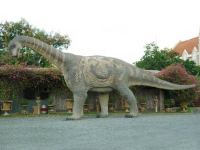 Dinosaurs capture the imagination of both young and old. They are big, fast, powerful, and sometimes deadly. These mysteries of the ancient world have entertained us all the way from the old Flint-stones cartoon series (currently being revived as a movie), to Barney, the current children’s TV favorite, to Jurassic Park, the block buster movie of a few years ago. But don’t let the current dinosaur-mania, and the idea of evolution that seems to undergird it, either undermine your faith in the God of the Bible or brainwash your children.
What are dinosaurs?
The word “dinosaur’ was coined in 1841 by Sir Richard Owen, who studied the bones of the Iguanadon and the Megalosaurus. He named this new order of animal the “dinosaur” which means “terrible, huge lizard.” The bones studied were fossils of creatures that lived in the past. A fossil is formed when minerals replace parts of the body and turn it into rock. Dinosaurs were amazing creatures. When did they live? What happened to them?
Any facts that we have concerning dinosaurs are gathered from fossil remains found in sedimentary rocks. When we consider fossils, we are dealing with evidence of past events, much like students of ancient history or forensic science do. We seek likely explanations of the past, which can be tested, but not proven conclusively. We need a witness, just like in a court case. And we have one, God, who was there in the beginning! He is the witness who knows everything, is reliable and has given us the Bible. In the book of Job, He asks, “Where were you when I laid the earth’s foundations?” (Job 38:4 NIV).
Dinosaurs in Genesis
The King James Version of the Bible was translated in 1611, over 200 years before the word “dinosaur” was coined. For this reason, it does not occur specifically in the Bible, and the influence of evolution probably stopped translators from using it in more modern translations today. There are five events recorded in the Bible that have affected every person on the planet: the Creation, the Fall, the Flood, the tower of Babel, and the life of Jesus Christ. Three of these shed light on the subject of dinosaurs.
The Creation: Dinosaurs were created on the sixth day with all the other land animals. Adam was also created then, so they lived together. This wasn’t a problem, as they were all plant eaters. Adam and Eve “ruled” over them and Adam named them. God saw that it was “very good” – the Garden of Eden was paradise on earth for both man and dinosaurs! (Gen. 1:25-30; 2:19,20).
The Fall: Adam and Eve’s rebellion against God resulted in a different world. After their sin, several things came in: suffering, conflict, decay and death. Romans 5:12 says, “Just as sin entered the world through one man, and death through sin, in this way death came to all men, because all sinned.” Death affected all creation. Romans 8:21-22 says that all creation is waiting to be “liberated from its bondage to decay … We know that the whole of creation has been groaning as in the pains of childbirth up to the present time.”
The Flood: The earth was full of violence: “The Lord saw how great man’s wickedness had become.” He was grieved, and decided to “wipe … from the face of the earth – men and animals, and creatures that move along the ground” (Gen. 6:6-7). This statement includes dinosaurs, as does Genesis 6:19-21: “Bring into the ark … two of every kind … of animal and of every kind of creature that moves along the ground … to be kept alive.”
Then Genesis 7:11 says that “all springs of the great deep burst forth and the floodgates of heaven were opened.” This would have led to erosion and the transport of sediments. It was a worldwide flood, not just a regional one. The ark was needed to save Noah’s family and the animals that were in the ark with him. Except for those in the ark, God destroyed the whole world as punishment for man’s sin and the evil that resulted from it. The flood was a catastrophe involving tremendous amounts of water and upheavals of the earth.
What would we expect to find after the flood? Billions of dead things buried in rock layers, laid down by water, all over the earth. And what do we find? Billions of dead things, buried in rock layers, laid down by water, all over the earth! Sedimentary rock – such as sandstone (from sand), shale (from mud and clay), and conglomerate (a mixture of both) – covers three quarters of the earth. Fossils required a quick burial – resulting from something such as a catastrophic flood – in mud or sand that turned into rock. These fossil graveyards are everywhere. They provide us with fossil fuels such as oil – which supplies our world’s entire petro-chemical industry, and coal – a fossil fuel used worldwide for heat, the production of electricity and many industrial uses.
Dinosaurs in Job
Except for Genesis 1-11, Job is the oldest book in the Bible. Its main character probably lived about 2,000 BC – after the flood, but before large cities were built again. The book shows that Job’s faith was very strong, despite the suffering he went through. In Chapters 38-42, Job is made to realize the vastness of God’s power as revealed in His creation of the physical and biological world. This realization made Job feel insignificant enough to say, “I know that you can do anything, and that no one can stop you” (Job 42:2). We don’t control the universe – God does. The climax of God’s response to Job is a description of the two largest creatures He had created – the behemoth and the leviathan.
The behemoth (Job 40:15-24) was the greatest of land animals. It ate plants; it was strong, powerful, unbothered by raging rivers, and beyond being captured. The leviathan (Job 41), another gigantic beast, lived in the water. It was a creature without fear; it terrified the mighty; it couldn’t be subdued; and the mere sight of it was overpowering. It had fearsome teeth, a flaming mouth and smoking nostrils. The leviathan is referred to as a dragon in the King James Version and a sea monster in the New International Version (Isa. 27:1).
Some say these creatures are mythical. But if they are, also referred to in the same passage are a lion, horse, ostrich and eagle, which are not mythical. Some say they are just other words for present day animals such as the hippopotamus, the elephant and the crocodile. If that’s the case, did the Jews have special words for the first two, but not the third? Or are they the now extinct Brachiosaurus and the Plesiosaurus dinosaurs?
Dinosaurs surely would have shown God’s power in creation! But then, any creature with life is amazing and demonstrates God’s creative power — even the smallest of things, such as the DNA molecule which carries the genetic code. The dinosaur probably became extinct after the flood, because of the much harsher, drier climate and the ice age; because of less vegetation; and possibly because of the impact of humans who continue to cause other animals to become extinct.
Dinosaurs in evolution
Evolutionary ideas about dinosaurs began at the beginning of the last century with Hutton (1795) and Lyell (1830), who taught that “the present is the key to the past.” They attempted to explain the past by present processes alone. So fossils were interpreted in terms of geologic ages, which are based on theoretical “index fossils” and an “evolutionary tree.” They say that dinosaurs lived from 200-70 million years ago inthe Triassic, Jurassic and Cretaceous Ages. The so-called evolutionary tree presents the idea that all life has evolved by natural processes of development alone over millions of years – from molecules to man.
This idea of an evolutionary tree is held by most scientists. It is presented as a fact, not as a theory, which it is, since it can’t be proven. It is taught in schools, universities, museums and the media. Thus everyone is indoctrinated. But the Bible says they are wrong. And 2 Peter-3:3-7 says the exact opposite of what evolutionists teach: “In the last days scoffers will come … But they deliberately forget that long ago by God’s word … the earth was formed … By water also the world … was deluged and destroyed … The present heavens and earth are reserved for fire.”
The scoffers don’t believe that God created the world. They see no need for a Creator God, so there is no authority (Jud. 21:25). They say there are no moral absolutes, no sin, and, therefore, no need for a Savior! They do not believe that God destroyed the whole world by water. They do not believe that God will judge the world by fire. With no authority and no sin, there is no judgment or accountability – past, present or future.
Evolution attacks the very foundation of the Christian faith. It says that suffering and death existed from the beginning, before Adam and Eve ever sinned. But God is not the source of suffering and death, and He would never refer to a creation based on evolutionary theories as “good.” God’s purpose was the creation and redemption (or rescue) of mankind, not millions of years of evolution! 1 Timothy 6:20-21 says such “opposing ideas of what is falsely called knowledge” cause some to “have wandered from the faith.” Don’t let this happen to you!
You decide
Dinosaurs were massive examples of God’s creation, but now they are dead and gone from the face of the earth, and we see them only as fossils. As such, they are merely symbols of God’s judgment of sin. The real examples of God’s judgment on the sin and wickedness of mankind are: the destruction caused by the global flood (be reminded of this every time you see sedimentary rock layers); the burning sulfur rained on Sodom and Gomorrah as God’s judgment on evil (verified by fossil remains); the coming tribulation period; and the coming final judgment and destruction by fire (both prophesied in the Bible).
Romans 6:23 is God’s provision for us: “For the wages of sin is death, but the gift of God is eternal life in Christ Jesus our Lord.” Don’t let dinosaurmania and the idea of evolution either undermine your faith in the God of the Bible or brainwash your children. Remember that Jurassic Park is just a fictitious, money-making movie with a comment on genetic engineering. The Bible tells the real story about the creation, existence and extinction of dinosaurs.
Published, December 1995
Also see: Year of the dragon
Authority questions
Share this:

How can we know that God exists?

God revealed
Does God exist? Some people say yes, others say no, and some just don’t know. Let’s look at some of the evidence that should help all of us.
Creation
We live in an amazingly complex world. The universe is so vast that scientists use light-years to measure distances in space. The distance that light travels in one year is 9.5 trillion kilometers. That’s 9.5 followed by 12 zeros! Starting with us, size increases: the earth, the sun, the solar system, and our galaxy – the Milky Way – which is approximately 100,000 light-years across.
Not only is it very large, but the universe is also made up of very small constituents. Consider us; then consider the ant, the amoeba, the molecule, the atom, the proton, neutron and electron, and subnuclear particles called quarks.
Most digital cameras have a zoom lens that can change the image size by up to three times, and camcorders have 10 times optical zoom. But if we went on a cosmic zoom extending from the galaxy down to quarks, we would change size by 1×1042 times, which is “1” with 42 zeros after it!
This amazingly complex universe is loaded with information and evidence of design. On earth we also have a living world which reproduces itself. The information for living creatures is coded in DNA molecules. But information is the product of intelligence, not chance. We know from the world around us that life always comes from something else which is living. Life does not come from nothing, it comes from something, and that something is always something which is alive. A living God created the world and all life that exists came from Him. God is the origin of life.
 According to the law of cause and effect, creation demands a creator and design demands a designer. By looking at our universe, anyone can know that there is a Creator God. Creation shows that God is intelligent and powerful. The Bible’s message to those who reject this knowledge is: “The truth about God is known instinctively. God has put this knowledge in their hearts. From the time the world was created, people have seen the earth and sky and all that God made. They can clearly see His invisible qualities – His eternal power and divine nature. So they have no excuse whatsoever for not knowing God” (Rom. 1:19-20 NLT).
Conscience
But there is another kind of information in our world. Every person is born with a conscience. Each of us has an instinctive knowledge of right and wrong. For example, most people know it is wrong to lie, steal, commit adultery and murder. The conscience is like a built-in alarm. If we liken our body to computer hardware, then our conscience is like the software program that issues instructions to the hardware. But in this sinful world it is often programmed wrongly.
The Bible gives God’s standards for right and wrong (2 Tim. 3:16-17). But for those who are ignorant of these moral laws it says: “They demonstrate that God’s law is written within them, for their consciences either accuse them or tell them they are doing what is right” (Rom. 2:15).
Those who have not heard about what the Bible says will be judged according to their conscience. So the Creator made us with a mind that is able to make choices, not one that is driven by instinct. The conscience shows that God is concerned with our decisions and our behavior. Unfortunately, we often choose to disobey our conscience. Then we have a guilty conscience. But the Creator has provided the solution to our sinful ways.
Christ
The Bible is God’s special message for mankind. It tells us all we need to know: about history and mankind; about the moral choices made throughout history from the time of our original parents Adam and Eve; about how we have all rebelled against God and gone our own way; about how we all have a guilty conscience, whether we acknowledge it or not; about how this sinful attitude has led to suffering, disease, decay, death and eternal punishment; about how God’s solution to our problems was to send His Son Jesus Christ to take the punishment that we deserve. Christ was crucified and then resurrected back to life, which is particularly remembered at Easter time. His suffering and death were dramatized last year in the Mel Gibson film, “The Passion of the Christ.”
The Bible says, “the wages of sin is death, but the gift of God is eternal life in Christ Jesus our Lord” (Rom. 6:23 NIV). Christ offers each of us the opportunity to be reconciled to God and have our conscience cleansed (Heb. 9:14; 10:22). First, we need to realize our hopeless situation, and then we need to accept God’s gift of forgiveness. Jesus Christ shows that God is compassionate and loving. He is waiting for people to accept His offer to give them a new life and an inheritance with Him in the life to come.
Life Changing Evidence!
God has revealed Himself in three ways: in creation, through our conscience and by His Son, Jesus Christ. Based on this evidence it is foolish to say there is no God (Ps. 14:1; 53:1). Creation and conscience are available to every person, while the clearest revelation is through Jesus Christ, who is made known through the Bible. This is why the Bible is the most important book ever written.
If you come to a different conclusion, then there is a faulty assumption in your reasoning. Have you excluded the correct conclusion before examining the evidence?





 George's Journal
RECENT COMMENTS