
Can we trust our Bibles?
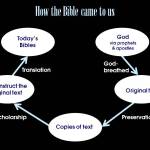
 How the Bible came to us
I recently read about five alleged myths and shortcomings of the Bible: the creation story, the morality of the Jews destroying the Canaanites, Noah’s flood, the virgin birth and inconsistencies between different parts of the Bible. So can we trust our Bibles or are they the unreliable product of a more primitive era? To answer this question we will look at how the Bible came to us.
The word Bible comes from biblion, the Greek word for book and the word Scripture comes from scriptura, the Latin word for something written. The Bible is a collection of 66 books from more than 40 authors. It has two main parts, the Old Testament (OT), written before Christ and the New Testament (NT), written after Christ. They were both written in the everyday language of their time. The OT was written in Hebrew, except for portions in Aramaic after the Jewish exile in Babylon, while the New Testament was written in Greek.
Original text
Paul said that the OT was “the very words of God” (Rom. 3:2). This also applies to the NT as Peter equates Paul’s letters with Scripture (2 Pet. 3:16). So how did the words of God get to be written on earth? Well, the apostle John reported, “On the Lord’s Day I was in the Spirit, and I heard behind me a loud voice like a trumpet, which said: ‘Write on a scroll what you see and send it to the seven churches: …’” (Rev. 1:10-11NIV). In this case John was given a vision and he was to write down what he saw. In Jeremiah’s case, he dictated God-given words to his secretary Baruch (Jer. 36:1-4).
In Hebrews we learn, “In the past God spoke to our ancestors through the prophets at many times and in various ways, but in these last days He has spoken to us by His Son” (Heb. 1:1-2). This means that in the OT God communicated to people via the prophets and in the NT He communicated via Jesus and the apostles, who recorded the life of Jesus and the early church.
Paul wrote, “All Scripture is God-breathed” (2 Tim. 3:16). Peter wrote, “We also have the prophetic message as something completely reliable … Above all, you must understand that no prophecy of Scripture came about by the prophet’s own interpretation of things (own mind). For prophecy never had its origin in the human will, but prophets, though human, spoke from God as they were carried along by the Holy Spirit” (2 Pet. 1:19-21). Clearly the Bible message came from God via the prophets and apostles. The Holy Spirit influenced them like a wind moves a sailing boat: see Acts 27:15 where the same word is used. So the Holy Spirit helped the authors write the words. But it wasn’t just dictated mechanically, because each author used their own style.
So God created the books of the Bible via human authors. It’s God’s words (in the original text). That’s why it is also referred to as God’s Word. Each word of the entire Bible was “God-breathed” as originally written. This means it was recorded accurately without error. So it’s trustworthy and reliable in all the matters it addresses.
Paul communicated “things God has revealed to us by His Spirit” (1 Cor. 2:10), “not in words taught us by human wisdom but in words taught by the Spirit” (1 Cor. 2:13). So the words used by the apostles were especially chosen by the Holy Spirit. Paul and the other writers “had the mind of Christ” (1 Cor. 2:16). This passage is about new truths revealed in the NT, not about heaven.
What about the Apocrypha which is comprised of 13 Jewish writings from the period between the OT and the NT (430 BC to 50 AD) that are included in the Roman Catholic and Eastern Orthodox Bibles? The word Apocrypha comes from a Greek word meaning hidden. However:
- They were never accepted by the Jews as part of their God-given Scriptures
- None are quoted or referred to in the NT or accepted by Jesus and the apostles as God-given Scripture
- None were written by the OT prophets
- They were only recognised by Roman Catholics as part of their Scriptures in the 1540s (1,500 years after they were written)
So the Apocrypha are Jewish religious books written between the times of the OT and the NT, but they are not God-breathed Scripture.
By 400 BC the OT was complete and written on scrolls and by 100 AD the NT was complete and written on scrolls. However, because scrolls don’t last for thousands of years, we don’t have any of the original Biblical texts today. Does this mean our Bibles are unreliable? No! Many copies have been made and early manuscripts have been preserved.
Early manuscripts
Photocopiers have been used since 1959 and the printing press since the 1450s. Gutenberg printed the first Bible in 1456. Copies of the books of the Bible were handwritten before the printing press. A handwritten copy is called a manuscript, which comes from the Latin words manu (hand) and scriptum (written). An amazing number of Bible manuscripts have been preserved for us to examine today. These comprise ancient fragments, scrolls and books.
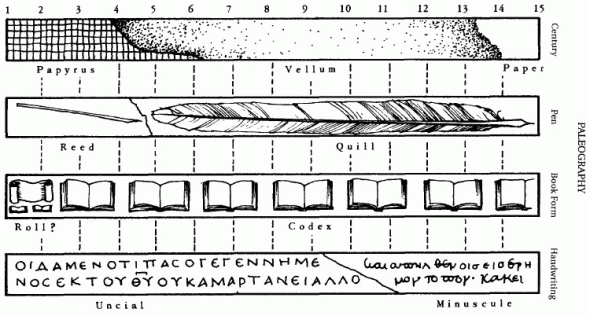
The characteristics of these documents changed over the centuries between when they were first composed and the advent of the printing press. The media they were written on changed from stones (like the Ten Commandments), to clay tablets (Moses), to papyrus (paper made from a reed plant that grew along the Nile River – that’s where our word paper comes from), to parchment (also called vellum; made from animal skins), and to paper. Paper as we know it was invented in China, but wasn’t used in Europe until the 1200s. Books replaced scrolls in about the second century AD. In about the eleventh century AD, the Greek text changed from modified capitals to lower case. In about the fifth century AD, the quill replaced the reed as the “pen” used by copyists. Scholars examine these characteristics when dating manuscripts.
Old Testament manuscripts
The OT was written between 1500 BC and 400 BC. The Dead Sea Scrolls (DSS) were the most important archaeological discovery in the last century. They were found in clay jays in caves near the north-western shore of the Dead Sea. Scholars believe that the DSS were hidden about 70 AD when Roman legions invaded Israel.
Before this time, the oldest Hebrew manuscript of the whole OT was Codex Leningradensis (1008 AD). Codex means book. In the DSS there was a copy of Isaiah dated 150 BC, which was about 550 years after the original text was written. The Hebrew text of this copy was virtually the same as the copy made over 1,000 years later. So the Jewish scribes did a good job! They were diligent and developed many practices to protect copies of their scriptures from error. For example, the Masoretes numbered the letters, words, and paragraphs of each book and the middle paragraph, middle word and middle letter had to correspond to those of the original document. Earlier Jewish scribes were just as meticulous in their transcription. After all, they were instructed not to add to or take away from the word of God (Dt. 4:2; Prov. 30:6).
Most of the DSS predate the time of Christ (they were written 150 BC to 70 AD). Parts of all the books of the Old Testament were found except Esther. They closely follow the Masoretic Text, the Hebrew text of the Jewish Bible (the tanakh), copied by a group of Jews about the 10th century AD, but there are a few exceptions. For example, Psalm 145 is an alphabetical psalm. Each verse begins with the next letter in the alphabet, but “N” verse is missing in the Masoretic Text and King James Bible.
Between the third century BC and 130 BC, the OT was translated into Greek and this version of the OT is known as the Septuagint. Fragments of Septuagint manuscripts date from the first and second centuries BC. Relatively complete manuscripts of the Septuagint include the Codex Vaticanus from the 4th century AD and the Codex Alexandrinus of the 5th century. These are the oldest surviving nearly complete manuscripts of the Old Testament in any language; the oldest existing complete Hebrew texts date some 600 years later, from the 10th century.
New Testament manuscripts
The NT was written between 50 AD and 100 AD. The oldest NT manuscript is a papyrus fragment of the Gospel of John, which is dated about 125 AD about 30 years after the book was first written! The earliest manuscripts of each book in the NT are usually papyrus fragments which are dated from 125 AD (for John) to 350 AD for 1&2 Timothy and 3 John, with a median date of 200 AD.
 Codex Sinaiticus, a manuscript of the Bible written about 350 AD, contains the earliest complete copy of the New Testament. It was discovered at a monastery on Mount Sinai in the 1850s. The hand-written text is in Greek. On the other hand, the earliest manuscripts of the works of the Jewish historian Josephus in their original language are dated 900-1000 AD, at least 800 years after they were written.
As there are earlier, better and more manuscripts of Scripture, the manuscript evidence of the Bible is superior to that for any other ancient book. However, none of these Biblical manuscripts is perfectly accurate, they all contain copy errors. Does this mean our Bibles are unreliable? No! Scholars have reconstructed the original text.
Reconstructed text
The study of biblical manuscripts is important because handwritten copies of books usually contain errors. Textural scholars reconstruct the original text from the manuscripts available. Generally earlier versions are closer to the original as they have fewer copy errors.
Scholars have grouped the NT manuscripts into families: Alexandrian (200s-400s AD), Caesarean (200s AD onwards), Western (300s-500s AD) and Byzantine (500s onwards). There have been three major attempts to reconstruct the original New Testament text from ancient Greek manuscripts:
The Received Text (“Textus Receptus” in Latin) was based on some Byzantine (eastern portion of the Roman Empire) manuscripts (dated from 1000 AD). It was first published in 1516. This text lacks the input of many early Biblical manuscripts which have been discovered since this time.
The Eclectic Text (selected from the best of a variety of sources) was based on an analysis of all the manuscripts, with a preference for the earliest ones (mainly Alexandrian, Caesarean and Western manuscripts). It was first published in the 1880s. This text tends to be shorter than the others.
The Majority Text was based on the majority of existing Greek manuscripts and first published in the 1982. As fewer ancient texts have survived and the Byzantine church was quite wealthy and produced many manuscripts, the Majority Text is largely based on the Byzantine family of manuscripts (dated the 9th to the 13th centuries AD) and has some similarities to the Received Text. However, no major Bible translations are based on the Majority Text.
The differences between the reconstructed New Testament texts mentioned above are mainly technical and not doctrinal. They don’t affect any Christian doctrine because the Bible is a robust document. It has a great deal of redundancy and repetition with multiple accounts of important events. For example, there two accounts of Israel’s history (Samuel & Kings; Chronicles), three genealogies from Adam to Abraham (Genesis 5&11; 1 Chronicles; Luke 3) and four accounts of the life of Jesus (the gospels). All major doctrines are taught in several places in the Bible. They don’t rely on a single verse.
So scholars have reconstructed the original Biblical texts. However, as these reconstructed original texts are in Hebrew and Greek, which most of us can’t read, does that mean that our Bibles, which are not in Hebrew and Greek are unreliable? No! These languages have been translated accurately.
Accurate translation
Translators transfer the message from a source language to a receptor language. These Biblical texts have been translated into most of the languages in the world. In fact, the Bible has been translated and retranslated more than any other book in history. New translations are needed from time to time because all languages are constantly changing.
Some ancient translations are:
• The Septuagint – a Greek translation of the OT dated about 200 BC, which was quoted by Christ and the apostles. This shows that God approves of translations. Jesus viewed this translation of the Old Testament as reliable and trustworthy (Mt. 5:17-18; Jn. 10:35).
• The Vulgate – a Latin translation of the Bible dated about 400 AD, which was used for over 1,000 years including the Middle Ages.
If you look at an Interlinear Bible you will realise that a word-for-word translation is impossible. This is because each language has a different vocabulary (we may need more than one word to describe a word in another language or vice-versa) and a different grammar (or sentence structure). Also, languages are flexible and there is often more than one way to correctly translate a text. The same information can be communicated in different ways.
What’s the difference between different translations of the Bible?
Source text
Two types of reconstructed source have mainly been used:
- Received Text – This was used by the 1611 KJV and has been maintained by subsequent editions of the KJV and for the NKJV.
- Eclectic Text – This is used by most other translations of the Bible where some verses are omitted because it is believed that they were added by copyists.
Readability
Some translations try to follow the pattern of the source language (but are not as readable), others follow the pattern of the receptor language (but are not as close literally). For example:
- Most literal includes: NASB (11), KJV (12), NKJV (9) and ESV (9)
- Most readable includes: CEV (4), NLT (6)
- Intermediate: NIV (8), HCSB (8)
The number is the grade level required to read the text. Note: interlinear Bibles are most literal, but they are not readable at all, and The Message is a paraphrase not a translation. Different translations have different purposes, which are indicated in the front of the Bible. They usually have a particular readership in mind. Most of the translations are trustworthy. Rarely does a doctrinal matter hinge on the translation of the text.
Lessons for us
We can be thankful for the Bible’s preservation over thousands of years.
Our Bibles are very close to the original because early manuscripts have been preserved, scholars have reconstructed the original text and languages have been translated accurately. So we can trust our Bibles.
Paul told Timothy, “from infancy you have known the Holy Scriptures, which are able to make you wise for salvation through faith in Christ Jesus. All Scripture is God-breathed and is useful for teaching, rebuking, correcting and training in righteousness, so that the servant of God may be thoroughly equipped for every good work” (2 Tim. 3:15-17). Each of our Bibles contains all we need to know about salvation, spiritual growth and Christian living, by making us “wise for salvation through faith in Christ Jesus” and thoroughly equipping us for every good work.
Which is the best Bible? The one you read! Read it regularly and memorise key verses.
Written, March 2012
Also see: Is the New Testament reliable?
Mind the gap
Do we have the right Bible?
Can Greek be translated into English?
Share this:

What makes the Bible so great?
 The Bible is a collection of books which were written over a period of over 1,500 years with unique origin and content.
Unique origin
We will look at three statements about the source of the Bible. “All Scripture is God-breathed” (2 Tim. 3:16NIV). When written in ~67AD by Paul, this statement mainly applied to the Old Testament as not all the New Testament books had been written. But when Paul quoted from the book of Luke, he called it Scripture (1 Tim. 5:18) and Peter referred to Paul’s letters as Scripture (2 Pet. 3:16). So today we can apply the statement to the whole Bible. This means that God is the source of every verse in the Bible.
“Above all, you must understand that no prophecy of Scripture came about by the prophet’s own interpretation of things (mind). For prophecy never had its origin in the human will, but prophets, though human, spoke from God as they were carried along by the Holy Spirit” (2 Pet. 1:20-21). The men who were given the message were called prophets. This passage emphasises that the words of Scripture were given by God via the Holy Spirit; and they didn’t originate from the prophet’s mind.
“This is what we speak, not in words taught us by human wisdom but in words taught by the Spirit, explaining spiritual realities with Spirit-taught words” (1 Cor. 2:13). Once again, the Bible contains God’s wisdom, not human wisdom (1 Cor. 2:6-15). It’s “the thoughts of God” and the amazing things that “God has prepared for those who love Him”, which can only be understood with the help of the Holy Spirit.
As the Bible is the only book with God as the author, it is unique. The Bible is God’s message to us. The supreme God who created the universe and continues to sustain it has communicated with us. This also means that:
- The Bible has authority – coming from the ruler of the visible and invisible universe.
- The Bible is infallible. It is “completely reliable” as the source of truth, being absolutely true (2 Pet.1:19). The original text was without error and only minor copyist errors have occurred over the passage of time. When interpreted correctly, it never deceives us, never contradicts itself and can be trusted.
- The Bible is profitable. God has told us what we need to know. It’s like our instruction manual for life.
Unique content
The Bible tells us the history of the universe from beginning to end. It begins with the creation of the universe and contains a history of mankind from Adam and Eve to the end of history. It describes the global flood that has shaped the earth and gives a detailed history of the Jewish nation, which is confirmed by archaeology. There is also a history of God’s dealing with mankind, a history of human failures, an accurate record of human behaviour and information about heaven and hell.
The Bible answers difficult questions, such as the following. Why do we exist? Why does anything exist? What can we hope for in the future? What is our destiny? Where has humanity come from? Why are we male and female? Where does marriage come from? Why is there suffering?
The Bible deals with our greatest problem (being God’s enemy instead of His friend) and our greatest need (to be reconciled with God) and how that was addressed by Jesus. God’s plan of salvation through Jesus is the theme of Scripture. We learn the way of salvation through the Bible (2 Tim. 3:15). It also provides assurance of salvation.
The Bible tells us what to know about the unseen world, including: God, angels, Satan, and demons. It describes the interaction between the unseen and seen parts of our world. It reveals what is God like; what has God done; God the Father, Jesus Christ, and the Holy Spirit. It also reveals that humans are comprised of spirit, soul and body.
As the Bible is the only reliable source of this information, it is unique (Eccl. 3:11).
Powerful
The Bible uses the following powerful images to describe itself:
- A sharp sword that penetrates and judges our thoughts and attitudes (Heb. 4:12-13). It is the sword of the Spirit (Eph. 6:17).
- A light that shines in darkness (Ps. 119:105; 2 Pet. 1:19). It illuminates the way ahead and guides us.
- A mirror that shows our true condition (Jas. 1:22-25).
- Food (milk and solid food) that sustains us (1 Cor. 3:1-2; Heb. 5:12-14).
- Water that purifies us as we obey Scripture (Eph. 5:25).
- More precious than gold (Ps. 19:10).
- Sweeter than honey (Ps. 19:10).
So, the Bible is not just another book, it’s God’s unique powerful message to us. Let’s read it, study it, memorise it and obey it.
Written, September 2011
Also see: Read the Bible in one year
Share this:

New Testament Shepherds
 Revision
God uses images of sheep and shepherds in the Bible; sheep are often used to illustrate people and shepherds to illustrate leaders, such as God and kings. The imagery of a shepherd and his flock provided a picture of the way God cared for His people, and also serves as a model for human leaders. In this article we look at shepherds in the New Testament.
I recently visited my brother on his sheep farm. During lambing season he visits each flock on a daily basis. So we drove around the fields and sighted each sheep. As new lambs are small and can be hidden in the grass, you need to drive near each ewe. Life isn’t easy for a sheep and there were a few carcasses of sheep that had died and flocks of ravens were in the trees to feed on any that were dead or dying. We saw a sheep upside down in the adjacent field and looked to see if it was dead. But a leg moved, so we drove over. He rolled her over and sat her up for a while. She was large and may have been expecting twins. He eventually got her to stand up, but she wouldn’t walk. He thought she may have lambing sickness, so we lifted her up onto the back of the small truck and drove her to sheep yards where he gave her two injections and a dose of medicine with the mouth drench. We left her with some water and wheat. That’s an example of the work of a modern shepherd.
The apostles
When Jesus was about to be crucified, three times the apostle Peter publicly denied knowing Him. Then after Christ rose from the dead Peter repented and was restored to fellowship with the Lord. This is illustrated by the following incident when Peter was restored publicly. On three occasions the Lord asked Peter, “Do you love me”? When Peter said that he loved the Lord, he was told to: “Feed my lambs”; “Shepherd my sheep”; and“Feed my sheep” (Jn. 21:15-17NIV). God’s sheep are His people, those who follow Him (Lk. 12:32). So Peter was to demonstrate his love for Christ by caring for the people of God like a shepherd cares for his sheep. “Feeding” implies teaching, while “shepherding” implies pastoral care, and the “lambs” are those who are young in the Christian faith.
Soon afterwards, the Holy Spirit indwelt the believers on the day of Pentecost and Peter spoke to the people. We see that Peter and the other apostles were leaders of the early church. The history of the early church is given in the book of Acts. When Cornelius received the Holy Spirit, Peter baptised Gentiles into the church. Paul was the special apostle to the gentiles and he preached to many people and planted many churches.
So the apostles were shepherds in the early church; they were leaders who cared for the welfare of fellow believers. Peter fed the sheep of God’s people when he spoke as recorded in the book of Acts and when he wrote his letters of 1&2 Peter. We now look at the passages that specifically mention shepherds in the early church.
Elders in Turkey
In the letter of 1 Peter, Peter wrote to believers scattered across what is now the country of Turkey. It was written about 30 years after the day of Pentecost (1 Pt. 1:1). After dealing with their suffering under the Emperor Nero, he wrote: “To the elders among you, I appeal as a fellow elder, a witness of Christ’s sufferings and one who also will share in the glory to be revealed: Be shepherds of God’s flock that is under your care, serving as overseers—not because you must, but because you are willing, as God wants you to be; not greedy for money, but eager to serve; not lording it over those entrusted to you, but being examples to the flock. And when the Chief Shepherd appears, you will receive the crown of glory that will never fade away” (1 Pt. 5:1-4).
He used the image of shepherds and sheep. The elders in the local church are the shepherds and the congregation are the sheep. Although they were apostles, Peter and John both identified themselves as church elders (1 Pt. 5:1; 2 Jn. 1; 3 Jn. 1). The Greek word translated “elder” is “presbuteros”, which describes a position of responsibility. Firstly, the elders are to shepherd God’s flock. This means caring for the believers in the local church. It is God’s flock and the elders work for Him; they shepherd under the Chief Shepherd. Secondly, they were to be willing and eager to serve and not reluctant. Thirdly, they were to be good examples; not selfish or bossy and not a dictator like Diotrophes (3 Jn. 9-10). So the elders were shepherds in the early churches in Turkey; they were leaders who cared for the welfare of follow believers.
Elders at Ephesus
Paul spread the gospel to countries like Turkey, Greece and Italy. On his third missionary journey his boat was going to Miletus, which was about 55 km from Ephesus. “From Miletus, Paul sent to Ephesus for the elders of the church” (Acts 20:17). They had a close relationship with Paul because he had spent over two years with them in daily discussions (Acts 19:10). When they arrived, Paul gave them his farewell message. He knew that prison and hardship was ahead for him. “Keep watch over yourselves and all the flock of which the Holy Spirit has made you overseers. Be shepherds of the church of God, which he bought with his own blood. I know that after I leave, savage wolves will come in among you and will not spare the flock. Even from your own number men will arise and distort the truth in order to draw away disciples after them. So be on your guard! Remember that for three years I never stopped warning each of you night and day with tears” (Acts 20:28-31).
In this passage, the elders are also described as “overseers” (v.28). The Greek word is “episkopos” or “bishop” (English), which means to look or watch over. So in the early church the terms “elders”, “overseers” and “bishops” were equivalent descriptions of the leaders in the local church (Tit. 1:5,7). Here we see that the elders were chosen by the Holy Spirit and recognised by the congregation (1 Th. 5:12-13). In this case they travelled as a group to a town 55 km (35 miles) away to see Paul.
The elders were to: keep watch over each other (v.28); keep watch over the congregation; and protect the congregation from external attack (wolves) and internal attack (false teachers drawing people after themselves). So the elders were shepherds in the church at Ephesus; they cared for and protected follow believers.
A special gift
When Paul wrote to the church at Ephesus he mentioned some special gifts that Christ had given to the local church: “It was he who gave some to be apostles, some to be prophets, some to be evangelists, and some to be pastors (shepherds) and teachers, to prepare God’s people for works of service, so that the body of Christ may be built up” (Eph. 4:11-12). These gifts were people, not abilities. The people given to the church were: apostles, prophets, evangelists, shepherds and teachers. The apostles and prophets established the early church and wrote the New Testament (Eph. 2:20). The apostles had been taught by the Lord and seen His resurrection body and had the power to do miracles (Acts 1:21-22; 2 Cor. 12:12). The prophets spoke the word of God before the New Testament was available. The evangelists preached the good news of salvation through the Lord’s death and resurrection. The word translated “pastors” is the Greek word for “shepherds”. “Pastor” is the Latin word for shepherd. The teachers interpret the scriptures and apply it to the congregation. This is the food provided by the shepherds.
The “shepherds and teachers” (Eph. 4:11) are the elders. We have already seen how the elders are to shepherd the congregation. An elder must be “able to teach” (1 Tim. 3:2). This passage shows that a major objective of the work of the elders is “to prepare God’s people for works of service, so that the body of Christ may be built up until we all reach unity in the faith and in the knowledge of the Son of God and become mature, attaining to the whole measure of the fullness of Christ” (Eph. 4:12-14). So elders should ensure that the congregation is trained towards spiritual growth and maturity.
The other abilities that are useful for eldership are leadership skills (Rom. 12:8) and administrative skills (1 Cor. 12:28). Also, elders must be able to manage their household well (1 Tim. 3:4,5).
Plural leadership
Note that it was plural leadership, not singular leadership – “elders”, not “elder” and “overseers”, not “overseer” (Acts 14:23; 20:17; Phil. 1:1; 1 Tim. 5:17; Tit. 1:5). It was a leadership group, not a single leader. The singular sense is only used when describing the qualifications of an elder (1 Tim. 3:2; Tit. 1:6-7) or an accusation against an elder (1 Tim. 5:19) or themselves as individuals(1 Pt. 5:1; 2 Jn. 1; 3 Jn. 1).
Was James the senior elder at Jerusalem? He spoke at a meeting of the apostles and elders and made a judgment which was accepted by the others in the church (Acts 15:13-30). Also, when he visited Jerusalem, Paul “went to see James and all the elders were present” (Acts 21:18). It is clear from the context that James was an elder at Jerusalem, but there is no other evidence that he was senior to the other elders. He may have been a spokesman for the elders. These verses are not sufficient to indicate a hierarchy within the eldership.
Collective leadership provides collective abilities, experience and wisdom. It guards against domination by individuals, which has caused divisions within churches (1 Cor. 1:11-13; 3:1-9; 3 Jn. 9-10). This means shared responsibility and accountability amongst the elders. Elders need to work together as peers. This structure encourages humility and servanthood and discourages pride, ego and dictatorial power.
In some respects the elders of a local church are to function like a Board of Directors of a membership based organisation. All decisions are to be made collectively and all elders share equal responsibility for those decisions. Likewise, elders need to be able to work as part of a group, be genuinely interested in the congregation and act with honesty and integrity.
Wolves
Paul told the elders at Ephesus “I know that after I leave, savage wolves will come in among you and will not spare the flock” (Acts 20:29). As predators such as wolves kill sheep, the shepherd needs to protect the sheep against the predators. We know that David killed a lion and a bear while he was protecting his flock. In John 10 the sheep were put in the sheep pen for the night for their protection.
Jesus said, “Watch out for false prophets. They come to you in sheep’s clothing, but inwardly they are ferocious wolves” (Mt. 7:15). Peter wrote “There were false prophets among the people, just as there will be false teachers among you” (2 Pt. 2:1). Elders are to protect the congregation against false teachers.
Sometimes the attacks can be deceptive. Satan is described as the one “who leads the whole world astray” (Rev. 12:9) and John wrote “Dear children, do not let anyone lead you astray (or deceive you)” (1 Jn. 3:7). Elders also “keep watch over you as men who must give an account” (Heb. 13:17). The elders are responsible for the spiritual welfare of the church and will give an account of this work to God.
Sheep
We know that the elders are to be shepherds of the congregation who are God’s flock. What are the responsibilities of the congregation?
Realize that the elders have been established by God: “Keep watch over yourselves and all the flock of which the Holy Spirit has made you overseers” (Acts 20:28). Respect them: “Respect those who work hard among you, who are over you in the Lord and who admonish you. Hold them in the highest regard in love because of their work” (1 Th. 5:12-13). Honor and support them where appropriate (1 Tim. 5:17-18). Imitate their faith (Heb. 13:7) and obey them (Heb. 13:17). As elders will be attacked, the congregation should protect them from false accusations by rejecting allegations that are not supported by two or three witnesses (1 Tim. 5:19). So Christians should recognise and obey those who have the qualifications and who do the work of elders.
Lessons for us
A church needs active elders. If my brother didn’t go around the sheep every day, more sheep would die from sickness, disease, harsh weather or predators. The congregation should be under the care of active elders as sheep should be under the care of a shepherd (1 Pt. 5:2). Otherwise, it would be “like sheep without a shepherd” (Mt. 9:36; Mk. 6:34). When there are no active elders to give guidance and direction, people wander from the path they should be taking in life and there is tragedy. This happened to Israel in the Old Testament and the same principle applies in the church today.
What have we learnt for elders?
Good leadership begins with God as our shepherd. All elders should follow the example of the Good and Chief Shepherd, as they shepherd God’s flock: teach the young in the Christian faith; care for, protect and teach the congregation; be a team worker, part of a collective leadership; be accountable to each other; be willing and eager to serve; train the congregation for works of service; be good examples; be responsible for the spiritual welfare of the congregation and ready to give an account of this work to God.
What is our responsibility to elders?
Our attitude towards elders should be similar to our attitude the Lord who is the Good Shepherd and the Chief Shepherd: remember, honor and respect them; hold them in the highest regard in love; obey them; submit to their authority; and imitate their faith.
Written, November 2005
Also see:
– Old Testament shepherds
– The Good Shepherd
– The Good Shepherd is always near
– Was James the senior pastor of the church at Jerusalem
Share this:

What does the New Testament say about Christians getting tattoos?
 Dealing with debatable matters
In the previous article we saw that God communicates to us progressively through the Bible. So Old Testament (OT) verses need to be understood in view of the additional knowledge we have in the New Testament (NT). In doing this we can look for examples, warnings, encouragement and hope in the OT which are consistent with the messages given to churches in the NT. In the case of Leviticus 19:28, which prohibited the Jews having tattoos, the tests for a tattoo today could be: Is it consistent or inconsistent with being devoted to God? Is it linked to idolatry? Does it display the fruit of the Spirit or an act of the sinful nature? What is the motivation behind the tattoo?
Now we will look at how the teachings of the NT apply to this topic, which provides further insight into how we can apply the teaching of Scripture to our daily lives. The previous article stated that tattooing was not mentioned specifically in the NT. However, some people think the following verses could refer to tattoos. During the time of tribulation after true Christians are taken to heaven, the false prophet will force “all people, great and small, rich and poor, free and slave, to receive a mark on their right hands or on their foreheads, so that they could not buy or sell unless they had the mark, which is the name of the beast or the number of its name. This calls for wisdom. Let those who have insight calculate the number of the beast, for it is the number of a man. That number is 666” (Rev. 13:16-18TNIV). Also, when Christ returns to earth to put down His enemies and to set up His kingdom, “On His robe and on His thigh He has this name written: KING OF KINGS AND LORD OF LORDS.” (Rev. 19:16).
As the word translated “mark” (Strongs #5480) is a scratch or etching; something engraved or stamped it looks like it could be a literal mark on the skin. However, this is only an inference. The word translated “written” (Strong’s #1125) usually refers to something written in a book, scroll, or on a board. However, it may be symbolic not literal, like the sword out of His mouth (v.15). Obviously, there can be various views on the “mark” and the “writing”.
Debatable Matters
In a situation that is not sinful, whether to get a tattoo can be considered to be a debatable matter where Christians may have different opinions and convictions. These are secondary matters that are not essential to the Christian faith. The bible distinguishes between essentials and non-essentials in the Christian faith. The essentials or fundamentals or primary matters are things which all believers should agree on. They are the tests the Bible quotes for recognising false teachers and false ideas about things such as the person and work of Christ; the good news of salvation “by grace … through faith .. not by works” (Eph. 2:8-9); and the inspiration and authority of the Bible as God’s revelation to us.
Apart from such foundational truths, there are many other things in the bible that are not as clear and not as easily understood. These are non-essentials or secondary matters. Romans 14:1 – 15:7; 1 Corinthians 8 and 1 Corinthians 10:23-33 are key passages on this topic. In Romans 14:1 they are called “disputable matters” (Rom. 14:1TNIV) or “doubtful things” (NKJV), but as the Greek word used (Strongs #1261) means “discussion” or “debate”, I prefer to call them “debatable matters”. We can debate them, but shouldn’t dispute them. In these instances as the Bible allows for differences of opinion, we must also allow for differing opinions. Romans 14 addresses whether to eat food that has been offered to idols or whether one day was more sacred than another, which were issues in the first century AD around the Mediterranean. As Paul wrote, “The kingdom of God is not a matter of eating and drinking, but of righteousness, peace and joy in the Holy Spirit” (Rom. 14:17), what counts in God’s kingdom is not what we eat or drink, but lives characterised by practical righteousness, peace and joy.
The first example in this chapter concerns eating meat, “One person’s faith allows them to eat everything, but another person, whose faith is weak, eats only vegetables.” (Rom. 14:2). When the book of Romans was written, many Gentile believers (those with no Jewish ancestry) had previously participated in pagan worship which included animal sacrifices to pagan gods. The animals that were sacrificed were usually sold as meat on the open market. So for those who had been saved out of this lifestyle the question became whether they should eat the meat sacrificed to these idols. By eating this meat, were they participating in the idolatry of pagans? This was a hard question for many. And desiring not to participate in idolatrous practices, many of these Gentile Christians became vegetarians. Only in that way could they assure themselves that they were not eating meat sacrificed to idols.
Paul says that the weak believer, with a strict conscience, ate only vegetables whereas the strong believer’s faith allowed them to eat this meat because they understood that the idols to which the meat had been offered were not gods at all – only pieces of wood, stone or metal. Therefore, as they ate the meat with that understanding, they were not participating in idolatry.
The second example has to do with observing special days as holy days, “Some consider one day more sacred than another; others consider every day alike” (Rom. 14:5). Those who had been saved out of a Jewish tradition of Sabbath days and festivals were apt to make a great deal out of those observances. However, others not coming from that background felt that every day was the Lord’s day, and that none were more special than others. This created problems in the early church. How were believers to live together who did not agree in every detail? How are we, today, to deal with other believers whose opinions differ from ours?
When I was young smoking, drinking alcohol, playing cards, movies and dancing were viewed as being sinful and taboo. In some circumstances this is true, but in others they may be debatable maters. The Bible gives principles that can help us determine God’s will in debatable matters. It is clear that these principles are important because of the numerous references to them in the New Testament.
God’s Honor
First, we are to honor God with our bodies (1 Cor. 6:19-20). When Paul said to “flee from sexual immorality”, he gave the following reason: “Do you not know that your bodies are temples of the Holy Spirit, who is in you, whom you have received from God? You are not your own; you were bought at a price. Therefore honor God with your bodies” (1 Cor. 6:19-20). This means considering questions such as: Will it honor or dishonor God? Will His reputation be enhanced or harmed? Will God be exalted or disgraced? Will others think less of God, His church or of His word? Is the motive to draw attention to ourselves (1 Tim. 2:9)?
A related principle is that whatever we do should be done for the glory of God. When Paul discussed whether to eat meat that had been offered to idols he concluded, “So whether you eat or drink or whatever you do, do it all for the glory of God” (1 Cor. 10:31).
The Welfare of Others
Next we are to consider the welfare of others by putting the following three principles into practice.
Acting in love (Rom. 14:15)
With regard to debatable matters, Paul wrote, “‘I have the right to do anything,’ you say—but not everything is beneficial. ‘I have the right to do anything’—but not everything is constructive. No one should seek their own good, but the good of others” (1 Cor 10:23-24). In this area, although there is freedom of action, acting in love means that we consider the impact on others, particularly those whose conscience is weak or strict (1 Cor. 8:7). As a result of this we may need to modify our behaviour and not enjoy all the liberties that we could otherwise.
Acting in love means forbearing those with a stricter conscience, not insisting on doing what we want without considering the views of those around us, in order to build them up; “We who are strong ought to bear with the failings of the weak and not to please ourselves. We should all please our neighbors for their good, to build them up. For even Christ did not please Himself …” (Rom. 15:1-3a).
Acceptance
The practice of acceptance features in the passage in Romans, which begins with “accept those whose faith is weak” (Rom. 14:1). Those whose convictions allow them more freedom are to accept those with stricter consciences on debatable matters. Despite our differences of opinion with regard to debatable matters, believers should accept one another just as Christ has accepted us; “Accept one another, then, just as Christ accepted you, in order to bring praise to God” (Rom. 15:7).
Our fellowship with one another shouldn’t depend on one’s viewpoint on such matters. As Christ died for all believers and they have been accepted as His children, we should accept them as well (Rom. 14:15). The call to the Christian is to accept every other believer without having to pass judgment on every opinion they hold. In other words, we are to allow for differing opinions, because differing opinions do not necessarily mean a differing faith.
Harmony
With regard to debatable matters Paul wrote, “Let us therefore make every effort to do what leads to peace and to mutual edification” (Rom. 14:19). This means promoting peace and spiritual growth and determining whether the matter would help or hinder the harmony of believers.
Furthermore, the welfare of others involves avoiding the following three situations in debatable matters.
Don’t quarrel
Paul also wrote, “Accept those whose faith is weak, without quarreling over disputable (or debatable) matters” (Rom. 14:1). One way of accepting other believers is to not engage in disputes about their strict views and not force our convictions on them (Rom 14:22). We can share our opinion, but it is important to give others space to grow and to allow for the possibility that we may be wrong.
Don’t judge
Those with a strong conscience shouldn’t despise those with a strict conscience; “The one who eats everything must not treat with contempt the one who does not” (Rom. 14:3a). On the other hand, those with a strict conscience are not to judge others as being sinners; “the one who does not eat everything must not judge the one who does, for God has accepted that person” (Rom. 14:3b).
As far as our service goes as the Lord’s servants we are all accountable to Him, not to each other (Rom. 14:4, 10-13). This means respecting each other’s opinion as we can have differing views on what pleases the Lord (1 Th. 4:1). We are to allow for differing conclusions of honest believers seeking the mind of Christ, without criticism, without contempt, and without judgment (Rom. 14:10). Don’t judge one another critically to put others down (Rom. 14:13). React with love not criticism. Remember, God has accepted them. He is the judge in these matters, not us.
Note that these verses are dealing with debatable matters. We can certainly make judgements about matters that involve the fundamentals of the faith and sinful behaviour.
Don’t hinder spiritual growth
There are many references to not stumbling a weaker believer (Rom. 14:13, 15, 20-21; 1 Cor. 8:9-13; 1 Cor. 10:32-33). This means refraining from doing something that is not forbidden in Scripture if it hinders the spiritual progress of those with a strict conscience, by causing them to act against their conscience. Otherwise, both parties sin.
Don’t let debatable matters destroy the work of God. Paul even extends this principle to unbelievers because he wanted them to accept Christ as their Savior; “Do not cause anyone to stumble, whether Jews, Greeks or the church of God—even as I try to please everyone in every way. For I am not seeking my own good but the good of many, so that they may be saved” (1 Cor 10:32-33). It’s loving and unselfish to think of others above ourselves (Rom. 14:15; 15:1-2).
Order in the Church
When he was addressing disorder in the meetings of the church in Corinth, Paul wrote; “For God is not a God of disorder but of peace—as in all the congregations of the Lord’s people” and “everything should be done in a fitting and orderly way” (1 Cor. 14:33; 40). In this situation, Paul imposed some boundaries to ensure there was order instead of disorder.
Some debatable matters can affect the unity or functioning of the local church. Because the local church is to operate in an orderly way, in the case of debatable matters that directly affect the unity or functioning of the local church, there should be boundaries on what is taught and practised. In these situations, what is taught and practised within the church needs to be consistent and it will not always match everyone’s opinion because after all, we can have various opinions on these topics.
Tattoos
As tattoos are permanent, consider whether we and our family will still want or regret a tattoo in many years time. Also, because images affect our thoughts, any tattoo or image that we focus on should be true, honourable, right, pure, lovely, admirable, excellent and praiseworthy and not obscene (Eph. 5:4; Phil. 4:8). For example, it could symbolise a Biblical truth which benefits our relationship with Christ.
Finally, our body is like an instrument or tool that can be used for good or sinful purposes (Rom. 6:13). The important question is whether we are giving our bodies to God, not whether we have a tattoo or not (Rom. 12:1).
Lessons For Us
When considering tattoos and other debatable matters such as food, drink, clothes, standards of living and entertainments, we can ask the following questions: Will it honor or dishonor God? Are we acting in love?
Are we accepting one another regardless of their views on matters of secondary importance? Will it help or hinder the harmony of believers? Are we judging believers on matters of secondary importance? Will it hinder the spiritual progress of a weaker believer? Will it promote order or disorder in the local church?
Let’s apply these NT principles to the debateable matters in our daily lives.
Written, August 2009
See the other articles in this series:
– What does the Old Testament say about Christians getting tattoos?
– What does the Bible say about Christians getting tattoos?
– What does the Bible say about Christians getting vaccinations?
Share this:

Does John 14:21 mean that God loves us more if we love Him?
 “Whoever has My commands and obeys them, he is the one who loves Me. He who loves Me will be loved by My Father, and I too will love him and show Myself to him” (Jn. 14:21 NIV).
John gives us the longest account of what Jesus told the disciples in the upper room on the night before He was crucified (Jn. 13-17). A few verses before John 14:21 the Lord promised to send the Holy Spirit to indwell the disciples on the day of Pentecost. The key word “love” (“agapao” in Greek) appears 31 times in John 13-17. This self-sacrificing, unselfish love has a divine origin.
Two types of people are mentioned in John 14:15-24 – those who loved the Lord and those who did not. The first were believers, who were indwelt forever by the Holy Spirit, and who obeyed His commands. The others were unbelievers, who did not have the Holy Spirit and did not obey the Lord’s commands.
John 14:21 addresses believers, not unbelievers, in two sentences. The first sentence says that obeying the Lord’s command is evidence that one is a believer. For example, the disciples were told to “love one another” and this would show others that they were followers of Christ (Jn. 13:34-35). The second sentence says that the believer is loved by God the Father and God the Son, and they will make Themselves known to him in a special way: “We will come to him and make Our home with him” (Jn. 14:23-26). Of course unbelievers are also loved by God, but it’s a one-sided relationship as the love is not reciprocal: “God demonstrates His own love toward us, in that while we were still sinners, Christ died for us” (Rom. 5:8; Jn. 3:16).
John 14:21-26 shows that because believers have a relationship with the Lord and are indwelt by the Holy Spirit, the Son reveals Himself to them in a way that is not possible for unbelievers. So, increased love for God doesn’t mean that He will love us more, but that we will know Him better.
Published April 2010
Share this:

God’s great and precious promises
 About 4,000 years ago Abraham received some special promises when God spoke to him. The bible contains many other promises as well and in this article we look at some key promises given for Christians today. As Abraham had to listen in order to hear God’s promises to him, we should read the Bible to know God’s promises for us.
A survey of the New Testament
The Greek word for promise is “epangalia” (Strongs #1860). This article is based on a survey of every occurrence of this word and its close derivatives in the New Testament that relate to God’s promises—this was 60 verses, which are all referenced below. I am assuming that these verses indicate God’s key promises for Christians living between the day of Pentecost and the rapture. We will look at the context of these verses to help discover—what message did they convey to those of the early church and what is their message for us?
The topics that relate to the word “promise” in these verses are listed in the table below. It is interesting that half of the verses relate to promises given to Abraham and his descendants—the majority of these being in the books of Romans, Galatians and Hebrews. This is not surprising as a majority of the early Christians were Jewish and the Old Testament was the only Scripture that the early church possessed. Therefore, God often used illustrations from the Old Testament. Also, these books deal with topics of those times, such as the fact that justification by faith and not works is taught in the Old Testament, and with the trap of legalistic Judaism.
Key promises mentioned in the New Testament
| Promise | Verses | % |
| Given to Abraham and his descendants | 32 | 53 |
| Eternal life | 12 | 20 |
| Holy Spirit | 7 | 12 |
| Second coming or end times | 6 | 10 |
| Children of God | 1 | 2 |
| All God’s promises | 2 | 3 |
| Total | 60 | 100 |
Old Testament promises mentioned in the New Testament
The greatest occurrence of the word “epangalia” in the New Testament relates to the promises given to Abraham and his descendants (Acts 7:5,17; Rom. 4:20-21; 9:4, 8, 9; Gal. 3:16; Eph. 2:12; Heb. 6:13; 7:6; 11:9,13,17,33). The three main messages in these passages are summarized below:
Firstly, God keeps His promises—Isaac was born “as the result of a promise” (Gal. 4:23NIV). “And so after waiting patiently, Abraham received what was promised” (Heb. 6:15). This happened because of Abraham’s faith and God’s power (Heb 11:11).
This was an important message for the early church, particularly in times of persecution. They knew that their sins had been forgiven and they had a home in heaven. This gave them hope and security. It is also important for us during difficult and disappointing times—if we can’t trust in God, who can we trust? No-one. In a post-modern world, characterized by change and instability, it can be difficult to trust in God. When our faith is weak we act as though God is a part of creation; but of course God is not like us—He is reliable and always keeps His promises.
Secondly, Jesus was the promised Messiah (Acts 13:23,32; 26:6; Heb. 11:39). Paul wrote, “For I tell you that Christ has become a servant of the Jews on behalf of God’s truth, to confirm the promises made to the patriarchs” (Rom 15:8). The remainder of this sentence says Christ came so that the Gentiles would also praise God. When sinners put their faith in Christ, they share in the promises given to Abraham (Gal. 3:29; 4:28).
As already mentioned a majority of the early Christians were Jewish. When they realized that Jesus was the Messiah, they converted from Judaism to Christianity and this truth about Jesus would have featured in evangelism to the Jews. For example, on the day of Pentecost Peter proclaimed, “God has made this Jesus, whom you crucified, both Lord and Christ” and Stephen told the Jewish Council, the Sanhedrin, “you betrayed and murdered the Messiah”.
The message for us is that all God’s promises are fulfilled through Jesus (2 Cor. 1:20). Paul writes that we are blessed with every spiritual blessing because we belong to Christ. The promises in the Old Testament look ahead to Christ and those for the future rely on His great sacrifice for the sin of the world.
Finally, God’s promise of salvation (and eternal life) is a gift to be received by faith, not something to be earnt. In Romans 4 Paul shows how the gospel is in harmony with the Old Testament—God accepted Abraham because Abraham had faith in Him (Rom 4:13-14)—“The promise comes by faith, so that it may be by grace and may be guaranteed to all Abraham’s offspring–not only to those who are of the law but also to those who are of the faith of Abraham. He is the father of us all” (Rom 4:16). The Old Testament law was only a temporary measure until the coming of Christ (Gal. 3:17-19, 21-22). So, eternal life is guaranteed to those who have faith in God like Abraham did (Heb. 11:11).
The Pharisees were the religious leaders of the Jews in the times of the early church. They endeavored to live in strict accordance with the Old Testament law as interpreted and amplified by the scribes and their tradition and they believed in salvation by works. Consequently, the message of salvation by faith and not works was a vital distinction between Christianity and Judaism.
This truth is also important for us as it is fundamental to the Christian faith. Salvation is a gift that God promises to those who receive it by faith. There is no way we can earn our salvation. As a result of this salvation all believers are assured of participating in and receiving the remaining promises.
Eternal life
The second most prevalent topic associated with the word “epangalia” in the New Testament is that of eternal life. When we accept Christ as Savior, we receive eternal life which is valuable now and when we get to heaven. Eternal life enables us to live for Christ today and to look forward to life after death (1 Jn. 2:25; 1 Tim. 4:8). Eternal life is one of the “better promises” in the new covenant that came though Christ (Heb. 8:6). It is shared by all believers—there is no distinction based on race or any other difference between believers (Eph. 3:6).
As Paul wrote concerning “a faith and knowledge resting on the hope of eternal life, which God, who does not lie, promised before the beginning of time”, people who followed God in Old Testament times will be included in those who share eternal life (Tit. 1:2).
Heaven, the place of eternal rest is still available to all who believe in Christ (2 Tim 1:1; Heb 4:1; 6:17). It is an “eternal inheritance” for all those who have been freed from the penalty of their sins by Christ’s death (Heb 6:12; 9:15; Jas. 2:5). All believers have eternal life and are looking forward to new bodies, the marriage supper of the Lamb and living with the Lord.
Heaven also includes rewards given at the judgement seat of Christ for service done for the Lord. For example, those who persevere under trials are promised “the crown of life”, which may be a deeper appreciation of eternal life in heaven (Jas. 1:12).
As God promises eternal life as a gift to sinners who receive it by faith it is guaranteed to all believers (Rom 4:16). We can be confident of this based on God’s Word, because we can’t earn salvation by good works.
Some in the early church thought Jews were privileged and so they looked down on Gentiles. But the fact that they both had eternal life and were indwelt by the Holy Spirit illustrated that there should be no barrier between them—Christianity is multinational! The same applies today—we should accept all true Christians as Christ would—regardless of differences in race, in status, or in gender.
The Holy Spirit
The word “epangalia” in the New Testament is also often associated with the topic of the Holy Spirit. Before His ascension, Christ promised His disciples that the Holy Spirit would come as had been promised in the Old Testament (Is. 44:3; Ezek. 36:27; Lk. 24:49; Acts 1:4). The Holy Spirit is God and He gives believers a divine power. This happened initially on the day of Pentecost (Acts 2:33). This promise was for all believers, whether they were Jews (“you and your children”) or Gentiles (“all who are far off”) (Acts 2:39).
The Holy Spirit indwells a believer when they trust in the good news of God’s offer of salvation—“And you also were included in Christ when you heard the word of truth, the gospel of your salvation. Having believed, you were marked in him with a seal, the promised Holy Spirit who is a deposit guaranteeing our inheritance until the redemption of those who are God’s possession” (Eph. 1:13). This pattern—hearing the message, believing it, and then receiving the Holy Spirit—was evident when Peter spoke at Cornelius’ house. The gift of the Holy Spirit is part of the blessings that were promised to Abraham (Gal. 3:14).
These verses also teach that the Holy Spirit is a sign that we belong to God and that He will protect us and will keep His promises.
This promise is equally important to the early church and to us. The New Testament is full of the work of the Holy Spirit in the lives of believers and they are instructed to “be filled with the Spirit”. He is God with us on a continual basis—God speaks to us today through the Holy Spirit. He is a great helper and teacher and will remind us of relevant Scripture.
Second coming or end times
The second coming of Christ and other future events are also often associated with the word “epangalia” in the New Testament. The book of Hebrews was written for those struggling with leaving Judaism for Christianity, who were encouraged to persevere until they received the reward that God had promised (Heb. 10:36). This reward is explained in the next verse as being when Christ returns to take Christians to be with Himself at the rapture. It is important that our present circumstances do not cause us to forget about the wonderful future that God has promised us—“Let us hold unswervingly to the hope we profess, for He who promised is faithful” (Heb 10:23). God is reliable and will keep His promises.
Scoffers say, “Where is this ‘coming’ He promised?”—they do not believe that God is coming to judge the world (2 Pt. 3:4). So, why has there been a long delay in the coming of God’s judgement? The reason is that He is patient, “not wanting anyone to perish, but everyone to come to repentance” (2 Pt. 3:9). He is giving people every opportunity to be saved. He waited 120 years before He sent the flood and has waited thousands of years before destroying the world with fire.
God has promised many awesome demonstrations of His power after He takes the believers to be with Himself during the rapture (Heb. 12:26). But, believers are to look forward to “a new heaven and a new earth, the home of righteousness” (2 Pt. 3:13). This is the eternal state after God has triumphed over Satan and evil.
This expectation can help believers through life’s struggles—whether they live in the first century or today. It gives them an eternal perspective.
Children of God
The promises of 2 Corthinians 7:1, mentioned in the previous verses, include that believers are “sons and daughters” of God the Father and that God welcomes those who stand against evil. There are two relationships here: between a child and a parent and between siblings. As a result of this promise, we receive blessings from God and from one another.
A parent has special care for their child who they nurture and encourage from infancy to adolescence and then to adulthood—that’s how God cares for us. Meanwhile a child is to obey their parents—and Christians are to obey and imitate God.
Although siblings can be rivals, they share a common family and the same parents. As a consequence of this relationship, most of us help and care for others in our family. Likewise believers, who follow the same Savior and share the same destiny, should care for one another.
The illustration of being children of God applies to the early church and to today. All believers need to appreciate they serve a loving Father. However the situation regarding relationships between believers has changed in the past 1,900 years. The early church was small and all believers fellowshipped with one another, except when dictators such as Diotrephes had their way. Today there are different Christian denominations and we need to remember we are children in a global family comprising believers from all Christian denominations, not just the one we happen to support. The Bible emphasises that God has no favorites, nor should we.
All God’s promises
The remaining instances of the word “epangalia” in the New Testament are two verses that relate to all of God’s promises. We mentioned earlier that all of God’s promises have been fulfilled in Christ (2 Cor. 1:20).
God has given us everything we need to live for Him including “His very great and precious promises, so that through them you may participate in the divine nature and escape the corruption in the world caused by evil desires” (2 Pt. 1:4). It is estimated that there are at least 30,000 promises in the Bible. They are “very great” because they help us do such things as:
- “participate in the divine nature”—as we appreciate what God has promised, we become more like Him, and
- “escape the corruption in the world caused by evil desires”—God’s promises can help us resist temptation—when temptations come we should claim the promises.
Application to us
These promises can have a strong influence on our lives when we remember:
- We follow a God who keeps His promises—look back at history. Our God is reliable and trustworthy.
- All of God’s promises are fulfilled in Christ – Christ has “better promises” than any others in the world because they are given by the God who made the universe and continues to sustain it.
- Salvation is a gift to be received by faith, not something to be earnt—this is a fundamental of the Christian faith.
- The Holy Spirit is God with us on a continual basis—we should be more aware of His presence as all our power to live for Christ comes from the Holy Spirit.
- We are children of God—we have a global family and should welcome fellowship with other believers. The early church was not restricted to a small community—it witnessed in Jerusalem, then Judea the southern section of Palestine, then Samaria in central Palestine and then to the ends of the earth. Like evangelism, our fellowship should spread out across the land. Paul had to be reminded by the Lord when he was in Corinth; “I am with you, and no one is going to attack and harm you, because I have many people in this city”. We need to be aware of other believers in our community who are also a part of the body of Christ and not avoid them or isolate ourselves from them.
- We should be looking forward to Christ’s return to fulfil His promises concerning the future. This includes eternal life in heaven and seeing Jesus exalted to the highest place and seeing every knee bow before Him and hearing every tongue confess that Jesus Christ is Lord and singing together with all creation, “To him who sits on the throne and to the Lamb be praise and honor and glory and power, for ever and ever!”
- God doesn’t reveal His promises to us unless we read them in the Bible—so we need to: read them, understand them, meditate on them, and store them in our memories. If you have trouble sleeping at night, then be like the psalmist who wrote, “I lie awake at night thinking of your promises” (Ps. 119:148). Then we can say, “I have hidden your word in my heart” (Ps. 119:11). As a consequence you will realize that they are great promises and they will become precious to you, and The Holy Spirit will recall them when you need refreshment and encouragement—“Your promise revives me; it comforts me in all my troubles” (Ps. 119:50).
Written, March 2003
Also see: God’s greatest promise
Share this:

An outline of future events
Revelation is the major prophetic book in the New Testament. It is the best reference that Christians have on future events because:
- the Bible is a progressive revelation of God’s dealings with humanity;
- John wrote down what was revealed to him by God (Revelation 1:19); and
- It is the Bible’s final prophecy – the words are not to be changed in any way (by addition or subtraction) (Revelation 22:18-19).
Timeline
The timing of future events is evident from the sequence of topics in the book of Revelation (see below).
 At present the church is on earth (Revelation 2-3) and the next event is the “rapture” when all believers (dead and alive) will be resurrected to heaven. The rapture is not mentioned specifically in Revelation; but in Revelation 4, the church is in heaven. While the church is in heaven (Revelation 4-5), there will be a period of tribulation on earth (Revelation 6-18), which will end with the “appearing” of the Lord Jesus Christ in great power and glory (Revelation 19:11-21). This will be followed by the 1,000 year reign of the Lord on the earth (the millennium) (Revelation 20:1-10), and then the eternal state of the new heaven and the new earth (Revelation 21-22).
The key to understanding the second coming of the Lord is that the second coming is associated with a series of events, not one event and these occur over a period of time, not all at once. From the order of events in Matthew 24:15-31 and 1 Thessalonians 4:13 – 5:11, it is clear the “rapture” is before the tribulation and the “appearing” is at the end of the tribulation. Jesus said the great distress (tribulation) occurs immediately before His second advent (Mat.24:21-31). Also, the judgements in Rev. 6 – 18 are associated with the great tribulation (Rev. 7:14), and they conclude with Christ appearing as “King of kings and Lord of lords (Rev. 19:16).
“The Tribulation” will be a time of suffering for those on the earth. The church is not mentioned during this period because it is in heaven (Revelation 6-18). Instead there are 144,000 Jewish witnesses (Rev. 7 and 14), a Jewish temple (Rev. 11:1-13), and Jewish persecution (Rev 12). Also, the advice “Whoever has ears, let them hear” is addressed to Christian churches in Revelation 2:7, 11, 17, 29; 3:6, 13, 22 whereas in Revelation 13:9, it is addressed to believers, but there is no mention of the church.
As the following events haven’t happened yet, they are still in the future, as they were for John in 95 AD when he called them “what will take place later” (Rev. 1:19):
- At the Rapture, all true Christians will be taken from the earth.
- There will be a Jewish temple in Jerusalem during the tribulation (Rev. 11:1-13), whereas this has not been the case since it was destroyed in AD70.
- At the Appearing, Jesus Christ will return to the earth and defeat all His enemies (Rev. 19:11-21).
- During the millennium, Satan will be bound so he can’t deceive people (Rev. 20:1-3).
Learning from the past
Prophecy about the future will be fulfilled literally, just as has prophecy of the past. For example, when the Old Testament prophet Jeremiah predicted that the Jewish captivity would be 70 years (Jeremiah 25:11-12), it turned out that this prediction was literal, not symbolic.
Since the prophecies about Christ’s first coming were fulfilled literally, then the prophecies relating to His second Coming will also be fulfilled literally. Although symbols and figures of speech are used in giving both of these prophecies, this does not affect their historical and prophetic fulfillment.
Written, March 2010
Share this:

A Look At First Thessalonians. Part 6: Living As A Christian
 In this Series on 1 Thessalonians we have seen that Paul visited and preached in Thessalonica and a church was established. Because he couldn’t visit them for some time, he wrote a letter of encouragement. From 4:1 to 5:11 Paul reminded them how to please God – avoid sexual immorality and excel in holiness and brotherly love. Instead of grieving for those who had died, they were to look forward to being reunited with them and to be awake and sober as they looked forward to the Lord’s return. Paul ended his letter with practical guidelines on Christian living. He addressed godly attitudes and behavior in relationships with the elders, other believers and God.
Living With Church Leaders
“Now we ask you, brothers, to respect those who work hard among you, who are over you in the Lord and who admonish you. Hold them in the highest regard in love because of their work. Live in peace with each other.” 1 Thessalonians 5:12-13 NIV
These verses address leadership in the local church. The Bible teaches that each church is to be led by a group of qualified elders who share this responsibility. Several characteristics of elders are mentioned here. They are to “work hard” at caring for people. They are to be “over” the congregation, meaning that they are to maintain or rule. In other letters Paul said that they “direct the affairs of the church” and “lead” (1 Tim. 5:17; Rom. 12:8). Both Paul and Peter likened their care to spiritual parents caring for a family (1 Tim. 3:4,5,12; 1 Pet. 5:2-3). Elders are also to “admonish” or gently reprove the congregation. Paul used the same word when he told them to warn anyone who didn’t obey his instructions (2 Th. 3:15). Elders are to remind the church of God’s truths and the dangers of living a self-centered life.
In this passage, the congregation was given two responsibilities with respect to the elders. It was to “respect” them. This Greek word is translated as “acknowledge” (TNIV), “know” (KJV), “recognize” (NKJV), “appreciate” (NASB) and “honor” (NLT). The congregation needs to know the elders if they are going to trust and follow them. They are also to “hold them in the highest regard in love because of their work.” This means to value them because of their important work, not because of their personality, spiritual gifts, wealth or anything else.
In this context Paul encouraged Thessalonians to “live in peace with each other.” Harmony should be characteristic of all Christian relationships, as peace is a fruit of the Spirit and we follow the God of peace (1 Th. 5:23; Gal. 5:22). There is a need to value all the elders, as favoring one divides the congregation. Also, elders should serve the whole congregation, not just part of it. Paul wrote elsewhere that we should “make every effort to do what leads to peace” and “as far as it depends on you, live at peace with everyone” (Rom. 14:19; 12:18).
Living With Believers
“And we urge you, brothers, warn those who are idle, encourage the timid, help the weak, be patient with everyone. Make sure that nobody pays back wrong for wrong, but always try to be kind to each other and to everyone else.” 1 Thessalonians 5:14-15
Here Paul shows us how we are to live with three types of people. We are to “warn those who are idle.” Apparently, some Thessalonians had stopped working in order to prepare for the second coming of the Lord (2 Th. 3:10-11). They lived off others, were disorderly and became busybodies disrupting the local church. Paul’s solution was that they get back to work to support themselves and their families. He warned that “anyone who is unwilling to work shall not eat.” Paul said don’t help them by feeding them; instead let them experience the consequences of their behavior (2 Th. 3:10-13). This admonition is followed by two examples of caring.
“Encourage the disheartened.” Those who are disappointed with life are to be encouraged by individuals coming alongside and empathizing with them. Circumstances can cause people to think they don’t belong and have nothing to contribute. But we all have God-given gifts. We need to help such people find their place in the church and encourage them in their work.
“Help the weak” refers to those who may not be sure of their salvation because of their past, or who may doubt God’s power. Paul also taught that we shouldn’t stumble those who are weak in the faith (Rom. 14:1-15; 1 Cor. 8:13). They need our encouragement, friendship and help.
Paul then mentioned three attitudes required when warning, encouraging and helping others: First, “Be patient with everyone.” This means trying again and again even though there may be no response from those you are warning, encouraging and helping. Second, “Make sure that nobody pays back wrong for wrong.” Christians are called to forgive, not retaliate (Mt. 18:21-22; Rom. 12:17). When someone hurts us, we should not get angry and retaliate, but rather seek reconciliation (Mt. 18:15-17). Be patient and continue to show Christian kindness and love. Third, “Always strive to do what is good for each other and for everyone else.” The goal of warning, encouraging and helping others should be to achieve what is best for them in the Lord.
 Living Before God In All Circumstances
“Be joyful always; pray continually; give thanks in all circumstances, for this is God’s will for you in Christ Jesus.” 1 Thessalonians 5:16-18
It is God’s will that believers be characterized by joy, prayer and thanksgiving. Paul began with “Be joyful always” to encourage us not to let things get us down. In Philippians 4:4 he added that our rejoicing should be “in the Lord.” This joy is to be shown in all circumstances including suffering and persecution (Jas. 1:2-4; 1 Pet. 4:13). The Thessalonians were persecuted (1 Th. 1:6; 2:14; 3:3-4). Paul sang while in prison (Acts 16:22-25). How can this be? Their joy was an internal attitude that was not overtaken by external circumstances; it is a fruit of the Spirit (Gal. 5:22), with Christ as its source and subject. He controls our circumstances and through Him we have victory. We develop joy by focusing on God’s promises and spending time with joyful believers. Joy is contagious.
Then Paul urged them to “pray continually” – at regular times and as needed. When trials come we need to pray our way through them. For example, when Peter was in prison, the believers prayed and he was released (Acts 12:1-19). We should “pray in the Spirit on all occasions with all kinds of prayers and requests … and always keep on praying for all the Lord’s people” (Eph. 6:18).
Paul also told believers to “give thanks in all circumstances.” Believers should be “overflowing with thankfulness” (Col. 2:7) even in the trials and difficulties which mature us. We don’t have to give thanks for everything that happens to us; it says “in” our circumstances, not “for” them. But we shouldn’t complain or grumble. Thanking God is not a feeling, it’s a choice. Daniel prayed three times a day, “giving thanks to his God” even though his life was in danger (Dan. 6:10-12). We can develop an attitude of praising God in all circumstances.
Living Before God As He Guides
“Do not put out the Spirit’s fire; do not treat prophecies with contempt. Test everything. Hold on to the good. Avoid every kind of evil.” 1 Thessalonians 5:19-22
“Do not put out the Spirit’s fire” is a metaphor for hindering or extinguishing the operation of the Holy Spirit in an individual or the church. This may be caused by sin, disunity or suppression of the Spirit’s gifts. Instead, we are to keep the Spirit’s fire burning by following Paul’s instructions to be joyful, prayerful and thankful, and by following the Spirit when He prompts us to do what is right or stop doing what is wrong.
“Do not treat prophecies with contempt. Test everything.” The early Church did not have a completed Bible so the gift of prophecy was God’s way of getting His message to His people. Now that the canon of Scripture is set, this takes place as His Word is taught and preached. Instead of despising prophecies, the Thessalonians were to evaluate them. Paul also said that those listening to prophets should discern or “weigh carefully” what they say (1 Cor. 14:29). They were to test them against the apostles’ teachings. Then they could accept what was good and reject what was bad. In Acts, Luke told the Jews in Thessalonica to learn from the Bereans who “examined the Scriptures every day to see if what Paul said was true” (Acts 17:11).
Paul’s Prayer
“May God Himself, the God of peace, sanctify you through and through. May your whole spirit, soul and body be kept blameless at the coming of our Lord Jesus Christ. The One who calls you is faithful and He will do it.” 1 Thessalonians 5:23-24
The Thessalonians couldn’t live like this in their own strength, so Paul prayed for them as only God could make their efforts successful. There are different aspects to sanctification (holiness), and here he addressed progressive sanctification. Paul prayed that their sanctification would extend to their whole being – spirit, soul and body. The spirit is our link to God, the soul is our mind, emotions and will, and the body is the physical part housing the spirit and soul.
It is God who makes us holy, and Paul was confident that He would complete what He began (Phil. 1:6). He is faithful to keep His promises. The end of this progression is the coming of our Lord, at the judgment seat of Christ, when each Christian’s life will be reviewed as he/she stands before Him.
In Conclusion
“Brothers, pray for us. Greet all the brothers with a holy kiss. I charge you before the Lord to have this letter read to all the brothers. The grace of our Lord Jesus Christ be with you.” 1 Thessalonians 5:25-28
After he prayed for them, Paul asked the Thessalonians to pray for him. The kiss was a normal greeting of that day, similar to a handshake in western countries. It expressed friendship with fellow believers. Paul wanted “to have this letter read to all” brothers and sisters, a statement not found in any of his other letters (5:27); he thought it was that important. We should read it with this in mind.
Three keys to living together as Christians alluded to here are prayer, fellowship and Bible reading. Paul ended this letter with a benediction of grace for the Thessalonians – God’s unmerited favor through the saving work of Christ.
Lessons For Us
Let’s develop godly attitudes and behaviors in our relationships with church elders, with other believers and with God. Get to know the elders of your church, and value them because of their work. Obey them and encourage them in their work. The same principle applies to ministry leaders within the church. Believers should serve one another through encouragement, practical help, patience, peaceable living, and by treating everyone as equals in Christ. Our attitude toward God should be one of joy, prayer and thanksgiving in all circumstances. We should not stifle the work of the Holy Spirit in an individual or in the church. The standard by which we should test all preaching and teaching is the Word.
May we use the resources God has provided to live for Him until the Rapture when Christ returns to take us to be with Him forever.
Published, June 2009
See the next article in this series: Encouragement during trials and suffering (2 Thessalonians 1)
See the first article in this series: Model believers (1 Thessalonians 1)
Also see summary of 1 Thessalonians: Encouragement for tough times
Share this:

A Look At First Thessalonians. Part 5: The Rapture And The Day Of The Lord
In this Series we have seen that Paul visited Thessalonica and in response to his preaching a church was established. Because he was unable to visit them for some time, he wrote a letter to encourage these new believers. In chapter 4 Paul told them how to live to please God. They were to avoid sexual immorality and excel in holiness and brotherly love. In this part we will look at the Second Coming, a major theme mentioned in each chapter (1 Th. 1:9-10; 2:19; 3:13; 4:17; 5:23). The Thessalonians knew of the Second Coming as part of the gospel message. In fact, some were so sure it would be soon that they gave up their jobs to prepare for it (1 Th. 5:14; 2 Th. 3:6-12). Further teaching was needed on this topic.
Death Is Like Sleep
“We do not want you to be ignorant about those who fall asleep, or to grieve like the rest of men, who have no hope. We believe that Jesus died and rose again and so we believe that God will bring with Jesus those who have fallen asleep in Him” (1 Thessalonians 4:13-14 NIV).
The Thessalonians who were expecting the Lord to return any day (1 Th. 1:10) must have been worried about those who had already died. Would they see their loved ones before the final resurrection at the end of time (Jn. 11:24)? Also Paul had probably taught them that Christ was coming back to reign and that Christians would reign with Him (Rev. 20:6). Would those who had already died miss this? Paul wrote this passage to allay their fears.
He used “asleep” three times to describe the state of the believer after death (13,14,15). When someone is “asleep” or resting, we can have contact with them again after they wake. This metaphor teaches us that death is not the end; as waking follows sleep, resurrection follows death. Paul said they were “asleep in Jesus” (4:14), meaning they were in His care. The soul and spirit don’t sleep in death, as they are “at home with the Lord” (2 Cor. 5:8).
When a believer dies, there is sorrow but not despair, because there is the hope of heaven and reunion (4:13). The basis of our hope is the resurrection of the Lord (4:14). Paul wrote elsewhere: “Since death came through a man, the resurrection of the dead comes also through a man. For as in Adam all die, so in Christ all will be made alive” (1 Cor. 15:21-22). Because Christ rose, so will all believers who have died. We are assured of this because God will bring them with Jesus (4:14). When will this be? When Jesus returns in power and glory. The dead won’t miss the glory of the coming kingdom.
A Period Of Time
The “coming” of the Lord “down from heaven” (4:15-16) is derived from the word parousia. It means both “arrival” or “coming” and “presence with.” It is the opposite of absence. In the Bible, parousia is associated with: the Rapture, when Christ returns for all true believers (1 Th. 4:15); the Judgment Seat of Christ, when rewards are given to believers for service (1 Th. 2:19; 5:23); and the appearing, when Christ returns to earth in great power and glory (1 Th. 3:13; 2 Th. 2:8). The Second Coming (or “presence”) of the Lord will be a series of events that occurs over a period of time, not all at once.
This sequence of future events can be inferred from The Revelation: the Church on earth (Rev. 2-3); the Rapture, that is Christ’s return to take all believers (dead and alive) home to be with Him; the Church in heaven (Rev. 4-5); the Tribulation on earth (Rev. 6-18); the appearing, that is Christ’s return to earth in great power (Rev. 19); the Millennium, a 1,000 year kingdom (Rev. 20); and the new heaven and new earth, a new eternal universe (Rev. 21-22).
When we think of the Lord’s coming, we should think of a period of time, not an isolated event. For example, Christ’s first coming to earth (“presence”) was over a period of 33 years; that’s how long He was physically present on earth. In fact, one of His names is “Immanuel – which means ‘God with us’” (Mt. 1:23).
 The Rapture
“According to the Lord’s own word, we tell you that we who are still alive, who are left till the coming of the Lord, will certainly not precede those who have fallen asleep. For the Lord Himself will come down from heaven, with a loud command, with the voice of the archangel and with the trumpet call of God, and the dead in Christ will rise first. After that, we who are still alive and are left will be caught up together with them in the clouds to meet the Lord in the air. And so we will be with the Lord forever” (1 Thessalonians 4:15-17).
The Rapture (4:15) was a new revelation, referred to as a mystery or truth previously unknown (1 Cor. 15:51). Two categories of Christians are mentioned – those living and the dead. The bodies of the dead will not be left behind at the Rapture. The sequence of events is in four steps. First is the Lord’s return, when Jesus will come down from heaven with a loud command, the voice of the archangel and the trumpet call of God. The command is probably addressed to the dead (Jn. 5:28-29; 11:43). Second is the resurrection of the dead, when the “dead in Christ” will rise first, with God recreating from the remains of dust the bodies of all who have died. Third is the transformation of the living believers who will be “caught up” (rapturo in Latin) together with the dead. Fourth is the reunion, when we will meet the Lord in the air to be with Him forever. Jesus summarized the Rapture this way: “If I go and prepare a place for you, I will come back and take you to be with Me that you also may be where I am” (Jn. 14:3).
The truth of resurrection was not the mystery, since it appeared in the Old Testament; the change of the living believers at the Lord’s return was the mystery. Paul described this sudden change: “We will not all sleep, but we will all be changed – in a flash, in the twinkling of an eye, at the last trumpet. For the trumpet will sound, the dead will be raised imperishable, and we will be changed. For the perishable must clothe itself with the imperishable, and the mortal with immortality” (1 Cor. 15:51-53).
Paul also wrote that “our citizenship is in heaven. And we eagerly await a Savior from there, the Lord Jesus Christ, who, by the power that enables Him to bring everything under His control, will transform our lowly bodies so that they will be like His glorious body” (Phil. 3:20-21). When He returns, our bodies will be transformed to be like His resurrection body – suited to heaven, not subject to sickness, decay or death, and free from sin and its effects. This is called the “redemption of our bodies” (Rom. 8:23). The Bible doesn’t say whether it will be a secret or a public event. Because it takes place in a flash, some say it won’t be seen by unbelievers. Others say it will be heard. Paul’s answer to their concerns was this: When the Lord returns, your loved ones who have died will not miss His appearing or the Millennium.
The Day Of The Lord
“About times and dates we do not need to write to you, for you know very well that the day of the Lord will come like a thief in the night. While people are saying, “Peace and safety,” destruction will come on them suddenly, as labor pains on a pregnant woman, and they will not escape” (1 Thessalonians 5:1-4).
The “day of the Lord” is not a 24- hour period. In the New Testament, it refers to God’s future time of judgment of the world (Acts 2:20; 1 Th. 5:2; 2 Pet. 3:10). It will be characterized by gloom, darkness and destruction. The sun moon and stars will be darkened (Mt. 24:29; Rev. 6:12). There will be judgments on God’s enemies as described by the seals, trumpets and bowls in the Revelation. The “day of the Lord” is used to describe events in the Tribulation, the appearing and the final destruction of the heavens and earth with fire.
The “day of the Lord” will be a time of judgment of unbelievers; note the words “them” and “they” (5:3). Paul gives three characteristics of that time: it will be unexpected, destructive and inevitable.
First, Jesus said it will be unexpected: “Just as it was in the days of Noah, so also will it be in the days of the Son of Man. People were eating, drinking, marrying and being given in marriage up to the day Noah entered the ark. Then the flood came and destroyed them all. It was the same in the days of Lot. People were eating and drinking, buying and selling, planting and building. But the day Lot left Sodom, fire and sulfur rained down from heaven and destroyed them all. It will be just like this on the day the Son of Man is revealed” (Lk. 17:26-30). Life will go on as usual until God removes His people, and then His judgment will come on the earth.
Second, He also said it will be destructive, and described it as follows: “For then there will be great distress, unequaled from the beginning of the world until now – and never to be equaled again” (Mt. 24:21). The great distress only ends when the Lord comes in great power and glory (Mt. 24:29-31).
Third, it will be inevitable, like the labor preceding birth. Once it starts a woman can’t change her mind, and birth follows soon after. Paul said the world cannot escape God’s terrible judgments.
Salvation Instead Of Suffering
“But you … are not in darkness so that this day should surprise you like a thief. You are all sons of the light and sons of the day. We do not belong to the night or to the darkness” (1 Thessalonians 5:4-5).
Paul said that there is a way of escape. The words “you,” “we” and “us” (5:4,5,9,10) tell us that Christians will not go through these judgments. Paul contrasted two groups: Unbelievers are in darkness and night, while believers are in light and day. In Scripture, “light” represents what is good and true, while “darkness” represents what is evil and false (Acts 26:18; 2 Cor. 6:14; 1 Jn. 1:5-7). He said that only those in darkness will experience these judgments. “For God did not appoint us to suffer wrath but to receive salvation through our Lord Jesus Christ. He died for us so that, whether we are awake or asleep, we may live together with Him” (1 Th. 5:9-10).
Verses 9-10 tell us that instead of suffering judgment, believers will receive salvation; they will be with Christ where there is no sin. Other verses also show that Christians will not experience the suffering described in the “day of the Lord” or the Tribulation (Rom. 5:9; 1 Th. 1:10; 2 Pet. 2:9; Rev. 3:10). Instead, we will be raptured, that is taken away as Noah was taken away from destruction of the flood and Lot from the destruction of Sodom.
Living In View Of The Second Coming
“Let us not be like others, who are asleep, but let us be alert and self-controlled. For those who sleep, sleep at night, and those who get drunk, get drunk at night. But since we belong to the day, let us be self-controlled, putting on faith and love as a breastplate, and the hope of salvation as a helmet” (1 Thessalonians 5:6-8).
Paul urged believers to live consistently as children of the day and of the light, alert and self-controlled. We should be expecting Christ’s return at any moment, living for Him and not being lazy, careless, distracted, self-indulgent, or living in sinful behavior. We should also be sober, seeking to further the kingdom of God instead of our own entertainment, being self-controlled and not losing control of our behavior.
He then said believers should exercise faith, love and hope like armor that protects us from losing control. Faith involves depending on God. Our love for the Lord and for each other can help us live for God today. And Christ’s return is our hope. The prospect of heaven helps us live for God today.
Paul’s passages on the Rapture and the day of the Lord have similar conclusions: “Encourage one another with these words” (1 Th. 4:18). “Encourage one another and build each other up, just as in fact you are doing” (1 Th. 5:11).
Lessons For Us
The second coming of the Lord is a series of events over a period of time. The Rapture will be a great reunion of believers both dead and alive. Like the first century Christians, we should expect it to occur at any moment. Are we encouraging each other as we eagerly wait for it?
Published, May 2009
See the next article in this series: Living as a Christian
Also see summary of 1 Thessalonians: Encouragement for tough times
Share this:

A Look At First Thessalonians. Part 4: Living To Please God
In this Series we have seen that Paul visited Thessalonica and established a church there. These new believers were a good example for all in Greece. Paul was also a good example: he loved them, and was a bold, honest, hard worker who followed up by encouraging and supporting them. He had instructed them how to live to please God; now he tells them to avoid sexual immorality and to love one another. Many today say that it doesn’t matter what you do as long as you don’t hurt anyone. But this philosophy is wrong because it is not consistent with Scripture.
A Way Of Living
“We instructed you how to live in order to please God, as in fact you are living. Now we ask you and urge you in the Lord Jesus to do this more and more. For you know what instructions we gave you by the authority of the Lord Jesus” (1 Th. 4:1-2 NIV).
Living in order to please God is the theme of 1 Thessalonians 4:1-12. The word translated “live” (4:1) means “walk” in Greek; it is a metaphor for our progress in life. Paul addressed their behavior when he was with them. Their top priority should be to please God. Two things hinder this: “Without faith it is impossible to please God” (Heb. 11:6), and “Those controlled by the sinful nature cannot please God” (Rom. 8:8).
Elsewhere Paul gave two reasons why Christians should live to please God. First, because of what the Lord has done for us: “He died for all, that those who live should no longer live for themselves but for Him who died for them and was raised again” (2 Cor. 5:15); “You are not your own; you were bought at a price” (1 Cor. 6:19-20). Believers are under new ownership and should live to please their divine Master, not to satisfy their sinful desires.
Second, because all believers will give an account of what they have done when they get to heaven: “We make it our goal to please Him … For we must all appear before the judgment seat of Christ, that everyone may receive what is due them for the things done while in the body, whether good or bad” (2 Cor. 5:9-10). Here all our works for the Lord will be revealed. While our salvation is by faith, our reward is based on our good works for the Lord. Elsewhere he wrote that we please God by our good works (Col. 1:10).
Although the Thessalonians were pleasing God, Paul urged them to do so more and more (4:1). The Christian life is one of continual progress. Each day there are new challenges and opportunities to please God.
The Greek word translated “instructions” (4:2) means a “command” or “order.” It was used by the Sanhedrin when they commanded the apostles not to preach the gospel (Acts 5:28). These are important instructions for those who claim to follow the Lord. They show us the way to live for Him.
 Self-Control And Respect
“It is God’s will that you should be sanctified: that you should avoid sexual immorality; that each of you should learn to control his own body in a way that is holy and honorable, not in passionate lust like the heathen, who do not know God; and that in this matter no one should wrong his brother or take advantage of him” (1 Th. 4:3-6).
God’s will was that the Christians in Thessalonica be sanctified. Sanctification means being set apart for God. There are three phases to sanctification – positional, progressive and perfect. Believers are positionally sanctified when they are saved (1 Cor. 1:2; 6:11); they become progressively more godly in character through the power of the indwelling Holy Spirit (Heb. 2:11; 1 Pet. 1:15-16); when they get to heaven they will be sanctified perfectly like the Lord (1 Th. 5:23; 1 Jn. 3:2). In this passage Paul addressed progressive sanctification in daily living – a process over time, not a single event.
Paul then gave two examples of sanctification – avoiding sexual immorality and pursuing brotherly love (4:4-10). And he gave them three steps to avoid sexual immorality: control sexual desires (4:4); respect the rights of others (4:6); and listen to God and love one another (4:7-10).
Control Sexual Desires
This passage addresses the sin of sexual immorality in the Christian community. Because sexual immorality was a problem in Corinth, Paul wrote to them: “Since there is so much sexual immorality, each man should have his own wife, and each woman her own husband.” The marriage relationship is the right place for sexual activity. Any other sexual relationship is sinful (1 Cor. 7:2, 11).
Paul also wrote: “Flee from sexual immorality … he who sins sexually sins against his own body. Do you not know that your bodies are temples of the Holy Spirit, who is in you, whom you have received from God? You are not your own; you were bought at a price. Therefore honor God with your body” (1 Cor. 6:18-20). We are indwelt with the Spirit and our bodies belong to the Lord.
We live in a world where many don’t know God’s biblical guidelines. Sexual immorality is promoted in movies, television and magazines. But a Christian has a different standard: “Among you there must not be even a hint of sexual immorality, or of any kind of impurity … because these are improper for God’s holy people” (Eph. 5:3). This includes our desires and thoughts (Mt. 5:27-28).
Because our natural functions need to be controlled, the Thessalonians were urged to control their sexual desires (4:4) instead of indulging in “passionate lust like the heathen” who don’t trust God. The phrase, “who do not know God” (4:5) refers to those who refuse to recognize Him (Rom. 1:28; 2 Th. 1:8; 2:10,12). Such people considered few activities as immoral. This should be one of the areas where a believer should differ, or be set apart from an unbeliever.
In Romans 1, Paul described what happens when people reject the Creator: “Although they claimed to be wise, they became fools and exchanged the glory of the immortal God for images made to look like mortal man and birds and animals and reptiles. Therefore God gave them over in the sinful desires of their hearts to sexual impurity for the degrading of their bodies with one another. They exchanged the truth of God for a lie, and worshiped and served created things rather than the Creator” (Rom. 1:22-25). All kinds of sexual immorality are the outcome of such unbelief – idolatry is mentioned before and after “sexual impurity.” In fact, sexual immorality is an act of the sinful nature and Christians should not be controlled by such desires (Gal. 5:19; Col. 3:5). Those who practice such sins are not Christians (1 Cor. 6:9-10).
Respect Rights Of Others
Our behavior affects others, so there is a need for boundaries if we are to continue to be friends. Paul wrote, “No one should wrong or take advantage of a brother” (1 Th. 4:6a). Sexual sin harms others besides those who engage in it. Outside of marriage, there is no such thing as safe sex. In adultery, the spouse is wronged. Premarital sex wrongs one’s future spouse. Believers should respect others and not harm them by the consequences of sexual sin. “The Lord will punish men for all such sins, as we have already told you and warned you” (1 Th. 4:6b).
The Bible says, “Marriage should be honored by all, and the marriage bed kept pure, for God will judge the adulterer and all the sexually immoral” (Heb. 13:4). Any sexual relationship outside marriage is sin, which God will judge. This sin will affect one’s character, family life and relationship with God. Sex outside marriage ruins people’s lives. For example, adultery ruins marriages and the devastation of AIDS in Africa is largely caused by the transmission of the HIV virus via sex outside marriage. Those who commit such sins can be restored by turning from sin and accepting God’s forgiveness (1 Cor. 6:11; 2 Cor. 11:2).
Listen To God And Love One Another
“For God did not call us to be impure, but to live a holy life. Therefore, he who rejects this instruction does not reject man but God, who gives you His Holy Spirit. Now about brotherly love we do not need to write to you, for you yourselves have been taught by God to love each other. And in fact, you do love all the brothers throughout Macedonia. Yet we urge you, brothers, to do so more and more” {1 Th. 4:7-10).
We need boundaries if we are to maintain a good relationship with the Lord. Paul reinforced that this instruction was given by God and confirmed by the Holy Spirit. These are not Paul’s words, but God’s. He wants us to control ourselves and not fall into sin. The Holy Spirit lives within us to help us please God. Believers should follow His instruction about sexual sin.
Paul now changes the topic to love, and mentions two types of love. The first is the affection shared by brothers and sisters in a family – a heart love (phileo). The other is a deliberate decision to act in the interests of another – a love of the mind (agape). The relationships between believers should be driven by both loves. Our care and concern for each other is a Christian obligation, but it should be expressed with affection. It holds us together and attracts others to Christ. Both types of love are also mentioned in Romans 12:9-10.
Jesus commanded us to express “agape” love to each other: “A new command I give you: Love one another. As I have loved you, so you must love one another. By this everyone will know that you are my disciples, if you love one another” (Jn. 13:34-35). Christians are to love as Christ loved us. His unconditional, sacrificial love was shown by His death on the cross. Such love seeks what’s best for others, does not draw attention to itself, persists despite the cost and seeks to serve rather than be served.
Although the believers in Thessalonica loved one another and all believers in Macedonia, Paul urged them to do so “more and more.” The same phrase was applied to “living to please God” (4:1), where we saw that the Christian life should be one of continual improvement. Here this principle is applied to agape love. Paul had already mentioned this earlier: “May the Lord make your love increase and overflow for each other and for everyone else, just as ours does for you” (1 Th. 3:12). Each day there are new challenges and opportunities to love one another. But how can we “love one another” daily?
Love In Action
“Make it your ambition to lead a quiet life: You should mind your own business and work with your hands, just as we told you, so that your daily life may win the respect of outsiders and so that you will not be dependent on anybody” (1 Th. 4:11-12).
Paul gave these believers three examples of loving one another. First, “Make it your ambition to lead a quiet life.” Some who misunderstood the promise of Christ’s return were restless and panic-stricken. Others retaliated against persecution. He told them not to seek the limelight, live a life of selfish ambition or clamor for recognition, but to lead a peaceful life.
Second, he said, “mind your own business.” Some idle Thessalonians were taking undue interest in other people’s lives (2 Th. 3:11). He told them not to be busybodies who interfere in the lives of others in unnecessary, unhelpful ways. Idleness and meddling in the lives of others is incompatible with love.
Third, he said “work with your hands” to provide for your families (1 Tim. 5:8). Paul, Silas and Timothy had worked hard while they preached in Thessalonica so they wouldn’t be a burden to others (1 Th. 2:9). Because of their belief in the imminent return of Christ, some in Thessalonica stopped working and relied on others for support. But Christians have dual citizenship – in earth and heaven (Rom. 13:1-7; Phil. 3:20) – and should not neglect their practical responsibilities. Two reasons were given by Paul for working: “to win the respect of outsiders” who were watching and judging Christianity and God’s Word by their behavior; to “not be dependent on anybody.” In Ephesians Paul gives a third reason: to “have something to share with those in need” (Eph. 4:28). Living quiet lives, minding our own business and earning a living are all acts of love.
Lessons For Us
Because our mission is to please God, we should avoid sexual immorality as it destroys the beauty of a sanctified and holy life. Sexual purity is the key to holiness. The three steps to achieve it are: controlling sexual desires, respecting the rights of others, and loving one another.
Don’t follow your feelings; instead engage your mind and don’t give in to society’s sexual pressures.
Published, April 2009
See the next article in this series: The Rapture and the Day of the Lord
Also see summary of 1 Thessalonians: Encouragement for tough times
Share this:

A Look At First Thessalonians. Part 3: Paul’s Joy
In this series we have seen that Paul preached in Thessalonica and a church was established. These people turned from idols to serve the living and true God and to wait for His Son from heaven. They were also a good example for all believers in Greece. Paul loved new believers like a mother caring for her baby, and coached them like a father training his children. He was a hard worker. He knew the opposition the Thessalonians faced because he had faced it as well.
In Part 3 we look at Paul’s joy, which is mentioned three times (1 Th. 2:19,20; 3:9). We will see his priorities in life and his attitude towards new believers.
Paul’s Concern
“But, brothers, when we were torn away from you for a short time (in person, not in thought), out of our intense longing we made every effort to see you. For we wanted to come to you – certainly I, Paul, did, again and again – but Satan stopped us. For what is our hope, our joy, or the crown in which we will glory in the presence of our Lord Jesus when He comes? Is it not you? Indeed, you are our glory and joy.” (1 Th. 2:17-20 NIV)
Paul explained his failure to return to Thessalonica (2:17-18). Perhaps his critics accused him of being afraid to go back because of the opposition he faced, but Paul said that his separation from them was like being “torn away.” He felt like an orphan – their close relationship was like family.
His concern for the Thessalonians is clearly evident. Although he was forced to leave the city, he still thought about them regularly. In fact, he had an “intense longing” to know how they were doing, and did all he could to visit them again. He tried at least twice, but his plans were blocked by Satan (2:18). But God always overrules Satan’s opposition, and in this case He used Paul’s delay so this letter would be written and believers in all eras could benefit from Paul’s example.
Satan wants to hinder the spread of the gospel and the spiritual growth of believers. When we face hindrances in God’s work, Satan is often behind them. Paul wrote: “Our struggle is not against flesh and blood, but against … the powers of this dark world and against the spiritual forces of evil in the heavenly realms” (Eph. 6:12). Satan and his demons are the real enemy, not the people or circumstances that they use. Satanic opposition is permitted by God. Remember how Satan got God’s permission before he afflicted Job. It is God’s way of getting our attention. Nothing happens by chance to Christians.
Paul believed that his most important work was helping new believers grow in the Christian faith (2:19-20). As his spiritual children, they were his hope of reward and great rejoicing in heaven. He also said that the believers in Philippi were his “joy and crown” (Phil. 4:1).
The believers at Thessalonica were also Paul’s “glory and joy” on earth (2:20). His investment of time with them resulted in believers who would praise God forever. Such investments are the best we can make because the reward extends into eternity. What a great incentive for this type of work!
Delegation
“So when we could stand it no longer, we thought it best to be left by ourselves in Athens. We sent Timothy, who is our brother and God’s fellow worker in spreading the gospel of Christ, to strengthen and encourage you in your faith, so that no one would be unsettled by these trials. You know quite well that we were destined for them. In fact, when we were with you, we kept telling you that we would be persecuted. And it turned out that way, as you well know. For this reason, when I could stand it no longer, I sent to find out about your faith. I was afraid that in some way the tempter had tempted you and our efforts might have been useless” (1 Th. 3:1-5).
Paul had heard no news and wanted to find out how they were doing (3:1-2). He sent Timothy, a spiritual brother and co-worker in God’s service (1 Cor. 3:9), to accomplish three tasks: strengthen and encourage them in their faith (3:2); ensure they were not being unsettled by persecution (3:3); and check their progress in the Christian life (3:5). Paul was afraid that they may have been seduced by Satan to escape persecution by giving up their faith. The choice was loyalty to Christ or personal comfort. If they chose personal comfort, the church would wither and die and Paul’s work would have been in vain.
Hardship And Opposition
Paul had already reminded them to expect persecution (3:4). When he revisited Pisidia he said, “We must go through many hardships to enter the kingdom of God” (Acts 14:22). The journey for believers before they share in Christ’s glory involves suffering (2 Tim. 3:12; Jn. 16:33). The Lord warned His disciples that to follow Him meant facing opposition: “If they persecuted Me, they will persecute you also” (Jn. 15:20). We know that Christ and the apostles were persecuted (1 Pet. 2:21). Timothy would have told them to expect opposition and to persist through it. He would have also reminded them of the presence of the Holy Spirit, and the fact that God was training them through their hardship.
God uses opposition, persecution, suffering and trials to discipline and train us (Heb. 12:7-11). They can test and prove our faith and weed out those who profess but don’t have true faith (Mk. 4:17; 1 Pet. 1:6-7). As we experience God’s comfort, we can encourage others who are going through difficult times (2 Cor. 1:4). Difficulties also develop character (Rom. 5:3; Jas. 1:3) and make us more zealous in spreading the gospel (Acts 8:3-4).
Timothy’s Report
“But Timothy has just now come to us from you and has brought good news about your faith and love. He has told us that you always have pleasant memories of us and that you long to see us, just as we also long to see you. Therefore, brothers, in all our distress and persecution we were encouraged about you because of your faith. For now we really live, since you are standing firm in the Lord. How can we thank God enough for you in return for all the joy we have in the presence of our God because of you?” (1Th. 3:6-9).
Timothy’s good report from Thessalonica filled Paul with joy. His labor was not in vain. Their faith and love were clearly evident. They had pleasant memories of Paul’s visit and longed to see him again. His response was to write this letter.
They were living according to his teaching and showing this by loving one another (3:6). They had the right attitude towards God, towards others and towards Paul. To the Galatians Paul wrote: “The only thing that counts is faith expressing itself through love” (Gal. 5:6). And to the Ephesians he wrote: “Since I heard about your faith in the Lord Jesus and your love for all the saints I have not stopped giving thanks” (Eph. 1:15-16).
Although he was suffering “distress and persecution,” Paul was greatly encouraged because of their faith (3:7). He was relieved to know they were doing well (3:8). In fact, words couldn’t express His thankfulness to God (3:9). His attitude was like John who wrote, “I have no greater joy than to hear that my children are walking in the truth” (3 Jn. 4).
Paul’s Prayer
“Night and day we pray most earnestly that we may see you again and supply what is lacking in your faith. Now may our God and Father Himself and our Lord Jesus clear the way for us to come to you. May the Lord make your love increase and overflow for each other and for everyone else, just as ours does for you. May He strengthen your hearts so that you will be blameless and holy in the presence of our God and Father when our Lord Jesus comes with all His holy ones” (1 Th. 3:10-13).
When it’s hard to know what to pray for Paul wrote: “The Spirit helps us in our weakness. We do not know what we ought to pray for, but the Spirit Himself intercedes for us with groans that words cannot express. And He who searches our hearts knows the mind of the Spirit, because the Spirit intercedes for God’s people in accordance with God’s will” (Rom. 8:26-27).
When the Thessalonians were persecuted, Paul prayed most earnestly, frequently and specifically. “Most earnestly” is a compound Greek word meaning “most exceedingly.” He knew what they were going through and prayed night and day. It’s not surprising that they were “standing firm in the Lord” (3:8). He also wrote, “Rejoice always; pray continually; give thanks in all circumstances, for this is God’s will for you in Christ Jesus” (1 Th. 5:16-17).
Paul mentioned four things specifically in his prayer. First, he wanted to see them again. Second, he wanted to teach them further truths from God. Third, he wanted God to “clear the way” for him to come to them. God answered this prayer when he returned to Thessalonica (Acts 20:1-3). Fourth, he prayed that their love for others might increase.
In Chapter 1, Paul noted their “labor prompted by love” (1 Th. 1:3); they had made a great start. Their love was to include both believers and unbelievers – and even their enemies. This was the kind of love that Paul modeled. It is a love that is to be practiced continually.
Our expression of love in this life leads to blamelessness in the next. If we love one another and all humanity, we will stand “blameless and holy” when Christ returns to reign on earth. The Greek word used to describe believers in the New Testament means “holy one” or “saint.” Positionally, believers are holy (set apart for God), and practically should be becoming more holy in character by the power of the Holy Spirit (1 Cor. 1:2; 1 Pet. 1:15-16).
 Lessons For Us
This is a lesson in the importance of follow-up work. It is not enough to lead sinners to the Savior; they must also be discipled towards maturity. Remember that Paul revisited many of the cities where he had preached and established a church. He sought to build up the believers in their faith, especially teaching them the truth of the Church and its importance in God’s program. The aim of such missionaries is to establish self-sustaining churches.
The Lord’s command to His disciples was, “Therefore go and make disciples of all nations, baptizing them in the name of the Father and of the Son and of the Holy Spirit, and teaching them to obey everything I have commanded you” (Mt. 28:19-20). Making disciples was Paul’s passion.
Are we like Paul? Do we encourage younger believers? Do we long to know how they are doing? Do we rejoice in their progress? Do we pray for them? Do we train them like Timothy, and then release them to do God’s work?
Are we like the Thessalonians? Do we stand firm in the Lord? Is our faith strong in the midst of suffering and temptation? Do we trust God despite the difficulties of life? Is our love evident and increasing? Are we living godly lives?
This was Paul’s desire for the Thessalonians, and for us.
Published, March 2009
See the next article in this series: Living to please God
Also see summary of 1 Thessalonians: Encouragement for tough times
Share this:

A Look At First Thessalonians. Part 2: Paul’s Example
In Part 1 we saw that Paul visited Thessalonica for a short time, and in response to his preaching a church was established. People had turned to God from idols to serve the living and true God and to wait for His Son from heaven. They became a good example for all the believers in Greece.
 A Reminder
Previously, Paul reminded the Thessalonians of his conduct while he was with them: “You know how we lived among you for your sake” (1 Th. 1:5). His life matched his message; he lived consistently and was not a hypocrite. Let’s learn more about the example set by Paul, Silas and Timothy.
Paul reminded them how he brought the gospel to them by asking them to check their memory with three phrases: “You know” (2:1,5,11); “You remember” (2:9) and “You are witnesses” (2:10). Paul did this to defend himself against criticisms raised by his opponents after he left Thessalonica. They had accused him of such things as heresy, impure motives, craftiness, flattery and greed – not the kind of person one should imitate. They attacked the messenger in a way that also discredited the message. By defending his character, Paul also defended the gospel. God used this incident to provide a written description of the example that the Thessalonians imitated, and we should imitate as well.
Paul’s Boldness
“You know, brothers, that our visit to you was not a failure. We had previously suffered and been insulted in Philippi, as you know, but with the help of our God we dared to tell you His gospel in spite of strong opposition” (1 Th. 2:1-2 NIV).
Their visit to Thessalonica had been effective, as there had been a radical change in the lives of those who turned to God from pagan idolatry and formed a Christian congregation.
Before Paul came to Thessalonica, he and Silas were in Philippi where they healed a demon-possessed slave girl. When the girl’s owners realized that they could no longer use her to make money by fortune telling, they had Paul and Silas arrested, stripped of their clothes, flogged severely and thrown into prison (Acts 16:37). Paul and Silas suffered in Philippi, but didn’t quit. Instead, they went to Thessalonica where God gave them courage to preach the gospel in the face of opposition. The Jewish leaders caused a riot and Paul and Silas left the city. In spite of this opposition, Paul was eager to preach these truths: that all had sinned and were separated from God; that Jesus was the only way to heaven; and that salvation was a free gift from God accepted by faith alone (Rom. 3:23; 6:23).
Paul practiced what he believed: “I am not ashamed of the gospel, because it is the power of God that brings salvation to everyone who believes: first for the Jew, then for the Gentile” (Rom. 1:16). Paul wasn’t courageous by nature (1 Cor. 2:3; 2 Cor. 7:5). Where did he get help to face opposition? It was “with the help of our God we dared to tell you His gospel in spite of strong opposition” (2:2).
Paul’s Honesty
“For the appeal we make does not spring from error or impure motives, nor are we trying to trick you. On the contrary, we speak as men approved by God to be entrusted with the gospel. We are not trying to please men but God, who tests our hearts. You know we never used flattery, nor did we put on a mask to cover up greed – God is our witness. We were not looking for support from men, not from you or anyone else. As apostles of Christ we could have been a burden to you” (1 Th. 2:3-6).
Why did Paul persist in preaching the gospel to the Thessalonians despite its unpopularity? Paul says it was not for any of the three reasons given by the opposition. First, Paul was not a false teacher. He didn’t promote his private conviction, but instead preached God’s truth. Second, he didn’t encourage people to indulge in immoral behavior and do whatever they liked. Third, he did not deceive nor delude his hearers with fine words. The Greek word used here describes a lure for catching fish; it was used for any sort of cunning for profit. Paul faced the same accusation of craftiness in Corinth (2 Cor. 12:16).
Then he told why they continued to preach even though it led to trouble: God had entrusted them with the gospel; It was God’s message, not theirs; They were not trying to please people but God; They knew that God’s opinion counted more than that of others. The person who seeks to please God makes decisions based upon the principles found in His Word.
Paul then countered two more reasons given by the opposition – flattery and greed. They never used flattery to influence others or to please people (2:4). They didn’t preach for money, even though they were entitled to support (1 Cor. 9:3-14; 2 Cor. 11:7-11). Personal profit was never Paul’s aim (Acts 20:33). He said that God was his witness as only God can know our motives. And Paul didn’t promise prosperity.
Paul’s Gentle Love
“We were gentle among you, like a mother caring for her little children. We loved you so much that we were delighted to share with you not only the gospel of God but our lives as well” (1 Th. 2:7-8).
After dealing with the accusations against him, Paul gave more information about their behavior in Thessalonica. Paul’s team behaved like a nursing mother caring for her children. They were gentle, protective and loving. As a mother puts the interests of her baby ahead of her own interests, they put the interests of the Thessalonians ahead of their own. As a mother expends energy day and night for her baby, so they spent time and energy shepherding the Thessalonians. They cared about them individually. What a contrast to the false accusations!
Paul’s Hard Work
“Surely you remember, brothers, our toil and hardship; we worked night and day in order not to be a burden to anyone while we preached the gospel of God to you” (1 Th. 2:9).
Paul was a hard worker, a tentmaker by trade. He could have relied on the support of others, but he worked to pay his own expenses and not be dependent on them. When he was not preaching, teaching and shepherding new believers, he was making and repairing tents.
In his second letter to Thessalonica he wrote: “We were not idle when we were with you, nor did we eat anyone’s food without paying for it. On the contrary, we worked night and day … so that we would not be a burden to any of you. We did this … in order to make ourselves a model for you to imitate” (2 Th. 3:7-9). He worked so he wouldn’t be a burden to the poor and persecuted, and he didn’t want to hinder the gospel message in any way.
Paul’s Integrity
“You are witnesses, and so is God, of how holy, righteous and blameless we were among you who believed” (1 Th. 2:10).
Paul described their conduct in three ways. First, they were “holy” – set apart to God from sin. They had a good relationship with God. Second, they were “righteous” in character and conduct. To the Corinthians he wrote that if drinking wine or eating meat offended anyone, he wouldn’t touch either (1 Cor. 8:13). Also, he told Titus, “In everything set them an example by doing what is good” (Ti. 2:7). Third, they were “blameless” towards God and people. This doesn’t mean they were sinless, but that they had confessed and knew that “God … tests the hearts” (2:4).
Paul set a high standard of integrity. This is the standard of living that we should aim for; not one of wealth, but one of integrity. It is the pattern of life of those who desire to please God.
Paul’s Coaching
“For you know that we dealt with each of you as a father deals with his own children, encouraging, comforting and urging you to live lives worthy of God, who calls you into His kingdom and glory” (1 Th. 2:11-12).
Paul not only cared like a mother, but he also coached like a father. In that culture the wife did most of the nurturing and the husband was responsible for the training. Paul’s goal was that they “live lives worthy of God.” This training was one-on-one discipleship: “We dealt with each of you.” A father coaching and training his children would include three elements: “encouraging, comforting and urging.” True discipleship takes time and patience. In order to grow to spiritual maturity, a new Christian needs all of these elements of discipleship. For the trainer to know what a trainee needs, he needs to get to know him personally.
Paul’s Example
What can we learn from Paul? First, he was an apostle. While we don’t have apostles today, as they were the founders of the Christian Church (Eph. 2:20), we do have elders to provide leadership in the local church. Second, Paul was a preacher, particularly to the Gentiles. The mission to spread the gospel is a responsibility for all believers, especially those with the gift of evangelism. Third, Paul was a teacher who wrote a significant portion of the New Testament. Elders, preachers and teachers can learn from Paul who said he was a servant to the Church (Col. 1:24-26). He worked hard to bring people to the Christian faith and to help them grow in it.
Is our lifestyle drawing people to Christ? Let’s follow Paul’s example and live lives worthy of God. His key message was the gospel. His motive was to please God. His manner of living was one of courage, gentleness, hard work and holiness. He showed love to new believers. He was bold, honest, full of integrity, and a toiler. His speech and behavior brought glory to God. The Thessalonians became model believers by imitating Paul’s example. Whether we are elders, preachers, teachers or servants, we can all imitate Paul.
Published, February 2009
See the next article in this series: Paul’s joy
Also see summary of 1 Thessalonians: Encouragement for tough times
Share this:

A Look At First Thessalonians. Part 1: Model Believers
Paul was a missionary who established churches around the Mediterranean Sea. His second missionary journey took him to Greece, then known as Macedonia and Achaia. Thessalonica, the capital of Macedonia, with a population of over 200,000, was a busy seaport. Christianity came to Thessalonica when Paul preached the gospel and some Jews and Greeks became believers (Acts 17:1-10). When the jealous Jewish leaders rioted in the city, Paul and Silas escaped at night to Berea. Paul later fled to Athens. He sent Timothy to check on the Thessalonian believers (1 Th. 2:17-3:3) while he went to Corinth. Timothy brought news of how they were standing firm despite opposition.
Paul wrote to the Thessalonian church in 50-51 AD to address the issues they faced. Jews claimed that Paul was not a real apostle; pagans persecuted them because they worshiped one God instead of many; sexual immorality was common in Greece; there were misunderstandings about the second coming of Christ; tensions arose between the congregation and the elders; and some stifled the Holy Spirit’s work, treating prophetic teachings with contempt.
Paul encouraged them “to live in order to please God, as in fact you are living. Now we ask you and urge you in the Lord Jesus to do this more and more” (1 Th. 4:1 NIV). This letter can be divided into six sections: model believers; Paul’s example; Paul’s joy; living to please God; the coming of the Lord; and living as a Christian. In part one we look at model believers.
Introduction
“Paul, Silas and Timothy, to the church of the Thessalonians in God the Father and the Lord Jesus Christ: Grace and peace to you” (1 Th. 1:1).
The letter begins by telling us who it was from. Whenever he could, Paul worked with others, and here he mentioned them by name. He also referred to the believers as “the church” in Thessalonica. In the Bible, “church” refers to a group of believers, not a building. Because the Greek word for “church” meant any gathering of people, the believers were referred to as being “in God … and … Christ” to distinguish them from pagans, as the rioters in Ephesus were also referred to as an “assembly” or “church” (Acts 19:32). Years later, the word “church” came to mean a gathering of Christians, instead of a gathering of any kind.
Saying they were “in” God the Father and Christ indicates two relationships. First, the Greek word for “Father” means “a nourisher, protector, upholder.” God’s relationship to a believer is that of father to child. Second, the Greek word translated “Lord” was a title for one with power and supreme authority, such as Caesar, the absolute monarch. It could be translated as “ruler,” “master,” “God” or “owner.” It was also a title of honor and respect, with which servants greeted their master. Christ’s relationship to us is that of master to servant. Christians are those who confess “Jesus as Lord” (Rom. 10:9,13). By placing “God” and “Christ” together, Paul says Christ is part of the godhead.
Paul’s Prayer
“We always thank God for all of you, mentioning you in our prayers. We continually remember before our God and Father your work produced by faith, your labor prompted by love, and your endurance inspired by hope in our Lord Jesus Christ” (1 Th. 1:2-3).
Paul regularly prayed for these believers. They were his children in the faith. He thanked God for the changes in their lives – their spiritual birth and growth, shown by their “work produced by faith,” their “labor prompted by love,” and their “endurance inspired by hope.” His thanksgiving preceded instruction.
Their “work produced by faith” was their conversion; they “turned to God from idols” (1:9). Faith is exercised when a sinner accepts the Savior and then lives in that faith. Faith is the act of trusting God (Jn. 6:28-29). This work includes the life of faith which follows conversion. Their “labor prompted by love” was their service for God motivated by love for Christ; they served “the living and true God” (1:9). Their “endurance inspired by hope” was their anticipation of Christ’s return. They waited “for His Son from heaven” (1:10; 4:13-18). Although persecuted for their faith, they didn’t give up.
Here we see that the motivation for Christian activity is faith, love and hope. The faith that God gives us results in love for God and the hope of Christ’s return, which in turn produces action such as labor and endurance.
 Faith In Action
“For we know, brothers loved by God, that He has chosen you, because our gospel came to you not simply with words, but also with power, with the Holy Spirit and with deep conviction” (1 Th. 1:4-5).
This letter was written to both men and women. The Greek word for “brothers” means “brothers and sisters” or “the community.” Here, Paul commended all the Christians in Thessalonica and called them model believers. And he reminded them of two things. First, they were loved. God loves all of us, even before faith is evident in our lives (Jn. 3:16; Rom. 5:8). He loves us so much that His Son died for us. Second, they were chosen by God (Jn. 6:44). After they became Christians it was evident from their behavior that they had been chosen by God (Eph. 1:4). The Bible teaches that people have the choice to accept or reject the gift of salvation. They accepted.
The dramatic change in their lives occurred after Paul preached to them the gospel of God and Christ (2:2,8; 3:2). It came “with” four things. First, “with words” he preached about the Old Testament promises of God, who Jesus was and what He had done. Second, “with power” there was conviction of sin, repentance and conversion. The gospel has power to change lives. Third, “with the Holy Spirit” identified as the source of that power. Fourth, “with deep conviction” they knew that Paul spoke for God and they gave their lives to Him. They accepted that Paul spoke God’s Word, “which is at work in you who believe” (1 Th. 2:13). His Word changes people as they obey it (2 Tim. 3:16; Heb. 4:12). They heard the message and acted upon it and it changed their lives.
Love In Action
“You know how we lived among you … You became imitators of us and of the Lord; in spite of severe suffering, you welcomed the message with the joy given by the Holy Spirit. And so you became a model to all the believers … The Lord’s message rang out from you … your faith in God has become known everywhere. Therefore we do not need to say anything about it, for they themselves report what kind of reception you gave us. They tell how you turned to God from idols to serve the living and true God” (1 Th. 1:5-9).
The Thessalonians imitated Paul and Christ, and were a good example to other believers (1:6-7), even though they were persecuted. Their love was shown in three ways. First, they stopped complaining and started rejoicing. They saw that God was in control and their eternal destiny was secure. Their suffering was short compared to their eternal salvation in Christ. Second, they shared the gospel with their neighbors and friends: “The Lord’s message rang out from you.” The gospel was worth telling because it gave joy and hope. Third, they trusted God to care for them daily; their “faith in God” was well known. Trust in God is needed to spread the gospel effectively. They did this so well that Paul didn’t need to repeat the gospel message.
The Thessalonians had made a great start in their Christian life. First, they repented of selfish living and turned to God from many forms of idols, from carved images to strong desires to possess things (Col. 3:5). Second, they served God out of love, which is a sacrificial concern for others (Jn. 13:34-35). Theirs was “labor prompted by love” (1:3).
Hope In Action
“They tell how you turned to God from idols … to wait for His Son from heaven, whom He raised from the dead – Jesus, who rescues us from the coming wrath” (1 Th. 1:10).
They were also waiting for Christ’s return (Jn. 14:3; 1 Th. 4:13-18; 1 Cor. 15:51-58). God promised to take believers to be with Him. This can happen at death: “away from the body and at home with the Lord” (2 Cor. 5:8). It can also happen at the rapture. Jesus said, “If I go and prepare a place for you, I will come back and take you to be with me that you also may be where I am” (Jn. 14:3). The Christian should live expecting the Lord to come at any moment.
Our hope is knowing that what God has begun through Christ’s work on earth, He will complete at His return. The trials of this life are temporary and bring endurance in spite of difficult circumstances. God is in control, and knows what He’s doing.
What does Paul mean when he refers to Jesus’ rescuing us from “the coming wrath”? The same thought is in 1 Th. 5:9, in the context of the “day of the Lord.” This is a coming time when God’s wrath will be poured out on the world (Mt. 24:21) immediately before His return in power and judgment (Mt. 24:27-31). When Christ returns at the rapture to take believers to heaven, He will rescue them from the tribulation that will occur between the rapture and His appearing (Mt. 24:4-28; 1 Th. 5:1-11; 2 Pet. 2:9; Rev. 3:10).
Changed Lives
The Thessalonians imitated Paul and Christ and were good examples for other believers in Greece. They are also good examples for us. But are we a good example for others? Are we a help or a hindrance to those we come in contact with? The gospel produced a radical change in these believers: a new faith – they followed God instead of idols; a new love – they served God; a new hope – they anticipated the second coming of Jesus Christ; a new joy – they knew God was in control; and a new mission – spreading the gospel. God wants us to be like them.
Published, January 2009
See the next article in this series: Paul’s example
Also see summary of 1 Thessalonians: Encouragement for tough times
Share this:

There’s More Good News!
 All true Christians have accepted the good news of God’s great salvation (Rom. 10:15; Heb. 2:3). Romans 8 contains even more good news for believers.
We are not condemned to be punished: “Therefore, there is now no condemnation for those who are in Christ Jesus” (Rom. 8:1 NIV). The phrase “in Christ Jesus” shows that God now sees us united with Him – we belong to Him. The phrase “no condemnation” shows that we are sinners who have been forgiven, not sinners who are condemned to be punished.
We are empowered by the Holy Spirit, who has freed us from the power of sin: “Through Christ Jesus the law of the Spirit of life set me free from the law of sin and death” (Rom. 8:2). Of course, our victory over sin will not be complete until we are in the presence of the Lord (Rev. 21:4).
We have eternal life and peace: “The mind controlled by the Spirit is life and peace” (Rom. 8:6). There is a future to look forward to and assurance that everything is under God’s control.
We are led by the Holy Spirit: Believers are described as, “those who are led by the Spirit of God” (v.14). The Spirit can lead us through various means such as the Bible, prayer, praise and other believers.
The Holy Spirit helps us and prays for us: “The Spirit helps us in our weakness … the Spirit intercedes for the saints in accordance with God’s will” (Rom. 8:26-27). When we are feeling weak, fearful or inadequate, let’s remember that the Holy Spirit pleads to God for us.
We have fellowship with God as children in His family: “We are God’s children” (Rom. 8:16). We also have an inheritance: “If we are children, then we are heirs – heirs of God and co-heirs with Christ” (Rom. 8:17). God is generous; He has given us Jesus and a wonderful future.
We will receive new bodies when Christ returns: “We wait eagerly for … the redemption of our bodies” (Rom. 8:23). These bodies will never wear out.
God works for our good: “And we know that in all things God works for the good of those who love Him, who have been called according to His purpose” (Rom. 8:28). We are secure because God is in control. Whatever the situation, God will bring good out of it.
We will be transformed to be like Christ: “Those God foreknew He also predestined to be conformed to the likeness of His Son” (Rom. 8:29). Whatever God allows in our lives is designed to make us more like Christ. This process will be complete when Christ returns and we will be transformed to be like Him – free from sin and with resurrected bodies.
We are justified and will be glorified: “Those He justified, He also glorified” (Rom. 8:30). We are free from the guilt of sin, the penalty of sin, and even the power of sin in our lives and will share His glory.
God is for us and no one can accuse, condemn, or defeat us: “If God is for us, who can be against us?” (Rom. 8:31-34). We are on the winning side because God is on our side.
Nothing can separate us from God’s love (Rom. 8:35-39). Death can’t and life can’t. The angels can’t and the demons can’t. Our fears, worries, and even the powers of hell can’t keep God’s love away. Whether we are high above the sky or in the deepest ocean, nothing in all creation will ever be able to separate us from the love of God that is revealed in Christ Jesus our Lord. The conclusion is that we are “more than conquerors through Him who loved us” (Rom. 8:37). Through Christ we have overwhelming victory.
What encouraging promises: We are not condemned, but will be transformed to be like Christ; God works for our good; He empowers us by the Holy Spirit; and nothing can separate us from His love.
Start enjoying all this good news today.
Published, April 2006

 “Write, therefore, what you have seen, what is now and what will take place later. The mystery of the seven stars … and of the seven golden lampstands is this: The seven stars are the angels of the seven churches, and the seven lampstands are the seven churches.” Revelation 1:19-20
 These messages may come to us in various ways. But the Bible is God’s clearest message to us, with statements that are appropriate for our various circumstances. You may also receive messages through prayer, from another believer or through peace of mind regarding a certain course of action.
 A look at the letter to the Philippian church
 Partners In The Gospel




 George's Journal
RECENT COMMENTS