
Making a difference

 Last week I assisted with “Made to make a difference”, a Holiday Camp for children with difficult family situations. The children were encouraged to reach beyond their situation to help others. To change the world! They were taught that they were to make a difference and that they have unique gifts and abilities that can be used to help others. That’s what God created them for. And they were encouraged to be all that God created them to be. Is this post we look at the vision and culture that set the tone of this Holiday Camp.
The vision
God says, “It’s in Christ that we find out who we are and what we are living for” (Eph. 1:11Message). Our vision is to see people eternally saved, free in Christ, and inspired and empowered to be all that God has created them to be. We want children to have a relationship with Jesus Christ and to realize that they are loved, believed in and created for a purpose. God has given them gifts, talents and abilities to change the world.
We want children to be able to declare: I am a nation changer! I have been designed and created to change the world. God is my wisdom, courage and strength. He has given me gifts, talents and abilities to use to glorify Him. I am loved. I am saved. I have a purpose. It’s in Jesus Christ that I find out who I am and what I am living for. I am a child of the most High King and it’s in Him that I find my worth. Because of this, I will aim to make good choices in life.
The culture
Those caring for the children at the Holiday Camp were encouraged to behave according to the following culture.
Can do attitude. I will be a part of the solution, never the problem. “I can do everything through Christ, who gives me strength” (Phil. 4:13NLT).
This is not a job, it’s a calling. “For I know the plans I have for you,” says the Lord. “They are plans for good and not for disaster, to give you a future and a hope” (Jer. 29:11).
Serving the Lord with gladness. Not being ruled by our minimum, think answers not problems. “Always be joyful. Never stop praying. Be thankful in all circumstances, for this is God’s will for you who belong to Christ Jesus” (1 Th. 5:16-18).
Empowerment starts with me. Being uncomplicated, avoiding I don’t knows, pulling people up, not down. “And Nehemiah continued, ‘Go and celebrate with a feast of rich foods and sweet drinks, and share gifts of food with people who have nothing prepared. This is a sacred day before our Lord. Don’t be dejected and sad, for the joy of the Lord is your strength!’” (Neh. 8:10).
Gossip is ugly. Keep it light. “But the wisdom from above is first of all pure. It is also peace loving, gentle at all times, and willing to yield to others. It is full of mercy and the fruit of good deeds. It shows no favoritism and is always sincere. And those who are peacemakers will plant seeds of peace and reap a harvest of righteousness” (Jas. 3:17-28).
Bringing people around you on the journey. Bad reflections bite you in the butt, be careful where you dump. If you want to be honored, be honoring. “The tongue can bring death or life; those who love to talk will reap the consequences” (Prov. 18:21).
I am the culture. I am the atmosphere. We all affect the spiritual culture at Camp. “Work willingly at whatever you do, as though you were working for the Lord rather than for people” (Col. 3:23).
My tone of voice is not whiny. Not playing emotional games of silence, speaking words of life and encouragement. “Serve the Lord with gladness; Come before Him with joyful singing” (Ps. 100:2NASB).
I delegate but I don’t dump. Being aware of the real worlds that people work in. “Don’t be misled—you cannot mock the justice of God. You will always harvest what you plant. Those who live only to satisfy their own sinful nature will harvest decay and death from that sinful nature. But those who live to please the Spirit will harvest everlasting life from the Spirit. So let’s not get tired of doing what is good. At just the right time we will reap a harvest of blessing if we don’t give up” (Gal. 6:7-9NLT).
My spirituality is attractive. Loving Jesus, sensitive to the Holy Spirit, forming a deliberate family. “Three things will last forever—faith, hope, and love—and the greatest of these is love” (1 Cor. 13:13).
I demonstrate Christ’s love in every situation. I love like Jesus. “Christ’s love controls us” (2 Cor. 5:14). “Dear children, let’s not merely say that we love each other; let us show the truth by our actions” (1 Jn. 3:18).
I welcome children. I affirm their worth, dignity and significance. “One day some parents brought their children to Jesus so He could touch and bless them. But the disciples scolded the parents for bothering Him. When Jesus saw what was happening, He was angry with His disciples. He said to them, “Let the children come to me. Don’t stop them! For the Kingdom of God belongs to those who are like these children. I tell you the truth, anyone who doesn’t receive the Kingdom of God like a child will never enter it.” Then He took the children in His arms and placed His hands on their heads and blessed them” (Mk. 10:13-16).
Summary
Although this vision and culture applied to a children’s Holiday Camp, it can apply elsewhere as well. We were all made to make a difference. So let’s practice our purpose by developing a relationship with Jesus Christ, realizing that we are loved, helping the needy, and encouraging others to do the same.
Acknowledgement: The content of this blogpost was sourced from Inspiring Hope, a humanitarian organization which exists to inspire the hope of Jesus to a hurting world.
Written, October 2018
Share this:

Leadership that lasts

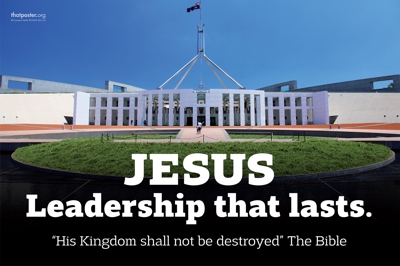 Over ten years, Australia has had seven prime ministers. ‘Madness’ said Malcolm Turnbull, the last prime minister to ‘get rolled’. Meanwhile, the media in other countries are describing us as the ‘coup capital of the world’. Here in Australia, voters are wondering exactly who and what they voted for.
The problem with changing leaders so often is that it’s hard for Prime Ministers and governments to implement a long-term vision. It takes time to build trust and relationships. It takes time to develop big ideas and work through obstacles to achieve them. But if leaders are being ‘rolled’ on a regular basis then the general public are entitled to think none of those good things are happening.
Although we Australians feel a little embarrassed about our leadership changes, it’s worth noting that political instability is commonplace in every country. And it’s always for the same reasons. We have a revolving door of Prime Ministers because political parties and the wider general public can’t agree about what the future should look like. Add jealous, personal rivalries and prejudice and you get instability.
But the Bible speaks about a leader whose vision stretches beyond the borders of this country into all of eternity. It speaks about a government where everyone who belongs will be happy and united – including people from all races and tribes.
That leader is Jesus. Here is how two prophets writing thousands of years ago described His rule. The great prophet Isaiah said,
“… The government will rest on his shoulders … his government and its peace
will never end” (Is. 9:6-7)
While the prophet Daniel spoke not just of an endless rule, but of a safe place open to every tribe and people group,
“He was given authority, honor, and sovereignty over all the nations of the world, so that people of every race and nation and language would obey him. His rule is eternal—it will never end. His kingdom will never be destroyed” (Daniel 7:14).
If you’re cynical and jaded about leaders then Jesus is a reason to start believing again. If politics have burned you badly then know that Jesus won’t let you down. He’s the true King, the real messiah, a leader you can be genuinely excited about!
Bible verse: Daniel 7:14, “… His kingdom will never be destroyed”.
Prayer: Dear God, thank you that Jesus is a leader we can trust and who will lead us home to heaven.
Acknowledgement: This article was sourced from Outreach Media, Sydney, Australia.
Images and text © Outreach Media 2018
Posted, September 2018
Share this:

The journey and the destination

 Recently I travelled from Australia to Europe to spend time with some family members. It was good to see them after a trip of over 26 hours. The people at the destination made the tiring trip worthwhile.
Before leaving Australia, I attended a funeral where it was said that it’s not our destination that matters, but the journey along the way. This was probably a creative way to say that life is better than death. Or focusing on the present and enjoying the present instead of worrying about what will happen at the end of life.
Bible journeys
Abraham travelled from Mesopotamia to Canaan, a distance of about 1770 km (1100 miles). His descendants, the Israelites, travelled from Egypt to Canaan. This took 40 years and most of the adults died along the way. Later, after their exile in Babylon, the Jews travelled back to Judah. The purpose of these journeys was achieved when the people reached their destination.
Jesus travelled within Palestine preaching the good news about the kingdom of God. Then He travelled to Jerusalem to give up His life sacrificially. After the resurrection and ascension of Christ, Paul and the apostles took missionary journeys across the Roman Empire. For Paul, sometimes the journey was difficult (2 Cor. 11:23-33). Likewise, the purpose of these journeys was achieved at their destinations.
The journey of life
A journey is also a great metaphor for life. Life is a difficult journey and a time of testing, challenges and maybe persecution. Like Job we have many questions about life and its unfairness. But God steers His people through difficult times (Isa. 43:1-7). May God help us trust in Him for what we don’t understand (Job 42:3). And may we take up the opportunities to trust in God’s faithfulness over and over again.
But the busyness of life can distract us from the important things of life like being aware of God’s presence and His willingness to help in times of need. Life is a journey in history, with a past, present and future. As time goes by our present becomes past memories and our final destination comes closer. Death and life after death is our ultimate destination.
Lessons for us
Let’s face the reality of our journey of life. Few of us would think of taking a two-week vacation without any plans as to where we will go or what we will do. But we often forget to consider our personal destination.
Many opinions about this topic are available on the internet. But the best ones are in the Bible because God is the “author” (or “source”) of life (Acts 3:15). And Jesus is the “word of life” and the “bread of life” (Jn. 6:35, 48; 1 Jn. 1:1). These metaphors describe God’s role in physical and spiritual life.
Although the journey of life is better than death, it isn’t better than eternal life. Physical life ends, but spiritual life doesn’t end. And the purpose of life isn’t to enjoy ourselves or accumulate wealth or possessions. Instead our spiritual destination is more important than the journey. Is our future destination secure? At the end of our earthly life journey we will leave everything physical behind. So our enjoyment, wealth, and possessions provide no security for our future destination. But if we put God first instead of material things, we will be rewarded in heaven for the things we do that have eternal value (Mt. 6:19-24). Have we started on that spiritual journey? Do we focus on things of eternal consequence? Do we follow Jesus? Do we help other people to follow Jesus? Do we live by faith, and not by sight (2 Cor. 5:7)? Are we motivated by what lies at the end of the journey (Heb. 11:13-16)? Are we progressing spiritually (2 Cor. 3:18)? Are we becoming more Christ-like (Phil. 1:20-21)?
Written, August 2018
Share this:

Fake news
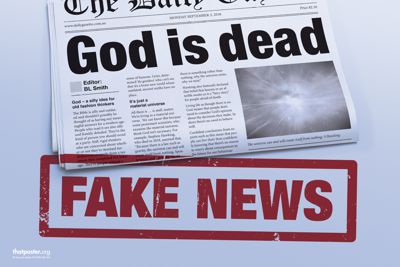 Donald Trump points from his podium to the assembled news media and yells, ‘Fake news… They’re all fake news!’
His menacing words and tone are nasty. And because it’s a blanket condemnation, his words are unfair and untrue. Yet, Trump has tapped into a global grievance. According to the annual Edelman Trust Barometer, worldwide trust in the media is at an all-time low. And it’s not hard to see why. The media’s commercial and ideological agendas seem all too obvious.
Certainly, there is a bias directed against Christianity. Too often, media commentators are ill informed and dismissive when they speak about God and the Bible. Many blithely assume the most qualified person to determine the existence of God is a prominent scientist (usually a physicist).
For example, a few years ago on the 7:30 Report, Leigh Sales asked the following question of the cosmologist, Lawrence Krauss, “Why has science not yet done away with belief in God?”. The assumption amongst many journalists is that religion and superstition overlap perfectly – but that, hopefully and eventually, science will do away with God. After all, if He were real, God should be detectable in a test tube or with a large radio dish.
Such boundless confidence in science seems to come from the fact that science keeps providing technological marvels to help us in our everyday lives as well as in understanding the natural world. But God is supernatural and spiritual. Which means, He’s not a measurable part of our natural world. Instead, as Creator, He’s outside its bounds.
Ironically, the one place where God intervened publicly and dramatically is a place where observational scientific methods (such as repeatable experiments) aren’t applicable. That place is the cross of Christ nearly 2,000 years ago. There, God sent His Son to die for the world making it possible for us to return to Him in relationship. This was a historical event, which is more like forensic science than operational science.
However, the cross makes for a pathetic news story. Indeed the Bible says, ‘The message of the cross is foolish to those who are headed for destruction! But we who are being saved know it is the very power of God’ (1 Corinthians 1:18).
But how do we know what’s fake? Perhaps the Bible itself is fake news? Consider this, when Jesus’s empty tomb was found, the Bible recounts how the chief priests conspired to bribe the Roman soldiers guarding Jesus’s tomb to spread a report that Jesus’s disciples had stolen the body. If the Bible is trustworthy then Jesus rose from the dead. If it’s fake news then that story is spin.
As always, the only way forward is to think carefully (and prayerfully) about the reliability of the source.
Bible verse: 1 Corinthians 1:18, “The message of the cross is foolish to those who are headed for destruction! But we who are being saved know it is the very power of God”.
Prayer: Dear God, thank you for the way your words in the Bible reveal your integrity and faithful love to all generations.
Acknowledgement: This article was sourced from Outreach Media, Sydney, Australia.
Images and text © Outreach Media 2018
Also see: Using history and science to investigate ancient times
Share this:

God’s mercy is bigger

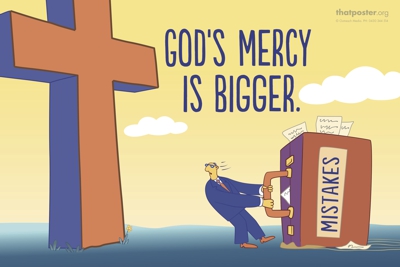 If you look in a newspaper or history book you won’t find the real history of the world. You see our version of history is so different from what matters to God. When we think of great battles in history we probably think of the Napoleonic Wars or World Wars I & II.
But to God, the great battles of history are those waged each day inside a person. The struggle we have to either resist or give in to temptation. God notices when we’re not kind to others or we boast or steal or slander or decide to acknowledge Him as our creator and sustainer… or not. These decisions are, by far, the most significant battles in history.
In the Bible, one of the first Christian leaders, Paul of Tarsus, spoke of his own personal battle with temptation. He said this in a letter he wrote to the church in Rome,
I want to do what is right, but I can’t. I want to do what is good, but I don’t. I don’t want to do what is wrong, but I do it anyway (Romans 7:18-19).
We can all identify with these words. So, can there be any hope when the catalogue of our mistakes is so long and when the cost of our bad decisions to others, ourselves and the honor of God – is so great? The answer is ‘Yes – because God’s mercy is bigger than our mistakes!’ He is willing to forgive.
There’s another way in which our version of history is different to God’s. We keep thinking certain people are more valuable than others. Perhaps those of a particular race, or class or those with wealth, fame, power or good looks. But God cares about every person equally. And He’s prepared to forgive the sin of anyone – no matter how much baggage is in their life.
In a letter to Christians on the island of Crete, Paul spoke with wonder about why Jesus’s death on the cross was such good news. He explained that it means that we can be forgiven by God. He wrote,
… When God our Savior revealed His kindness and love, He saved us, not because of the righteous things we had done, but because of His mercy. He washed away our sins, giving us a new birth and new life through the Holy Spirit.
So, no matter how many your mistakes, take them to Jesus and the cross where He is willing and able to deal with them.
Bible verse: Titus 3:4-5, “… When God our Savior revealed His kindness and love, He saved us, not because of the righteous things we had done, but because of His mercy. He washed away our sins, giving us a new birth and new life through the Holy Spirit”.
Prayer: Dear God, please help me to trust that your mercy really is big enough to deal with all my mistakes.
Acknowledgement: This article was sourced from Outreach Media, Sydney, Australia.
Images and text © Outreach Media 2018
Share this:

The book that reads you

 In the months leading up to my decision to become a Christian I read the Bible intensely. I remember being impressed that an ancient book could be so relevant in a modern world. Yet, two things stood out most of all for me.
Firstly, the sense I had that God was present as I read. I had never felt this before with any other book. It seemed as though how I responded mattered to God. And the Bible exposed me. It read me accurately. It knew the wrong things I had done – the selfish thinking and pretending to be somebody that I wasn’t. As I read I struggled with the knowledge that experiences can be manufactured by the mind. Did I want there to be a God? Or was God revealing Himself to me? Over time, my struggle with skepticism decreased.
The second thing that stood out was how impressive Jesus was in the four gospel accounts of His life. At the end of Jesus’s famous, Sermon On The Mount, Matthew, the author of the gospel reports that, ‘crowds were amazed at His teaching, because He taught as one who had authority’ (Mark 1:22). I can appreciate this sentiment. Jesus really does teach with wisdom and authority. Elsewhere in the gospels people are in awe at His power over the physical world – demonstrated repeatedly with various, extraordinary miracles. Given the integrity of Jesus’s words, it didn’t seem reasonable that those events were clever deceptions.
So, despite the age of the Bible, it read my need and provided a solution – Jesus. It was Jesus who spoke of the possibility of knowing God and it was Jesus who died on the cross to make the hope of a fresh start with God possible.
In the Bible, the book of Hebrews describes what I, and many others have experienced. It says:
For the word of God is alive and powerful. It is sharper than the sharpest two-edged sword, cutting between soul and spirit, between joint and marrow. It exposes our innermost thoughts and desires. Everything is naked and exposed before His eyes, and He is the one to whom we are accountable.
So, if you’ve never read the Bible, then my encouragement to you is … find a copy and begin by reading the shortest biography of Jesus – Mark’s gospel.
Bible verse: Hebrews 4:12, “For the word of God is alive and powerful. It is sharper than the sharpest two-edged sword, cutting between soul and spirit, between joint and marrow. It exposes our innermost thoughts and desires”.
Prayer: Dear God, thank you for speaking to us through the Bible in ways that soften our hearts and move us to you.
Acknowledgement: Written by Malcolm Williams, Director of Outreach Media.
Images and text © Outreach Media 2018
Share this:

You can trust God with your data

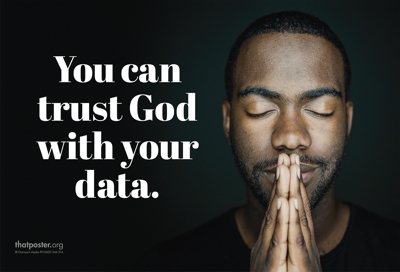 There’s good reason to be worried about what happens to our data. Smart phones and computers store so much of our personal information. For example… intimate photos, political opinions, religious beliefs, bank account details. Or those emails from when you were sacked or that argument you had with your mother-in-law. The potential for embarrassment or even blackmail from data in the wrong hands is significant.
But whose hands are the wrong hands? Google, Facebook and Amazon try to profile our every thought and action so they can either sell us things or else sell our profile to advertisers and other companies. Tim Cook, the head of Apple, says, ‘When an online service is free, you’re not the customer – you’re the product’. Recently, Apple has been telling its users that ‘Privacy is a human right’. But then, can we trust Apple?
And is privacy a human right? It’s certainly a time in history where it’s harder than ever to leave past mistakes behind and start again. In a globalized, connected world, one can’t just escape over a border and disappear to start again somewhere else. The Internet preserves and reveals all kinds of mistakes that we’d prefer to be forgotten.
In case you weren’t aware, since God is our maker, He has access to all our data. In the Bible, King David prays to God and says, ‘Even before I speak a word, O Lord, You know it all’ (Psalm 139:4). Therefore, since God knows about our every evil thought, word and deed, the question is, ‘What will God do with our data?’ Will He punish us by exposing our mistakes and shaming us before everyone?
No. You’ll be relieved to know that God’s radical promise to those who come to Him in repentance and prayer is that He will entirely erase this data. 2000 years ago, at the cross, God put all our shame and embarrassment onto Jesus. And since our crimes have now been dealt with, God has decided to forget about them. In the 8th Century before Jesus came God spoke through the prophet Isaiah saying:
“I am the One who takes away your sins because of who I am. And I will not remember your sins“.
So, turn to God in prayer, acknowledge all your secrets to Him and thank Him for His kindness to you in Jesus.
Bible verse: Isaiah 43:25, “I am the One who takes away your sins because of who I am. And I will not remember your sins”.
Prayer: Dear God, thank you for dealing with my sensitive data. Please help me to live a life without shame.
Acknowledgement: This blogpost was sourced from Outreach Media, Sydney, Australia.
Images and text © Outreach Media 2018
Share this:

Housing crisis?

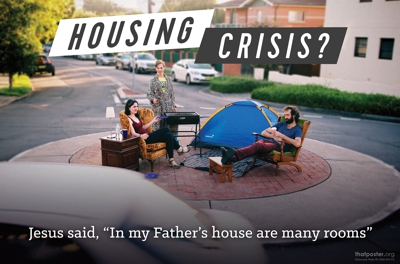 Australia has a housing crisis. Tonight, on average, 44,000 homeless young people will sleep rough. Meanwhile Anglicare Sydney reports, “almost 1 in 10 people aged 55 years and over supported through [our] Emergency Relief program are experiencing insecure housing including sleeping rough, in tents, couch surfing and using their family car as a form of shelter”.
Why, in a wealthy modern economy like Australia, is a widowed grandmother being forced out of her home to live on the streets? Yet this is happening. And why are rents so high? In 1960 less than 8% of our income was spent on housing – today it’s closer to 21% on average. And in the major capital cities it’s a lot higher (in Sydney, it’s nearly 40%!).
This is not the place to address the reasons we’re in such stress. But if you’re one of those many people struggling to cope then know this… God is aware of your situation. And, in the Bible, Jesus speaks of a future where God will provide permanent and free accommodation in heaven for all eternity.
2,000 years ago, at a time when things were even more uncertain than ours, Jesus told His followers, “Do not let your hearts be troubled. You believe in God; believe also in me. My Father’s house has many rooms; if that were not so, would I have told you that I am going there to prepare a place for you? And if I go and prepare a place for you, I will come back and take you to be with me that you also may be where I am” (The Bible – John 14:1-3).
When Jesus speaks of heaven as a house, He’s reassuring us that God is well and truly able to look after us. His words are so enormously comforting. No matter how dire our situation is now – even if we’re on the street or worse, Jesus promises heavenly security for those who trust in Him. In this bright future God promises to let us live with Him in close friendship and fellowship.
And not just in any old house. It will be a place where, “He will wipe every tear … and there will be no more death or sorrow or crying or pain. All these things are gone forever” (The Bible – Revelation 21:4).
You know that old real estate cliché about ‘Great potential’? Well that’s you and God. So, trust in Jesus now to secure your place.
Bible verse: John 14:2, Jesus: “My Father’s house (heaven) has many rooms”.
Prayer: Dear God, grant me the faith to trust Jesus’ promise that I am welcome in your house forever.
Acknowledgement: This blogpost was sourced from Outreach Media, Sydney, Australia.
Images and text © Outreach Media 2018
Share this:

When Santa learned the gospel

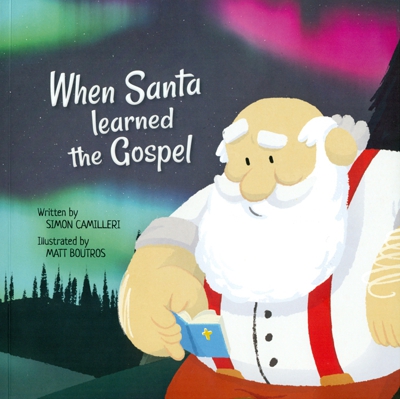 A poem by Simon Camilleri
When Santa learned the gospel, he first heard it from an elf.
This tiny Santa’s helper had just learnt of it himself.
A child had asked for Christmas to receive a Bible book.
This elf had made one in the shop, then paused to have a look.
He read all about Jesus and the call to follow Him.
He learned how Jesus lived and taught and died to pay for sin.
He learned how Jesus rose again and how He will return
And then this elf read how he should respond to all he’d learned.
He shut the book, put down his tools, then closed his eyes and prayed.
Right there and then this little elf trusted in Christ that day.
The next day he told Santa. It was awkward, unprepared.
He knew he didn’t know that much, but what he knew he shared.
He told Santa the gospel. It was simple. It was short.
But a seed was sown in Santa’s heart, which grew into a thought.
Santa reflected on his life and the message he supported,
Then compared it to the gospel that the elf had just reported.
He’d always thought that everyone was naughty or was nice.
He had them all on two big lists. He even checked it twice.
He’d always thought that you got gifts only if you’d been good.
The naughty kids got lumps of coal. That’s what he understood.
They’d all line up in shopping malls and sit upon his knee
And claim that they were always nice. As nice as nice can be.
Of course, he saw them when they slept and knew when they awoke.
He also knew their nice attempts were pretty much a joke.
Their heads were filled not with nice thoughts of kindness, peace and joy,
But with the never-ending list of their desired toys.
He knew their hearts, but he had thought, “They’re trying to be good.
That’s good enough to make the list. Otherwise no one would!”
So every year their “good enough” with toys would be rewarded.
And every year (he realized) this message he supported:
THE “GOOD” WILL GET THE PRESENTS.
THE “BAD” WILL GET THE COAL.
AND TRYING TO BE GOOD ENOUGH
IS GOOD ENOUGH A GOAL.
That was the message that he knew, but now he knew another.
He had just heard the gospel. So he compared them to each other.
The message of the gospel turned his message upside down.
The good, the bad, naughty and nice, it switched it all around.
“There’s no one good but God alone” he’d heard Jesus concluded.
And those who claim they’re “good enough” are simply just deluded.
If there’s a list of who is “good”, the standard we’ve all missed.
And Santa saw that even he was on the naughty list.
That shook his world. That rocked his boat. That gripped him in his soul.
To think that even Santa Claus deserved a lump of coal.
But that was only half of what the gospel message said.
It also flipped what happened to the naughty on its head.
Instead of being written off as just not good enough.
The message to the naughty list was one of grace and love.
The gospel offered mercy to all those deserving coal.
The gospel offered forgiveness and cleansing of your soul.
The gospel told how Jesus died our death to pay the price
To reconcile us all to God – both naughty and the nice.
This offer was a real gift, unlike presents ‘neath the tree.
It was not earned by being good. It was offered for free.
For all his life Santa had claimed that if you had been bad
Then you would not get presents and your Christmas would be sad.
Santa compared his message with this new one he had learned.
His message said you get the presents your good deeds had earned.
The message of the gospel offered something so much greater…
Jesus had come to reconcile the world to their Creator.
When Santa grasped the gospel, he did not know what to do
And so the elf said nervously, “How ’bout I pray with you?”
Then that night at the North Pole, by the fire in his den,
With a simple prayer led by an elf, Santa was born again.
And now, in Christ, forgiven, free – his new life had begun
and Santa had a new message to share with everyone.
© Simon Camelleri
Posted, December 2017
Share this:

What Jesus wants for Christmas

 What a precious thing is a baby! The news that a little tiny human has safely made its way into the world is such a miracle, such a cause for celebration. Even when there is mourning or hardship, a new baby can bring hope.
On the first Christmas when baby Jesus arrived there was the usual joy and celebration. But there was so much more than that. Angels sang in the sky, shepherds dropped everything and came, wise men followed a star… all to honor and worship this new baby.
When God sent His Son into the world, in the form of a baby boy, He did it for us. In John’s gospel it says,
“For this is how God loved the world: He gave His one and only Son, so that everyone who believes in Him will not perish but have eternal life“.
This is one of the most famous verses in the Bible, perhaps because it states so simply the most important things. God loves us so much that He sent His only Son to help us. This is why Christmas is special! It’s a time to celebrate the gift God gave to us long ago that shows how much He wants us to join His family. What we need to do is believe in Him.
There is a beautiful Christmas poem by Christina Rossetti that was put to music and became the carol, “In the Bleak Midwinter”. It tells of the unlikely and difficult place where the baby Jesus was born, of angels singing praises to welcome the new King, and of shepherds visiting and bowing down and of wise men who traveled a great distance to honor Him.
The author wonders what she could give to Him as a tribute.
“What can I give Him,
Poor as I am?
If I were a Shepherd
I would bring a lamb;
If I were a Wise Man
I would do my part,
Yet what can I give Him,
Give my heart.”
The Wise Men brought gifts fit for a King to honor the newborn Jesus, but there is nothing that we can give that is enough. All Jesus wants for Christmas is YOU!
Bible Verse: John 3:16 “For this is how God loved the world: He gave His one and only Son, so that everyone who believes in Him will not perish but have eternal life”.
Prayer: Dear God, thank you for loving me so much. Thank you for the precious gift of your Son. Please forgive me and help me to worship and honor you all year long. Amen.
Acknowledgement: This blogpost was sourced from Outreach Media, Sydney, Australia.
Images and text © Outreach Media 2017
Share this:

The faith of a geochemist

 Associate Professor David Cohen of the University of New South Wales, Australia, says:
For geologists and geochemists like myself, the planet is a vast laboratory. Our task is to make sense of the physical and biological evidence for the processes that have shaped our planet. We begin by observing and measuring and then we propose models to explain those observations. Our goal is to provide a scientific narrative – a sort of geological book of Genesis – that explains how the world came to be like it is.
Much of the planet’s history can be linked to ‘plate tectonics’. It’s now the commonly accepted view that the world has seven large plates on its surface that move. This model explains such diverse evidence as continental drift and the distribution of earthquakes. While the plate tectonics model seems so elegant, effective and obvious to today’s generation of geologists, there was significant opposition by some leading geologists when it was first proposed. Yet, the evidence for the model is overwhelming, and underpins much of our geological thinking today.
In the same way that I have faith in the evidence for plate tectonics I also have faith that Jesus Christ, God’s Son, has made it possible for me to be friends with God forever. But what does the biblical evidence about Jesus demand in terms of a model? And what and why do I believe?
At the end of the famous Sermon on the Mount, Matthew records the response of those who were listening to Jesus:
“When Jesus had finished saying these things, the crowds were amazed at His teaching, for He taught with real authority—quite unlike their teachers of religious law.” (Mt. 28-29).
I can relate to that crowd. It’s not just the teaching of Jesus that appeals to me, but also extraordinary events and miracles that reveal His nature and support His claims to be the Messiah promised by the prophets of the Old Testament. Throughout the Old Testament, prophets such as Moses, Isaiah, Daniel, the writers of the Psalms and many others predicted that one day God would send a Messiah, or anointed King who would save people from their sin. Jesus fulfils these promises in convincing ways, which are extraordinary and specific. For example, Isaiah 53 paints a very detailed picture of the sufferings Jesus endured on the cross. Jesus understood that He was fulfilling these promises. He said to His disciples:
“The Father gave me these works to accomplish, and they prove that He sent me” (Jn. 5:36 – see also Lk. 24:26).
And Jesus knew that the prophets predicted a terrible execution for the Messiah. But He also knew that afterwards He would rise from the dead. Speaking to His disciples He said:
“We’re going up to Jerusalem, where the Son of Man (Jesus) wlll be betrayed to the leading priests and the teachers of religious law. They will sentence Him to die and hand Him over to the Romans. They will mock Him, spit on Him, flog Him with a whip, and kill Him, but after three days He will rise again” (Mk. 10:33-34).
The reason Jesus gives for His death is that it is a ‘ransom’ or payment for sin (see Mk. 10:45). But Jesus explains that it is essential to trust in Him for forgiveness. He says that He is ‘the way, the truth and the life’ and that we must trust in Him for forgiveness.
Nothing in science beats a predictive model that’s subsequently confirmed by new evidence. My decision to follow Christ was gradual, not revolutionary. It was the result of considering the events and ideas presented in the Bible and observing the faith and actions of other followers of Jesus over some years. I found the evidence in the Bible about Jesus to be compelling proof of His nature as God. This includes His words, His actions, His resurrection from the dead and His appearing before many witnesses.
If the Biblical evidence points to Jesus as the Son of God, the Messiah, what is the implication for our future? Jesus says this:
“I am the resurrection and the life. Anyone who believes in me will live, even after dying” (John 11:25)
This is the core of Christianity. Not church traditions but a simple set of propositions in the Bible. It’s why I believe.
Bible Verse: John 11:25 “I am the resurrection and the life. Anyone who believes in me will live, even after dying”.
Prayer: Dear God, thank you for all the evidence about Jesus in the Bible. Help us to always put our trust in Jesus.
Acknowledgement: This blogpost was sourced from Outreach Media, Sydney, Australia.
Images and text © Outreach Media 2017
Share this:

500 year anniversary

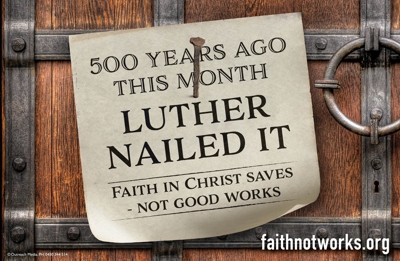 500 years ago on October 31st, 1517, a young Catholic monk called Martin Luther nailed a piece of paper to the doors of the Wittenberg Castle Church. You can still visit this site in Germany today. Luther’s paper contained 95 objections or ‘theses’ that set off a theological earthquake that eventually came to be known as the Protestant Reformation. It bears this name because of escalating ‘protests’ and challenges to ‘reform’ that Luther and others made from this point onwards.
The Roman Catholic Church was earning vast sums of money by selling salvation. For example, the monk, John Tetzel, visited towns and cities selling indulgences on behalf of Pope Leo X. Indulgences supposedly speeded up entry into heaven from purgatory for yourself or your loved ones. But the Bible says nothing about this.
In its corruption, the church was teaching that a person must, through good works, please God. But because every person is sinful this was impossible. Luther saw that the effect on his native German people was to leave them without assurance of ever being friends with God – a situation that grieved him.
Luther’s study of the Bible, specifically Paul’s letter to the Romans, had shown him that God didn’t expect us to try to work at making ourselves acceptable. Rather, in his spectacular generosity, God has already reached down to us offering salvation freely through Jesus Christ.
Luther’s breakthrough was that in the death of Jesus Christ, salvation and forgiveness are free gifts from God. So, there is nothing we need to do accept trust in God. So, good works don’t secure salvation. Rather, they are the response of joyful, thankful faith.
After the publication of the 95 theses Luther continued to refine his thinking and challenge the Church of Rome. Sometime later he wrote:
‘… we do not depend on our own strength, conscience, experience or works, but depend on that which is outside ourselves, that is on the promise and truth of God.’
Martin Luther was a complicated man with many faults. As the leading cause of the split with the Church of Rome, his legacy is much debated. Yet his strident declaration to all the world – that salvation is ‘Sola Fide’ or ‘by faith alone’ in Jesus Christ – was much needed. It was as though a key had suddenly unlocked a door that had been ignored by many for centuries. It was an overwhelmingly exciting moment. But, of course it wasn’t a new discovery; it had been there in the pages of the Bible for almost 1,500 years.
Bible Verse: Romans 5:1 “Therefore, since we have been made right in God’s sight by faith, we have peace with God because of what Jesus Christ our Lord has done for us”.
Prayer: Dear God, thank you that, at the cross, Jesus won salvation for all those who have faith in Him. Help us to always put our trust in Jesus.
Acknowledgement: This blogpost was sourced from Outreach Media, Sydney, Australia.
Images and text © Outreach Media 2017
Share this:

Stream some reality

 We’re the ‘still generation’. Heart rates barely crest the flat line as we flab and sprawl motionless for hours, bingeing on episode after episode… after episode… Most of all we’re bingeing on Netflix – consuming huge amounts of data watching ‘House of cards’ and ‘Suits’ and ‘Stranger Things’. Anything that will take us to ‘fiction world’ where our pulse can race with fear and love and excitement – somewhere better than our own dreary reality.
Some shows are like the mute button on our lives. They grab us so completely that we’re drawn into the very skin of the main character. When our hero sees a threat, we feel their fear. When they see the beautiful girl, we fall in love. When they conquer the world, we feel proud. In ‘fiction world’ there are always people better than we are… stronger, braver, smarter… good looking. A place with heroes we can pretend to be.
But meanwhile, God is keeping the services running – like sunshine, oxygen, gravity, temperature control and so on – things that sparkle and matter if you take the time to notice. And in God’s real world there are urgent responsibilities – to love and care for those around us. Mom, Dad, Gran, the kids, the neighbors… even the dog. The really urgent responsibility though is to spend time with God – someone you can easily forget if you spend all your time online. You see, inside ‘fiction world’ God barely gets a mention or else He’s mocked or taken for granted. But when you turn reality back on – you remember that God is the one in control. It’s His reality. He made it and He promises in the Bible that if we draw near to Him He’ll draw near to us.
Oh, and if you’re looking for an exciting superhero – you know, someone who saves the day, then don’t look to fiction. In reality, Jesus sets the standard in action heroes. When He arrived amongst us humans He came with a terrifying challenge – to give His life selflessly so that we might live. By dying on the cross, Jesus defeated death making it possible for all people to come close to God. Which means your own reality – dreary or not – can feature the most exciting true story of all.
Bible Verse: James 4:8 “Come close to God, and God will come close to you”.
Prayer: Dear God, in a world full of stories – help me to remember who you are and why your Son’s story is first in importance.
Acknowledgement: This blogpost was sourced from Outreach Media, Sydney, Australia.
Images and text © Outreach Media 2017
Share this:

Build your house on the rock
 When Jesus wanted His listeners to understand how important it was to put His words into actions, He chose to tell a parable…
“Anyone who listens to my teaching and follows it is wise, like a person who builds a house on solid rock. Though the rain comes in torrents and the floodwaters rise and the winds beat against that house, it won’t collapse because it is built on bedrock. But anyone who hears my teaching and doesn’t obey it is foolish, like a person who builds a house on sand. When the rains and floods come and the winds beat against that house, it will collapse with a mighty crash” (Matthew 7:24-27NLT).
Not everyone ends up building an actual house. But we all have to build a life. Which means, in a world that gets harder and more complicated with each passing year, we need to make wise decisions. Decisions about where it’s safe to live, how to earn money, who we can trust to hang out with… and lots and lots of moral decisions. For example, every day there are temptations to lie, steal, slander, be cruel or at least indifferent to someone we can help. And sometimes a terrible test comes along when we least expect it. People have woken up and, without any planning, made split decisions that have landed them in jail… or worse. We can lose our temper in a parking lot or agree to cover up corruption at work.
So, if building a life is like building a house then how do we build wisely? How do we avoid the rain, winds and floods that tear lives apart? Jesus tells us to build our life foundation on His words. When He said this Jesus was concluding the most important and world changing speech of all time – His famous Sermon On The Mount. In it He asks people to be honest with themselves and God. And He challenges people to live their lives to God’s high standard. Deep down we know these things are right.
Are you ready to start a fresh building? Considering this magnificent fact may be a help… Jesus willingly went to the cross and sacrificed His life for the sake of the world. It shows us that His words aren’t empty. On the contrary – they’re solid as a rock.
Bible Verse: Matthew 7:24 “Anyone who listens to my teaching and follows it is wise, like a person who builds a house on solid rock”.
Acknowledgement: This blogpost was sourced from Outreach Media, Sydney, Australia.
Images and text © Outreach Media 2017
Posted, August 2017
Share this:

God: Fill the earth and subdue it
 The earth is in trouble. Forests are disappearing. Rates of extinction for animals and plants are 1,000 times greater than before the industrial revolution. Every minute a garbage truck’s worth of plastic slips into the world’s oceans. By 2050 the amount of plastic by weight floating at various depths will equal the total amount of all fish (World Economic Forum report).
Recently, scientists have started calling our age the Anthropocene era – the first point in history in which humans have become the major environmental influence on the planet. Sadly, so much of our impact on the world is destructive of other forms of life.
Are we pleasing God? When God told us in Genesis – back in the first chapter of the first book of the Bible, that we were to: “Be fruitful and increase in number; fill the earth and subdue it. Rule over the fish in the sea and the birds in the sky and over every living creature that moves on the ground”. … did God want us to care for creatures other than ourselves? Did He want us to care for plants and ecosystems? Or should we just focus on increasing the human population?
The answer to these questions is found in the same chapter of Genesis. As God looked at each part of His creation He declared it to be good (Gen. 1:4, 10, 12, 18, 21, 25) and very good (Gen. 1:31). Which means creation is not just good because it helps humans survive and thrive. It is also good in and of itself – having both instrumental and intrinsic goodness. And because we humans have been given the task of ruling creation it’s our responsibility to safeguard this intrinsic goodness. Which is terribly difficult. But then, making hard decisions is the lot of all rulers. As we balance competing interests, sacrifices will be inevitable.
Some may say that, since God promises ‘a new heaven and a new earth’ when Jesus returns, we shouldn’t be too bothered about this world. After all, isn’t it going to pass away? Yet that would be ignoring both God’s command and basic common sense. You see, since we have no timetable for Jesus’s return we must plan for both the short and long term. Indeed, our wait for Jesus could be a long time. Are we really happy to leave a toxic and treeless planet for our children’s children?
If you’ve only just realized the extent of your responsibility to God’s creation then please take action where you can. It’s your duty.
Bible Verse: Genesis 1:28 “Be fruitful and increase in number; fill the earth and subdue it. Rule over the fish in the sea and the birds in the sky and over every living creature that moves on the ground”.
Prayer: Dear God, please help me to be a wise ruler of your creation every day as I wait for Jesus to return.
Images and text © Outreach Media 2017
Posted, July 2017
Share this:

Apply daily to look good on the inside

 When it’s high in the sky the sun’s beauty is fierce. Though, as it sets, your gaze can be full and frank. From a rooftop late in the afternoon, something more beautiful and more terrifying held the gaze of King David. Most men experience turmoil at the sight of a beautiful, naked woman. A primal, instinctual urge turns interest automatically into desire. Only a forceful act of the will can turn the gaze. But David kept looking. On an adjacent rooftop a woman bathed. The teller of David’s story tells us, ‘She was very beautiful’. Yet, although Bathsheba was married, David took her anyway. Then, when she became pregnant and the sin couldn’t be concealed, David organized for the murder of her husband, Uriah.
When you read the fuller version of this Bible story you’ll notice many lessons. Chiefly, that God sees who we really are. And He’s angry when we behave badly. With David, God’s anger burned. He cursed his household with evil, further adultery and the death of the child conceived with Bathsheba, promising that, ‘the sword shall never depart from your house’.
David and Bathsheba’s story also has lessons for us about beauty. Firstly, contrary to popular complaint, beauty is no modern obsession – it’s always been a thing… because every society believes that good-looking people have more worth. Secondly, beautiful people get ahead in life. Bathsheba’s husband was not an Israelite. Yet her beauty overshadowed this stigma. David simply couldn’t resist her. Later, their son, Solomon, reigned as King at the highest point in Israel’s history. Thirdly, we learn that outward beauty is no guarantee of anything nice on the inside. The Bible tells us that David was also good looking. Specifically, ‘he was ruddy and had beautiful eyes and was handsome’. But God made it clear that this wasn’t the reason he chose him. He said, ‘man looks on the outward appearance, but the LORD looks on the heart’.
Well, as we’ve seen, David’s heart became a corrupt mess. Later in the Bible (Psalm 51) he pleaded with God for help to make him beautiful on the inside. He cried, ‘Create in me a clean heart, O God, and renew a loyal spirit within me.’
So now, a disturbing question remains, ‘What does God see when He turns His fierce gaze upon me?’ Deep down we know the answer. Yet when we read the Bible we discover that God is willing to help. He’s willing to forgive and to come into our hearts so that we might become beautiful to Him.
Bible Verse: Psalm 51:10 “Create in me a clean heart, O God, and renew a loyal spirit within me”.
Prayer: Dear God, please forgive those things that I’ve thought, said and done that are ugly. Please help me to be beautiful on the inside.
Acknowledgement: This blogpost was sourced from Outreach Media, Sydney, Australia.
Images and text © Outreach Media 2017
Share this:

Come and join us

 Lisa Pearce from Open Doors says that, “If a Christian is discovered in Somalia, they’re unlikely to live to see another day”. The question to ask yourself is, ‘Why join a group experiencing 80% of the religious persecution in the world today? Especially when, in North Africa, the Middle East and many parts of Asia, Christians are vanishing. It seems a lost and futile cause.’
… but not according to Jesus – or His followers. Jesus said to all who’d follow Him, “you will be arrested, persecuted, and killed. You will be hated all over the world because you are my followers” (Matthew 24:9). Thankfully, He also promised that nothing would overcome His church (Matthew 16:18). So, trusting in these comforting words, Christians await persecution with confidence, praying, that when it comes, they’ll be ready to stand strong and bear witness to their Lord. They know, from the promises of scripture and the lessons of history, that nothing strengthens faith like persecution unto death.
So why does God allow such persecution? Because when a lost world sees Christians preferring to die than dishonor their Lord – they see faith that’s real. And when Christians love their enemies – the world sees a miracle. Esther from Eritrea says, “As Christians we’re required to love our enemies even though it is very difficult to do that when they make you suffer, or when they harm or kill your loved ones!”
Sadly, not all Christians listen to Jesus’s commands. In every age there are people behaving badly in the name of Jesus. Even now, in the Central African Republic, “Christian” militias persecute and murder Muslims. But the unreported truth is that religious persecution is utterly one sided. The vast majority of persecution between the world’s two largest religions is from Muslims towards Christians. So, if the secular media has given you an impression that all religious people just fight and kill each other then please reconsider.
The US Center for the Study of Global Christianity (and other sources) estimates that 100,000 Christians are martyred annually – roughly 11 per hour, or 1 every 5 minutes. You can read or download a moving and tragic article about their methodology.
The following articles are exceptions to the media silence:
https://tinyurl.com/n6keu5t https://tinyurl.com/mq49qa9
https://tinyurl.com/msa3wma https://tinyurl.com/qxsg2u4
You can help persecuted Christians by supporting the Voice of the Martyrs and Open Doors.
Finally, dear friend, “Don’t be afraid of those who want to kill your body; they cannot touch your soul. Fear only God, who can destroy both soul and body in hell” (Jesus’s words in Matthew 10:28). Do not be deterred by reports of persecution but come and join us as we worship Jesus.
Bible Verse: Matthew 24:9 “You will be arrested, persecuted, and killed. You will be hated all over the world because you are my followers”.
Prayer: Dear God please give hearts of lions to your people everywhere that they might stand firm for you.
Acknowledgement: This blogpost was sourced from Outreach Media, Sydney, Australia.
Images and text © Outreach Media 2017
Share this:

Everlasting peace

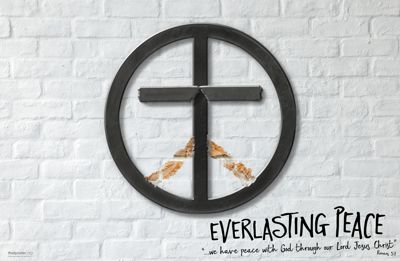 For years there’s been a Christian conspiracy theory about the logo for the Peace Movement. Rumors have alleged that the design is a poke in the eye to Christians. A Christian cross, turned upside down, with broken arms – rejecting the Christian message and its cross as the path to peace.
Yet the truth is that in 1958 a British designer called Gerald Holtom took two semaphore flag letters, ’N’ and ‘D’, to signal Nuclear Disarmament. The resulting symbol was then used on flags and placards at an anti nuclear rally.
And further to the story, Holtom was, in fact, a Christian. Although he’d wanted to use traditional Christian symbols of peace and unity he knew they’d never be widely accepted. After all, the Japanese had recently suffered a nuclear holocaust at the hands of ‘Christian’ America and the Muslims had long memories of Christian crusades. So the conspiracy is unfounded.
But, although many Christians have sympathized with the non-violent goals of the modern Peace Movement, suspicions about other agendas have been well founded. For example, when it took off, it had strong connections to the 60’s counterculture that promoted drug taking and sexual promiscuity as well as the New Age Movement that began in the 70’s with it’s focus on alternative religious philosophies.
Over the decades the movement has struggled to survive and know what it stands for. Is it against all wars including defensive ones? And now that traditional energy forms threaten the environment, is it still against nuclear energy? Especially since it doesn’t add carbon dioxide to the atmosphere?
Christianity, meanwhile, continues to be the peace movement that’s clear and relevant to everyone. The Bible promises there will always be wars in this age as well as discord and violence between individuals. But the solution won’t be found by simply trying to be nice to each other. We humans need renovating on the inside and that comes from being back in relationship with God – blessed by His powerful Holy Spirit inside us helping us to live peacefully.
To achieve this great reconciliation, Jesus went to the cross to pay for our sin so that God might forgive us. This is why the Christian cross is, after all, the supreme and most profoundly important symbol of peace in the world today. It represents real and lasting peace with God both now and forever.
So, will you make peace with God? Will you join the movement Jesus began that never ends?
Bible Verse: Romans 5:1 “And we have peace with God through our Lord Jesus Christ”.
Prayer: Dear God, I have been your enemy. Please forgive me and help me to live peacefully with you and others.
Acknowledgement: This blogpost was sourced from Outreach Media, Sydney, Australia.
Images and text © Outreach Media 2017
Share this:

The world’s most testable religion

The “Questions from atheists” Facebook page claims that “Christianity is the world’s most testable religion”. And “There is a huge difference between Christianity and other religions”. They have posted a video online that compares the origin of Christianity against the origin of other religions. Here’s what it says:
How other religions began
– Someone had a private idea about God, or
– Someone had a private dream about God, or
– Someone had a private encounter with an angel
Then that person told the rest of the world.
This makes other religions impossible to verify because there are no eye-witnesses of the prime event.
How Christianity began
– Jesus spent three years doing miracles and teaching publicly (There were at least three Passovers during this period – Jn. 2:23;6:6; 12:1), and
– Jesus was executed publicly (Mt. 27:39-43; Lk. 23:4-49), and
– Jesus was buried (Mt. 27:62-66) and rose from a public tomb publicly (Mt. 28:11-15), and
– Jesus showed that He was alive publicly (1 Cor. 15:3-8)
Then the public told the rest of the world.
Conclusion
So, Christianity is the world’s most testable religion. That’s a good reason why the Christian Bible is the best place to look for spiritual answers.
Reference
This blogpost reproduces information on the “Questions from atheists” Facebook page, which was brought to my attention by Steve Warsa.
Written, May 2016
Share this:

Looking for spiritual answers

 The National Geographic Channel is screening a documentary series “The story of God with Morgan Freeman”. It asks big cosmological questions like; How did we get here? What happens when we die? Why does evil exist? What is the apocalypse? And, the power of miracles. The series blends science, history, anthropology and personal experience on a journey to understand humanity’s religious devotion. It tells the story of religion and spirituality, across disciplines and faiths.
Freeman played God in the movie “Bruce Almighty”. When asked about his picture of God, Freeman said, “I don’t think there is an image of God. I like the idea of rays coming down from clouds. I like the idea of seeing the Milky Way on a clear and starry night or under a full moon. That is the essence of existence. You’re there totally with the great unknown. That’s God”. Also, “The highest power is the human mind. That’s where God came from, and my belief in God is my belief in myself”.
Many people are aware of a spiritual dimension to life. They may sense a divine higher being that provides meaning and purpose and moral guidance. Or they may realize that their capacity for thinking, willing and feeling is beyond the physical realm. The fact that we need to find meaning and purpose in our lives means that we are spiritual beings.
A Google search on “spiritual answers” gives a range of responses including those based on, meditation, yoga, Christianity, Hinduism, Mormonism, psychics, mysticism, and higher consciousness. Some say that all religions lead to God and heaven. But, according to the Bible that’s not true.
True and false
When Jesus was in Sychar, He asked a Samaritan woman for water to drink from the well. In their conversation Jesus mentioned her previous five husbands. She responded by calling him a prophet and discussing places of worship. Then Jesus said, “a time is coming when you will worship the Father neither on this mountain nor in Jerusalem. You Samaritans worship what you do not know; we worship what we do know, for salvation is from the Jews” (Jn. 4:21-22NIV). The Samaritan Bible contained only the Pentateuch (the first five books of the Bible). Samaritans worshipped the true God, but their failure to accept much of His revelation meant that they knew little about Him. They mixed the law of Moses with idolatry and built a temple on Mount Gerizim. Consequently, Jesus condemned their ways of worship and spiritual practices, which must have been inconsistent with the Old Testament (the Bible at that time). He corrected her by saying that God’s revelation in Scripture came through the Jews (their Scripture taught that a Messiah was coming into the world) and the Messiah (who was talking to her) was Jewish.
Jesus is saying that God can now be worshipped in any place. In the Old Testament the Israelites were to worship God at the tabernacle (as it moved from Sinai to Canaan) or at the temple (in Jerusalem). But after Jesus came, there’s no one special place to worship God. Instead, our bodies are temples of the Holy Spirit (1 Cor. 3:16; 6:19; 2 Cor. 6:16). We can worship God anywhere. And corporate worship is possible wherever Christians gather together. Also, Jesus said that He was metaphorically the new temple, the new meeting place with God – “Destroy this temple (His body), and I will raise it again in three days” (Jn. 2:19).
Then Jesus said that because God is spirit, people must worship God “in the Spirit and in truth” – “a time is coming and has now come when the true worshipers will worship the Father in the Spirit and in truth, for they are the kind of worshipers the Father seeks. God is spirit, and His worshipers must worship in the Spirit and in truth.” (Jn. 4:23-24).
Because truth is associated with Jesus Christ, true worship must include Jesus (Jn. 1:14; 14:6). Jesus is “full of grace and truth”. And He’s “the way and the truth and the life”. So there is true worship and false worship. There is true religion and false religion. There is true spirituality and false spirituality. This is how to test spiritual answers. Because the Samaritan worship didn’t include Jesus (as Messiah), it was a false worship. A false religion. Jesus said, “Whoever rejects me rejects Him who sent me (Lk. 10:16). If you reject Jesus, you reject the true God. This means that Islam, Hinduism, Buddhism, Judaism, and any other religion or philosophy that does not accept Jesus as the divine Savior of the world who came to die for sinners and rise again and become the Mediator between God and humanity is false. The Bible says that only one religion leads to God and heaven – true Christianity. Despite our pluralistic, multicultural, relativistic and all-tolerant world, all other religions are false.
What about Morgan Freeman’s search around the world for spiritual answers? He said that “the great unknown” is God. Is this true or false? It’s false because God has revealed much more about Himself in the Bible. His search doesn’t include Jesus at all. And God is much more that our mind or our self-belief. What about all the religions and philosophies? All except Christianity as described in the Bible are false. They don’t include Jesus. Or if they do include Jesus, it’s not the Jesus described in the Bible.
Lessons for us
Don’t be like Morgan Freeman and look for spiritual answers in the wrong places. And the results of a Google search that don’t include Jesus as described in the Bible are wrong places.
It’s easy to be influenced by others. For example, the Israelites were influenced to worship the gods of other nations. Likewise, today we can be influenced by the news media, social media, academics, politicians, and movies. In fact, we can be influenced by anyone.
Let’s look in the Bible for our spiritual answers and not be swayed by the other false religions and philosophies.
Written, May 2016
Share this:

You’ve got to enjoy life!

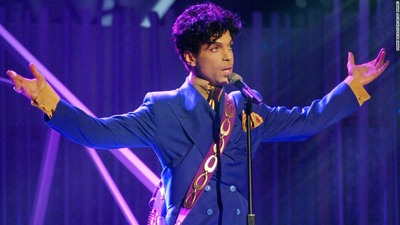 Today the music legend, Prince, died suddenly aged 57 years. According to Billboard, Prince was “One of the most iconic musicians in music history”. “His legacy as a musician, a singer, a style icon and an endlessly creative mind is nearly unparalleled, and his influence stretches from pop to R&B to funk to hip-hop and everywhere in between”. Tony Parsons wrote: “Prince danced like Fred Astaire, he played guitar like Hendrix, he wrote songs as good as Dylan, he smashed as many barriers as Bowie”. Prince received seven Grammy Awards from 32 nominations. Over his 35-year career, he released 39 solo studio albums. Four of these were No. 1 on the Billboard 200.
When discussing the death on radio today, a commentator said “You’ve got to enjoy life”; presumably because it can end suddenly. King Solomon tried living like this.
Solomon enjoyed life
I said to myself, “Come on, let’s try pleasure. Let’s look for the ‘good things’ in life.” But I found that this, too, was meaningless. So I said, “Laughter is silly. What good does it do to seek pleasure?” After much thought, I decided to cheer myself with wine. And while still seeking wisdom, I clutched at foolishness. In this way, I tried to experience the only happiness most people find during their brief life in this world. (Eccl. 2:1-3NLT)
“Anything I wanted, I would take. I denied myself no pleasure” (Eccl. 2:10).
His attitude was: enjoy life while you can!
“So I concluded there is nothing better than to be happy and enjoy ourselves as long as we can. And people should eat and drink and enjoy the fruits of their labor, for these are gifts from God.” (Eccl. 3:12-13)
“So I recommend having fun, because there is nothing better for people in this world than to eat, drink, and enjoy life. That way they will experience some happiness along with all the hard work God gives them under the sun.” (Eccl. 8:15).
“Eat your food with joy, and drink your wine with a happy heart, for God approves of this! Wear fine clothes, with a splash of cologne! Live happily with the woman you love through all the meaningless days of life that God has given you under the sun. The wife God gives you is your reward for all your earthly toil. Whatever you do, do well. For when you go to the grave, there will be no work or planning or knowledge or wisdom” (Eccl. 9:7-10).
But Solomon found that a life which is not related to God is meaningless (Eccl. 2:11; 12:8). It is like “chasing after the wind.” True fulfilment and lasting satisfaction are elusive. The things we do apart from God are hollow and futile because they can be destroyed and come to nothing.
Death, the leveller
100% of people die. Solomon realized that we all share a common destiny (Eccl. 9:2-3). Death is a great leveller. It happens to the rich and famous like Prince and to ordinary people like us.
Here’s what Solomon concluded from his investigation into all the ways of living without God:
Don’t let the excitement of youth cause you to forget your Creator. Honor Him in your youth before you grow old and say, “Life is not pleasant anymore.” (Eccl. 12:1).
Here now is my final conclusion: Fear God and obey His commands, for this is everyone’s duty. God will judge us for everything we do, including every secret thing, whether good or bad.” (Eccl. 12:13-14).
From this we see that our purpose in life is related to the God who created the universe and to whom we are accountable.
If our quest is to enjoy life, then it will absorb so much of our time and energy that we will miss the purpose of our life. This life is the support act for the main show. It’s the prelude to eternity.
Prince’s biographer said he was spiritual. I wonder what this means? But salvation isn’t based on our goodness. Instead, it’s based on Jesus’s goodness, “If you openly declare that Jesus is Lord and believe in your heart that God raised Him from the dead, you will be saved” (Rom. 10:9).
Conclusion
According to the Bible, we are not here just to enjoy life or to be spiritual. But we are here to have a close relationship with the God who created the universe. This is prohibited by our rebellious sinful nature. Fortunately, God sent Jesus to earth to overcome this barrier so we can be reconciled with God. Have you accepted this gift?
Written, April 2016
Share this:

The greatest leaders

 According to Listovative.com the greatest leaders of all time were Mahatma Gandhi, Nelson Mandela, Martin Luther King Jr, Abraham Lincoln, Mao Zedong, Adolf Hitler, George Washington, Napoleon Bonaparte, Franklin D Roosevelt, Julius Caesar, Winston Churchill, Asoka, Alexander The Great, Che Guevara, and Fidel Castro.
But the Bible says that Adam and Jesus Christ are the greatest leaders of humanity. In this post we look at the contrast between Adam and Jesus in Romans 5:12-21, where it is evident that Adam is the leader of sinful humanity and Christ the leader of forgiven humanity. And Christ’s gift is greater than Adam’s sin.
Context
The theme of the book of Romans is the good news (gospel) that God has intervened in our history so that through faith in Christ’s sacrificial death we can be reconciled with God. It describes the universal need for this reconciliation (Rom. 1:18 – 3:20), how it can be obtained through faith in Christ (3:21-31), an example of similar faith in Old Testament times (4:1-25), and the benefits of such faith (5:1-11). Then the good news is summarized by contrasting Adam and Jesus (5:12-21), which is followed by a description of the process by which believers grow to maturity (sanctification) (6:1-23).
Contrast
The state and destiny of humanity is pictured in two men: Adam and Jesus. Adam trespassed by disobeying God (when he ate from the tree of the knowledge of good and evil). This resulted in humanity becoming sinful and God’s punishment was the death penalty (physical death and eternal spiritual death). That’s why people die. On the other hand, Jesus obeyed God (when He allowed men to execute Him). This resulted in humanity being freely offered to have the penalty of eternal spiritual death cancelled and replaced with eternal life. So Adam is the source of all our problems, suffering, pain, and God’s judgment; while Jesus is the source of our reconciliation with God and the promises this brings. Adam brought death and Christ brought life.
The major difference between Adam and Christ was their disobedience and obedience to God. This has a dramatic impact on our world and our destiny.
Adam and Jesus were both unique. Adam was the first man. Jesus was both human (a man) and divine (the Son of God). They were similar as men, but different because Adam wasn’t divine. They were also similar in that a single act (Adam eating the fruit and Jesus dying) impacted all humanity.
Adam’s sin
Romans 5:12-21 teaches that Adam is the leader of sinful humanity.
“just as sin entered the world through one man (Adam), and death through sin, and in this way death came to all people (everyone), because all sinned” (5:12NIV).
“death reigned from the time of Adam to the time of Moses, even over those who did not sin by breaking a command, as did Adam” (5:14)
“many (everyone) died by the trespass of the one man (Adam)” (5:15).
“the result of one man’s (Adam’s) sin: The judgment followed one sin and brought condemnation” (5:16).
“by the trespass of the one man (Adam), death reigned through that one man” (5:17).
“one trespass (Adam’s) resulted in condemnation for all people (everyone)” (5:18).
“through the disobedience of the one man (Adam) the many (everyone) were made sinners” (5:19).
“sin reigned in death” (5:21).
As a result of Adam’s disobedience, sin and death passed to all his descendants. Through Adam’s sin all were condemned as sinners. Death is the penalty for sin. Death shows our sinfulness. The proof that Adam’s sin affected the entire human race is that death is universal. So because of Adam all people are sinful in their nature and in their behavior. Adam’s sin altered our human nature so that it’s corrupt and rebellious. That’s the condition of humanity for you, me and everyone else. We’re habitual sinners because of Adam’s original sin. It’s the greatest problem of the human race and it’s the source of the evil in our world. That’s why the world is as it is.
Christ’s gift
This passage also teaches that Jesus Christ is the leader of forgiven humanity.
“how much more did God’s grace and the gift that came by the grace of the one man, Jesus Christ, overflow to the many (believers)!” (5:15).
“the gift of God … the gift (of Christ’s righteousness, v.17) followed many trespasses and brought justification (to believers)” (5:16).
“how much more will those who receive God’s abundant provision of grace and of the gift of righteousness (believers) reign in life through the one man, Jesus Christ!” (5:17).
“one righteous act (Christ’s) resulted in justification and life for all people (believers)” (5:18).
“through the obedience of the one man (Christ) the many (believers) will be made righteous” (5:19).
“grace might reign through righteousness to bring eternal life through Jesus Christ our Lord” (5:21).
What a contrast between Adam’s sin and Christ’s gift! Condemnation came to us through Adam’s sin, while justification comes to us through Christ’s gift of righteousness. The good news is that Christ’s gift paid the penalty for Adam’s sin, and we can be reconciled with God if we accept this gift. There’s no other way to get right with God.
Clearly Christ’s gift of salvation is superior to Adam’s sin and the judgment we deserve. It’s “much more” (5:15, 17) and is sufficient for “many trespasses” (5:16) because Christ takes our judgement and we are seen in His righteousness. Instead of being ruled by death, in a coming day we will reign with Christ (5:17; Rev. 3:21). While Adam brought eternal death, Christ brings eternal life (1 Cor. 13:19-23).
Similar
Paul also says that Adam “is a pattern of the one to come (Jesus)” (5:14). How is Jesus like Adam? He explains this:
“Adam’s one sin brings condemnation for everyone, but Christ’s one act of righteousness brings a right relationship with God and new life for everyone. Because one person disobeyed God (Adam), many became sinners. But because one other person (Christ) obeyed God, many (believers) will be made righteous” (5:18-19NLT).
As Adam’s sin is imputed to everyone (5:12), Christ’s righteousness is imputed to all who trust in Him (1 Cor. 15:21-22). So, both judgment and salvation come from one man.
Summary
Adam and Jesus had a great influence on the human race. Adam is the leader of sinful humanity and Christ the leader of forgiven humanity. But Christ’s gift is greater than Adam’s sin.
The universal problem of the human race is sin and the universal solution is the gospel. All people, no matter what they have done, can get right with God because of Christ’s obedience and His righteousness. That’s the most important thing that we can do. But like any gift, it belongs only to those who accept it. Only those who by faith receive God’s gift of justification will enjoy the benefits of Christ’s obedience (5:17). Our eternal destiny depends on which humanity we choose: that of Adam or that of Christ.
Because of our humanity, we all begin life “in Adam”. A Christian changes their allegiance from Adam to Jesus. This means they are positioned “in Christ”. If we are in Christ, our salvation is secure not because of anything in us, but because we’re in Him.
Christians have accepted Christ’s gift, but they are still influenced by Adam’s sin. They have a new identity in Christ and an old identity in Adam. Whether our new identity is shown in our everyday life depends on whether we obey God’s instructions for us in the parts of the Bible written to the church (Acts to Revelation). Do we live like Adam (who disobeyed God) or like Jesus (who obeyed God)? Let’s be like Paul and follow the example of Christ (1 Cor. 11:1).
Written, February 2016
Share this:

Where’s hell?

 The Town of Paradise is in Newfoundland, Canada and there is an area near Boston, Ohio, called Hell Town. Place names arouse particular connotations, connections and feelings. The Old Testament prophets and Jesus used such associations in their teaching. For example, when Jesus spoke about what we call hell, He used the Greek word Gehenna. But what did the word “Gehenna” mean to those living in Jerusalem in the 1st century AD?
Hinnom valley
The ancient city of Jerusalem was bounded by Kidron valley on the east and Hinnom valley on the south and west. The boundary between the Israelite tribes of Judah & Benjamin was along Hinnom valley (Josh. 15:8; 18:16). The Greek word for this valley was Gehenna (Strongs #1067). Today it is called Wadi er-Rababi. The valley was probably named after a Jebusite named Hinnom. The southern part of Hinnom (#2011) valley is also lowest point near the ancient city. This area, named Topheth, was where there was child sacrifice to the god Molech in the 7th and 8th centuries BC and after this it was a garbage dump.
Child sacrifice
Topheth in the valley of Hinnom was a place of idol worship. The wicked kings Ahaz and Manassah of Judah practiced child sacrifice here (2 Ki. 16:3; 21:6; 2 Chron. 28:3; 33:6). Parents would sacrifice their children in the fire on shrines to Molech, the god of the Ammonites (1 Ki. 11:5; 2 Ki. 23:10), which was prohibited by the law of Moses (Lev. 18:21; 20:2). It was a place of burning (Jer. 7:31; 32:35). Child sacrifices were also made to Baal (Jer. 19:5; 32:35).
During king Josiah’s reforms in the 7th century BC he demolished the pagan shrines and made them ceremonially unclean by covering the sites with human bones (Num. 19:16; 2 Ki. 23:10-14).
So in the first instance Gehenna was the site of horrendous fiery idolatry, which was destroyed by a godly king.
Garbage dump
After this we time read that one of the southern gates of Jerusalem was called the Potsherd gate (Jer.19:2). Potsherd is broken pottery. This gate led to the valley of Hinnom where potsherds were thrown (Jer. 19:10-11). It was later known as the Dung gate (Neh. 2:13; 3:13-14; 12:31). The Potsherd/Dung gate overlooked the valley, which was the main dump for broken pottery and other garbage.
The sacrificial laws God gave Israel required that the dung and certain portions of sacrificial animals were to the taken outside the camp (beyond the city walls in temple times) and burned (Ex. 29:14; Lev. 4:11-12; 8:17; 16:27).
So in the second instance Gehenna was a garbage dump for the disposal and burning of refuse.
Symbol of God’s judgment on Judah
Jeremiah used a clay jar in a dramatic message to the people of Jerusalem (Jer. 19:1-15). It was delivered at the Potsherd gate overlooking Topheth. After he smashed the jar, he claimed that God says “I will smash this nation and this city” and “I will make this city like Topheth” (Jer. 19:11-13NIV). He also predicted that the valley of Hinnom would be a vast cemetery (Jer. 7:30-34; 19:6). Just as the jar was smashed, the city will be destroyed and the people buried in the valley of Hinnom. Jerusalem will become a waste land devoid of life and littered with corpses and fires like Topheth. This was fulfilled when the Babylonians invaded Jerusalem in 586 BC.
So in the third instance Gehenna was a symbol of God’s judgment on Jerusalem when they were invaded by the Babylonians.
Symbol of hell
In the 7th century BC Isaiah used “Topheth” as a metaphor for hell when he says its burning fires are ready to welcome the wicked king of Assyria (Is. 30:33). Elsewhere the Bible says that God’s enemies are judged by fire (Isa. 31:9; Zech. 12:6; Rev. 20:9-10). The image of everlasting punishment of God’s enemies in Isaiah 66:24 is also associated with Gehenna. It describes people looking at the valley of Hinnom, which was a picture of hell.
Jesus used the Greek word Gehenna 11 times in the New Testament. In four of these instances it is associated with fire (Mt. 5:22; 18:9; Mk. 9:43, 45). A person goes there after death; they are sent there by God: “Fear Him who, after your body has been killed, has authority to throw you into hell” (Lk. 12:5). Both body and soul are destroyed there: “be afraid of the One who can destroy both soul and body in hell” (Mt. 10:28). And it is eternal: “the fire never goes out” (Mk. 9:43). It is clear that this is a figure of speech and that Jesus wasn’t referring to going to the valley of Hinnom.
In this context, Gehenna is used to describe the “eternal fire prepared for the devil and his angels” (Mt. 25:41); “the darkness, where there will be weeping and gnashing of teeth” (Mt. 8:12); “the blazing furnace, where there will be weeping and gnashing of teeth” (Mt. 13:42, 50); and “this place of torment” (Lk. 16:28). It’s a place of eternal punishment for unbelievers in contrast to the eternal life of believers (Mt. 25:46). Elsewhere it is called “everlasting destruction and shut out from the presence of the Lord” (2 Th. 1:9); “blackest darkness” (2 Pt. 2:17; Jude 13); “the second death” (Rev. 2:11; 20:6; 21:8); “the fiery lake of burning sulfur” and “the lake of fire” (Rev. 19:20; 20:10, 14). It’s the final destiny of sinners who refuse God’s revelation and Christ’s offer of forgiveness.
According to the English dictionary, the word “hell” means “a place or state of existence where the wicked are punished after death”. So in the New Testament the Greek word Gehenna is used as a metaphor for hell. This isn’t evident to most readers because it is translated “hell” in modern English Bibles.
So in the fourth instance Gehenna was a symbol of God’s judgment of unbelievers in hell.
Symbol of Satan
James also uses the word Gehenna in his letter to Jewish Christians. In the context of a series of metaphors for uncontrolled speech, he writes “The tongue also is a fire, a world of evil among the parts of the body. It corrupts the whole body, sets the whole course of one’s life on fire, and is itself set on fire by hell” (Jas. 3:6). Uncontrolled speech destroys our life like a wildfire destroys everything in its pathway. Then it says that hell (Gehenna) is the source of this evil. Because hell matches the characteristics and destiny of Satan, this is a figurative way of saying that Satan is the source of this evil.
So in the fourth instance Gehenna was a symbol of Satan.
Summary
The Bible doesn’t say where hell is. But the valley near Jerusalem called “Gehenna”, was a symbol of hell. People living in Jerusalem in the 1st century AD would have associated this valley with the wickedness of child sacrifice, the desolation of a garbage dump, the invasion of Judah by the Babylonians, the eternal punishment of the wicked in hell and Satan the source of all evil.
The only way to avoid hell is to listen to the message of Scripture (Lk. 16:27-31). Let’s believe that Jesus died so that we don’t have to endure its eternal suffering (Jn. 3:16).
Written, February 2016
Also see other articles on places in the Bible:
Bethlehem, God’s solution to our crises
Where’s Zion?
Babylon, center of humanism and materialism
Lessons from Egypt
Lessons from Sodom
Massacres and miracles in Jericho
Rebellion and deception at Samaria
Nineveh experienced God’s mercy and justice
Worshipping God and idols at Bethel
Many battles at Megiddo
Share this:

Good news and bad news

 Every day we experience good news and bad news. Life is a mixture of both. But the news media often gives us more bad news than good news. Did you know that the Bible contains both good news and bad news?
The main message in the New Testament is called the “gospel”, which means “good news”. It’s good news about bad news. To understand it we need to understand the bad news first.
In the beginning of time, God made everything. It was very good. Everything was as God intended and people were in harmony with God. It was good news at the start.
But it didn’t stay that way very long because the first people rebelled against God. Their rebellion affected all God’s creation causing suffering, problems, disease and death. Things were no longer as God intended and people weren’t in harmony with God. That’s bad news. It’s our greatest problem.
So we live in a world that has been influenced by both good and bad news.
Jesus came to bring good news once again. To right the wrongs and solve the problems. But He does this in two stages and we live between them, between His first visit to earth and His second visit. He is the central theme of the gospel (or good news). The verses of Scripture that mention “Jesus” or “Christ” and “gospel” or “good news” are about Christ’s death, resurrection, glory (His second visit), His promise (of eternal life), the peace He brings, the fact that He can replace death with life and immortality, and His judgment of our lives.
That’s the message of the Bible. It’s the whole gospel. It’s not a human idea, but it’s God’s idea (Gal. 1:11).
The Bible says that the gospel is “the power of God that brings salvation to everyone who believes” (Rom. 1:16NIV). This power comes from God when people repent by turning towards God. God has already done His part, but we can only experience it if we do our part. It’s of no value to those who don’t accept it (Heb. 4:2).
So, let’s remember the whole gospel story. Why it’s good news about bad news. This is important because many people don’t know about the early history of our earth and humanity given in the Bible.
Written, July 2015
Also see: Good news in a world of bad news





 George's Journal
RECENT COMMENTS