
Mary, the Mother of Jesus
What can we learn from her life?
About 2,000 years ago, a young teenage girl named Mary lived in Nazareth, Israel, a despised town of which people said, “Can anything good come from there?” (Jn. 1:46 NIV).
Mary’s World
Mary lived under her father’s authority and had been trained by her mother to protect her father’s honor. In public, she dressed according to their social standing, behaved according to good manners, and spoke to men only when spoken to. Otherwise she would bring shame to her father.
In her day, a Jewish woman’s words didn’t count – everything had to be supported by male witnesses. Every day, the Jewish man thanked God that he had not been born a Gentile, a slave or a woman. Women received little education and were not taught the Law of God. In public, they were veiled; an uncovered head could result in divorce. Their social relationships were confined to other women. They did not eat with male guests, and men were discouraged from talking to women.
Mary’s mother managed the household under her husband’s direction. She managed the budget, prepared the food and saw to the welcoming rituals when her husband entertained. She reared and educated the children, the father taking over the son’s education and discipline at puberty. When she left the house to go shopping, she was usually accompanied by a suitable companion to protect her husband’s name from mistakes she might make.
At puberty, daughters were expected to marry, and suitable husbands were found by the parents. Daughters had no choice in this, otherwise they would bring shame on the family. Marriage age was low – 18-24 years for the man, 13-16 years for the girl. It was a patriarchal society which placed women in the same category as one’s ox, donkey or possessions.
A women’s security in her husband’s family was limited by his legal right to divorce her if she caused an “impediment” to the marriage. A man could divorce his wife without her consent for reasons ranging from unchastity, to burning a meal, or finding a fairer woman. When they went to the synagogue the women sat separate from the men. At social occasions the women were always in the background.
Mary was engaged to Joseph, the contract probably being arranged by their fathers and finalized in a public ceremony in the town square. If the husband-to-be wanted to break the betrothal, he had to get a bill of divorce. Let’s see how Mary responded to the circumstances in her life and what we can learn about that for mothers.

Fear And Confusion
When an angel visited Mary she was afraid and confused. She was “greatly troubled at his words,” but the angel said “Do not be afraid” (Lk. 1:29-30). She knew about angels from the synagogue and an angel had visited Zechariah, the priest in the temple (Lk. 1:11). Angels usually visited men, not women. This was most unusual. What was going on? Why did it visit her, the least important one in the family, and not Joseph or her father? How would she tell Joseph about it; there were no male witnesses? Would he believe her being made pregnant by the Holy Spirit (Lk. 1:35)?
Then there was the fear of rejection. To be pregnant while engaged was scandalous. If suspected of unfaithfulness she could be divorced or even put to death (Dt. 22:23-24). Would she be rejected by Joseph and left to bring up this child alone in a culture hostile to women – and probably remain unmarried for life? If she was also rejected by her father she could be forced into begging or prostitution to survive.
An Illegitimate Child
Although Jesus would have been easy to love, Mary faced many struggles. A child born during engagement was considered illegitimate. There would have been suspicions of adultery. People would have wondered, who was the father? Did the child look like Joseph? Mary would have faced this stigma for years, as the whole community would have known.
A Hated Child
Then she had to face the fact that people hated her child. Joseph and Mary escaped into Egypt when Jesus was a baby because the king wanted to kill Him (Mt. 2:13). Later, the respected religious leaders bitterly opposed Jesus. They accused Him of blasphemy – of mocking God by claiming to forgive sins – and of breaking the Law (Lk. 5:21; Mt. 12:2), and planned to kill Him (Mt. 12:14). Mary would have felt this hatred as well, as she identified closely with her special son.
A Missing Child
Then there was the occasion when Jesus was lost for three days at the age of 12. Mary and Joseph rushed back to Jerusalem and searched frantically for Him until they found Him among the teachers in the temple courts (Lk. 2:41-51). When His parents saw Him, they were astonished and Mary said, “Son, why have you treated us like this? Your father and I have been anxiously searching for you” (Lk. 2:48). She didn’t know whether her firstborn was dead or alive. Who was He with? Had He been kidnapped? Where did He spend the night? She was very concerned for His safety.
Two Tragedies
Mary faced two tragedies that are not often thought about. First, Joseph probably died sometime after Jesus was 12 years old, leaving her to raise the children alone. The fact that Joseph is not named in Matthew 13:55 possibly indicates his death. This means that Mary was a single mother and Jesus, the eldest son, was the head of the household and expected to care for his mother, brothers and sisters. This would have been a difficult time for Mary, bringing up her children without the support of a husband.
The second tragedy was when Jesus gave up His carpenter’s occupation and left home. The eldest son was expected to follow his father’s trade and position in society. In people’s eyes, Jesus dishonored His dead father when He left home on His messianic mission. He brought great shame on the family by giving up His responsibility as head of the household. That’s why Mary tried to get Jesus back into the household (Mk. 3:31-32).
A Rejected Child
His family said Jesus was insane; respected Jewish leaders said He was demon possessed (Mk. 3:21, 22). How would a mother cope with that? When she went to talk with Him, a messenger was sent through the crowd, but instead of replying to her concern, Jesus used the incident to teach the people the importance of putting God’s interests above family interests (Mk. 3:31-35). Mary could have felt rejected at this time. On another occasion we read that “even His own brothers did not believe in Him” (Jn. 7:5). How difficult for Mary, with such disputes between her children.

She Saw Her Child Die
Then Mary had to endure watching Jesus being crucified. Although most of the disciples had fled, she didn’t abandon Him (Jn. 19:25). When Jesus was eight days old, Simeon said that Mary would suffer as though she had been stabbed with a sword (Lk. 2:35). What suffering it would be for a mother to see her firstborn wrongfully accused, humiliated and executed.
How did Mary cope with motherhood that brought fear – the shame of an illegitimate child who was hated by the king and who went missing, being a single mother of a son who brought disgrace on the family and was rejected by society and executed before her eyes?
Followed God’s Will
Although she was afraid when the angel visited her, she accepted God’s will. After being told that she would be the mother of the long-awaited Messiah, Mary accepted the situation saying, “I am the Lord’s servant, may it be to me as you have said” (Lk. 1:38). She calls herself a female slave, one who waits on her Master and obeys in complete submission.
She believed that it would be a miraculous conception involving the Holy Spirit and God’s power, because the angel said “nothing is impossible with God.” Unlike Moses, she readily accepted the task. When God told Moses to go to Pharaoh to bring the Israelites out of Egypt, Moses said he was not good enough, and asked God to send someone else (Ex. 4:10, 13).
Praised God
Mary rejoiced so much in what God was going to do with her life that she wrote a song about it (Lk. 1:46-55). She trusted that God was going to bring much blessing out of her life as mother of the Messiah. She knew that children are a gift from the Lord (Ps. 127:3).
In her song Mary praised God for His salvation (Lk. 1:46-49), for His mighty deeds (50-53), and for His faithfulness to Israel (54-55). Her song is full of Old Testament references. Clearly, Mary trusted God and the Scriptures.
A mother who praises God and knows His word makes a difference in her children and family. For example, Paul wrote to Timothy, “I have been reminded of your sincere faith, which first lived in your grandmother Lois and in your mother Eunice and, I am persuaded, now lives in you also” (2 Tim. 1:5). Timothy’s mother and grandmother passed on their Christian faith to him. Because Mary accepted God’s will for her life and praised Him, she was highly favored by God (Lk. 1:28, 30).
Protected Her Children
From the moment Jesus was born His life was in danger. When King Herod threatened His life, Mary and Joseph took Jesus and escaped to Egypt (Mt. 2:13-15). Mary also protected Jesus’ identity. Though she knew He was the promised Messiah, she kept this to herself. At His birth she “treasured up all these things and pondered them in her heart” and as he grew up she “treasured all these things in her heart” (Lk. 2:19,51).
Showed Love and Devotion
Mary’s love and devotion for Jesus began before He was born and lasted beyond the cross. She stood near the cross when He was crucified (Jn. 19:25-27) and was present with the believers in the upper room after the Ascension (Acts 1:14). Mary’s was an enduring love and devotion.
Mary was rewarded: she was there when Jesus was raised from the dead; she was among the 120 when the Holy Spirit came at Pentecost; she saw her other children accept Jesus as Messiah; and today she’s in heaven.
A Supportive Husband
Although Joseph planned to divorce Mary quietly when he found out she was pregnant, so he “wouldn’t expose her to public disgrace,” he changed his mind after an angel appeared to him (Mt. 1:18-25). Joseph obeyed the angel’s message and married Mary. Mary had a supportive husband for at least 12 years. They were partners in raising Jesus to adulthood.
Husbands should love their wives, “just as Christ loved the Church and gave Himself up for her” (Eph. 5:25). Specifically we are to love our wives as our own bodies, helping them grow, and making them feel special (Eph. 5:28-29). This means supporting them by expressing confidence in them rather than controlling them, and praising them rather than criticizing them or taking them for granted.
An Understanding Friend
Mary visited Elizabeth, an older relative who was also expecting a child through miraculous circumstances – she was past the age of childbearing. Her child was John the Baptist. Elizabeth encouraged Mary during a difficult time.
Extended families are important and this should include the local church. Look around and you’ll find someone who needs encouragement. Or maybe you could offer to baby-sit so a husband and wife can have a day or evening to themselves. When her children were not present to support Mary in her grief at the cross, John was asked to care for her (Jn. 19:26-27), an example of the extended family.
A Model Mother
Mary was a special mother who had a special child. She lived in a society that was very different from ours, yet she had to deal with fear and a child that was hated, rejected and abused. She endured tragedy and suffering and she didn’t always understand what her child was saying or doing (Lk. 2:50). Yet the characteristics of the mother God chose to nurture His Son are a model for motherhood: she followed God’s will, knew His Word, praised Him enthusiastically, protected her children from danger, and showed them much love and devotion. She also had the support of her husband and friends in the family of God. Mothers play a most important role in our families. They deserve our honor and support.
Published, May 2003
Share this:

 A picture worth a thousand words
 A drama is a vignette of life
Recognizing False Teachers
There are a lot of religions for people to follow today. Eastern religions are spreading all over the world. Extreme cults (that lead to tragedies such as the mass suicides of the Branch Davidians in Texas and Heaven’s Gate in California) continue to appear. Other more established cults continue to spread their message by door-to-door canvassing. And then there are numerous spin-offs from established denominations, that over-emphasize one aspect of biblical truth at the expense of all others.
While false teachers seem to characterize these religions, the Bible says, “Beware of false prophets” (Mt. 7:15 NIV), because they can also appear in any church. They are also referred to as “false teachers” and “false apostles.” All of them will be called “false teachers” in this series.
False teachers are mentioned somehow in all except two of the 27 books in the New Testament. For example, Christ warned against the Pharisees and Sadducees in the Gospels. The Book of Acts tells us of false teachers who promoted idolatry, occult practices and Jewish traditions. In the Epistles, many verses warn of false teachers within the Church, including two whole books, Galatians and Jude. And much of Romans urges believers to turn away from Jewish legalism.
 Deceivers
The most common word used to describe false teachers is that they are deceivers, who lead people astray. They distort the truth in order to draw followers after themselves (Acts 20:30), and make them zealous for their cause (Gal. 4:17). False teachers can leave a trail of destruction, like savage wolves among sheep (Acts 20:29). They can also bring teachings from demons (1 Tim. 4:1).
Paul reminded those in Ephesus daily for three years to “be on your guard” against false teachers (Acts 20:31). The Bible indicates that the best defense against false teachers is to become mature in the Christian faith.
A Sign Of Maturity
The immature are “tossed back and forth by the waves, and blown here and there by every wind of teaching and by the cunning and craftiness of men in their deceitful scheming” (Eph. 4:14). They are blown off course like a sail boat in a storm. However, the mature are not deceived or blown off course because they “have trained themselves to distinguish good from evil” (Heb. 5:14).
The Three Tests
It is important to evaluate those that promote a new or different teaching. In fact, all teachers should be tested “to see whether they are from God, because many false prophets have gone out into the world” (1 Jn. 4:1). In a more general sense, believers should “test everything. Hold on to the good. Avoid every kind of evil” (1 Th. 5:21-22).
The church at Ephesus must have heeded Paul’s warning, as it was commended: “I know that you cannot tolerate wicked men, that you have tested those who claim to be apostles but are not, and have found them false” (Rev. 2:2).
There are three clear tests for recognizing false teachers: the Jesus Test, the Gospel Test and the Fruit Test.
The Jesus Test
The Jesus Test for distinguishing good from evil states that, “Every spirit that acknowledges that Jesus Christ has come in the flesh is from God, but every spirit that does not acknowledge Jesus is not from God. This is the spirit of the antichrist … This is how we recognize the Spirit of truth and the spirit of falsehood” (1 Jn. 4:2,3,6).
Similarly, the Bible also asks, “Who is the liar? It is the one who denies that Jesus is the Christ. Such a man is the antichrist – he denies the Father and the Son. No one who denies the Son has the Father; whoever acknowledges the Son has the Father also” (1 Jn. 2:22-23). Such people do not agree with what the Bible says about Jesus Christ (2 Jn. 7; Jude 4).
In Matthew 16:13-16, Jesus asked his disciples, “Who do people say I am?” They replied, “Some say John the Baptist; others say Elijah; and still others, Jeremiah or one of the prophets.” “But what about you?” he asked. “Who do you say I am?” Simon Peter answered, “You are the Christ, the Son of the living God.” This conversation occurred after Christ warned the disciples of the false teaching of the Pharisees and Sadducees.
So, the question to be answered in the Jesus Test is this: Who is Jesus Christ? False teachers deny that Christ is the divine Son of God, believing him to be nothing more than a great teacher. Some of those who fail the Jesus Test are: Animist, Baha’i, Buddhist, Christian Scientist, Hare Krishna, Hindu, Jehovah’s Witness, Humanist, practicing Jew, Mormon, Muslim, New Ager, occult worshiper and Scientologist. All these groups worship physical things or follow false beliefs (Rom. 1:23,25; Col. 2:8; 1 Tim. 6:20). Christians believe that Christ is divine and human (Jn. 1:14; 10:30; Phil. 2:5-8), sinless (Heb. 4:15), eternal (Jn. 17:24), and the Creator (Col.1:16). Jesus is truly unique.
The Gospel Test
Besides believing in a different Jesus, the Bible also states that false teachers promote a different gospel: “For if someone comes to you and preaches a Jesus other than the Jesus we preached, or if you receive a different spirit from the one you received, or a different gospel from the one you accepted … such men are false apostles, deceitful workmen, masquerading as apostles of Christ” (2 Cor. 11:4,13).
To the Galatians, Paul writes: “I am astonished that you are … turning to a different gospel – which is really no gospel at all” (Gal. 1:6-7). He then states that these false teachers were “trying to pervert the gospel of Christ” and should be “eternally condemned” (Gal. 1:7-9). These strong words are repeated to emphasize their importance.
So, the question to be answered in this test is: What is their gospel? The Bible says that the root cause of all our problems is that everyone has sinned and fallen short of God’s requirements – resulting in death (Rom. 3:23; 6:23). The only means of rescue is salvation by faith in Christ (Eph. 2:8,9). “Different gospels” do not present this truth. They either add to it or take away from it, and Revelation warns against this tampering with aspects of the Gospel (ch. 22:18-19; 1:5; 4:11; 21:1-22:6).
A “different gospel” may also deceive by using words similar to the true gospel, but giving them different meanings. Three examples are the works gospel, the pleasure gospel and the greed gospel.
The works gospel adds extra requirements to the true gospel, such as the rules and regulations of the Pharisees and Sadducees (Mt. 16:5-12). Simply put, it says there are things you must do to get saved and stay saved.
Followers of the pleasure gospel “never stop sinning” and entice others by “appealing to the lustful desires of the sinful human nature,” while they are “slaves of depravity” (2 Pet. 2:13-22). They “change the grace of our God into a license for immorality” (Jude 4).
Those caught up in the greed gospel “think that godliness is a means to financial gain,” despite the warning that “the love of money is a root of all kinds of evil” that causes people to “wander from the faith” and “pierce themselves with many griefs” (1 Tim. 6:5,10). Examples of the greed gospel would be the “health” and “wealth” gospels so prevalent today.
The Fruit Test
It is God’s will that we be fruitful. Jesus said “I am the vine; you are the branches. If you remain in me and I in you, you will bear much fruit; apart from me you can do nothing … I chose you and appointed you to go and bear fruit – fruit that will last” (Jn. 15:5,16).
Jesus warned, “Watch out for false prophets. They come to you in sheep’s clothing, but inwardly they are ferocious wolves. By their fruit you will recognize them” (Mt. 7:15,16,20). He also said, “Each tree is recognized by its own fruit. People do not pick figs from thornbushes, or grapes from briars. The good man brings good things out of the good stored up in his heart, and the evil man brings evil things out of the evil stored up in his heart. For out of the overflow of his heart his mouth speaks” (Lk. 6:44-45).
So, the question of this test is: What kind of fruit is evident? Is the divine nature or the sinful nature most evident? The former is characterized by the fruit of the Spirit: love, joy, peace, patience, kindness, goodness, faithfulness, gentleness and self-control. The sinful nature may involve idolatry, sexual immorality, selfish ambition, pride and dissension (Gal. 5:19-23).
A related question would be: Is there evidence of spiritual growth? For example, in another book that deals with false teachers, John writes, “It has given me great joy to find some of your children walking in the truth, just as the Father commanded us” (2 Jn. 4).
It can be seen that the three tests get at the core of Christianity. If we use them to distinguish good and evil, then there are two possibilities, a pass or a failure. The consequences of these are now considered in turn.
Those That Fail The Tests
False teachers within the Church are a serious issue because they lead to divisions rather than unity (Rom. 16:17; Ti. 3:10; Jude 19). The biblical response is to warn them twice and then “have nothing to do with them” (Ti. 3:10). For example, at Galatia Paul resisted false teachers by not giving in to them for a moment and standing firm against them (Gal. 2:5; 5:1). He also opposed Peter, a fellow-worker, to his face when Peter failed the gospel test (Gal. 2:11-13). The reason for this is that false teachings can spread as yeast works through a batch of dough (1 Cor. 5: 6-7; Gal. 5:9).
False teachers within the Church should be confronted (Ti. 1:13; Rev. 2:2), in order to silence them and stop their influence on other believers (1 Tim. 1:3; Ti. 1:11). If they do not cease, they should be expelled in order to avoid contaminating the local church (Rom. 16:17; Gal. 4:30; 1 Tim. 4:7; 2 Tim. 2:21). This also applies to those practicing sexual immorality (1 Cor. 5:1-13). It is the method to be followed when contending for the faith (Jude 3). Elders are responsible for this – they are to be on their guard and protect the church as a shepherd protects the sheep (Acts 20:28-31). They should not ignore false teachers, hoping they will go away.
We should not welcome or help false teachers from outside the church, as this causes us to share in their wicked work (2 Jn. 10-11). This is consistent with keeping ourselves from idols (1 Cor. 10:14; 1 Jn. 5:21). We should also “have nothing to do with them” (2 Tim. 3:5). In all situations involving false teachers we must remember this warning: “Do not be misled: Bad company corrupts good character” (1 Cor. 15:33).
Those That Pass The Tests
We need to make sure we correctly identify those that pass the Jesus Test, the Gospel Test and the Fruit Test. For example, John told Jesus, “we saw a man driving out demons in your name and we told him to stop, because he was not one of us.” Jesus replied, “Do not stop him. No one who does a miracle in my name can in the next moment say anything bad about me, for whoever is not against us is for us” (Mk. 9:38-40). The disciples were rebuked for using the wrong test. Likewise, we should be careful not to use the wrong test when assessing other believers. It would be wrong to treat other believers as false teachers, just because they are “not one of us.”
It is interesting to note that the Lord told Peter in Corinth, “I have many people in this city” (Acts 18:10). Likewise, God has people in every town and nation, and we should not be afraid to associate with people who pass the tests, otherwise we become like Peter in Galatians 2. If God accepts them, we should too (Acts 10:34-35; Rom. 15:7).
Testing Ourselves
Finally, we should test ourselves: “Examine yourselves to see whether you are in the faith; test yourselves. Do you not realize that Christ Jesus is in you – unless, of course, you fail the test?” (2 Cor. 13:5).
Do we live as though Jesus is God? Do we add to or take away from the gospel of salvation by faith in Christ? Do we drift into different gospels such as that of works, pleasure or greed? What sort of fruit is evident? Is there spiritual growth?
Wrong Emphasis
The Bible contains all the principles we need to live the Christian life. Yet it is possible to over-emphasize minor parts of the Bible and under-emphasize major parts. It is wrong to build a major theology from a Bible passage taken out of context. For example, there are numerous verses in the New Testament about loving one another – a major part of the Christian faith (Jn. 15:17) – while there are only a few about speaking in tongues. It would be wrong to act as though speaking in tongues was a more important issue than loving one another. As has often been said, we should never major in the minors!
Published, July – September 1998
Also see: Environmentalism: Idolatry or Stewardship?
In six days
Testing Islam
Testing Buddhism
Testing Hinduism
Share this:

What are the “idle” words referred to in Matthew 12:36?
 Jesus said we are accountable for every “idle word” we speak
According to Matthew 12:36-37 (NLT) Jesus said this to the Pharisees: “you must give an account on judgment day for every idle word you speak. The words you say will either acquit you or condemn you”. The Greek word argos – here translated as “idle” – means “inactive, unfruitful, barren, lazy, useless or unprofitable.” This word was also used to describe inactive workers (Mt. 20:3,6), young widows who were busybodies and gossips who didn’t care for their children and homes (1 Tim. 5:13), gluttonous Cretans (Ti. 1:12), and unproductive believers (2 Pet. 1:8). Notice that in all these instances argos described people.
There are two instances in the New Testament where argos is used metaphorically to describe a person’s words (Mt. 12:36) and faith unaccompanied by works (Jas. 2:20). So the “idle” words of Matthew 12:36 (NKJV, NLT) are those that are ineffective and worthless. Other translations call them “empty” (NIV), “careless” (ESV, NASB, CSB, CEV), or “worthless” (NET) conversation. Now let’s look at the context of this verse.
After Jesus healed a demon-possessed man who was blind and mute, the common people thought He was Israel’s Messiah, but the Pharisees disagreed and said that the miracle had been performed under Satan’s power (Mt. 12:22-32). They said “It is only by Beelzebul, the prince of demons, that this fellow drives out demons” (Mt 12:24). However, Jesus said that the miraculous power had come from the Holy Spirit. Jesus then told the Pharisees that a tree is recognized by its fruit – a good tree having good fruit and a bad tree having bad fruit (Mt. 12:33-35). Similarly, their unjustified accusations came from their evil lives. Then Jesus said, “I tell you that everyone will have to give account on the day of judgment for every empty word they have spoken. For by your words you will be acquitted, and by your words you will be condemned” (Mt. 12:36-37NIV). Because the words spoken are an accurate indication of a person’s inner life, they are a suitable basis for the judgment of that life.
Regarding “the day of judgment,” in the case of unbelievers, it is at “the great white throne” where the Lord Jesus is the judge. Their destiny is the lake of fire and their degree of punishment is “according to what they have done” (Rev. 20:11,13,15; Jn. 5:22). The words spoken by unbelievers during their life will condemn them. For example, the Pharisees will be judged for claiming that Jesus was empowered by demons. They said that Jesus performed miracles by the power of Satan rather than by the power of the Holy Spirit.
In the case of believers, their judgment is at “the judgment seat of Christ” (2 Cor. 5:10). Their destiny is to be with Christ forever, as the penalty for their sin – including careless speech – has been paid through His death on the cross. The Lord will reward them “for the things done while in the body, whether good or bad” (2 Cor. 5:10). Speech and behavior that is unconfessed and therefore unforgiven will reduce one’s reward at the judgment seat of Christ (1 Jn. 1:9).
So, an idle word is one that is useless for productive communication and somehow does damage. Every such empty or careless word will be judged because it reveals the inner self. Believers should speak as those who are going to be judged at the judgment seat of Christ (Jas. 2:12). Paul says Christians should not engage in “foolish talk” like this, and he categorizes it along with obscenity and coarse joking (Eph. 5:4). In many ways one’s conversation is an indicator of that person’s spiritual health (Jas. 3:1-12).
Jesus applied this teaching to religious leaders (Pharisees). They counteracted the words of the people who said “Could this be the Son of David?” (v.23). They were turning the people against Jesus. Their words harmed the ministry of Jesus. And ministries today face gossip, envy, and spite.
Paul said, “Do not let any unwholesome talk come out of your mouths, but only what is helpful for building others up according to their needs, that it may benefit those who listen” (Eph. 4:29).
Published, June 2010. Updated, January 2019.
Share this:

Does God heal all our sicknesses? Part 1
 Our attitude towards illness and healing
I recently read an article in a Christian magazine that said, “God heals all our sicknesses,” and it referenced Exodus 15:26 and 1 Peter 2:24. Because people have different ideas about the topic of healing, let’s look at what else the Bible says about it.
GOD’S PROMISES
There are differences between God’s promises in the Old Testament and those in the New Testament. Abraham was promised a great reputation and the land of Canaan for his many descendants (Gen. 12:1-3; 17:8). Obedient Jews were promised a long life, prosperity, and victory over their enemies (Dt. 6:1-2; Ps. 128:1-2; Isa. 38:1-8). Most of the promises given to the Jews in the Old Testament were for physical or material blessings.
On the other hand, in the New Testament, God’s promises to believers in the early Church were eternal life, the Holy Spirit, peace, and the return of Christ (Eph. 1:13; Phil. 4:7; Heb. 10:36-37; 1 Jn. 2:25). All are spiritual blessings, not physical ones (Eph. 1:3). We should be careful not to apply to New Testament Christians promises of physical blessings given to the Old Testament Jews.
HEALING IN OLD TESTAMENT TIMES
The Bible teaches that all genuine healing comes from God (Ps. 103:2-3; 107:17-20; Hos. 11:1-3). The Hebrew word rapa means “to heal” or “to restore to normal.” But because bodily processes diminish due to aging, there is no such thing as perfect health, especially as we get older.
In the Old Testament God gave conditional promises to the Jews that He would protect them from disease and heal them. The condition was that they had to keep God’s commands, do what was right in His eyes and not follow pagan gods. He also promised that there would be no miscarriages, no couples unable to have children, no animals unable to bear young, and their enemies would be inflicted with the diseases that they were protected from (Ex. 15:25-26; 23:25-26; Dt. 7:14-15). We find no such promises in the New Testament.
Exodus 15:26 – which says, “I will not bring on you any of the diseases I brought on the Egyptians, for I am the LORD, who heals you” – was quoted out of context in the magazine article I read. This verse applies specifically to the children of Israel traveling from Egypt to Canaan, but not to us today. Otherwise, we could still claim God’s promise to collect manna for daily food!
There are many instances of miraculous healing in the Old Testament. For example, when King Hezekiah was sick and about to die, he prayed and God allowed him to live for an additional 15 years (2 Ki. 20:5-6).
JESUS, THE HEALER
When He was on earth, the Lord healed all who were brought to Him (Mt. 8:16-17). Jesus said that this had been prophesied by Isaiah (Isa. 53:4). These miracles displayed His divine power (Mt. 11:2-5; Jn. 20:30-31). The Lord still heals all kinds of illnesses, and therefore we should acknowledge God in every case of healing. In the future when He returns to rule over the earth during the Millennium, the Bible tells us that the Lord will heal all diseases (Isa. 33:24; Jer. 30:17). But that is for a future time, not today.
With reference to the Lord, Peter quoted from Isaiah in his first letter: “By His wounds you have been healed” (Isa. 53:5; 1 Pet. 2:24). This type of healing – described in the next verse as, “For you were like sheep going astray, but now you have returned to the Shepherd and Overseer of your souls” (1 Pet. 2:25) – is spiritual, between sinful people and God. Also, it is in the past tense, not the present tense. This verse means that Christ suffered on the cross and died as our substitute so that our sins could be forgiven and we could have a restored relationship with God. It has nothing to do with physical healing; it would be wrong to tell a seriously ill Christian that by Christ’s wounds he has been physically healed. First Peter 2:24 was also quoted out of context in the magazine article mentioned earlier. This verse is about spiritual, not physical healing.
SELF-HEALING BODIES
Our bodies have been amazingly designed to heal themselves of most injuries and illnesses. Living cells are being replaced continuously. If we cut a finger the wound heals itself. Broken bones grow back together. Doctors know that many complaints are better by morning. Our immune system can automatically fix mild colds and throat infections. One prominent physician wrote, “Most coughs are self-curative usually within 1-3 weeks with or without treatment.” David wrote, “I praise You because I am fearfully and wonderfully made” (Ps. 139:14).
THE BIG PICTURE
In Genesis 1-2 God created a perfect world where there was no sickness, pain or death. It was utopia, but it didn’t last long. When sin came into the world (Gen. 3), our world changed completely. Not only are we spiritually separated from God because of sin, we now live in a decaying world of disease, suffering, injustice and death.
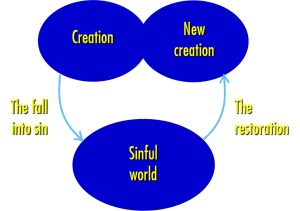
Fortunately that’s not the end of the story. God had a rescue plan for mankind that involved sending His Son, Jesus Christ, to earth to restore our relationship with God. The outcome of this plan will not be finalized until the end of time. Christians are already redeemed or healed spiritually, but not yet physically. Today we live in a world whose suffering Paul described this way: “I consider that our present sufferings are not worth comparing with the glory that will be revealed in us. The creation waits in eager expectation for the sons of God to be revealed. For the creation was subjected to frustration, not by its own choice, but by the will of the One who subjected it, in hope that the creation itself will be liberated from its bondage to decay and brought into the glorious freedom of the children of God. We know that the whole creation has been groaning as in the pains of childbirth right up to the present time. Not only so, but we ourselves, who have the first fruits of the Spirit, groan inwardly as we wait eagerly for our adoption as sons, the redemption of our bodies” (Rom 8:18-23).
Paul’s “present sufferings” are contrasted to “the glory that will be revealed in us.” Like Paul, we suffer from sicknesses and these will not be totally healed until our bodies are resurrected, which is the final phase of our salvation – our deliverance from suffering. We look forward to God’s promised deliverance from sin and its effects.
Paul persevered in suffering because he had the hope of the resurrection: “Therefore we do not lose heart. Though outwardly we are wasting away, yet inwardly we are being renewed day by day. For our light and momentary troubles are achieving for us an eternal glory that far outweighs them all. So we fix our eyes not on what is seen, but on what is unseen, since what is seen is temporary, but what is unseen is eternal” (2 Cor. 4:16-18).
Although the process of physical decay was going on continuously in Paul’s life, his suffering was not the most important thing in his life. Instead he focused on the unseen things like the resurrection body, the splendor of heaven and the triumph of the Lord at the Second Coming. The pattern for Christ was suffering at His first coming, and glory, honor and praise at His second coming. Likewise, the pattern for believers is present suffering and future glory.
LESSONS FOR US
Let’s always be careful when interpreting the Bible, especially in matters of health. It is not a collection of verses to be selected by topic and understood in isolation. Instead, start with what the Bible says and then consider the context by asking who the passage was written to, and what the surrounding verses say. When we do this we find that most of the promises given to the Jews in the Old Testament were physical or material blessings, while those given to Christians in the New Testament were spiritual blessings.
Although believers have been redeemed spiritually, they will experience sickness until death or the redemption of their bodies at the Rapture (1 Cor. 15:35-58). God’s emphasis now in the New Testament is on saving people by healing them spiritually, not physically. And isn’t this what is most important?
Let’s be like Paul and acknowledge that believers will suffer due to illnesses and injuries, and let’s accept these as being insignificant when compared to being liberated from sin and its effects.
Published April 2010
Also see: Does God heal all our sicknesses? Part 2
What does “by his wounds you have been healed” mean?
Share this:

Boats and bicycles
 How are you travelling?
During a visit to the Netherlands I was amazed at the number of boats and bicycles throughout the country. The boats and bicycles are used for transport and recreation. Many of the boats sail along a network canals. Others are house boats. One company combines the two modes of transport by offering bicycle tours with overnight accommodation on a barge.
The word “nether” means “lower”. The Netherlands as the name suggests is a low-lying country. Almost half of the land is below sea level. Elsewhere, the elevation rarely exceeds 50 meters (or 160 feet). Vaalserberg near the border with Belgium and Germany is the nations highest point at 321 meters (or 1053 feet) above sea level. Yet it is only 25 kilometers (or 16 miles) from canals near the Maas river.
Boats
Boating is a way of life to the Dutch. There are numerous canals, rivers and lakes and some locks between waterways at different heights. The total length of the navigable canals is approximately 7,000 kilometers (or 4,350 miles). Some canals are elevated to carry boats above the freeway. Two wonderful cruising areas are the Amsterdam, Rotterdam, Utrecht region and the lake region of Friesland in the north.
In the New Testament we read that Jesus and His disciples travelled in boats, while Paul travelled in ships. The most dramatic voyages in the bible are Jonah’s towards Tarshish and Paul’s to Rome (Jon. 1:1-2:10; Acts 27:1-14). A violent storm arose on both occasions and the ship threatened to break up. The sailors were afraid and they threw the cargo into the sea to lighten the ship (Jon. 1:5; Acts 27:18). Due to miraculous circumstances no lives were lost.
Jonah and Paul were both sent to the headquarters of an empire; Ninevah, the Assyrian capital, and Rome, the Roman capital. Jonah was running away from God by travelling in the opposite direction to God’s command (Jon. 1:2-3). Paul was obeying God (Acts 23:11). This reminds me we are all travelling in the journey of life. Which direction are you going? If you are going in the wrong direction, are you willing to acknowledge this and turn to God like Jonah?
Bicycles
There are approximately 18 million bicycles in the Netherlands, which is more than one per person. Bicycles can go along narrow alleys and other places where other motor vehicles can’t. They can also be taken on trains and ridden in the city and in the countryside. This reminds me of the parable of the great banquet, which is an illustration of the gospel message being spread across the world (Lk. 14:16-24).
After the original invitations to the banquet were rejected, the invitation went to whoever could be found from the “streets and alleys of the town” and the “roads and country lanes” (vv. 21, 23NIV). This includes all kinds of thoroughfares. It is like the pattern of evangelism, which includes people in all kinds of places—“you will be my witnesses in Jerusalem, and in all Judea and Samaria, and to the ends of the earth” (Acts 1:8). “Jerusalem” was the city they were in at the time and the chief city in Judea. “Judea” was the surrounding region that had a large Jewish population. “Samaria” was an adjacent region that had no dealings with the Jews. “The ends of the earth” at that time was the known world around the Mediterranean Sea. This is the pattern of evangelism that was followed by the early church—firstly Jerusalem (Acts 1:1-7:60), then surrounding and adjacent regions (Acts 8:1-9:31), and then more distant lands (Acts 9:32- 28:31). It shows that evangelism should begin in your neighbourhood and extend across the globe. So, let’s take the gospel whenever and wherever we travel, on bike, boat or some other way!
Written, January 2003
Share this:

God’s great and precious promises
 About 4,000 years ago Abraham received some special promises when God spoke to him. The bible contains many other promises as well and in this article we look at some key promises given for Christians today. As Abraham had to listen in order to hear God’s promises to him, we should read the Bible to know God’s promises for us.
A survey of the New Testament
The Greek word for promise is “epangalia” (Strongs #1860). This article is based on a survey of every occurrence of this word and its close derivatives in the New Testament that relate to God’s promises—this was 60 verses, which are all referenced below. I am assuming that these verses indicate God’s key promises for Christians living between the day of Pentecost and the rapture. We will look at the context of these verses to help discover—what message did they convey to those of the early church and what is their message for us?
The topics that relate to the word “promise” in these verses are listed in the table below. It is interesting that half of the verses relate to promises given to Abraham and his descendants—the majority of these being in the books of Romans, Galatians and Hebrews. This is not surprising as a majority of the early Christians were Jewish and the Old Testament was the only Scripture that the early church possessed. Therefore, God often used illustrations from the Old Testament. Also, these books deal with topics of those times, such as the fact that justification by faith and not works is taught in the Old Testament, and with the trap of legalistic Judaism.
Key promises mentioned in the New Testament
| Promise | Verses | % |
| Given to Abraham and his descendants | 32 | 53 |
| Eternal life | 12 | 20 |
| Holy Spirit | 7 | 12 |
| Second coming or end times | 6 | 10 |
| Children of God | 1 | 2 |
| All God’s promises | 2 | 3 |
| Total | 60 | 100 |
Old Testament promises mentioned in the New Testament
The greatest occurrence of the word “epangalia” in the New Testament relates to the promises given to Abraham and his descendants (Acts 7:5,17; Rom. 4:20-21; 9:4, 8, 9; Gal. 3:16; Eph. 2:12; Heb. 6:13; 7:6; 11:9,13,17,33). The three main messages in these passages are summarized below:
Firstly, God keeps His promises—Isaac was born “as the result of a promise” (Gal. 4:23NIV). “And so after waiting patiently, Abraham received what was promised” (Heb. 6:15). This happened because of Abraham’s faith and God’s power (Heb 11:11).
This was an important message for the early church, particularly in times of persecution. They knew that their sins had been forgiven and they had a home in heaven. This gave them hope and security. It is also important for us during difficult and disappointing times—if we can’t trust in God, who can we trust? No-one. In a post-modern world, characterized by change and instability, it can be difficult to trust in God. When our faith is weak we act as though God is a part of creation; but of course God is not like us—He is reliable and always keeps His promises.
Secondly, Jesus was the promised Messiah (Acts 13:23,32; 26:6; Heb. 11:39). Paul wrote, “For I tell you that Christ has become a servant of the Jews on behalf of God’s truth, to confirm the promises made to the patriarchs” (Rom 15:8). The remainder of this sentence says Christ came so that the Gentiles would also praise God. When sinners put their faith in Christ, they share in the promises given to Abraham (Gal. 3:29; 4:28).
As already mentioned a majority of the early Christians were Jewish. When they realized that Jesus was the Messiah, they converted from Judaism to Christianity and this truth about Jesus would have featured in evangelism to the Jews. For example, on the day of Pentecost Peter proclaimed, “God has made this Jesus, whom you crucified, both Lord and Christ” and Stephen told the Jewish Council, the Sanhedrin, “you betrayed and murdered the Messiah”.
The message for us is that all God’s promises are fulfilled through Jesus (2 Cor. 1:20). Paul writes that we are blessed with every spiritual blessing because we belong to Christ. The promises in the Old Testament look ahead to Christ and those for the future rely on His great sacrifice for the sin of the world.
Finally, God’s promise of salvation (and eternal life) is a gift to be received by faith, not something to be earnt. In Romans 4 Paul shows how the gospel is in harmony with the Old Testament—God accepted Abraham because Abraham had faith in Him (Rom 4:13-14)—“The promise comes by faith, so that it may be by grace and may be guaranteed to all Abraham’s offspring–not only to those who are of the law but also to those who are of the faith of Abraham. He is the father of us all” (Rom 4:16). The Old Testament law was only a temporary measure until the coming of Christ (Gal. 3:17-19, 21-22). So, eternal life is guaranteed to those who have faith in God like Abraham did (Heb. 11:11).
The Pharisees were the religious leaders of the Jews in the times of the early church. They endeavored to live in strict accordance with the Old Testament law as interpreted and amplified by the scribes and their tradition and they believed in salvation by works. Consequently, the message of salvation by faith and not works was a vital distinction between Christianity and Judaism.
This truth is also important for us as it is fundamental to the Christian faith. Salvation is a gift that God promises to those who receive it by faith. There is no way we can earn our salvation. As a result of this salvation all believers are assured of participating in and receiving the remaining promises.
Eternal life
The second most prevalent topic associated with the word “epangalia” in the New Testament is that of eternal life. When we accept Christ as Savior, we receive eternal life which is valuable now and when we get to heaven. Eternal life enables us to live for Christ today and to look forward to life after death (1 Jn. 2:25; 1 Tim. 4:8). Eternal life is one of the “better promises” in the new covenant that came though Christ (Heb. 8:6). It is shared by all believers—there is no distinction based on race or any other difference between believers (Eph. 3:6).
As Paul wrote concerning “a faith and knowledge resting on the hope of eternal life, which God, who does not lie, promised before the beginning of time”, people who followed God in Old Testament times will be included in those who share eternal life (Tit. 1:2).
Heaven, the place of eternal rest is still available to all who believe in Christ (2 Tim 1:1; Heb 4:1; 6:17). It is an “eternal inheritance” for all those who have been freed from the penalty of their sins by Christ’s death (Heb 6:12; 9:15; Jas. 2:5). All believers have eternal life and are looking forward to new bodies, the marriage supper of the Lamb and living with the Lord.
Heaven also includes rewards given at the judgement seat of Christ for service done for the Lord. For example, those who persevere under trials are promised “the crown of life”, which may be a deeper appreciation of eternal life in heaven (Jas. 1:12).
As God promises eternal life as a gift to sinners who receive it by faith it is guaranteed to all believers (Rom 4:16). We can be confident of this based on God’s Word, because we can’t earn salvation by good works.
Some in the early church thought Jews were privileged and so they looked down on Gentiles. But the fact that they both had eternal life and were indwelt by the Holy Spirit illustrated that there should be no barrier between them—Christianity is multinational! The same applies today—we should accept all true Christians as Christ would—regardless of differences in race, in status, or in gender.
The Holy Spirit
The word “epangalia” in the New Testament is also often associated with the topic of the Holy Spirit. Before His ascension, Christ promised His disciples that the Holy Spirit would come as had been promised in the Old Testament (Is. 44:3; Ezek. 36:27; Lk. 24:49; Acts 1:4). The Holy Spirit is God and He gives believers a divine power. This happened initially on the day of Pentecost (Acts 2:33). This promise was for all believers, whether they were Jews (“you and your children”) or Gentiles (“all who are far off”) (Acts 2:39).
The Holy Spirit indwells a believer when they trust in the good news of God’s offer of salvation—“And you also were included in Christ when you heard the word of truth, the gospel of your salvation. Having believed, you were marked in him with a seal, the promised Holy Spirit who is a deposit guaranteeing our inheritance until the redemption of those who are God’s possession” (Eph. 1:13). This pattern—hearing the message, believing it, and then receiving the Holy Spirit—was evident when Peter spoke at Cornelius’ house. The gift of the Holy Spirit is part of the blessings that were promised to Abraham (Gal. 3:14).
These verses also teach that the Holy Spirit is a sign that we belong to God and that He will protect us and will keep His promises.
This promise is equally important to the early church and to us. The New Testament is full of the work of the Holy Spirit in the lives of believers and they are instructed to “be filled with the Spirit”. He is God with us on a continual basis—God speaks to us today through the Holy Spirit. He is a great helper and teacher and will remind us of relevant Scripture.
Second coming or end times
The second coming of Christ and other future events are also often associated with the word “epangalia” in the New Testament. The book of Hebrews was written for those struggling with leaving Judaism for Christianity, who were encouraged to persevere until they received the reward that God had promised (Heb. 10:36). This reward is explained in the next verse as being when Christ returns to take Christians to be with Himself at the rapture. It is important that our present circumstances do not cause us to forget about the wonderful future that God has promised us—“Let us hold unswervingly to the hope we profess, for He who promised is faithful” (Heb 10:23). God is reliable and will keep His promises.
Scoffers say, “Where is this ‘coming’ He promised?”—they do not believe that God is coming to judge the world (2 Pt. 3:4). So, why has there been a long delay in the coming of God’s judgement? The reason is that He is patient, “not wanting anyone to perish, but everyone to come to repentance” (2 Pt. 3:9). He is giving people every opportunity to be saved. He waited 120 years before He sent the flood and has waited thousands of years before destroying the world with fire.
God has promised many awesome demonstrations of His power after He takes the believers to be with Himself during the rapture (Heb. 12:26). But, believers are to look forward to “a new heaven and a new earth, the home of righteousness” (2 Pt. 3:13). This is the eternal state after God has triumphed over Satan and evil.
This expectation can help believers through life’s struggles—whether they live in the first century or today. It gives them an eternal perspective.
Children of God
The promises of 2 Corthinians 7:1, mentioned in the previous verses, include that believers are “sons and daughters” of God the Father and that God welcomes those who stand against evil. There are two relationships here: between a child and a parent and between siblings. As a result of this promise, we receive blessings from God and from one another.
A parent has special care for their child who they nurture and encourage from infancy to adolescence and then to adulthood—that’s how God cares for us. Meanwhile a child is to obey their parents—and Christians are to obey and imitate God.
Although siblings can be rivals, they share a common family and the same parents. As a consequence of this relationship, most of us help and care for others in our family. Likewise believers, who follow the same Savior and share the same destiny, should care for one another.
The illustration of being children of God applies to the early church and to today. All believers need to appreciate they serve a loving Father. However the situation regarding relationships between believers has changed in the past 1,900 years. The early church was small and all believers fellowshipped with one another, except when dictators such as Diotrephes had their way. Today there are different Christian denominations and we need to remember we are children in a global family comprising believers from all Christian denominations, not just the one we happen to support. The Bible emphasises that God has no favorites, nor should we.
All God’s promises
The remaining instances of the word “epangalia” in the New Testament are two verses that relate to all of God’s promises. We mentioned earlier that all of God’s promises have been fulfilled in Christ (2 Cor. 1:20).
God has given us everything we need to live for Him including “His very great and precious promises, so that through them you may participate in the divine nature and escape the corruption in the world caused by evil desires” (2 Pt. 1:4). It is estimated that there are at least 30,000 promises in the Bible. They are “very great” because they help us do such things as:
- “participate in the divine nature”—as we appreciate what God has promised, we become more like Him, and
- “escape the corruption in the world caused by evil desires”—God’s promises can help us resist temptation—when temptations come we should claim the promises.
Application to us
These promises can have a strong influence on our lives when we remember:
- We follow a God who keeps His promises—look back at history. Our God is reliable and trustworthy.
- All of God’s promises are fulfilled in Christ – Christ has “better promises” than any others in the world because they are given by the God who made the universe and continues to sustain it.
- Salvation is a gift to be received by faith, not something to be earnt—this is a fundamental of the Christian faith.
- The Holy Spirit is God with us on a continual basis—we should be more aware of His presence as all our power to live for Christ comes from the Holy Spirit.
- We are children of God—we have a global family and should welcome fellowship with other believers. The early church was not restricted to a small community—it witnessed in Jerusalem, then Judea the southern section of Palestine, then Samaria in central Palestine and then to the ends of the earth. Like evangelism, our fellowship should spread out across the land. Paul had to be reminded by the Lord when he was in Corinth; “I am with you, and no one is going to attack and harm you, because I have many people in this city”. We need to be aware of other believers in our community who are also a part of the body of Christ and not avoid them or isolate ourselves from them.
- We should be looking forward to Christ’s return to fulfil His promises concerning the future. This includes eternal life in heaven and seeing Jesus exalted to the highest place and seeing every knee bow before Him and hearing every tongue confess that Jesus Christ is Lord and singing together with all creation, “To him who sits on the throne and to the Lamb be praise and honor and glory and power, for ever and ever!”
- God doesn’t reveal His promises to us unless we read them in the Bible—so we need to: read them, understand them, meditate on them, and store them in our memories. If you have trouble sleeping at night, then be like the psalmist who wrote, “I lie awake at night thinking of your promises” (Ps. 119:148). Then we can say, “I have hidden your word in my heart” (Ps. 119:11). As a consequence you will realize that they are great promises and they will become precious to you, and The Holy Spirit will recall them when you need refreshment and encouragement—“Your promise revives me; it comforts me in all my troubles” (Ps. 119:50).
Written, March 2003
Also see: God’s greatest promise
Share this:

Jesus, what a beautiful name
 A special Christmas message
Every December 25, Christians all over the world celebrate an event that occurred about 2,000 years ago – the birth of Jesus Christ. Unlike most boys of that time, Jesus was not named after a human father or given a family name (Lk. 1:59-60). Instead, He was given special names to signify His special mission.
Although born in a Jewish community in a town near Jerusalem, Jesus was to affect the lives of all humanity – past, present and future. This is evident from the names associated with the birth of this unique child.
God with us
It was prophesied centuries before that He would be called “Immanuel”, which means “God with us” (Is. 7:14; Mt. 1:22-23NIV). This shows that Jesus was God living on earth as a human being and is consistent with Joseph being told that Jesus was conceived “from the Holy Spirit” (Matt. 1:20). How remarkable that the Creator of the universe should be born on earth as a baby boy.
The Bible states that Jesus “shared in our humanity” (Heb. 2:14) and “became flesh and made His dwelling among us” (Jn. 1:14). As a result, He is the clearest revelation of God to mankind. The fact that Jesus was both human and divine is fundamental to the Christian faith (1 Jn. 4:2; 2 Jn. 7). His followers recognised that He was “the man from heaven” (1 Cor. 15:49).
It seems as though God was also physically present on earth at the beginning of history as Adam and Eve “heard the sound of the LORD God as He was walking in the garden in the cool of the day” (Gen. 3:8). So why did the Divine return to earth as Jesus?
Savior
Joseph was told to give Mary’s son the name Jesus, “because He will save His people from their sins” (Mt. 1:21NIV). This was His mission.
The name “Jesus” is the Greek form of “Joshua”, which means “the Lord saves”. Joshua helped to spy out the promised land of Canaan (Num. 13). Most of the spies were afraid of the fortified cities, and the people who were strong and powerful and seemed like giants. Despite this Joshua and Caleb believed they could take possession of the land (Num. 13:30).
God used Joshua to destroy the walled city of Jericho and many other kingdoms and cities in Canaan. Under his leadership the Israelites had many victories and were saved from their enemies.
Today we live in a world of sin, suffering and death. As Joshua was used by God to save Israel, Jesus was used by God to save humanity. He came to have victory over sin, death and Satan and to rescue us from eternal judgement (Heb. 2:14-15; Rom. 5:18-21). In fact, “salvation is found in no one else, for there is no other name under heaven given to men by which we must be saved” (Acts 4:12).
Christ the Lord
The shepherds were told that the baby was “Christ the Lord” (Lk. 2:11). The name “Christ” is the Greek form of “Messiah”, which means “the Anointed One”. In the Old Testament, prophets, priests and kings were typically anointed with oil. When this name is applied to Jesus it means that He was divinely appointed – appointed by God.
Peter testified “how God anointed Jesus of Nazareth with the Holy Spirit and power, and how He went around doing good and healing all who were under the power of the devil, because God was with Him” (Acts 10:38).
John said of the Scriptures “these are written that you may believe that Jesus is the Christ, the Son of God, and that by believing you may have life in His name” (Jn. 20:31).
The word “Lord” signifies power and authority and is frequently used of God and Jesus in the Bible. Jesus taught “as one who had authority” (Mk. 1:22) and He demonstrated great power by His miracles, such as healing the sick, driving out demons and multiplying the loaves and fishes.
The wise men used a title of power and authority when they called the baby “the king of the Jews” (Matt. 2:2). Although king Herod was disturbed about this, Jesus was not recognised as such (Jn. 1:11), and this characteristic was not evident during His life on earth. Although this was the charge at His crucifixion, He said that His kingdom was not of this world (Jn. 18:36).
Jesus is supreme, His name “is above every name”. In the future His awesome power will be evident to everyone and every knee will bow and every tongue confess that He is Lord (Phil. 2:9-11).
Our response
At Christmas we celebrate the birthday of Jesus Christ, whose birth was to be “good news of great joy … for all the people” (Lk. 2:10). Responses to His birth included: obedience to God (Mt. 1:25), gifts and worship (Mt. 2:11), amazement (Lk. 2:18), meditation (Lk. 2:19), praise and thanks to God (Lk. 2:20,38) and worry (Mt. 2:3).
In the incarnation God took on human form to reveal Himself to people in a way they could grasp (Jn. 1:18), to become their Savior by ransoming their sins (Mk. 10:45), and to deal sympathetically with their needs (Heb. 2:17-18). But many rejected this offer of help: “though the world was made through Him, the world did not recognise Him” (Jn. 1:10).
As the birth of Jesus Christ divides history into B.C. (Before Christ) and A.D. (Anno Domini, meaning, in the year of our Lord), so people are divided into those who accept and those who reject Christ’s offer to rescue them from eternal judgement.
I trust that you can say “Jesus, what a beautiful name” and that His name is well known to you as Savior, Christ and Lord (Mk. 6:14).
Published, December 1998
Share this:

The Bible teaches us to submit to various authorities. But what if an authority makes a law that requires us to disobey God?
 Although Christians are citizens of heaven (Phil. 3:20), they must also submit themselves to all forms and levels of human government (Tit. 3:1). God established human government after the flood; and Genesis 9:6 introduces the concept of governmental authority when it speaks of capital punishment. Governments help maintain law and order, keep the peace and avoid anarchy. Our attitude to authority is an important part of our Christian life.
Everyone must submit to the governing authorities because they are established by God and viewed as His servants (Rom. 13:1-7). The governing authorities are set in place by the permissive choice of God and their power is from God (Jn. 19:11; Rom. 9:17). Their weapons are a sign of their authority. So when people disobey a human ruler, they indirectly disobey God.
It’s good to be law-abiding citizens, because if we don’t submit to authority we will have a bad conscience. We are to pay our taxes to those in authority and never join in rebellion against the government or seek its overthrow by violence.
Paul quoted Exodus 22:28 when he said, “Do not speak evil about the ruler of your people” (Acts 23:5 NIV). He also said that we should pray for “all those in authority, that we may live peaceful and quiet lives in all godliness and holiness” (1 Tim. 2:1-2). It should be noted that the governing authorities were probably pagans when these passages of the Bible were written.
Here are three examples from Scripture of those who respected authorities in difficult circumstances.
- David honored wicked King Saul and called him the Lord’s anointed (1 Sam. 24:6) even though he sought to kill David.
- When the Pharisees tried to trap Jesus, He said to them, “Give to Caesar what is Caesar’s, and to God what is God’s” (Mt. 22:21).
- Nero (a godless brutal ruler) was the Roman emperor when Peter wrote “Submit yourselves for the Lord’s sake to every authority instituted among men: whether to the king, as the supreme authority, or to governors, who are sent by him to punish those who do wrong and to commend those who do right” (1 Pet. 2:13-14).
Christians should obey God, but not place the authorities above God (Jn. 14:21-24; 15:10; Eph. 5:24; Heb. 5:9; 12:9; Jas. 4:7). A Christian is not required to obey if an authority orders him to sin, to disobey God or to compromise his loyalty to Jesus Christ. When the apostles were commanded not to preach they replied “We must obey God rather than men” (Acts 4:18-20; 5:27-29).
Here are two examples from Scripture of those who disobeyed authorities instead of disowning God.
- When King Nebuchadnezzar of Babylon commanded that everyone should bow down to an idol, three Jews – Shadrach, Meshach and Abednego – chose to follow God’s command instead (Dan. 3; Ex. 20:3-5). Because of their faithfulness, God protected them from the fiery furnace and they were promoted in Babylon.
- When King Darius issued a decree saying that anyone who prayed to a god other than the king would be thrown into the lions’ den (Dan. 6), Daniel kept praying to his God “just as he had done before” (Dan. 6:10). When he was punished by being thrown into the lion’s den, God protected him, and he even prospered.
Scripture shows us that we should obey all authority, unless that authority requires us to disobey God, who is the highest authority.
Published, February 2010
Share this:

Is the Morning Star in the Bible Jesus Christ or Satan?
 In the Old Testament, the word “star” is used figuratively to refer to a ruler (Num. 24:17). In the New Testament, the term “Morning Star” is used metaphorically of Jesus Christ: “I, Jesus, have sent my angel to give you this testimony for the churches. I am the Root and the Offspring of David, and the bright Morning Star” (Rev. 22:16 NIV). According to Peter, believers should pay attention to the message of Scripture because it is “a light shining in a dark place, until the day dawns and the morning star rises” (2 Pet. 1:19).
The morning star appears in the sky before the sun rises at daybreak. Paul wrote that the finalization of our salvation is near because “The night is nearly over; the day is almost here” (Rom. 13:12). This means that the present age is like a night that is darkened by sin. We know that Christ will come to rapture believers to heaven at the end of this age (1 Th. 4:13-18) and then judge the sinful world before reigning over all. After God’s judgment of sin, there will be no more darkness (Rev. 21:25-27; 22:5), as darkness is a symbol of sin (Jn. 3:19).
In the second coming, Christ is pictured as the morning star that precedes the day. This was promised to the believers at Thyatira: “I will also give them the morning star” (Rev. 2:28). It is clear that in these three instances, the morning star is a metaphor for Jesus Christ. This illustration is not surprising as Christ’s incarnation was likened to a sunrise (Is. 9:2; Lk. 1:78-79).
The only other passage of the Bible that includes the term “morning star” is Isaiah 14:12. Here is how different versions translate it.
“How you have fallen from heaven, O morning star, son of the dawn! You have been cast down to the earth, you who once laid low the nations!” (NIV)
“How you are fallen from heaven, O Lucifer, son of the morning! How you are cut down to the ground, you who weakened the nations!” (NKJV)
“How you have fallen from heaven, O star of the morning, son of the dawn! You have been cut down to the earth, you who weakened the nations!” (NASB)
The context of this verse is God’s judgment on the king of Babylon; it was part of a taunt sung by the Israelites (Isa. 14:3). This is the only place in Scripture where the Hebrew word heylel appears; it has been interpreted as “shining one” or “star of the morning.” Isaiah seems to be using this metaphor of a bright light, though not the greatest light, to illustrate the apparent power and boastfulness of the Babylonian king which then faded.
When the Old Testament was translated into Latin in 405 AD, heylel was translated as “lucifer” – a synonym for “morning star.” Today the word “lucifer” has two meanings: “the planet Venus, the morning star” (the next brightest object in the sky after the sun and moon) and a name of Satan. Both of these interpretations were mentioned in the 1611 (KJV) translation of Isaiah 14:12.
Although the primary context of the passage is about a king of Babylon, in Isaiah 14:12-17, the focus seems to move to the fall of the one who energized the king of Babylon, Satan (14:13-14), and represents supreme arrogance, pride and conceit, which were Satan’s sins (1 Tim. 3:6). In this interpretation, the metaphor, the “morning star” is applied to Satan. But as we have seen, this title is also used of Christ (Rev. 22:16). This is not inconsistent because the term “lion” is also applied to both Satan and Christ (1 Pet. 5:8; Rev. 5:5). This possible association of the king of Babylon with Satan seems to be the origin of “Lucifer” as a term for Satan.
The “morning star” is a metaphor in Scripture applied to Jesus, the king of Babylon and maybe Satan. This is appropriate because they either have been, are or will be rulers. The reign of the king of Babylon is past; Satan’s is a doomed present (Rev. 20:7-10); Christ’s will be supreme and eternal (1 Cor. 15:24-27).
Published, July 2009
Share this:

What is a deliverance ministry? Is it scriptural? Should I get involved?
 What is a deliverance ministry?
A deliverance ministry is an activity or group that aims to release people from the influence of demons (Mt. 25:41). It is based on the belief that problems are caused by demons influencing the body or soul. These problems include: physical infirmities, emotional problems, abuse, torment, mental illness, recurring sins, addictions, financial problems, fear, anger, depression, suicidal thoughts, lust, pornography, and homosexuality.
A deliverance session usually involves a team of people taking authority over Satan and his demons, using the name of Jesus Christ. It often includes prayer: to bind the demons; to loose God’s plans for deliverance; for the blood of Jesus to provide protection; for guidance; to invite the Lord to heal and deliver. It also includes: confessing and renouncing specific sins; taking authority in Christ over demons and commanding them to depart; reading passages from the Scripture that support the believer’s authority over evil; asking the Lord to heal past emotional, spiritual or physical wounds that may be footholds for the current oppression; and prayer for severing sinful connections with other people, demons or objects. Deliverance may also involve the use of spiritual gifts such as prophecy, tongues and a word of knowledge.
Deliverance ministries became more prevalent after the release of the film “The Exorcist” in 1973, as it created interest in casting out demons. Also, interest in casting out demons came with the rise of the charismatic movement.
Is it scriptural?
Jesus and the twelve apostles certainly cast out demons: “When Jesus had called the Twelve together, he gave them power and authority to drive out all demons and to cure diseases, and he sent them out to preach the kingdom of God and to heal the sick” (Lk. 9:1-2 niv). Philip, the evangelist, and Paul cast out demons (Acts 8:7; 16:18; 19:11-12). There are no examples in the Bible of Christians being possessed by a demon, although they may be afflicted by Satan and demons (Lk. 13:16; 2 Cor. 12:7). The woman who had been bound by Satan for 18 years was healed, whereas Paul’s “thorn in the flesh, a messenger of Satan” (2 Cor. 12:7) was not healed. There is no indication in the New Testament that Christians might have to deal with their own sin or the sin of another Christian by casting out a demon and there are no examples in Scripture of Christians casting demons out of other Christians.
Deliverance ministries are usually based on instances of exorcism in the gospels and Acts. Three verses that are commonly used to justify them are as follows:
“Calling the Twelve to Him, He sent them out two by two and gave them authority over evil spirits” (Mk. 6:7).
“These signs will accompany those who believe: In My name they will drive out demons” (Mk 16:17).
“Therefore confess your sins to each other and pray for each other so that you may be healed. The prayer of a righteous man is powerful and effective” (Jas. 5:16).
It is not clear that the signs, wonders and miracles described in the gospels and Acts are available to Christians today. Instead, they were God’s confirmation of the ministry of Christ and the early Church (Heb. 2:3-4). Also, in context, the verses above do not support deliverance ministry. For example, Mark 6:7 was addressed to the apostles, who were a distinct group among the early believers (1 Cor. 12:28-29). The statement in Mark 16:17 is followed by, “they will pick up snakes with their hands; and when they drink deadly poison, it will not hurt them at all” (Mk. 16:18). Clearly, this occurred in the early Church, but we should not expect it today. The context of James 5:13-20 is the restoration of a backslider. In this case, physical healing is connected with forgiveness of sins, so presumably this sickness was a result of a sin, not demon influence. The meaning of James 5:16 is that when we sin against someone else, we should be prompt to confess this sin to the person we have wronged.
The idea of needing deliverance from demons goes against the fact that demons have no power other than that given them by God (Job 1:6-12; 2:1-6). We are commanded to fear God, not demons. God controls the world, demons do not (Mt. 4:8-11). They can’t separate us from God’s love (Rom. 8:38).
As Christians we should not become obsessed with Satan or demons and blame outside influences for our problems instead of our own sinful nature. This makes it difficult to take responsibility for our behavior and leads to seeking deliverance instead of repentance. It also makes us feel incapable of resisting our spiritual enemy and needing to rely on others for deliverance.
Should I get involved?
If we wish to live victorious lives and overcome Satan, we need to obey the Scriptures and apply their principles with wisdom to our lives (Rom. 16:19-20). Satan is not crushed under our feet by miracles or a deliverance ministry.
In the Old Testament, God prohibited His followers from seeking to make contact with demons (Lev. 19:26,31; 20:6,27; Dt. 18:9-13; Jer. 27:9-10). According to the New Testament, every Christian is capable of resisting Satan through the Holy Spirit (1 Cor. 10:13; Eph. 6:11; 1 Pet. 5:6-11). “Submit yourselves, then, to God. Resist the devil and he will flee from you” (Jas. 4:7).
Instead of relying on a deliverance ministry to bring wholeness to our lives, we should pray daily that God may “lead us not into temptation, but deliver us from the evil one” (Mt. 6:13), and stand against the enemy by living in the power of the gospel (Rom. 1:16; Eph. 6:10-20).
Published, April 2009
Share this:

Putting Christmas In Context
 Preparing for the holiday
Christmas is coming! It’s a great time of festivity, celebration, exchanging gifts and expressing love and goodwill toward one another. It’s when Christians remember the birth of Jesus Christ. Everyone is friendly at this time of year.
The Christmas story is in the context of a bigger story. We learn about it from the Bible, which is God’s historical message to humanity. Some would ask, “Why bring God into Christmas?” Because He was behind the special Babe born in Bethlehem about 2,000 years ago.
But hasn’t science explained everything without the need to bring God into it? No! It can’t explain the complexity of life. We live in a world of many living things, so complex that science is unable to create it from non-living matter. Scientists can’t even manufacture a single living cell, like an amoeba. Furthermore, living organisms have the unique ability to continually repair and maintain and reproduce themselves – an ability that cannot be replicated by science and technology. Also, the origin of the “software” of the DNA molecule can’t be explained by science. The origin of life is beyond the realm of science, as is the origin of matter, energy and time. Why is there anything at all? These “why” and “origin” questions are beyond the realm of science.
The Big Picture
In the beginning of time God created life on earth. The first people, Adam and Eve, lived in the Garden of Eden. It was utopia, but it didn’t last long. God tested their obedience by telling them not to eat from one of the trees in the garden. But they were tempted to eat from this tree and when they did, they disobeyed God. This brought evil and rebellion into the world, and we have all inherited this sinful nature. The world changed completely when God cursed it; He introduced death and put a barrier between people and God. That’s why we live in a tough, disappointing and decaying world – a world of disease, suffering and injustice. That’s why life is a struggle and our relationships are fractured – with each other, with the physical environment and with God. No one can have utopia today. If that was the end of the story, then there would be nothing lasting to live for and we would be disillusioned, depressed and pessimistic.
Fortunately that’s not the end of the story. God had a rescue plan for mankind; it’s recorded in the Bible by eyewitnesses. Here’s a summary of that plan. God would send His Son, Jesus Christ, to earth to fix the relationship between us and God. He entered our world in a personal way. He’s on our side and did everything possible to rescue us. Jesus lived like a human being, except without being sinful since He was the divine Son of God. He lived a perfect, sinless life in obedience to God; something that Adam and Eve didn’t do. Then He was killed to rescue us – to take the punishment for sin that we deserve. Only a perfect person could do that. This plan took about 33 years – from Jesus’ birth until His death. We remember His birth at Christmas and His death at Easter.
These occasions remind us that Jesus had a unique birth and a unique death. To show that He was not an ordinary person, after He was buried He came back to life and then went back to be with God. Only the God who created life has such power. People are given the opportunity to accept or reject God’s rescue plan. This has been happening for almost 2,000 years. Finally, God will return to judge the world and restore it to be like paradise. All who accept the rescue plan will enjoy God’s new creation. When God personally steps into His creation, big things happen. He has done this once and will do it again. The rescue plan gives us Someone and something to live for with purpose, confidence and optimism.
The big picture is visualized in the diagram. God created a perfect world. This world was changed and spoiled when humanity sinned. God sent His Son to take the punishment by dying for us so that those who accept the rescue plan can enter into God’s new creation. That’s the background to the Christmas story.
The First Christmas
All these things are real historical events; we acknowledge Christ’s existence whenever we write the date. The current year is 2008 AD, which means 2008 years since His birth. The word “Jesus” is not just a swear word, but the name given to this baby before He was born. “Jesus” is the Greek form of “Joshua” which means “God saves” – because “He will save His people from their sins” (Mt. 1:21 NIV). God sent Him to be the Savior of the world (1 Jn. 4:14). Like a lifesaver rescues those who are drowning, Jesus can rescue us from God’s eternal judgment. His name reflects the fact that He is the most important part of God’s rescue plan.
After His birth, an angel told the shepherds, “I’m here to announce a great and joyful event that is meant for everybody. The Savior, who is Messiah and Master has been born today in Bethlehem, the city of David” (Lk. 2:10-11 MSG). Christ’s birth was announced as good news of great joy for everyone because this baby was the Savior and the promised Messiah. He was God in human form – “God with us” – the Messiah that the Jews were looking for (Mt. 1:23). That’s why His birth, life and death were unique. He’s also called Master and King because He is the leader of God’s new creation.
Angels sang the first Christmas carol: “Glory to God in the highest, and on earth peace to men on whom His favor rests” (Lk. 2:14). They praised God for this Baby who would enable people to have peace with God and be rescued from the coming judgment (Jn. 3:17; Eph. 2:14-17). The most important thing we can do is make peace with God by admitting that we’re less than perfect, deciding to turn away from our sins, asking God to forgive our sins and control our life. When we accept His gift of pardon, forgiveness and reconciliation with God, we gain inner peace and can look forward to the paradise of God’s new creation (Rom. 5:1). It’s like being reborn into a new life. Then we have a real reason to celebrate Christ’s coming to the world.
Your choice
God doesn’t force any of this on us. It’s like a gift that can be accepted or rejected – Jesus is God’s gift to us (Jn. 4:10-14). We have a choice. God lets us manage our own lives, but we receive the consequences of our choices. We will all face God one day. Will you face a lifesaver, or a judge?
Published, November 2008
Share this:

Pleasing God
It’s never too late to start walking with God
 God’s message in Malachi’s day was, “I am not pleased with you” (Mal. 1:10 NIV). What an indictment to people claiming to follow God! Their behavior was unacceptable; it dishonored God. So, how can we please God today?
Enoch Pleased God
“When Enoch had lived 65 years, he became the father of Methuselah. And after he became the father of Methuselah, Enoch walked with God 300 years … Altogether, Enoch lived 365 years. Enoch walked with God; then he was no more, because God took him away” (Gen. 5:21-24).
It is mentioned twice that “Enoch walked with God.” This phrase replaces the word “lived” in the other verses and reminds us that there is a difference between walking with God and merely living. It’s figurative for saying he was going the way God was going. They had an ongoing relationship. It means not letting sin rule in our life, moving at God’s pace and seeing things as God sees them. It seems like Enoch started walking with God after the birth of a baby; a new life caused him to remember the author of life (Gen. 5:22, Acts 3:15).
We learn more about Enoch in Hebrews: “By faith Enoch was taken from this life, so that he did not experience death; he could not be found, because God had taken him away … he was commended as one who pleased God” (Heb. 11:5). Like Elijah, he did not experience death; he was transported to heaven. Two reasons are given: he was faithful, and he pleased God. Enoch pleased God by his faith which was shown by his walk with God. What an example for us!
Jesus Pleased God
“As soon as Jesus was baptized … heaven was opened, and He saw the Spirit of God descending like a dove and lighting on Him. And a voice from heaven said, ‘This is My Son, whom I love; with Him I am well pleased’” (Mt. 3:16-17). God proclaimed that He was well pleased with Jesus. One of the reasons was because Jesus chose to do the Father’s will and not His own (Mt. 26:39,42; Jn. 6:38). He was not selfish; He obeyed God instead of pleasing self (Jn. 5:30). He had a lifetime desire to finish His mission and said, “I brought You glory on earth by completing the work You gave Me to do” (Jn. 17:4).
This message was repeated at the Transfiguration, when Peter, James and John saw Jesus’ appearance change so that His face shone like the sun and His clothing became dazzling white. “While He was still speaking, a bright cloud enveloped them, and a voice from the cloud said, ‘This is My Son, whom I love; with Him I am well pleased. Listen to Him!’” (Mt. 17:5).
God’s message to the disciples was to listen to Jesus. On one occasion He told them to do God’s work while there was opportunity (Jn. 9:4). On another He stressed obedience to Him (Jn. 14:15,21,23; 15:10). He is our best example because He followed His Father’s commands “exactly” (Jn. 14:31).
 We Can Please God
So how can we please God? First, we can become a disciple like Peter, James and John, and follow His guidelines in the New Testament. The Bible says “without faith it is impossible to please God,” and “those controlled by the sinful nature cannot please God” (Heb. 11:6; Rom. 8:8). Second, we can offer our bodies to God. “I urge you … to offer your bodies as living sacrifices, holy and pleasing to God” (Rom.12:1). A sacrifice is an offering to God. The greatest example is Christ offering His life on the cross. Third, we can offer praise to God. “Through Jesus … let us continually offer to God a sacrifice of praise – the fruit of lips that confess His name. And do not forget to do good and to share with others, for with such sacrifices God is pleased” (Heb. 13:15-16). God loves worship from those who “confess His name.” Fourth, we can offer our possessions to God (Heb. 13:16) by sharing our resources with those in need – the opposite of accumulating things for ourselves.
Let’s walk with God like Enoch, do God’s will like Jesus, and offer to God our bodies, our praise and our possessions.
Published, September 2008
Share this:

DIVINE FAVORS AND GIFTS: Are You Enjoying Your Spiritual Blessings?
 “Praise be to the God and Father of our Lord Jesus Christ, who has blessed us in the heavenly realms with every spiritual blessing in Christ. For He chose us in Him before the creation of the world to be holy and blameless in His sight. In love He predestined us to be adopted as His sons through Jesus Christ, in accordance with His pleasure and will – to the praise of His glorious grace, which He has freely given us in the One He loves. In Him we have redemption through His blood, the forgiveness of sins, in accordance with the riches of God’s grace that He lavished on us with all wisdom and understanding. And He made known to us the mystery of His will according to His good pleasure, which He purposed in Christ, to be put into effect when the times will have reached their fulfillment – to bring all things in heaven and on earth together under one head, even Christ. In Him we were also chosen, having been predestined according to the plan of Him who works out everything in conformity with the purpose of His will, in order that we, who were the first to hope in Christ, might be for the praise of His glory. And you also were included in Christ when you heard the word of truth, the gospel of your salvation. Having believed, you were marked in Him with a seal, the promised Holy Spirit, who is a deposit guaranteeing our inheritance until the redemption of those who are God’s possession – to the praise of His glory.” – Ephesians 1:3-14 NIV
These verses from Ephesians 1 summarize what God has done for believers. They were written by Paul to believers in Ephesus, but they also apply to us today. What a wonderful record of favors and gifts! Here we see that God the Father is the source of our salvation (1:3-6), Jesus Christ is the means of our salvation (1:7-12) and the Holy Spirit is the proof of our salvation (1:13-14). Each believer’s blessings are associated with each member of the Godhead. We are very rich in the invisible spiritual dimension of life.
 His Blessings
Before the creation of the world, God the Father chose us to be part of His holy people (election). He did this by adopting us as children into His family (adoption). As slaves were freed from captivity by the payment of a ransom, Jesus paid the ransom for our sins by His death (redemption). This means that our sins are now forgiven (forgiveness). God’s plan for the universe – to bring everything in the material and spiritual world under the authority of Christ – has been revealed to us (dominion). The presence of the Holy Spirit within the believer is our mark of divine ownership and security (sealed). He is a deposit or guarantee of all that God has promised (inheritance). These blessings can’t be bought with money and they can’t be taken away by tragedy.
It is clear that the Lord Jesus is the center of God’s plan of salvation. Eleven times in these 12 verses of Ephesians 1 we read: “in Christ” or “in Him” or “in the one He loves” or “through Jesus Christ.” This is also expressed in song by Stuart Townsend and Keith Getty: “In Christ alone my hope is found.” These blessings are our source of security, joy and hope. Are you enjoying them?
Our Response
God deserves all our praise for His wonderful kindness (1:6) shown in the many spiritual blessings He has for those who trust Him (1:14). The believer’s purpose in life is to praise God, and He has given us many reasons to do so (1:3,11,12).
Published, May 2008
Share this:

The Most Important Message: What We Believe And Preach
 In 1 Corinthians 15:1-11, Paul defended the key truth of Christianity. On this occasion his goal was to remind the believers of the gospel message which they had believed as a result of his preaching. He needed to do this because some were saying “there is no resurrection of the dead” (15:12 NIV). So there was some doubt about whether they understood the gospel message or not (15:2,13,16).
The Message
The essence of the gospel message is that Jesus Christ died for our sins, was buried, and then raised on the third day to die no more. Paul claimed it to be the most important of all messages. He also said it was “according to the Scriptures,” meaning that this central part of God’s plan to rescue mankind was prophesied in the Old Testament (Is. 53:5-9; Ps. 16:9-10).
Of course we also believe this message “according to the Scriptures,” because we can only know about these events through the writers of the New Testament. Therefore, as the Lord told Thomas, we can be blessed as “those who have not seen and yet have believed” (Jn. 20:29).
 The Witnesses
Paul wrote that the risen Lord appeared to six different groups of people. Christ’s resurrection was witnessed by many who were still alive at the time these verses were written including the apostles, James and more than 500 men. In Jewish law, the testimony of two or three witnesses was sufficient to confirm the truth in a matter (Dt. 19:15; 2 Cor. 13:1). Elsewhere we read that after His resurrection, Christ also appeared to Mary Magdalene and the two travelling to Emmaus (Lk. 24:13-35; Jn. 20:10-18).
If anyone wanted to verify the accuracy of Paul’s report, they could have checked with any of the eye-witnesses who had seen Jesus walking around after His resurrection. They could confirm that the dead body couldn’t be found by the Jewish leaders.
Able To Be Verified
This core of Christianity is a series of historical events that are able to be verified. There were numerous witnesses and four of these wrote the gospels. Their accounts were preserved when scribes diligently copied the original documents. There are thousands of ancient manuscripts of portions of the New Testament in museums – more than any other historical literature. The oldest are papyrus from the second century AD.
The Preacher’s Theme
Paul emphasized that “if Christ has not been raised, our preaching is useless and so is your faith” and “if Christ has not been raised, your faith is futile; you are still in your sins.” Because if this were the case, then Christ’s death had no more value than anyone else’s death and Christianity would just be a prop to get through this life, and of no eternal value.
The witnesses of Christ’s resurrection were transformed into great preachers and were the founders of the Church. As a result, faith in Jesus became so prominent that it eventually took over the Roman Empire that had originally persecuted it. This passage ends as it began by emphasizing that the gospel message that Paul preached and they believed was that Jesus Christ died for our sins, was buried, and was raised on the third day (1 Cor. 15:11). He then ascended into heaven and is now at God’s right hand (Mk. 16:19).
Published, January 2008
Share this:

Why do Christians celebrate Christmas, when everybody knows it is pagan in origin, tradition and most of its practices?
 Christmas is a time when Christians remember the birth of Jesus Christ. Most historians agree that the celebration of Christmas did not begin until the fourth century, although they are not certain exactly how or why it began as a Christian festival. The most accepted explanation is that it began in Roman culture that held a pagan celebration for the winter solstice on December 25. As Christians were reluctant to take part, they replaced it with Christmas.
Local customs, culture, traditions and history influence Christmas practices around the world. Some, such as giving gifts or using a star, were derived from the biblical nativity stories. Some, such as the legend of Saint Nicholas, have their origin in Church history. Others, such as the use of evergreens and a yule log, have pagan origins. Still others, such as reindeer, elves, and the North Pole, are secular in origin and used as commercial marketing techniques.
The word “pagan” means one who worships a false god – an idolater, an unbeliever. Many things have a pagan origin. For example, the names of the days of the week in English were named after Anglo-Saxon gods and goddesses (except for Saturday, which was named after the Roman god Saturn). These in turn were based on Roman gods. However, the meaning of these names has changed from that of a deity to that of a particular day. Previously they had a pagan connection, but now they do not. So, it’s not the source long ago that’s important, but whether there is a connection today to idolatry (1 Cor. 10:20). The same applies to tradition: it’s the situation today that counts.
Many customs cannot be linked directly to Scripture. For example, families remember birthdays and weddings, but in the Bible the former are only mentioned with respect to Pharaoh and Herod (Gen. 40:20; Mt. 14:6). This custom is not wrong. We have freedom in many areas of life. New Testament passages that apply to the Church are much less prescriptive than those applied to the Jews in the Old Testament. Customs can be morally good (Lk. 4:16), evil or neutral. Two tests that can be applied to customs and practices are: Will God be glorified, and will anyone be stumbled (1 Cor. 10:31-32)?
There is no mention in Scripture of celebrating Christ’s birth, although believers are to remember His death. On the other hand, there is no prohibition against it. The incarnation is part of the gospel message: Christ was born and lived as a human before He was crucified. The celebration of Christmas could be considered a debatable matter (Rom. 14:1). Christians shouldn’t quarrel over debatable matters, but follow their conscience and honor God in whatever they do (Rom. 14:1-15:7; 1 Cor. 8:4-13; 10:14-33). They shouldn’t impose their convictions on others but respect each other’s conscience on these matters.
In a secular society, Christmas provides a great opportunity for evangelism. The birth of Christ is the theme of many Christmas carols. Believers can use this time to explain that Christ came into the world to address the problem of our separation from God and enable us to be reconciled with God and to have the promise of eternal life with Him in heaven.
The main dangers at Christmas are the idols of selfishness, materialism and the gospel of good works. Are we focused on what we receive or on what we give? Do we get caught up in the frenzy of shopping and celebrating? Do we tell children that if they are good enough they will receive presents from Santa Claus?
Beware of the false gods of Christmas. Remember that, “It is more blessed to give than to receive” (Acts 20:35), and that the gospel teaches that we are not saved by what we do, but by God’s grace (Eph. 2:8).
Published, December 2007
Also see: 3 explanations of the origin of the date of Christmas
Should Christians celebrate Christmas?
Share this:

Why doesn’t the Bible record Christ’s entire life?
 The Bible is a selective history of God’s dealings with mankind. It is not exhaustive, otherwise it would be too large for wide distribution (Jn. 21:25). The Bible records only the highlights of Christ’s life. These include the fulfillment of Old Testament prophecies regarding the Messiah, such as His birth, life, death, and events related to God’s salvation plan. John wrote, “Jesus did many other miraculous signs in the presence of His disciples, which are not recorded in this book. But these are written that you may believe that Jesus is the Christ, the Son of God, and that by believing you may have life in His name” (Jn. 20:30-31 NIV). The Bible was written so we could know Jesus.
Luke wrote, “Jesus Himself was about thirty years old when He began His ministry” (Lk. 3:23). Note that thirty was the age when a Levite began to serve (Num. 4:3,23,30,35,39,43,47; 1 Chr. 23:3). Joseph was thirty when he began to serve Pharaoh, and Saul and David were thirty when each became king over Israel (Gen. 41:46; 1 Sam. 13:1 NIV; 2 Sam. 5:4). A man was considered to have sufficient maturity at 30 to exercise authority in a Jewish community. John records that Jesus’ ministry lasted for at least three years (Jn. 2:13,23; 5:1; 6:4; 11:55). The highlights of His ministry are recorded in the four gospels, with one-third of their content devoted to the last week of His life.
The years of Christ’s life, between 12 and 30, have been called the silent years, because the Bible says little about them. During this time Jesus lived with His family as a carpenter in the village of Nazareth and He “grew in wisdom and stature, and in favor with God and men” (Lk. 2:52). Some early writers tried to satisfy human curiosity about the silent years by inventing stories to cover the missing periods of Christ’s life. These so-called apocryphal gospels are fiction. Only the most important parts of Christ’s life are documented in the Bible.
Published, June 2007
Share this:

 Preachers and teachers
Responsibilities in a Christian Marriage
“This explains why a man leaves his father and mother and is joined to his wife, and the two are united into one” Genesis 2:24 NLT
As marriage was God’s idea from the beginning (Gen. 2:24), it’s appropriate to see what else He says about it in His Word, the Bible. We’ll look specifically at three aspects of Christian marriage – a new home, sacrificial love and mutual respect. It’s important to be aware of these topics whether you are married or about to be married.
A new home
The Bible says that a marriage occurs when a man leaves his parents and is joined to his wife, and the two are united into one. This definition – taught by Moses, Jesus Christ, and the apostle Paul (Gen. 2:24; Mt. 19:5-6; Eph. 5:31) – has applied since the time of Adam and Eve. By inference, the woman also leaves her parents and is joined to her husband, to be united into one. They are no longer two individuals, but one new entity. A husband and wife become linked together and interdependent in a way that requires cooperation and unity.
A wedding is a celebration of a new relationship, a new allegiance, a new identity, a new home and a new family unit. The old relationship with their parents is now superseded by their new marital relationship. They should no longer be physically or emotionally dependent on their parents. Next to God, their top loyalty is to be to their spouse. This means shared goals, shared budgets, shared experiences in life and shared plans for the future. If one rejoices, the other rejoices. If one is hurt, the other is hurt.

Sacrificial Love
First Corinthians 13 is a chapter about how Christians are to love each other in the local church. This kind of love (Greek: agape) is referred to by Paul six times in Ephesians 5:22-33, and is the same love essential to a Christian marriage.
What is agape love like? According to 1 Corinthians 13:4-8, it is patient, kind, truthful, protecting, trusting, hopeful, enduring, and everlasting. It is not jealous, boastful, proud, rude, selfish, irritable, evil-minded, or unjust. Such love is an ongoing commitment and an act of the will, not just a feeling or an emotion. It is a giving love, not a getting love – an unselfish love that is ready to serve. Elsewhere, we learn that it comes from God who demonstrated it when He sent Jesus to be our Savior: “God so loved the world that He gave His only Son, so that everyone who believes in Him will not perish but have eternal life” (Jn. 3:16). Also, this love is an aspect of the fruit of the Holy Spirit that is available to all believers (Gal. 5:22).
How does the Bible describe what agape love is like in a Christian marriage? First, “you husbands must love your wives with the same love Christ showed the Church. He gave up His life for her” (Eph. 5:25). Husbands, do you love your wife enough to die for her? Is it reflected in how you spend money? In how much time you spend with her? In how you talk to her? In your prayers for her? Jesus is the example for a husband’s love for his wife.
Second, “Husbands ought to love their wives as they love their own bodies” (Eph. 5:28). You are to care for your wife and put her needs before yours. It’s like your wife is a part of you. It’s the closest relationship you can have with another person. Husbands, when you show this agape love in your marriage, it provides the emotional security that your wife needs and it creates a happy atmosphere in the home.
Leadership and Respect
In Ephesians 5:22-33 the husband and wife are given complementary roles. The husband is the leader in their relationship, just as Christ is the leader of His Church (Eph. 5:23). He is to love his wife with the same love that Christ showed His Church (Eph. 5:25). As all believers are to “submit to one another out of reverence for Christ” (Eph. 5:21), “wives will submit to your husbands as you do the lord” (Eph. 5:22). Also “the wife must respect her husband” (Eph. 5:33).
What kind of leadership is this? It’s a cooperative relationship (Jn. 5:17-23; 1 Cor. 11:3), one that consults and listens to the viewpoints and desires of the wife and meets her needs. A benevolent leader acts in the interests of his wife and children, and delegates responsibilities when and where this is appropriate. He is a wise, prayerful and caring leader in physical and spiritual matters. Husbands, it’s your responsibility to show this kind of leadership in your marriage and family. Don’t shirk your responsibility or seek to dominate, dictate or control your wife.
What kind of respect and submission is this? As Christians commit their lives to the Lord, wives are to commit their lives to their husbands. They submit to Christ’s authority through their husbands. Wives, adapt yourselves to your husband; be loyal and respect your husband’s leadership; be a helper and companion like Eve was to Adam (Gen. 2:18,20). Encourage your husband to take responsibility and lead the family. Showing respect and submission in your marriage provides what your husband needs.
Marriage is about commitment – giving ourselves to our spouses. It is about teamwork – husband and wife working together. Marriage is a journey – husband and wife travelling together. May godly leadership and mutual love and respect flourish in our homes as we follow God’s plan for marriage.
Published, March 2011





 George's Journal
RECENT COMMENTS