
The greatest miracle
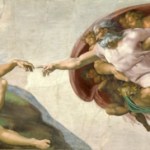
 Michelangelo painted “The creation of Adam” and other biblical scenes on the ceiling of the Sistine Chapel in Rome (1508-1512). It seems to reflect the idea that humanity has been created in the image and likeness of God. And, as discussed below, Adam is shown as a male adult. Why is the first miracle in the Bible the greatest?
Creation
The Bible begins with, “In the beginning God created the heavens and the earth” (Gen. 1:1NIV). This is the absolute (not relative) beginning of space-time. It begins with a creative act of God and rules out many false ideas that people have today (Appendix A). This creation is a reason to praise God (Appendix B). “The heavens and the earth” is a figure of speech called a merism in which two opposites are combined into an all-encompassing single concept. For example, a shop that is open “day and night” is open 24 hours per day. “The heavens and the earth” means the universe (or everything that has been created). It’s mentioned in the ten commandments as, “in six days the Lord made the heavens and the earth, the sea, and all that is in them” (Ex. 20:11). Then God describes how He created everything (Genesis 1:1 – 2:25). (more…)
Share this:

Where were you?

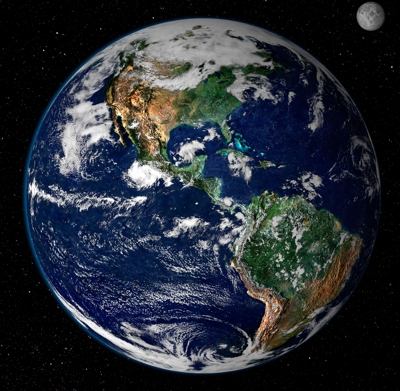 If you had the opportunity, what question would you ask God? After tragedy in his life, Job had many questions for God. But when they finally met the tables were turned and God asked Job “Where were you when I created the world”? Job was silenced because the answer was “Nowhere”.
Question and answer
The context is that God says that Job needs to be educated on mysteries that surpass his understanding (38:2). He should have realized that many things known to God are hidden from humanity.
The first question that God asked was:
4“Where were you when I laid the earth’s foundation?
Tell me, if you understand.
5 Who marked off its dimensions? Surely you know!
Who stretched a measuring line across it?
6 On what were its footings set,
or who laid its cornerstone—
7 while the morning stars sang together
and all the angels shouted for joy?” (Job 38:4-7NIV) (more…)
Share this:

An evolutionary miracle
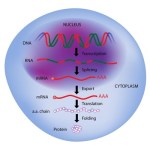
 The theory of biological evolution is the current scientific explanation of life on earth. This assumes that life has developed from simple to complex over time. So if we extrapolate backwards in time, we eventually reach the first living cell. As this theory relies on natural selection, it only operates on populations of species, and not on the original members of the species (like the first living cell). So where did the original living cell (which is assumed to be the ancestor of all life on earth) come from? It’s assumed that life originated from non-living chemicals via chemical evolution. Did you know that this theory includes a miracle that can’t be explained by modern science? According to the Macquarie dictionary, a miracle is “an effect in the physical world which surpasses all known human or natural powers and is therefore ascribed to supernatural agency”.
Complexity of life
In the 19th century many people believed the theory of spontaneous generation; that life arose from non-living matter. This is understandable because they knew little about the cell’s structure. (more…)
Share this:

Two Big-bang miracles

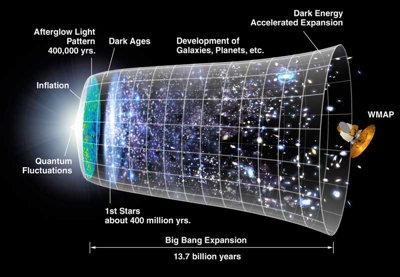 The big-bang model is the current scientific explanation of the universe (Appendix A). Did you know that this mathematical theory includes two miracles that can’t be explained by modern science? According to the Macquarie dictionary, a miracle is “an effect in the physical world which surpasses all known human or natural powers and is therefore ascribed to supernatural agency”.
A model is a mathematical explanation of something. Models that describe a current process can be tested experimentally against the real thing. Their predictions can be compared with observations. This is operational science which is reliable. But models about the distant past can’t be tested in that way because we can’t directly observe the past (and human records are fragmentary). This is historical (or forensic) science which is more speculative and unreliable than operational science. It involves the construction of tentative historical narratives to explain past events. And models about the distant future can’t be tested in that way because the future hasn’t occurred yet. This is futuristic science which is also more speculative and unreliable. Historical and futuristic science often rely on unreliable assumptions and extrapolations. But just because operational science is reliable, doesn’t mean that the others are also reliable. In fact, because they can’t be tested by experimentation, historical and futuristic science will always be less accurate than operational science. So operational science is more robust than historical and futuristic science. (more…)
Share this:

God created a huge universe
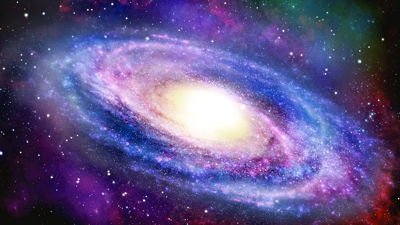 Was the universe small at the beginning and then grow to be huge or was it huge at the beginning? A common view is that because the universe is very large, it needed a long time to form.
What does the Bible say about this topic? We will look at the creation of vegetation, living creatures and people before looking at the creation of stars and galaxies.
Vegetation
Plants grow when a seed germinates. The seed grows to be a seedling, which grows to be a budding plant, which grows to be a flowering plant, which grows to be a ripened mature plant with seeds/fruit.
On the third day of creation, “The land produced vegetation: plants bearing seed according to their kinds and trees bearing fruit with seed in it according to their kinds” (Gen. 1:12NIV). So the plants had seeds and the trees had fruit, indicating that they were mature. (more…)
Share this:

The chicken or the egg?

 Which came first, the chicken or the egg? This is an old riddle. All chickens hatch from eggs, and all chicken eggs are laid by hens, which are adult chickens. It’s a way of describing situations where It’s not clear which of two events should be considered the cause and which should be considered the effect. In the case of literature, which came first? And did the earlier influence the later?
Some scholars claim that Biblical writers drew upon the cultural and religious legacy of the ancient Near East, its stories and its imagery. For example, could the Biblical account of creation be based on ancient mythology like Enuma Elish?
Hebrew account of creation
The first two chapters of Genesis describe the creation of the universe, earth and humanity. This book was edited by Moses in about 1450BC and the earliest copies available today are from the 2nd century BC found in the Dead Sea Scrolls.
Genesis 1-2 is summarized below:
In the beginning of time God created the universe over a period of six days. On day one light, water and the earth were created. On day two, the atmosphere. On day three, land with vegetation. On day four, the solar system and stars. On day five, animals and birds. On day six, the first people (Adam and Eve). And God rested on the seventh day. Before this, God was all that existed. God created a universe that was good and free from sin. And God created humanity to have a personal relationship with Him.
More detail about the creation of Adam (“from the dust of the ground”) and Eve (from Adam’s rib) is given in Genesis 2. This includes establishing the relationship of heterosexual marriage. They lived in the garden of Eden and were to “work it and take care of it”.
 Babylonian account of creation
The “Enuma Elish (EE)” is a Babylonian poem that tells the story of how the universe came into being, a great struggle among the gods, and the creation of the earth and humanity. The main purpose of this epic was to explain the elevation of the chief Babylonian god Marduk to the top of the Mesopotamian pantheon and the legitimization of his superiority over the other gods. It says that Babylon is the pre-eminent city in the world. And it puts more emphasis on explaining the origin of gods than the origin of the universe. The oldest copies of this poem are written on seven tablets from the 7th century BC found in the ruined Library of Ashurbanipal at Nineveh (Mosul, Iraq). The text on each tablet is between about 138 and 166 lines long and is comprised of two-line verses (sentence units).
 The translation of these texts is not exact. In some cases, badly damaged tablets make reading the text difficult. Some translators leave the gaps, while others attempt to reconstruct the text based on what remains. In other cases, there are differing interpretations of the meaning of words or the reading of the cuneiform itself. Many translations of the tablets try to capture the sense of the text rather than a literal translation.
 Enuma Elish (EE) has been summarized as follows. “The two original gods Apsu, the male, and Tiamat, the female, are created from water. They then beget all other gods, but these “children” make so much noise that Apsu is unable to sleep and decides to kill them. However, before he can, one of the offspring puts a spell on him and kills him. Tiamat, to avenge his death, takes up the cudgels, but Marduk (another offspring) eliminates her, splitting her in two, and the two parts of her corpse become the heavens and the Earth. Marduk relieves the other gods of all manual work by creating man (from the blood vessels of a defeated giant god), and Marduk then becomes the chief god” (Masters, 2004). A longer summary is given in Appendix C.
Comparison
The text of Genesis 1-2 is given in Appendix A and the text of EE is given in Appendix B. Can we tell if one was influenced by the other? There are similarities and differences between these accounts.
Similarities
There are some similarities between Genesis 1-2 and EE. In both, darkness precedes the creative acts; light exists before the creation of the sun, moon, and stars; there is a division of the waters above and below; and the sequence of creation is similar, including the division of waters, dry land, luminaries, and humanity, all followed by rest. There are also some similarities in the structure and terminology in their original languages because they came from similar cultural backgrounds.
Differences
There are also significant differences between Genesis1-2 and EE. All the text (100%) of Genesis is about creation, but only 9% of EE is about creation – the rest is about the Babylonian gods. This 9% is: Tablet 4:138-146; Tablet 5:1-77; and Tablet 6:32-38, 90-91. So creation is only a minor aspect of EE. EE is mainly a hymn of praise to Marduk, whereas Genesis is an account of creation. And EE is clearly mythological, but Genesis is not mythological.
The God in Genesis is monotheistic, while EE has many gods – it’s polytheistic. The God in Genesis is eternal, and not the result of sexual union like Marduk. The God in Genesis is distinct from nature (His creation), whereas the gods of EE are part of nature. The God in Genesis is organized and peaceful, while the gods in EE are warlike and violent. The God in Genesis creates by His spoken word without conflict, melodrama or a lengthy plot. And in Genesis the earth and sky aren’t deities.
In Genesis, humanity was created in the image of God (Gen. 1:26-27). Whereas, in EE humans were created to relieve the gods of their labors – they are given the work once assigned to the gods. In Genesis, Adam is created from the soil of the ground to rule over the creation. In EE, man is created from a god’s blood to be slaves of the gods.
These differences illustrate the differences between the Hebrew and Babylonian worldviews.
Textural criticism
In the Ancient Near East, the rule is that simple accounts or traditions may give rise (by accretion and embellishment) to elaborate legends, but not vice versa. A shorter text can lead to a more verbose text, but not vice-versa. So, the simple Hebrew account of creation can lead to the embellished Babylonian creation legend, but not vice-versa.
EE is usually compared to Genesis 1. EE (1097 lines) is much longer than Genesis 1 (33 verses, including Gen. 2:1-2). This means that if one borrowed from the other, it was the Babylonian account that was influenced by the older Genesis account. And it’s highly unlikely that Moses would have borrowed creation history from a foreign polytheistic civilization.
Conclusion
Genesis 1 is not a Hebrew version of EE. But EE could be a Babylonian version of Genesis 1. According to this evidence, the Biblical account of creation isn’t based on ancient mythology like Enuma Elish.
References
Lambert W G (2007) “Mesopotamian Creation Stories”, in M.J. Geller and M. Schipper (eds), Imagining Creation (IJS Studies in Judaica 5; Brill Academic Publisher
Masters P (2004) “Heritage of evidence: In the British Museum”, Walkman Trust, p.85-86.
Appendix A: Genesis 1-2 (NIV)
Jewish account of creation
Chapter 1
1 In the beginning God created the heavens and the earth. 2 Now the earth was formless and empty, darkness was over the surface of the deep, and the Spirit of God was hovering over the waters.
3 And God said, “Let there be light,” and there was light. 4 God saw that the light was good, and he separated the light from the darkness. 5 God called the light “day,” and the darkness he called “night.” And there was evening, and there was morning—the first day.
6 And God said, “Let there be a vault between the waters to separate water from water.” 7 So God made the vault and separated the water under the vault from the water above it. And it was so. 8 God called the vault “sky.” And there was evening, and there was morning—the second day.
9 And God said, “Let the water under the sky be gathered to one place, and let dry ground appear.” And it was so. 10 God called the dry ground “land,” and the gathered waters he called “seas.” And God saw that it was good.
11 Then God said, “Let the land produce vegetation: seed-bearing plants and trees on the land that bear fruit with seed in it, according to their various kinds.” And it was so. 12 The land produced vegetation: plants bearing seed according to their kinds and trees bearing fruit with seed in it according to their kinds. And God saw that it was good. 13 And there was evening, and there was morning—the third day.
14 And God said, “Let there be lights in the vault of the sky to separate the day from the night, and let them serve as signs to mark sacred times, and days and years, 15 and let them be lights in the vault of the sky to give light on the earth.” And it was so. 16 God made two great lights—the greater light to govern the day [the sun] and the lesser light to govern the night [the moon]. He also made the stars. 17 God set them in the vault of the sky to give light on the earth, 18 to govern the day and the night, and to separate light from darkness. And God saw that it was good. 19 And there was evening, and there was morning—the fourth day.
20 And God said, “Let the water teem with living creatures, and let birds fly above the earth across the vault of the sky.” 21 So God created the great creatures of the sea and every living thing with which the water teems and that moves about in it, according to their kinds, and every winged bird according to its kind. And God saw that it was good. 22 God blessed them and said, “Be fruitful and increase in number and fill the water in the seas, and let the birds increase on the earth.” 23 And there was evening, and there was morning—the fifth day.
24 And God said, “Let the land produce living creatures according to their kinds: the livestock, the creatures that move along the ground, and the wild animals, each according to its kind.” And it was so. 25 God made the wild animals according to their kinds, the livestock according to their kinds, and all the creatures that move along the ground according to their kinds. And God saw that it was good.
26 Then God said, “Let us make mankind in our image, in our likeness, so that they may rule over the fish in the sea and the birds in the sky, over the livestock and all the wild animals, and over all the creatures that move along the ground.”
27 So God created mankind in his own image,
in the image of God he created them;
male and female he created them.
28 God blessed them and said to them, “Be fruitful and increase in number; fill the earth and subdue it. Rule over the fish in the sea and the birds in the sky and over every living creature that moves on the ground.”
29 Then God said, “I give you every seed-bearing plant on the face of the whole earth and every tree that has fruit with seed in it. They will be yours for food. 30 And to all the beasts of the earth and all the birds in the sky and all the creatures that move along the ground—everything that has the breath of life in it—I give every green plant for food.” And it was so.
31 God saw all that he had made, and it was very good. And there was evening, and there was morning—the sixth day.
Chapter 2
1Thus the heavens and the earth were completed in all their vast array.
2 By the seventh day God had finished the work he had been doing; so on the seventh day he rested from all his work. 3 Then God blessed the seventh day and made it holy, because on it he rested from all the work of creating that he had done.
4 This is the account of the heavens and the earth when they were created, when the Lord God made the earth and the heavens.
5 Now no shrub had yet appeared on the earth and no plant had yet sprung up, for the Lord God had not sent rain on the earth and there was no one to work the ground, 6 but streams came up from the earth and watered the whole surface of the ground. 7 Then the Lord God formed a man from the dust of the ground and breathed into his nostrils the breath of life, and the man became a living being.
8 Now the Lord God had planted a garden in the east, in Eden; and there he put the man he had formed. 9 The Lord God made all kinds of trees grow out of the ground—trees that were pleasing to the eye and good for food. In the middle of the garden were the tree of life and the tree of the knowledge of good and evil.
10 A river watering the garden flowed from Eden; from there it was separated into four headwaters. 11 The name of the first is the Pishon; it winds through the entire land of Havilah, where there is gold. 12 (The gold of that land is good; aromatic resin and onyx are also there.) 13 The name of the second river is the Gihon; it winds through the entire land of Cush 14 The name of the third river is the Tigris; it runs along the east side of Ashur. And the fourth river is the Euphrates.
15 The Lord God took the man and put him in the Garden of Eden to work it and take care of it. 16 And the Lord God commanded the man, “You are free to eat from any tree in the garden; 17 but you must not eat from the tree of the knowledge of good and evil, for when you eat from it you will certainly die.”
18 The Lord God said, “It is not good for the man to be alone. I will make a helper suitable for him.”
19 Now the Lord God had formed out of the ground all the wild animals and all the birds in the sky. He brought them to the man to see what he would name them; and whatever the man called each living creature, that was its name. 20 So the man gave names to all the livestock, the birds in the sky and all the wild animals.
But for Adam no suitable helper was found. 21 So the Lord God caused the man to fall into a deep sleep; and while he was sleeping, he took one of the man’s ribs and then closed up the place with flesh. 22 Then the Lord God made a woman from the rib he had taken out of the man, and he brought her to the man.
23 The man said,
“This is now bone of my bones
and flesh of my flesh;
she shall be called ‘woman,’
for she was taken out of man.”
24 That is why a man leaves his father and mother and is united to his wife, and they become one flesh.
25 Adam and his wife were both naked, and they felt no shame.
Appendix B: Enuma Elish
Babylonian epic of creation
Translation by W G Lambert (2007)
Tablet 1
1 When the heavens above did not exist,
2 And earth beneath had not come into being —
3 There was Apsû, the first in order, their begetter,
4 And demiurge Tia-mat, who gave birth to them all;
5 They had mingled their waters together
6 Before meadow-land had coalesced and reed-bed was to he found —
7 When not one of the gods had been formed
8 Or had come into being, when no destinies had been decreed,
9 The gods were created within them:
10 Lah(mu and Lah(amu were formed and came into being.
11 While they grew and increased in stature
12 Anšar and Kišar, who excelled them, were created.
13 They prolonged their days, they multiplied their years.
14 Anu, their son, could rival his fathers.
15 Anu, the son, equalled Anšar,
16 And Anu begat Nudimmud, his own equal.
17 Nudimmud was the champion among his fathers:
18 Profoundly discerning, wise, of robust strength;
19 Very much stronger than his father’s begetter, Anšar
20 He had no rival among the gods, his brothers.
21 The divine brothers came together,
22 Their clamour got loud, throwing Tia-mat into a turmoil.
23 They jarred the nerves of Tia-mat,
24 And by their dancing they spread alarm in Anduruna.
25 Apsû did not diminish their clamour,
26 And Tia-mat was silent when confronted with them.
27 Their conduct was displeasing to her,
28 Yet though their behaviour was not good, she wished to spare them.
29 Thereupon Apsû, the begetter of the great gods,
30 Called Mummu, his vizier, and addressed him,
31 “Vizier Mummu, who gratifies my pleasure,
32 Come, let us go to Tia-mat!”
33 They went and sat, facing Tia-mat,
34 As they conferred about the gods, their sons.
35 Apsû opened his mouth
36 And addressed Tia-mat
37 “Their behaviour has become displeasing to me
38 And I cannot rest in the day-time or sleep at night.
39 I will destroy and break up their way of life
40 That silence may reign and we may sleep.”
41 When Tia-mat heard this
42 She raged and cried out to her spouse,
43 She cried in distress, fuming within herself,
44 She grieved over the (plotted) evil,
45 “How can we destroy what we have given birth to?
46 Though their behaviour causes distress, let us tighten discipline graciously.”
47 Mummu spoke up with counsel for Apsû—
48 (As from) a rebellious vizier was the counsel of his Mummu—
49 “Destroy, my father, that lawless way of life,
50 That you may rest in the day-time and sleep by night!”
51 Apsû was pleased with him, his face beamed
52 Because he had plotted evil against the gods, his sons.
53 Mummu put his arms around Apsû’s neck,
54 He sat on his knees kissing him.
55 What they plotted in their gathering
56 Was reported to the gods, their sons.
57 The gods heard it and were frantic.
58 They were overcome with silence and sat quietly.
59 Ea, who excels in knowledge, the skilled and learned,
60 Ea, who knows everything, perceived their tricks.
61 He fashioned it and made it to be all-embracing,
62 He executed it skilfully as supreme—his pure incantation.
63 He recited it and set it on the waters,
64 He poured sleep upon him as he was slumbering deeply.
65 He put Apsû to slumber as he poured out sleep,
66 And Mummu, the counsellor, was breathless with agitation.
67 He split (Apsû’s) sinews, ripped off his crown,
68 Carried away his aura and put it on himself.
69 He bound Apsû and killed him;
70 Mummu he confined and handled roughly.
71 He set his dwelling upon Apsû,
72 And laid hold on Mummu, keeping the nose-rope in his hand.
73 After Ea had bound and slain his enemies,
74 Had achieved victory over his foes,
75 He rested quietly in his chamber,
76 He called it Apsû, whose shrines he appointed.
77 Then he founded his living-quarters within it,
78 And Ea and Damkina, his wife, sat in splendour.
79 In the chamber of the destinies, the room of the archetypes,
80 The wisest of the wise, the sage of the gods, Be-l was conceived.
81 In Apsû was Marduk born,
82 In pure Apsû was Marduk born.
83 Ea his father begat him,
84 Damkina his mother bore him.
85 He sucked the breasts of goddesses,
86 A nurse reared him and filled him with terror.
87 His figure was well developed, the glance of his eyes was dazzling,
88 His growth was manly, he was mighty from the beginning.
89 Anu, his father’s begetter, saw him,
90 He exulted and smiled; his heart filled with joy.
91 Anu rendered him perfect: his divinity was remarkable,
92 And he became very lofty, excelling them in his attributes.
93 His members were incomprehensibly wonderful,
94 Incapable of being grasped with the mind, hard even to look on.
95 Four were his eyes, four his ears,
96 Flame shot forth as he moved his lips.
97 His four ears grew large,
93 And his eyes likewise took in everything.
99 His figure was lofty and superior in comparison with the gods,
100 His limbs were surpassing, his nature was superior.
101 ‘Mari-utu, Mari-utu,
102 The Son, the Sun-god, the Sun-god of the gods.’
103 He was clothed with the aura of the Ten Gods, so exalted was his strength,
104 The Fifty Dreads were loaded upon him.
105 Anu formed and gave birth to the four winds,
106 He delivered them to him, “My son, let them whirl!”
107 He formed dust and set a hurricane to drive it,
108 He made a wave to bring consternation on Tia-mat.
109 Tia-mat was confounded; day and night she was frantic.
110 The gods took no rest, they . . . . . . .
111 In their minds they plotted evil,
112 And addressed their mother Tia-mat,
113 “When Apsû, your spouse, was killed,
114 You did not go at his side, but sat quietly.
115 The four dreadful winds have been fashioned
116 To throw you into confusion, and we cannot sleep.
117 You gave no thought to Apsû, your spouse,
113 Nor to Mummu, who is a prisoner. Now you sit alone.
119 Henceforth you will be in frantic consternation!
120 And as for us, who cannot rest, you do not love us!
121 Consider our burden, our eyes are hollow.
122 Break the immovable yoke that we may sleep.
123 Make battle, avenge them!
124 [ . . ] . . . . reduce to nothingness!
125 Tia-mat heard, the speech pleased her,
126 (She said,) “Let us make demons, [as you] have advised.”
127 The gods assembled within her.
128 They conceived [evil] against the gods their begetters.
129 They . . . . . and took the side of Tia-mat,
130 Fiercely plotting, unresting by night and day,
131 Lusting for battle, raging, storming,
132 They set up a host to bring about conflict.
133 Mother H(ubur, who forms everything,
134 Supplied irresistible weapons, and gave birth to giant serpents.
135 They had sharp teeth, they were merciless . . . .
136 With poison instead of blood she filled their bodies.
137 She clothed the fearful monsters with dread,
138 She loaded them with an aura and made them godlike.
139 (She said,) “Let their onlooker feebly perish,
140 May they constantly leap forward and never retire.”
141 She created the Hydra, the Dragon, the Hairy Hero
142 The Great Demon, the Savage Dog, and the Scorpion-man,
143 Fierce demons, the Fish-man, and the Bull-man,
144 Carriers of merciless weapons, fearless in the face of battle.
145 Her commands were tremendous, not to be resisted.
146 Altogether she made eleven of that kind.
147 Among the gods, her sons, whom she constituted her host,
148 She exalted Qingu, and magnified him among them.
149 The leadership of the army, the direction of the host,
150 The bearing of weapons, campaigning, the mobilization of conflict,
151 The chief executive power of battle, supreme command,
152 She entrusted to him and set him on a throne,
153 “I have cast the spell for you and exalted you in the host of the gods,
154 I have delivered to you the rule of all the gods.
155 You are indeed exalted, my spouse, you are renowned,
156 Let your commands prevail over all the Anunnaki.”
157 She gave him the Tablet of Destinies and fastened it to his breast,
158 (Saying) “Your order may not be changed; let the utterance of your mouth be firm.”
159 After Qingu was elevated and had acquired the power of Anuship,
160 He decreed the destinies for the gods, her sons:
161 “May the utterance of your mouths subdue the fire-god,
162 May your poison by its accumulation put down aggression.”
Tablet 2
1 Tia-mat gathered together her creation
2 And organised battle against the gods, her offspring.
3 Henceforth Tia-mat plotted evil because of Apsû
4 It became known to Ea that she had arranged the conflict.
5 Ea heard this matter,
6 He lapsed into silence in his chamber and sat motionless.
7 After he had reflected and his anger had subsided
8 He directed his steps to Anšar his father.
9 He entered the presence of the father of his begetter, Anšar,
10 And related to him all of Tia-mat’s plotting.
11 “My father, Tia-mat our mother has conceived a hatred for us,
12 She has established a host in her savage fury.
13 All the gods have turned to her,
14 Even those you (pl.) begat also take her side
15 They . . . . . and took the side of Tia-mat,
16 Fiercely plotting, unresting by night and day,
17 Lusting for battle, raging, storming,
18 They set up a host to bring about conflict.
19 Mother H(ubur, who forms everything,
20 Supplied irresistible weapons, and gave birth to giant serpents.
21 They had sharp teeth, they were merciless.
22 With poison instead of blood she filled their bodies.
23 She clothed the fearful monsters with dread,
24 She loaded them with an aura and made them godlike.
25 (She said,) “Let their onlooker feebly perish,
26 May they constantly leap forward and never retire.”
27 She created the Hydra, the Dragon, the Hairy Hero,
28 The Great Demon, the Savage Dog, and the Scorpion-man,
29 Fierce demons, the Fish-man, and the Bull-man,
30 Carriers of merciless weapons, fearless in the face of battle.
31 Her commands were tremendous, not to be resisted.
32 Altogether she made eleven of that kind.
33 Among the gods, her sons, whom she constituted her host,
34 She exalted Qingu and magnified him among them.
35 The leadership of the army, the direction of the host,
36 The bearing of weapons, campaigning, the mobilization of conflict,
37 The chief executive power of battle supreme command,
38 She entrusted to him and set him on a throne.
39 “I have cast the spell for you and exalted you in the host of the gods,
40 I have delivered to you the rule of all the gods.
41 You are indeed exalted, my spouse, you are renowned,
42 Let your commands prevail over all the Anunnaki.”
43 She gave him the tablet of Destinies and fastened it to his breast,
44 (Saying) “Your order may not he changed; let the utterance of your mouth be firm.”
45 After Qingu was elevated and had acquired the power of Anuship
46 He decreed the destinies for the gods. her sons:
47 “May the utterance of your mouths subdue the fire-god,
48 May your poison by its accumulation put down aggression.”
49 Anšar heard; the matter was profoundly disturbing.
50 He cried “Woe!” and bit his lip.
51 His heart was in fury, his mind could not be calmed.
52 Over Ea his son his cry was faltering.
53 “My son, you who provoked the war,
54 Take responsibility for whatever you alone have done!
55 You set out and killed Apsû,
56 And as for Tia-mat, whom you made furious, where is her equal?”
57 The gatherer of counsel, the learned prince,
58 The creator of wisdom, the god Nudimmud
59 With soothing words and calming utterance
60 Gently answered [his] father Anšar
61 “My father, deep mind, who decrees destiny,
62 Who has the power to bring into being and destroy,
63 Anšar, deep mind, who decrees destiny,
64 Who has the power to bring into being and to destroy,
65 I want to say something to you, calm down for me for a moment
66 And consider that I performed a helpful deed.
67 Before I killed Apsû
68 Who could have seen the present situation?
69 Before I quickly made an end of him
70 What were the circumstances were I to destroy him?”
71 Anšar heard, the words pleased him.
72 His heart relaxed to speak to Ea,
73 “My son, your deeds are fitting for a god,
74 You are capable of a fierce, unequalled blow . . [ . . . ]
75 Ea, your deeds are fitting for a god,
76 You are capable of a fierce, unequalled blow . . [ . . . ]
77 Go before Tia-mat and appease her attack,
78 . . [ . . . ] . . . her fury with [your] incantation.”
79 He heard the speech of Anšar his father,
80 He took the road to her, proceeded on the route to her.
81 He went, he perceived the tricks of Tia-mat,
82 [He stopped], fell silent, and turned back.
83 [He] entered the presence of august Anšar
84 Penitently addressing him,
85 “[My father], Tia-mat’s deeds are too much for me.
86 I perceived her planning, and [my] incantation was not equal (to it).
87 Her strength is mighty, she is full of dread,
88 She is altogether very strong, none can go against her.
89 Her very loud cry did not diminish,
90 [I became afraid] of her cry and turned back.
91 [My father], do not lose hope, send a second person against her.
92 Though a woman’s strength is very great, it is not equal to a man’s.
93 Disband her cohorts, break up her plans
94 Before she lays her hands on us.”
95 Anšar cried out in intense fury,
96 Addressing Anu his son,
97 “Honoured son, hero, warrior,
98 Whose strength is mighty, whose attack is irresistible
99 Hasten and stand before Tia-mat,
100 Appease her rage that her heart may relax
101 If she does not harken to your words,
102 Address to her words of petition that she may be appeased.”
103 He heard the speech of Anšar his father,
104 He took the road to her, proceeded on the route to her.
105 Anu went, he perceived the tricks of Tia-mat,
106 He stopped, fell silent, and turned back.
107 He entered the presence of Anšar the father who begat him,
108 Penitently addressing him.
109 “My father, Tia-mat’s [deeds] are too much for me.
110 I perceived her planning, but my [incantation] was not [equal] (to it).
111 Her strength is mighty, she is [full] of dread,
112 She is altogether very strong, no one [can go against her].
113 Her very loud noise does not diminish,
114 I became afraid of her cry and turned back.
115 My father, do not lose hope, send another person against her.
116 Though a woman’s strength is very great, it is not equal to a man’s.
117 Disband her cohorts, break up her plans,
118 Before she lays her hands on us.”
119 Anšar lapsed into silence, staring at the ground,
120 He nodded to Ea, shaking his head.
121 The Igigi and all the Anunnaki had assembled,
122 They sat in tight-lipped silence.
123 No god would go to face . . [ . . ]
124 Would go out against Tia-mat . . . . [ . . ]
125 Yet the lord Anšar, the father of the great gods,
126 Was angry in his heart, and did not summon any one.
127 A mighty son, the avenger of his father,
128 He who hastens to war, the warrior Marduk
129 Ea summoned (him) to his private chamber
130 To explain to him his plans.
131 “Marduk, give counsel, listen to your father.
132 You are my son, who gives me pleasure,
133 Go reverently before Anšar,
134 Speak, take your stand, appease him with your glance.”
135 Be-l rejoiced at his father’s words,
136 He drew near and stood in the presence of Anšar.
137 Anšar saw him, his heart filled with satisfaction,
138 He kissed his lips and removed his fear.
139 “My [father] do not hold your peace, but speak forth,
140 I will go and fulfil your desires!
141 [Anšar,] do not hold your peace, but speak forth,
142 I will go and fulfil your desires!
143 Which man has drawn up his battle array against you?
144 And will Tia-mat, who is a woman, attack you with (her) weapons?
145 [“My father], begetter, rejoice and be glad,
146 Soon you will tread on the neck of Tia-mat!
147 [Anšar], begetter, rejoice and be glad,
148 Soon you will tread on the neck of Tia-mat!
149 [“Go,] my son, conversant with all knowledge,
150 Appease Tia-mat with your pure spell.
151 Drive the storm chariot without delay,
152 And with a [ . . ] which cannot be repelled turn her back.”
153 Be-l rejoiced at his father’s words,
154 With glad heart he addressed his father,
155 “Lord of the gods, Destiny of the great gods,
156 If I should become your avenger,
157 If I should bind Tia-mat and preserve you,
158 Convene an assembly and proclaim for me an exalted destiny.
159 Sit, all of you, in Upšukkinakku with gladness,
160 And let me, with my utterance, decree destinies instead of you.
161 Whatever I instigate must not be changed,
162 Nor may my command be nullified or altered.”
Tablet 3
1 Anšar opened his mouth
2 And addressed Kaka, his vizier,
3 “Vizier Kaka, who gratifies my pleasure,
4 I will send you to Lah(mu and Lah(amu.
5 You are skilled in making inquiry, learned in address.
6 Have the gods, my fathers, brought to my presence.
7 Let all the gods be brought,
8 Let them confer as they sit at table.
9 Let them eat grain, let them drink ale,
10 Let them decree the destiny for Marduk their avenger.
11 Go, be gone, Kaka, stand before them,
12 And repeat to them all that I tell you:
13 “Anšar, your son, has sent me,
14 And I am to explain his plans.
15-52 = Tablet 2, 11*-48 (* instead of ‘My father,’ put ‘ ‘Thus,’ )
53 I sent Anu, but he could not face her.
54 Nudimmud took fright and retired.
55 Marduk, the sage of the gods, your son, has come forward,
56 He has determined to meet Tia-mat.
57 He has spoken to me and said,
58-64 = Tablet 2, 156*-162 (* begin with quotation marks: “If )
65 Quickly, now, decree your destiny for him without delay,
66 That he may go and face your powerful enemy.”
67 Kaka went. He directed his steps
68 To Lah(mu and Lah(amu, the gods his fathers.
69 He prostrated himself, he kissed the ground before them,
70 He got up, saying to them he stood,
71-124 = Tablet 2, 13-66
125 When Lah(h(a and Lah(amu heard, they cried aloud.
126 All the Igigi moaned in distress,
127 “What has gone wrong that she took this decision about us?
128 We did not know what Tia-mat was doing.”
129 All the great gods who decree destinies
130 Gathered as they went,
131 They entered the presence of Anšar and became filled with [joy],
132 They kissed one another as they . [ . . ] in the assembly.
133 They conferred as they sat at table,
134 They ate grain, they drank ale.
135 They strained the sweet liquor through their straws,
136 As they drank beer and felt good,
137 They became quite carefree, their mood was merry,
138 And they decreed the fate for Marduk, their avenger.
Tablet 4
1 They set a lordly dais for him
2 And he took his seat before his fathers to receive kingship.
3 (They said,) “You are the most honoured among the great gods,
4 Your destiny is unequalled, your command is like Anu’s.
5 Marduk, you are the most honoured among the great gods,
6 Your destiny is unequalled, your command is like Anu’s.
7 Henceforth your order will not be annulled,
8 It is in your power to exalt and abase.
9 Your utterance is sure, your command cannot be rebelled against,
10 None of the gods will transgress the line you draw.
11 Shrines for all the gods needs provisioning,
12 That you may be established where their sanctuaries are.
13 You are Marduk, our avenger,
14 We have given you kingship over the sum of the whole universe.
15 Take your seat in the assembly, let your word be exalted,
16 Let your weapons not miss the mark, but may they slay your enemies.
17 Be-l, spare him who trusts in you,
18 But destroy the god who set his mind on evil.”
19 They set a constellation in the middle
20 And addressed Marduk, their son,
21 “Your destiny, Be-l, is superior to that of all the gods,
22 Command and bring about annihilation and re-creation.
23 Let the constellation disappear at your utterance,
24 With a second command let the constellation reappear.”
25 He gave the command and the constellation disappeared,
26 With a second command the constellation came into being again.
27 When the gods, his fathers, saw (the effect of) his utterance,
28 They rejoiced and offered congratulation: “Marduk is the king!”
29 They added to him a mace, a throne, and a rod,
30 They gave him an irresistible weapon that overwhelms the foe:
31 (They said,) “Go, cut Tia-mat’s throat,
32 And let the winds bear up her blood to give the news.”
33 The gods, his fathers, decreed the destiny of Be-l,
34 And set him on the road, the way of prosperity and success.
35 He fashioned a bow and made it his weapon,
36 He set an arrow in place, put the bow string on.
37 He took up his club and held it in his right hand,
38 His bow and quiver he hung at his side.
39 He placed lightning before him,
40 And filled his body with tongues of flame.
41 He made a net to enmesh the entrails of Tia-mat,
42 And stationed the four winds that no part of her escape.
43 The South Wind, the North Wind, the East Wind, the West Wind,
44 He put beside his net, winds given by his father, Anu.
45 He fashioned the Evil Wind, the Dust Storm, Tempest,
46 The Four-fold Wind, the Seven-fold Wind, the Chaos-spreading Wind, the . . . . .Wind.
47 He sent out the seven winds that he had fashioned,
48 And they took their stand behind him to harass Tia-mat’s entrails.
49 Be-l took up the Storm-flood, his great weapon,
50 He rode the fearful chariot of the irresistible storm.
51 Four steeds he yoked to it and harnessed them to it,
52 The Destroyer, The Merciless, The Trampler, The Fleet.
53 Their lips were parted, their teeth bore venom,
54 They were strangers to weariness, trained to sweep forward.
55 At his right hand he stationed raging battle and strife,
56 On the left, conflict that overwhelms a united battle array.
57 He was clad in a tunic, a fearful coat of mail,
58 And on has head he wore an aura of terror.
59 Be-l proceeded and set out on his way,
60 He set his face toward the raging Tia-mat.
61 In his lips he held a spell,
62 He grasped a plant to counter poison in his hand,
63 Thereupon they milled around him, the gods milled around him,
64 The gods, his fathers, milled around him, the gods milled around him.
65 Be-l drew near, surveying the maw of Tia-mat,
66 He observed the tricks of Qingu, her spouse.
67 As he looked, he lost his nerve,
68 His determination went and he faltered.
69 His divine aides, who were marching at his side,
70 Saw the warrior, the foremost, and their vision became dim.
71 Tia-mat cast her spell without turning her neck,
72 In her lips she held untruth and lies,
73 “[ . ] . . . . . . . . . . . . .
74 In their [ . ] . they have assembled by you.”
75 Be-l [lifted up] the Storm-flood, his great weapon,
76 And with these words threw it at the raging Tia-mat,
77 “Why are you aggressive and arrogant,
78 And strive to provoke battle?
79 The younger generation have shouted, outraging their elders,
80 But you, their mother, hold pity in contempt.
81 Qingu you have named to be your spouse,
82 And you have improperly appointed him to the rank of Anuship.
83 Against Anšar, king of the gods, you have stirred up trouble,
84 And against the gods, my fathers, your trouble is established.
85 Deploy your troops, gird on your weapons,
86 You and I will take our stand and do battle.”
87 When Tia-mat heard this
88 She went insane and lost her reason.
89 Tia-mat cried aloud and fiercely,
90 All her lower members trembled beneath her.
91 She was reciting an incantation, kept reciting her spell,
92 While the (battle-)gods were sharpening their weapons of war.
93 Tia-mat and Marduk, the sage of the gods, came together,
94 Joining in strife, drawing near to battle.
95 Be-l spread out his net and enmeshed her;
96 He let loose the Evil Wind, the rear guard, in her face.
97 Tia-mat opened her mouth to swallow it,
98 She let the Evil Wind in so that she could not close her lips.
99 The fierce winds weighed down her belly,
100 Her inwards were distended and she opened her mouth wide.
101 He let fly an arrow and pierced her belly,
102 He tore open her entrails and slit her inwards,
103 He bound her and extinguished her life,
104 He threw down her corpse and stood on it.
105 After he had killed Tia-mat, the leader,
106 Her assembly dispersed, her host scattered.
107 Her divine aides, who went beside her,
108 In trembling and fear beat a retreat.
109 . . . . to save their lives,
110 But they were completely surrounded, unable to escape.
111 He bound them and broke their weapons,
112 And they lay enmeshed, sitting in a snare,
113 Hiding in corners, filled with grief,
114 Bearing his punishment, held in a prison.
115 The eleven creatures who were laden with fearfulness,
116 The throng of devils who went as grooms at her right hand,
117 He put ropes upon them and bound their arms,
118 Together with their warfare he trampled them beneath him.
119 Now Qingu, who had risen to power among them,
120 He bound and reckoned with the Dead Gods.
121 He took from him the Tablet of Destinies, which was not properly his,
122 Sealed it with a seal and fastened it to his own breast.
123 After the warrior Marduk had bound and slain his enemies,
124 Had . . . . the arrogant enemy . . . ,
125 Had established victory for Anšar over all his foes,
126 Had fulfilled the desire of Nudimmud,
127 He strengthened his hold on the Bound Gods,
128 And returned to Tia-mat, whom he had bound.
129 Be-l placed his feet on the lower parts of Tia-mat
130 And with his merciless club smashed her skull.
131 He severed her arteries
132 And let the North wind bear up (her blood) to give the news.
133 His fathers saw it and were glad and exulted;
134 They brought gifts and presents to him.
135 Be-l rested, surveying the corpse,
136 In order to divide the lump by a clever scheme.
137 He split her into two like a dried fish:
138 One half of her he set up and stretched out as the heavens.
139 He stretched the skin and appointed a watch
140 With the instruction not to let her waters escape.
141 He crossed over the heavens, surveyed the celestial parts,
142 And adjusted them to match the Apsû, Nudimmud’s abode.
143 Be-l measured the shape of the Apsû
144 And set up Ešarra, a replica of Ešgalla.
145 In Ešgalla, Ešarra which he had built, and the heavens,
146 He settled in their shrines Anu, Enlil, and Ea.
Tablet 5
1 He fashioned heavenly stations for the great gods,
2 And set up constellations, the patterns of the stars.
3 He appointed the year, marked off divisions,
4 And set up three stars each for the twelve months.
5 After he had organized the year,
6 He established the heavenly station of Ne-beru to fix the stars’ intervals.
7 That none should transgress or be slothful
8 He fixed the heavenly stations of Enlil and Ea with it.
9 Gates he opened on both sides,
10 And put strong bolts at the left and the right.
11 He placed the heights (of heaven) in her (Tia-mat’s) belly,
12 He created Nannar, entrusting to him the night.
13 He appointed him as the jewel of the night to fix the days,
14 And month by month without ceasing he elevated him with a crown,
15 (Saying,) “Shine over the land at the beginning of the month,
16 Resplendent with horns to fix six days.
17 On the seventh day the crown will be half size,
18 On the fifteenth day, halfway through each month, stand in opposition.
19 When Šamaš [sees] you on the horizon,
20 Diminish in the proper stages and shine backwards.
21 On the 29th day, draw near to the path of Šamaš,
22 . [ . . ] the 30th day, stand in conjunction and rival Šamaš.
23 I have ( . . . . ] . the sign, follow its track,
24 Draw near . . ( . . . . . ) give judgment.
25 . [ . . . . ] . Šamaš, constrain [murder] and violence,
26 . [ . . . . . . . . . . . . . . . . . . . ] . me.
* * * * * *
35 At the end [ . . .
36 Let there [be] the 29th day [ . . . ”
37 After [he had . . . . ] the decrees [ . . .
38 The organization of front and . [ . . .
39 He made the day [ . . .
40 Let the year be equally [ . . .
41 At the new year [ . . .
42 The year . . . . . [ . . .
43 Let there be regularly [ . . .
44 The projecting bolt [ . . .
45 After he had [ . . .
46 The watches of night and day [ . . .
47 The foam which Tia-mat [ . . .
48 Marduk fashioned [ . . .
49 He gathered it together and made it into clouds.
50 The raging of the winds, violent rainstorms,
51 The billowing of mist—the accumulation of her spittle—
52 He appointed for himself and took them in his hand.
53 He put her head in position and poured out . . [ . . ] .
54 He opened the abyss and it was sated with water.
55 From her two eyes he let the Euphrates and Tigris flow,
56 He blocked her nostrils, but left . .
57 He heaped up the distant [mountains] on her breasts,
58 He bored wells to channel the springs.
59 He twisted her tail and wove it into the Durmah(u,
60 [ . . . ] . . the Apsû beneath his feet.
61 [He set up] her crotch—it wedged up the heavens—
62 [(Thus) the half of her] he stretched out and made it firm as the earth.
63 [After] he had finished his work inside Tia-mat,
64 [He spread] his net and let it right out.
65 He surveyed the heavens and the earth . . [ . ] .
66 [ . . ] their bonds . . . . . . .
67 After he had formulated his regulations and composed [his] decrees,
68 He attached guide-ropes and put them in Ea’s hands.
69 [The Tablet] of Destinies which Qingu had taken and carried,
70 He took charge of it as a trophy (?) and presented it to Anu.
71 [The . ] . of battle, which he had tied on or had put on his head,
72 [ . ] . he brought before his fathers.
73 [Now] the eleven creatures to which Tia-mat had given birth and . . . ,
74 He broke their weapons and bound them (the creatures) to his feet.
75 He made images of them and stationed them at the [Gate] of the Apsû,
76 To be a sign never to be forgotten.
77 [The gods] saw it and were jubilantly happy,
78 (That is,) Lah(mu, Lah(amu and all his fathers.
79 Anšar [embraced] him and published abroad his title, “Victorious King,”
80 Anu, Enlil and Ea gave him gifts.
81 Mother Damkina, who bore him, hailed him,
82 With a clean festal robe she made his face shine.
83 To Usmû, who held her present to give the news,
84 [He entrusted] the vizierate of the Apsû and the care of the holy places.
85 The Igigi assembled and all did obeisance to him,
86 Every one of the Anunnaki was kissing his feet.
87 They all [gathered] to show their submission,
88 [ . . . ] . they stood, they bowed down, “Behold the king!”
89 His fathers [ . . . ] . and took their fill of his beauty,
90 Be-l listened to their utterance, being girded with the dust of battle.
91 . [ . . . . . . . . . . . . ] . . . . . . .
92 Anointing his body with . [ . . . ] cedar perfume.
93 He clothed himself in [his] lordly robe,
94 With a crown of terror as a royal aura.
95 He took up his club and held it in his right hand,
96 . . . ] . he grasped in his left.
97 [ . . . . . . . . . . . . . . . . . . . . ]
98 . . . ] . he set his feet.
99 He put upon . [ . . .
100 The sceptre of prosperity and success [he hung] at his side.
101 After [he had . . . ] the aura [
102 He adorned(?) his sack, the Apsû, with a fearful [ . . ]
103 Was settled like . [ . . .
104 In [his] throne room [ . . .
105 In his cella [ . . .
106 Every one of the gods [ . . .
107 Lah(mu and Lah(amu . [ . . . . . . . ] .
108 Opened their mouths and [addressed] the Igigi gods,
109 “Previously Marduk was our beloved son,
110 Now he is your king, heed his command!”
111 Next, they all spoke up together,
112 “His name is Lugaldimmerankia, trust in him!”
113 When they had given kingship to Marduk,
114 They addressed to him a benediction for prosperity and success,
115 “Henceforth you are the caretaker of our shrine,
116 Whatever you command, we will do!”
117 Marduk opened his mouth to speak
118 And addressed the gods his fathers,
119 “Above the Apsû, the emerald (?) abode,
120 Opposite Ešarra, which I built for you,
121 Beneath the celestial parts, whose floor I made firm,
122 I will build a house to be my luxurious abode.
123 Within it I will establish its shrine,
124 I will found my chamber and establish my kingship.
125 When you come up from the Apsû to make a decision
126 This will be your resting place before the assembly.
127 When you descend from heaven to make a decision
128 This will be your resting place before the assembly.
129 I shall call its name ‘Babylon’, “The Homes of the Great Gods”,
130 Within it we will hold a festival: that will be the evening festival.
131 [The gods], his fathers, [heard] this speech of his,
132 . [ . . . . . . . . . . . . ] . they said,
133 “With regard to all that your hands have made,
134 Who has your [ . . . ]?
135 With regard to the earth that your hands have made,
136 Who has your [ . . . ]?
137 In Babylon, as you have named it,
138 Put our [resting place] for ever.
139 . [ . . . . . . . . . ] let them our bring regular offerings
140 . [ . . . . . . . . . . . . . . . . ] . .
141 Whoever [ . . . ] our tasks which we . [ . . .
142 Therein [ . . . . . ] its toil . [ . . .
143 [ . . . . . . . . . . . . . . . . . . . . . ]
144 They rejoiced [ . . . . . . . . . . . ] . . [ . . .
145 The gods . [ . . . . . . . . . . . . . ]
146 He who knows [ . . . . . . . . . ] . them
147 He opened [his mouth showing] them light,
148 . . [ . . . . . . . . . ] his speech . [ . ]
149 He made wide [ . . . . . . . . ] . them [ . . .
150 And . [ . . . . . . . . . . . . ] . . . . .
151 The gods bowed down, speaking to him,
152 They addressed Lugaldimmerankia, their lord,
153 “Formerly, lord, [you were our beloved] son,
154 Now you are our king, . . [ . . . ]
155 He who . [ . ] . [ . ] preserved [us]
156 . . [. . . ] the aura of club and sceptre.
157 Let him conceive plans [ . . . . ] . . [ . . . ]
158 [ . ] . . [ . . . . . . that] we . [ . . .”
Tablet 6
1 When Marduk heard the gods’ speech
2 He conceived a desire to accomplish clever things.
3 He opened his mouth addressing Ea,
4 He counsels that which he had pondered in his heart,
5 “I will bring together blood to form bone,
6 I will bring into being Lullû, whose name shall be ‘man’.
7 I will create Lullû—man
8 On whom the toil of the gods will be laid that they may rest.
9 I will skilfully alter the organization of the gods:
10 Though they are honoured as one, they shall be divided into two.”
11 Ea answered, as he addressed a word to him,
12 Expressing his comments on the resting of the gods,
13 “Let one brother of theirs be given up.
14 Let him perish that people may be fashioned.
15 Let the great gods assemble
16 And let the guilty one be given up that they may be confirmed.”
17 Marduk assembled the great gods,
18 Using gracious direction as he gave his order,
19 As he spoke the gods heeded him:
20 The king addressed a word to the Anunnaki,
21 “Your former oath was true indeed,
22 (Now also) tell me the solemn truth:
23 Who is the one who instigated warfare,
24 Who made Tia-mat rebel, and set battle in motion?
25 Let him who instigated warfare be given up
26 That I may lay his punishment on him; but you sit and rest.
27 The Igigi, the great gods, answered him,
28 That is, Lugaldimmerankia, the counsellor of the gods, the lord,
29 “Qingu is the one who instigated warfare,
30 Who made Tia-mat rebel and set battle in motion.”
31 They bound him, holding him before Ea,
32 They inflicted the penalty on him and severed his blood-vessels.
33 From his blood he (Ea) created mankind,
34 On whom he imposed the service of the gods, and set the gods free.
35 After the wise Ea had created mankind
36 And had imposed the service of the gods upon them—
37 That task is beyond comprehension
38 For Nudimmud performed the creation with the skill of Marduk—
39 King Marduk divided the gods,
40 All the Anunnaki into upper and lower groups.
41 He assigned 300 in the heavens to guard the decrees of Anu
42 And appointed them as a guard.
43 Next he arranged the organization of the netherworld.
44 In heaven and netherworld he stationed 600 gods.
45 After he had arranged all the decrees,
46 And had distributed incomes among the Anunnaki of heaven and netherworld,
47 The Anunnaki opened their mouths
48 And addressed their lord Marduk,
49 “Now, lord, seeing you have established our freedom
50 What favour can we do for you?
51 Let us make a shrine of great renown:
52 Your chamber will be our resting place wherein we may repose.
53 Let us erect a shrine to house a pedestal
54 Wherein we may repose when we finish (the work).”
55 When Marduk heard this,
56 He beamed as brightly as the light of day,
57 “Build Babylon, the task you have sought.
58 Let bricks for it be moulded, and raise the shrine!”
59 The Anunnaki wielded the pick.
60 For one year they made the needed bricks.
61 When the second year arrived,
62 They raised the peak of Esagil, a replica of the Apsû.
63 They built the lofty temple tower of the Apsû
64 And for Anu, Enlil, and Ea they established its . . as a dwelling.
65 He sat in splendour before them,
66 Suveying its horns, which were level with the base of Ešarra.
67 After they had completed the work on Esagil
68 All the Anunnaki constructed their own shrines.
69 300 Igigi of heaven and 600 of the Apsû, all of them, had assembled.
70 Be-l seated the gods, his fathers, at the banquet
71 In the lofty shrine which they had built for his dwelling,
72 (Saying,) “This is Babylon, your fixed dwelling,
73 Take your pleasure here! Sit down in joy!
74 The great gods sat down,
75 Beer-mugs were set out and they sat at the banquet.
76 After they had enjoyed themselves inside
77 They held a service in awesome Esagil.
78 The regulations and all the rules were confirmed:
79 All the gods divided the stations of heaven and netherwor1d.
80 The college of the Fifty great gods took their seats,
81 The Seven gods of destinies were appointed to give decisions.
82 Be-l received his weapon, the bow, and laid it before them:
83 His divine fathers saw the net which he had made.
84 His fathers saw how skilfully wrought was the structure of the bow
85 As they praised what he had made.
86 Anu lifted it up in the divine assembly,
87 He kissed the bow, saying, “It is my daughter!”
88 Thus he called the names of the bow:
89 “Long Stick” was the first; the second was, “May it hit the mark.”
90 With the third name, “Bow Star”, he made it to shine in the sky,
91 He fixed its heavenly position along with its divine brothers.
92 After Anu had decreed the destiny of the bow,
93 He set down a royal throne, a lofty one even for a god,
94 Anu set it there in the assembly of the gods.
95 The great gods assembled,
96 They exalted the destiny of Marduk and did obeisance.
97 They invoked a curse on themselves
98 And took an oath with water and oil, and put their hands to their throats.
99 They granted him the right to exercise kingship over the gods,
100 They confirmed him as lord of the gods of heaven and netherworld.
101 Anšar gave him his exalted name, Asalluh(i
102 “At the mention of his name, let us show submission!
103 When he speaks, let the gods heed him,
104 Let his command be superior in upper and lower regions.
105 May the son, our avenger, be exalted,
106 Let his lordship be superior and himself without rival.
107 Let him shepherd the black-heads, his creatures,
108 Let them tell of his character to future days without forgetting.
109 Let him establish lavish food offerings for his fathers,
110 Let him provide for their maintenance and be caretaker of their sanctuaries,
111 Let him burn incense to rejoice their sanctums.
112 Let him do on earth the same as he has done in heaven:
113 Let him appoint the black-heads to worship him.
114 The subject humans should take note and call on their gods,
115 Since he commands they should heed their goddesses,
116 Let food offerings be brought [for] (?) their gods and goddesses,
117 May they (?) not be forgotten, may they remember their gods,
118 May they . . . their . . , may they . . their shrines.
119 Though the black-heads worship some one, some another god,
120 He is the god of each and every one of us!
121 Come, let us call the fifty names
122 Of him whose character is resplendent, whose achievement is the same.
123 (1) MARDUK
As he was named by his father Anu from his birth,
124 Who supplies pasturage and watering, making the stables flourish.
125 Who bound the boastful with his weapon, the storm flood,
126 And saved the gods, his fathers, from distress.
127 He is the son, the sun-god of the gods, he is dazzling,
128 Let them ever walk in his bright light.
129 On the peoples that he created, the living beings,
130 He imposed the service of the gods and they took rest.
131 Creation and annihilation, forgiveness and exacting the penalty
132 Occur at his command, so let them fix their eyes on him.
133 (2) Marukka: he is the god who created them
134 Who put the Anunnaki at ease, the Igigi at rest.
135 (3) Marutukku: he is the support of land, city, and its peoples,
136 Henceforth let the peoples ever heed him.
137 (4) Meršakušu: fierce yet deliberating, angry yet relenting,
138 His mind is wide, his heart is all-embracing.
139 (5) Lugaldimmerankia is the name by which we all called him,
140 Whose command we have exalted above that of the gods his fathers.
141 He is the lord of all the gods of heaven and netherworld,
142 The king at whose injunctions the gods in upper and lower regions shudder.
143 (6) Narilugaldimmerankia is the name we gave him, the mentor of every god,
144 Who established our dwellings in heaven and netherworld in time of trouble,
145 Who distributed the heavenly stations between Igigi and Anunnaki,
146 Let the gods tremble at his name and quake on their seats.
147 (7) Asalluh(i is the name by which his father Anu called him,
148 He is the light of the gods, a mighty hero,
149 Who, as his name says, is a protecting angel for god and land,
150 Who by a terrible combat saved our dwelling in time of trouble.
151 (8) Asalluh(i-Namtilla they called him secondly, the life-giving god,
152 Who, in accordance with the form (of) his (name), restored all the ruined gods,
153 The lord, who brought to life the dead gods by his pure incantation,
154 Let us praise him as the destroyer of the crooked enemies.
155 (9) Asalluh(i-Namru, as his name is called thirdly,
156 The pure god, who cleanses our character.”
157 Anšar, Lah(mu, and Lah(amu (each) called him by three of his names,
158 Then they addressed the gods, their sons,
159 “We have each called him by three of his names,
160 Now you call his names, like us.”
161 The gods rejoiced as they heard their speech,
162 In Upšuukkinaki they held a conference,
163 “Of the warrior son, our avenger,
164 Of the provisioner, let us extol the name.”
165 They sat down in their assembly, summoning the destinies,
166 And with all due rites they called his name:
Tablet 7
1 (10)Asarre, the giver of arable land who established plough-land,
2 The creator of barley and flax, who made plant life grow.
3 (11)Asaralim, who is revered in the counsel chamber, whose counsel excels,
4 The gods heed it and grasp fear of him.
5 (12)Asaralimnunna, the noble, the light of the father, his begetter,
6 Who directs the decrees of Anu, Enlil, and Ea, that is Ninšiku.
7 He is their provisioner, who assigns their incomes,
8 Whose turban multiplies abundance for the land.
9 (13) Tutu is he, who accomplishes their renovation,
10 Let him purify their sanctuaries that they may repose.
11 Let him fashion an incantation that the gods may rest,
12 Though they rise up in fury, let them withdraw.
13 He is indeed exalted in the assembly of the gods, his [fathers],
14 No one among the gods can [equal] him.
15 (14) Tutu-Ziukkinna, the life of [his] host,
16 Who established, the pure heavens for the gods,
17 Who took charge of their courses, who appointed [their stations],
16 May he not be forgotten among mortals, but [let them remember] his deeds.
19 (15) Tutu-Ziku they called him thirdly, the establisher of purification,
20 The god of the pleasant breeze, lord of success and obedience,
21 Who produces bounty and wealth, who establishes abundance,
22 Who turns everything scant that we have into profusion,
23 Whose pleasant breeze we sniffed in time of terrible trouble,
24 Let men command that his praises be constantly uttered, let them offer worship to
him.
25 As (16) Tutu-Agaku, fourthly, let humans extol him,
26 Lord of the pure incantation, who brought the dead back to life,
27 Who showed mercy on the Bound Gods,
28 Who threw the imposed yoke on the gods, his enemies,
29 And to spare them created mankind.
30 The merciful, in whose power it is to restore to life,
31 Let his words be sure and not forgotten
32 From the mouths of the black-heads, his creatures.
33 As (17) Tutu-Tuku, fifthly, let their mouth give expression to his pure spell,
34 Who extirpated all the wicked by his pure incantation.
35 (18) Šazu, who knew the heart of the gods, who saw the reins,
36 Who did not let an evil-doer escape from him,
37 Who established the assembly of the gods, who rejoiced their hearts,
38 Who subjugated the disobedient, he is the gods’ encompassing protection.
39 He made truth to prosper, he uprooted perverse speech,
40 He separated falsehood from truth.
41 As (19) Šazu-Zisi, secondly, let them continually praise him, the subduer of aggressors,
42 Who ousted consternation of from the bodies of the gods, his fathers.
43 (20) Šazu-Suh(rim, thirdly, who extirpated every foe with his weapons,
44 Who confounded their plans and turned them into wind.
45 He snuffed out all the wicked who came against him,
46 Let the gods ever shout acclamations in the assembly.
47 (21) Šazu-Suh(gurim, fourthly, who established success for the gods, his fathers,
48 Who extirpated foes and destroyed their offspring,
49 Who scattered their achievements, leaving no part of them,
50 Let his name be spoken and proclaimed in the land.
51 As (22) Šazu-Zah(rim, fifthly, let future gererations discuss him,
52 The destroyer of every rebel, of all the disobedient,
53 Who brought all the fugitive gods into the shrines,
54 Let this name of his be established.
55 As (23) Šazu-Zah(gurim, sixthly, let them altogether and everywhere worship him,
56 Who himself destroyed all the foes in battle.
57 (24) Enbilulu is he, the lord who supplies them abundantly,
58 Their great chosen one, who provides cereal offerings,
59 Who keeps pasturage and watering in good condition and established it for the land,
60 Who opened watercourses and distributed plentiful water.
61 (25) Enbilulu-Epadun, lord of common land and . . ., let them [call him] secondly,
62 Canal supervisor of heaven and netherworld, who sets the furrow,
Who establishes clean arable land in the open country,
63 Who directs irrigation ditch and canal, and marks out the furrow.
64 As (26) Enbilulu-Gugal, canal supervisor of the water courses of the gods, let them praise him thirdly,
65 Lord of abundance, profusion, and huge stores (of grain),
66 Who provides bounty, who enriches human habitations,
67 Who gives wheat, and brings grain into being.
68 (27) Enbilulu-H(egal, who accumulates abundance for the peoples . . . .
69 Who rains down riches on the broad earth, and supplies abundant vegetation.
70 (28) Sirsir, who heaped up a mountain on top of Tia-mat,
71 Who plundered the corpse of Tia-mat with [his] weapons,
72 The guardian of the land, their trustworthy shepherd,
73 Whose hair is a growing crop, whose turban is a furrow,
74 Who kept crossing the broad Sea in his fury,
75 And kept crossing over the place of her battle as though it were a bridge.
76 (29) Sirsir-Malah( they named him secondly—so be it—
77 Tia-mat was his boat, he was her sailor.
78 (30) Gil, who ever heaps up piles of barley, massive mounds,
79 The creator of grain and flocks, who gives seed for the land.
80 (31) Gilima, who made the bond of the gods firm, who created stability,
81 A snare that overwhelmed them, who yet extended favours.
82 (32) Agilima, the lofty, who snatches off the crown, who takes charge of snow,
83 Who created the earth on the water and made firm the height of heaven.
84 (33) Zulum, who assigns meadows for the gods and divides up what he has created,
85 Who gives incomes and food-offerings, who administers shrines.
86 (34) Mummu, creator of heaven end underworld, who protects refugees,
87 The god who purifies heaven and underworld, secondly Zulummu,
88 In respect of whose strength none other among the gods can equal him.
89 (35) Gišnumunab, creator of all the peoples, who made the world regions,
90 Who destroyed Tia-mat’s gods, and made peoples from part of them.
91 (36) Lugalabdubur, the king who scattered the works of Tia-mat, who uprooted her weapons,
92 Whose foundation is secure on the “Fore and Aft”.
93 (37) Pagalguenna, foremost of all lords, whose strength is exalted,
94 Who is the greatest among the gods, his brothers, the most noble of them all.
95 (38) Lugaldurmah(, king of the bond of the gods, lord of Durmah(u,
96 Who is the greatest in the royal abode, infinitely more lofty than the other gods.
97 (39) Aranunna, counsellor of Ea, creator of the gods, his fathers,
98 Whom no god can equal in respect of his lordly walk.
99 (40) Dumuduku, who renews for himself his pure abode in Duku,
100 Dumuduku, without whom Lugalduku does not make a decision.
101 (41) Lugalšuanna, the king whose strength is exalted among the gods,
102 The lord, the strength of Anu, he who is supreme, chosen of Anšar.
103 (42) Irugga, who plundered them all in the Sea,
104 Who grasps all wisdom, is comprehensive in understanding.
105 (43) Irqingu, who plundered Qingu in . . . battle,
106 Who directs all decrees and establishes lordship.
107 (44) Kinma, the director of all the gods, who gives counsel,
108 At whose name the gods bend down in reverence as before a hurricane.
109 (45) Dingir-Esiskur—let him take his lofty seat in the House of Benediction,
110 Let the gods bring their presents before him
111 Until he receives their offerings.
112 No one but he accomplishes clever things
113 The four (regions) of black-heads are his creation,
114 Apart from him no god knows the measure of their days.
115 (46) Girru, who makes weapons hard (?),
116 Who accomplished clever things in the battle with Tia-mat,
117 Comprehensive in wisdom, skilled in understanding,
118 A deep mind, that all the gods combined do not understand.
119 Let (47) Addu be his name, let him cover the whole span of heaven,
120 Let him thunder with his pleasant voice upon the earth,
121 May the rumble fill (?) the clouds
And give sustenance to the peoples below.
122 (48) Aša-ru, who, as his name says, mustered the Divine Fates
123 He indeed is the warden of absolutely all peoples.
124 As (49) Ne-beru let him hold the crossing place of heaven and underworld,
125 They should not cross above or below, but should wait for him.
126 Ne-beru is his star, which he caused to shine in the sky,
127 Let him take his stand on the heavenly staircase that they may look at him.
128 Yes, he who constantly crosses the Sea without resting,
129 Let his name be Ne-beru, who grasps her middle,
130 Let him fix the paths of the stars of heaven,
131 Let him shepherd all the gods like sheep,
132 Let him bind Tia-mat and put her life in mortal danger,
133 To generations yet unborn, to distant future days,
134 May he continue unchecked, may he persist into eternity.
135 Since he created the heavens and fashioned the earth,
136 Enlil, the father, called him by his own name, (50) ‘Lord of the Lands’.
137 Ea heard the names which all the Igigi called
138 And his spirit became radiant.
139 “Why! He whose name was extolled by his fathers
140 Let him, like me, be called (51) ‘Ea’.
141 Let him control the sum of all my rites,
142 Let him administer all my decrees.”
143 With the word “Fifty” the great gods
144 Called his fifty names and assigned him an outstanding position.
145 They should be remembered; a leading figure should expound them,
146 The wise and learned should confer about them,
147 A father should repeat them and teach them to his son,
148 One should explain them to shepherd and herdsman.
149 If one is not negligent to Marduk, the Enlil of the gods,
150 May one’s land flourish, and oneself prosper,
151 (For) his word is reliable, his command unchanged,
152 No god can alter the utterance of his mouth.
153 When he looks in fury, he does not relent,
154 When his anger is ablaze, no god can face him.
155 His mind is deep, his spirit is all-embracing,
156 Before whom sin and transgression are sought out.
157 Instruction which a leading figure repeated before him (Marduk):
158 He wrote it down and stored it so that generations to come might hear it.
159 [ . . ] . Marduk, who created the Igigi gods,
160 Though they diminish . . . let them call on his name.
161 . . . the song of Marduk,
162 Who defeated Tia-mat and took kingship
Appendix C: Summary of Enuma Elish
Enuma Elish is centered on the supremacy of Marduk, a late generation god from ancient Mesopotamia and the patron deity of Babylon city. The main theme is the elevation of the chief god of Babylon ‘Marduk’ above other Mesopotamian gods. It says that humanity was created for the service of the gods.
Here is the summary of the poem according to Wikipedia.
Tablet 1
The tale begins before the advent of anything, when only the primordial entities Apsu and Tiamat existed, co-mingled together. No other things or gods are said to exist, nor had any future destinies been foretold .. then from the mixture of Apsu and Tiamat two gods where made – Lahmu and Lahamu; next Anshar and Kishar were created. From Anshar came a firstly the god Anu, and from Anu, came Nudimmud (also known as Ea).
Then these new gods disturbed Tiamat through their motions, and Apsu could not calm them. Further Tiamat found this abhorrent – Apsu called Mummu so that they might speak with Tiamat – he proposed to destroy them, but Tiamat was reticent on destroying what they had made. Mummu advised Apsu to destroy them, and he took it to do so, and embraced Mummu. The new gods heard of this and were worried – Ea however crafted a spell against Apsu’s plan, and put Apsu to sleep with it.
Mummu sought to wake Apsu but could not – Ea took Apsu’s halo and wore it himself, slew Apsu, and chained Mummu. Apsu became the dwelling place of Ea, together with his wife Damkina. Within the heart of Apsu, Ea and Damkina created Marduk. Marduk exceeded Ea and the other gods in his godliness – Ea called him “My son, the Sun!”. Anu creates four winds.
Other gods then say to Tiamat – ‘when your consort (Apsu) was slain you did nothing’, and complain about the wind which disturbs them. Tiamat then proposed to make ‘Monsters’ and do battle with the other gods. She creates eleven chimeric creatures armed with weapons, and makes the god Kingu chief of the war party, and her new consort too. The ‘Tablet of Destinies’ is then given to Kingu, making his command unchallengeable.
Tablet 2
Ea heard of Tiamat’s plan to fight and avenge Apsu. He speaks to his grandfather Anshar – he tells that many gods have gone to Tiamat’s cause, and that she has created eleven monstrous creatures fit for war, and made Kingu their leader, given him the ‘Tablet of Destinies’. Anshar is troubled. Eventually Anshar tells Anu so go speak with Tiamat, see if he can calm her, but is too weak to face her and turns back. Anshar becomes more worried, thinking no god can or will stand against Tiamat.
After thinking he proposes Marduk as their champion, Marduk is called and asks what (god) he must fight – Anshar replies it is not a god but a goddess – Tiamat. Anshar confidently assures he will soon beat down Tiamat. Marduk then asks to be proclaimed supreme god if he vanquishes Tiamat, and to have authority even over Anshar.
Tablet 3
Anshar speaks to Gaga his advisor, tells him to fetch Lahmu and Lahamu – tell them of Tiamat’s war plans, of the eleven monsters she has created, and so on, telling also of Marduk’s willingness to fight, and his demands for overlordship if he wins. Lahmu and Lahamu and other Igigi (heavenly gods) are distressed by this tale. The gods then drank together, becoming drowsy, whilst agreeing to the contract with Marduk.
Tablet 4
Marduk is given a throne, and sits presiding over the other gods – the other gods honor him, agreeing to his overlordship.
Marduk is given both the throne, as well as sceptre and vestments. He is given weapons, and sent to fight Tiamat – bow, quiver, and mace, plus bolts of lightning, together with the four winds – his body was aflame.
Using the four winds Marduk made a trap so that Tiamat could not escape – he added a whirlwind, a cyclone, and Imhullu (“the Evil Wind”) – together the seven winds stirred up Tiamat. In his war chariot drawn by four creatures he advanced. He challenges Tiamat stating she has unrightfully made Kingu her consort, accusing her of being the source of the trouble. Tiamat becomes enraged and single combat begins.
Marduk uses a net, a gift from Anu, to entrap Tiamat; Tiamat attempts to swallow Marduk, but ‘the Evil Wind’ enters her mouth, preventing this. With the winds swirling within her she becomes distended – Marduk then fires his arrow, hitting her heart – she is slain. The other gods attempt to flee but cannot, and Marduk captures them, breaks their weapons, and are trapped in the net. Her eleven monsters are also captured and chained; whilst Kingu is taken to Uggae (the Angel of Death) – the ‘Tablet of Destinies’ is taken from Kingu. Marduk then smashes Tiamat’s head with the mace, whilst her blood is carried off by the North Wind.
Marduk then splits Tiamat’s remains in two – from one half he makes the sky – in it he made places for Anu, Enlil, and Ea.
Tablet 5
Marduk makes likenesses of the gods in the sky, creating constellations, and defines the days of the year from them. He creates night and day, and the moon also. He creates clouds, causes them to rain, and their water to make the Tigris and Euphrates. He gives the ‘Tablet of Destinies’ to Anu.
Statues of the eleven monsters of Tiamat are made and installed at the gate of Apsu
Tablet 6
Marduk then speaks to Ea – saying he will use his blood to create man – and that man will serve the gods. Ea advises one of the gods be chosen as a sacrifice – the Igigi advice that Kingu be chosen – his blood is then used to create man.
Marduk then divides the gods into “above” and “below” – three hundred are placed in the heavens, and six hundred on earth. The gods then propose that they should build a throne or shrine for him – Marduk tells them to construct Babylon. The gods then spend a year making bricks – they build the Esagila (Temple to Marduk) to a great height, making it a place for Marduk, Ea, and Enlil.
A banquet is then held, with fifty of the great gods taking seats. Anu praises Enlil’s bow, then Marduk is praised.
The first nine names or titles of Marduk are given.
Tablet 7
Continuation of praise of Marduk as chief of Babylon and head of the Babylonian pantheon because of his role in creation. The rest of Marduk’s fifty throne names declaring his dominion are recited. Final blessings on Marduk and instructions to the people to remember and recite Marduk’s deeds.
Written, June 2018
Also see: Genesis 1-11: Fact or fiction?
Share this:

In six days?

 “Run”, “take”, “break”, “turn”, and “set” are said to be the words in the English language which have most meanings. Many of our words have multiple meanings, but we usually aren’t confused by them. That’s because the other important element of language is context. In this post we look at the meanings of the word “day” in Genesis 1.
Days of creation
The Hebrew noun yom (Strongs #3117), occurs 14 times in Genesis 1:1 – 2:3. Six of these are the “days” of creation, which are listed below.
“And there was evening, and there was morning—the first day” (1:5NIV).
“And there was evening, and there was morning—the second day” (1:8).
“And there was evening, and there was morning—the third day” (1:13).
“And there was evening, and there was morning—the fourth day” (1:19).
“And there was evening, and there was morning—the fifth day” (1:23).
“And there was evening, and there was morning—the sixth day” (1:31).
The Hebrew word yom has several meanings, with the most appropriate one usually being indicated by the context. In this post we look at what the word yom in these verses meant to the ancient Hebrews. Our method includes a study of the text, the context and how Moses used this word.
Other instances of “day” in the first section of Genesis
We will begin by looking at the other instances of the word yom in the first section of Genesis (Gen. 1:1 – 2:3). As it describes events that occurred before the creation of humanity, this account came from God. But it may have been edited by Moses. The first instance is “God called the light ‘day’, and the darkness He called ‘night’” (1:5). Here yom means the daylight period of a 24-hour day (approximately 12-hours). The remainder of the 24-hour day is called “night”.
The next instances of yom are in this passage, “And God said, ‘Let there be lights in the vault of the sky to separate the day (12 hours) from the night (12 hours), and let them serve as signs to mark sacred times, and days (24 hours) and years (12 months), and let them be lights in the vault of the sky to give light on the earth.’ And it was so. ‘God made two great lights—the greater light (sun) to govern the day (12 hours) and the lesser light (moon) to govern the night (12 hours). He also made the stars. God set them in the vault of the sky to give light on the earth, to govern the day (12 hours) and the night (12 hours), and to separate light from darkness” (1:14-18). The first instance of yom in this passage means the daylight period of a 24-hour day. While the second means “24-hours” because it’s associated with the word “years”. The remaining two instances of yom mean the daylight period of a 24-hour day.
The final instance of yom is in this passage, “By the seventh day God had finished the work He had been doing; so on the seventh day He rested from all His work. Then God blessed the seventh day and made it holy, because on it He rested from all the work of creating that He had done” (2:2-3). In this passage, the word yom is described by the adjective “seventh”. Previously each of the six days of creation was described by a numerical adjective, “one” to “six”. As this is the next “day” in a series of days, it has the same meaning that yom has in the other six days of creation, which is discussed below under the subheading “Interpretation of the days of creation” (See Appendix A).
So in this section of Genesis, the instances of the word yom apart from the days of creation can mean:
– a 12-hour period (sunrise to sunset), or
– a 24-hour period (sunset to next sunset).
Instances of “day” in the second section of Genesis
The instances of yom in the second section of Genesis (Gen. 2:4-4:26) are listed below. This section begins, “This is the account of the heavens and the earth (the universe) when they were created, when (in the day that) the Lord God made the earth and the heavens (the universe)” (2:4).
Adam is warned about the tree of the knowledge of good and evil, “when (in the day that) you eat from it you will certainly die” (2:17).
The serpent told Eve, “when (in the day that) you eat from it (the tree of the knowledge of good and evil) your eyes will be opened, and you will be like God, knowing good and evil” (3:5).
In these three instances, yom is used in the Hebrew idiom “in the day that”, which means “at the time that”, or “when”. It’s a time period of unspecified length. The time periods here are: the six days of creation, which are interpreted in the next section (2:4) and the time it takes to eat some fruit (say a few minutes) (2:17; 3:5).
After they sinned, Adam and Eve heard God “walking in the garden in the cool of the day (yom)” (3:8). This means either the daylight period of a 24-hour day or the whole 24-hour day. I favor the former.
The punishment given to the serpent and to Adam were for “all the days (yom) of your life” (3:14, 17). In this case, the plural version of yom means a 24-hour period, but the context adds “of your life” to give an expression meaning “a lifetime’. In this case yom has a figurative meaning which is a space of time defined by an associated term.
“In the course of time (yom)”, is used to describe the time period before Cain and Able brought offerings to God (4:3). The NET says that “The clause indicates the passing of a set period of time leading up to offering sacrifices”. The literal meaning is, “And it happened at the end of days”. It describes the time period when Cain and Abel grew to be adults. In this case, the plural version of yom means a 24-hour period, but the context adds “in the course of” to give an expression meaning “a portion of a lifetime’.
After being informed of his punishment, Cain told God, “Today (this yom) you are driving me from the land” (4:14). In this context, yom means a 24-hour day.
So in this section of Genesis the instances of the word yom can mean:
– a few minutes, or
– a 12-hour period (sunrise to sunset), or
– a 24-hour period (sunset to next sunset), or
– six days of creation (which are interpreted in the next section), or
– a portion of a lifetime (when yom is plural and accompanied with “in the course of”), or
– a lifetime (when yom is plural and accompanied with “of your life”).
So, here a phrase that includes the plural of version of yom can indicate a period of time period between 24 hours and a lifetime.
Interpretation of the days of creation
We have seen that the Hebrew noun “yom” can have several different meanings in the early chapters of Genesis. But in each day of creation, the word “yom” is singular. This rules out the meanings shown above that can be associated with the plural version of yom. So in this case that Hebrew text rules out “a lifetime” and “a portion of a lifetime”. This leaves the following possibilities:
– a few minutes, or
– a 12-hour period (sunrise to sunset), or
– a 24-hour period (sunset to next sunset).
And each of the six days of creation is associated with the statement, “And there was evening, and there was morning”. How does Moses use the words “evening” and “morning” elsewhere in Genesis? From appendices B and C it’s clear that “morning” usually means after sunrise and “evening” means after sunset. The only possible figurative meaning is in Genesis 49:27, which is poetic. But Genesis 1 isn’t poetic because it has no parallelism and isn’t type-set as poetry in most Bibles. It’s a numbered sequence of days like Numbers 7:12-89 and not a poem. So the meaning of these words in Genesis 1 should be “after sunrise” and “after sunset”. This seems to follow the Jewish order of reckoning time: from sunset to next sunset (rather than from midnight to next midnight). As “evening” and “morning” were part of each day of creation, the day seems to mean a 24-hour period rather than “at the time that” or “a 12-hour period”. This is supported by the Hebrew text associated with the first instance of “evening” and “morning”, which seems to indicate that having an evening and a morning amounts to having one full day (Appendix D).
It is instructive to see how God and Moses interpret the days of creation. The words of the fourth commandment were spoken by God (Ex. 20:1). These say, “Remember the Sabbath day by keeping it holy. Six days you shall labor and do all your work, but the seventh day is a sabbath to the Lord your God. On it you shall not do any work, neither you, nor your son or daughter, nor your male or female servant, nor your animals, nor any foreigner residing in your towns. For in six days the Lord made the heavens and the earth, the sea, and all that is in them, but He rested on the seventh day. Therefore the Lord blessed the Sabbath day and made it holy” (Ex. 20:8-11).
Clearly the “six days” of labor in this passage are the same period of time as the “six days” of creation – they both use the plural yom with the adjective “six”. They both mean six 24-hour days. And the “seventh day” of Sabbath rest is the same period of time as the “seventh day” that God rested after creating the universe – they both use the singular yom. They both mean one 24-hour day.
Similarly, this is repeated when “the Lord said to Moses” (Ex. 31:12), “Observe the Sabbath, because it is holy to you. Anyone who desecrates it is to be put to death; those who do any work on that day must be cut off from their people. For six days work is to be done, but the seventh day is a day of sabbath rest, holy to the Lord. Whoever does any work on the Sabbath day is to be put to death. The Israelites are to observe the Sabbath, celebrating it for the generations to come as a lasting covenant. It will be a sign between me and the Israelites forever, for in six days the Lord made the heavens and the earth, and on the seventh day He rested and was refreshed.’” (Ex. 31:14-17).
Clearly the “six days” of work in this passage are the same period of time as the “six days” of creation – they both use the plural yom with the adjective “six. They both mean six 24-hour days. And the “seventh day” of Sabbath rest is the same period of time as the “seventh day” that God rested after creating the universe – they both use the singular yom. They both mean one 24-hour day.
Can this “day” mean long periods of time?
Some people suppose that the “days” of creation in Genesis 1 are long eras of time. However, we have seen that the only meanings of yom in this section of Genesis are either a 12-hour period (sunrise to sunset), or a 24-hour period (sunset to next sunset).
We have also seen that in the second section of Genesis a phrase that includes the plural version of yom can indicate a period of time of up to a lifetime. But the occurrences of yom in Genesis 1 are singular, not plural. This is consistent with the NET Study Note that says, “The exegetical evidence suggests the word “day” in this chapter refers to a literal twenty-four hour day” (see Appendix E).
The other meanings of yom in the Old Testament are given in Appendix F.
Another explanation that is given for disregarding this interpretation of yom is to say that Genesis 1 is a symbolic or poetic genre rather than history or prose. This topic is addressed in a coming post on “Genesis 1-11: Fact or fiction”, which shows that Genesis 1 is not Hebrew poetry and it is not symbolic.
Can there be a day before the sun exists?
One objection to this interpretation is that 24-hour days can’t exist without the sun. The sun seems to be created on the fourth day of creation (Gen. 1:14-16). However, all a day requires is a light and a rotating earth. And the light doesn’t have to come from the sun. Was there a light on the first day? Yes (Gen. 5:4). Was there a rotating earth on the first day? We are not told specifically. But there is light and darkness and evening and morning. So we can’t rule out the possibility of a rotating earth on the first day of creation.
Why six days?
Why did God create the universe in six days and not in an instant or six seconds or six minutes or six hours or six weeks or six months or six years or six eras of time? The Israelites were told it was a pattern for the observance of their weekly Sabbath under the law of Moses (Ex. 20:8-11; 31:14-17). They were to work for six days and then observe the Sabbath on the seventh. As we are under the new covenant and not the law of Moses, we are not required to keep the laws of the Sabbath (they are not included in the New Testament commands to Christians). So God’s six days of creative work and one day of rest gives us the pattern of the seven-day week. There is no astronomical explanation for the week being seven days like there is for the length of a day (a rotation of the earth), a month (a rotation of the moon) or of a year (a rotation of the earth around the sun).
Are the days just a literary device?
It has been suggested that the seven “days” in the first section of Genesis (1:1-2:4a) is just a list of events or categories and not a chronological sequence. In this case the number and ordering of the “days” were chosen for literary or thematic reasons. They are a metaphorical framework that God used to describe the creative process. By looking at three foundations of this interpretation, we will see that it would not have been understood this way by the ancient Hebrews.
First, it is assumed that similarities between day 1 and day 4 (both mention light or lights), mean that these are two different ways of describing the same event. So the events described on day 4 add more detail to those described on day 1. Likewise for days 2 and 5 (both mention water and atmosphere), and days 3 and 6 (both mention land and vegetation). Therefore, Genesis 1 describes three events in no particular sequence. But water was created in day 1, so in this respect day 1 is also similar to day 5. And the heavens in which the sun and moon were placed were made on day 2, so in this respect day 2 is also similar to day 4. And the sea is mentioned in days 3 and 5, so in this respect day 3 is also similar to day 5. So the parallels are selective and other parallels are ignored! Obviously, water, land and the atmosphere needed to be created before creatures could inhabit these. That’s common sense, and not a literary technique!
Second, if the seventh day is still continuing, then the other six days are metaphors and not 24-hour periods. But we have seen that the seventh day isn’t a long period of time (Appendix A).
The third justification for the framework approach is that 24-hour days don’t make sense if is assumed that God used natural processes to create and not miraculous means. This is based on the presupposition that as miracles are not observed today, they have never happened. And so the events attributed to each day couldn’t be achieved in 24-hours. An interpretation of Genesis 2:5-6 is used to claim that God used natural means during the creation period and not supernatural ones. But Genesis 2:5 is in a section that describes what happened on day 6 in more detail, and it refers to cultivated plants, not those created on day 3. And the psalmist says this about creation, “By the word of the Lord the heavens were made, their starry host by the breath of His mouth … Let all the earth fear the Lord; let all the people of the world revere Him. For He spoke, and it came to be; He commanded, and it stood firm” (Ps. 33:6-9). And this is also what the writers of the New Testament believed, “By faith we understand that the universe was formed at God’s command, so that what is seen was not made out of what was visible” (Heb. 11:3). So the process of creation didn’t take a long period of time; God spoke and it was done. His creation was miraculous. And there are other nature miracles in the Bible like the Israelites crossing the Red Sea and the Jordan river on “dry ground” (Ex. 14:21-22; Josh. 3:15-17).
If we apply the framework hypothesis to Genesis 1, what stops this approach being applied to Genesis 3 (with a talking snake), Genesis 6-8 (with a global flood), Christ’s miracles and Christ’s resurrection? Nothing! So, it finishes up saying that most of the Bible is metaphorical; it doesn’t mean what it seems to mean. But the prophets and apostles didn’t devote their lives to metaphors. Their preaching was based on historical facts, not metaphors. Many of them died as martyrs. And they wouldn’t have been willing to give up their life if the Biblical account was mainly metaphors.
Some consider Genesis 1 to be an illustration to teach the theology of six days work plus the Sabbath. But this is back to front – the Sabbath was based on the historical events of Genesis 1, not vice-versa (Ex. 20:8-11).
Our study of the text and context indicates that the ancient Hebrews would have understood each “day” of creation to mean the 24-hours from sunset to next sunset. And they would have understood that the sequence of seven days comprised one week, which was the model for 6 days work and one day Sabbath rest. So the framework hypothesis is extra-biblical.
What about the rest of the Bible?
We have looked at what the word yom in Genesis 1 meant to the ancient Hebrews who took part in the exodus. But the Bible is a progressive revelation. Truth gets added as we move from the beginning to the end. What do the scriptures that were written after the Pentateuch say about this topic?
Did any of the other authors of the Old Testament mention the creation? Yes they did, but none of them specifically mention how long it took. Instead they seem to assume that it’s already known from the Pentateuch.
Did any of the authors of the New Testament mention the creation? Yes they did, but none of them mention specifically how long it took. Instead they seem to assume that it’s already known from the Pentateuch. But one author does refer to it implicitly.
The writer of Hebrews quotes from Genesis 2:2, “For somewhere He (God) has spoken about the seventh day in these words: ‘On the seventh day God rested from all His works’” (Heb. 4:4). In this verse the Greek noun hemera (Strongs #2250) is translated “day”. This singular word is also used seven other times in the book of Hebrews. In these instances it means:
– “In the day” (or “during the time”) of testing in the wilderness in 3:8. This was a period of about 38 years.
– “Every day” (or “daily”) in 3:13; 7:27; and 10:11. These are 24-hour days.
– “A certain day” (or a certain “time”) in 4:7.
– “Another day” (or “another time”) in 4:8
– “When” in 8:9.
So the singular noun hemera has several meanings in this book, but none of them means a long period of time. Could “the seventh day” in 4:4 have any of these meanings? Yes, it could be a 24-hour day that is referred to as “the seventh”. That’s the only one that makes sense in conjunction with the adjective “seventh”. Therefore, in Hebrews 4:4 “the seventh day” means a 24-hour day, like the 24-hour days described in Hebrews 3:13; 7:27; and 10:11. The adjective “seventh” implies that “the seventh day” followed six other 24-hour days (which were the six days of creation). By the way, there is no suggestion in this passage that “the seventh day” was a long period of time.
Did Jesus mention the creation? Yes He did, but He didn’t specifically mention how long it took. But Jesus showed that He accepted the Pentateuch as describing historical events. For example, in Matthew 19:4–6 He quotes from Genesis 1:27 and Genesis 2:24, which are the chapters of the Bible that describe the six days of creation.
Jesus told the Jews that they must accept the words of Moses (Jn. 5:45-47). At that time faithful Jews believed that the Pentateuch was factual because it was the foundation of their faith. And in it Moses wrote that God created the universe in six days (Ex. 20:11). This was a fundamental belief of faithful Jews, including Jesus and the apostles.
What about the fact that Christians are under a different covenant and no longer under the Old Testament law of Moses? Like Genesis 1-11, the six days of creation occurred before God’s promise were given to Abraham and the old covenant was given to Moses. So, the new covenant through Jesus doesn’t affect how God created the universe. But through Jesus we can anticipate God’s new creation (Rev. 21:1-22:5).
What about 2 Peter 3:8?
When writing to Christians in about AD 66, Peter warned them not to forget the promise that Christ would return to judge the world. As they were in danger of forgetting this promise which had been given about 35 years earlier, he wrote, “But do not forget this one thing, dear friends: With the Lord a day is like a thousand years, and a thousand years are like a day” (2 Pt. 3:8). 1,000 years is 365,000 days, which would be a long period of time for people living in Peter’s time. So the verse says that for God a short period of time is like a long period of time and a long period of time is like a short period of time. It’s two conflicting similes that doesn’t make sense unless time is irrelevant to God. Comparing 1,000 years with one day may have been a Hebrew idiom for comparing long and short periods of time (Ps. 90:4). From God’s eternal perspective, there’s no significant difference between one day (a short period of time) and 1,000 years (a long period of time). Just because there had been a time delay, didn’t mean that God had forgotten to keep His promise.
Some people use this verse to say that in the Bible one day can symbolize 1,000 years or a long period of time. But if this is the case, the verse also says that 1,000 years or a long period of time can symbolize one day or a short period of time. This doesn’t make sense because these have opposite meanings. Instead, the word “day” in this verse is used in two similes which together indicate that God doesn’t experience time like us. This makes sense because God crested time.
What about billions of years?
How do scientists calculate the age of the universe and the time it took to form? Three methods have been used. One is based on assumptions about stellar evolution. Another is based on assumptions of an expanding universe and the Big Bang theory. And a third is based on Einstein’s theory of General Relativity. They all seem to use the size and rate of expansion of the universe; parameters whose magnitudes are inferred because they can’t be measured directly. Instead they are measured by remote sensing. And they all use mathematical models that assume what happened in the universe over billions of years because it can’t be measured directly. And they assume the existence of entities like dark energy and dark matter. If the assumptions are wrong, then their estimate is wrong. It’s a circular method because the answer is based on their presuppositions.
The Bible says that God created the universe is six 24-hours days, but scientists claim that it formed naturally over about 14 billion years. The difference between these two periods of time is huge. Orders of magnitude are used to compare very large differences between numbers. It this case the difference is expressed as the power of 10. For example, 1,000 is one order of magnitude greater than 100, two orders of magnitude greater than 10, and three orders of magnitude greater than 1. In this case, 14 billion years is about 12 orders of magnitude greater than 6 days. This is a factor of 1012, which is 10 with 12 zeros after it! Or 10,000,000,000,000 times greater!
The 14 billion years comes from the naturalistic assumption that the present is the key to the past. But history goes forwards, not backwards. And causes go before their consequences (or effects) and not after them. It’s more accurate to say that the past is the key to the present. Scientists can only observe the present. As any statements they make about the past are based on assumptions, their accuracy is based on the accuracy of their assumptions. Because of this, there is a huge uncertainty in their estimation of the age of the universe.
Elsewhere I have shown how history trumps science when dealing with the past. This is because a reliable eyewitness is superior to forensic science in the investigation of crime. Consequently, reliable history is better than ancient forensic science in investigating what happened in ancient times.
Can the Hebrew language express long periods of time?
If the creation of the universe took much longer than six days, what Hebrew words are available to communicate this?
“Years” is mentioned in Genesis 1:14 and a “thousand” is mentioned in Genesis 20:16. The Hebrew word eleph (Strongs #505), translated “thousand” occurs 505 times in the Old Testament. And the Hebrew word shanah (Strongs #8141), translated “years” occurs 876 times in the Old Testament. The largest number mentioned specifically in the Old testament is Jeroboam’s 800,000 troops (2 Chron. 13:3). Olam (Strongs #5769) can mean “long duration”, but it usually seems to mean “forever” or everlasting”.
A characteristic of the natural world can also be used in a simile to convey a large number. For example, God told Abraham, “I will surely bless you and make your descendants as numerous as the stars in the sky and as the sand on the seashore” (Gen. 22:17). And He told Jacob “I will surely make you prosper and will make your descendants like the sand of the sea, which cannot be counted” (Gen. 32:12).
So the Hebrew language can express long periods of time.
A mature creation
One of the reasons why the Hebrew account didn’t need to mention long periods of time, was that God created a mature universe. Adam and Eve began life as adults, not babies. The fruit trees were already producing fruit. All natural processes and cycles were operating in equilibrium, not in their initial phases. Stars and galaxies were positioned in the universe. This happened in six days. There is no mention of matter being concentrated in a dense ball as is assumed by the Big Bang Model. And there is no need for evolutionary development from the simple to the complex. It’s easy for God to create complexity. He can do it instantly.
Conclusion
A study of the text and context indicates that the ancient Hebrews would have understood the noun yom in each “day” of creation to mean the 24 hours from sunset to next sunset. The idea that these could be large periods of time is extra-biblical and is not based on exegesis of the Hebrew text.
All of the authors of the Old Testament and the New Testament, and Jesus Christ, would have also believed that God created the universe in six days, each of which were 24-hours long. This trumps extra-biblical opinions. And God’s six days of creative work followed by one day of rest seems to be the source for the 7-day week in our calendar.
Because of the way it’s calculated, I’m skeptical of the claim that it took about 14 billion years to create the universe. It’s a huge amount of time. But the real uncertainty in this number is also huge.
Appendix A: Length of the seventh day
The entry for “Day” in Brown-Driver-Briggs Hebrew and English Lexicon includes:
“2. Day as a division of time:
d. day as defined by evening and morning Genesis 1:5,8,13,19,23,31 (compare further בֹּקֶר, עֶרֶב); see also Genesis 2:2 (twice in verse); Genesis 2:3, Exodus 20:11 (twice in verse), Exodus 31:17 (twice in verse).”
This lexicon associates the seventh day with the other six days, which is the case for Exodus, 20:11; 31:17. Remembering the Sabbath every week is consistent with the day of rest being 24-hours like the other days of creation and not a month or a year or some other length of time.
Because it was not a day of creation, the seventh day is described differently. It lacks the command (“God said”), fulfilment (“and it was so”), assessment (“God saw that it was good”) and conclusion (“there was evening, and there was morning”) of the other six days. Instead, the conclusion to day seven is “This is the account of the heavens and the earth when they were created” (Gen. 2:4a).
On the other hand Vine thinks that in Genesis 2:3 yom refers to the entire period of God’s resting from creating the universe, at least until the return of Christ. When the Jewish leaders criticized Jesus for healing a man on the Sabbath, “In His defense Jesus said to them, ‘My Father is always at His work to this very day, and I too am working’” (Jn. 5:17). It is clear from the context that Jesus is referring to God’s providential and redemptive work and not to His creative work.
And some use Hebrews 4 to claim that the seventh day is unending. But this is poor exegesis. Hebrews 3:7-4:13 warns against unbelief. That’s the context. The writer uses two illustrations. One is the Israelites who rebelled against God during the exodus and so they never entered God’s rest – “They shall never enter my rest” (Heb. 4:3b, 5), which is quoted from Psalm 95:11. Psalm 95:7-11 is also a warning against unbelief. The other illustration is God’s rest after the six days of creation – “And yet His (God’s) works (of creation) have been finished since the creation of the world. For somewhere (Gen. 2:2) He (God) has spoken about the seventh day in these words: ‘On the seventh day God rested from all His works’” (Heb. 4:3c-4). The writer wants unbelievers (who never enter God’s spiritual rest) to become believers (who have entered God’s spiritual rest). He says, “we (believers) who have believed enter that rest” (Heb. 4:3a). So the spiritual “rest” he is addressing is different to the “rest” from creating mentioned in Genesis 2:2-3.
Appendix B: Occurrence of the word “evening” in Genesis 2-49
The Hebrew noun ereb (Strongs #6153) means “evening”. It occurs in the following passages of Genesis 2-49.
“When the dove returned to him in the evening” (8:11).
“The two angels arrived at Sodom in the evening” (19:1).
“it was toward evening, the time the women go out to draw water” (24:11).
“He went out to the field one evening to meditate” (24:63).
“But when evening came, he took his daughter Leah and brought her to Jacob, and Jacob made love to her” (29:23).
“So when Jacob came in from the fields that evening” (30:16).
“Benjamin is a ravenous wolf; in the morning he devours the prey, in the evening he divides the plunder” (49:27). This is metaphoric language in a poem.
Appendix C: Occurrence of the word “morning” in Genesis 2-49
The Hebrew noun boqer (Strongs #1242) means morning. It occurs in the following passages of Genesis 2-49.
“Early the next morning Abraham got up” (19:27).
“Early the next morning Abimelek summoned all his officials” (20:8).
“Early the next morning Abraham took some food and a skin of water” (21:14).
“Early the next morning Abraham got up and loaded his donkey” (22:3).
“When they got up the next morning” (24:54).
“Early the next morning the men swore an oath to each other” (26:31).
“Early the next morning Jacob took the stone he had placed under his head” (28:18).
“When morning came, there was Leah!” (29:25).
“Early the next morning Laban kissed his grandchildren and his daughters” (31:55).
“When Joseph came to them the next morning” (40:6).
“In the morning his mind was troubled” (41:8).
“As morning dawned, the men were sent on their way with their donkeys” (44:3).
“Benjamin is a ravenous wolf; in the morning he devours the prey, in the evening he divides the plunder” (49:27). This is metaphoric language in a poem.
Appendix D: Is the “day” defined in Genesis 1:5?
Numbers can be cardinal or ordinal. A cardinal number indicates a quantity, such as one, two, three, four, five. It’s used for counting things. An ordinal number indicates position, such as 1st, 2nd, 3rd, 4th, 5th. It’s used for putting things in order. In the first section of Genesis (Gen. 1:1-2:4a), in the Hebrew language the number associated with yom is cardinal for day 1 (ehad, Strongs #259, meaning “one”) and ordinal for the remaining days 2-7 (Steinmann, 2002). Is this defining what a “day” is for the rest of the creation week? Steinmann found that in the Pentateuch ehad is only used as an ordinal number for numbering units of time to designate the day of a month (Gen.8:5, 13; Ex. 40:2, 17; Lev. 23:24; Num. 1:1, 18; 29:1; 33:38; Dt. 1:3). All other units of time are numbered using ordinals. Therefore, in Genesis 1 ehad should be translated as “one” and not “the first” (Gen. 1:5). This is the meaning given in Green (1985). The NASB translates it this way, “And there was evening and there was morning, one day”. And the NET says that an alternative version of this sentence is “There was night and then there was day, one day”. This statement is equivalent to saying that one rotation of the earth equals one day.
According to Steinmann, “Genesis 1:5 begins the cycle of the day. With the creation of light it is now possible to have a cycle of light and darkness, which God labels “day” and “night.” Evening is the transition from light/day to darkness/night. Morning is the transition from darkness/night to light/day. Having an evening and a morning amounts to having one full day. Hence the following equation is what Genesis 1:5 expresses: Evening + morning = one day.”
Appendix E: NET Study Note on the days of creation in Genesis 1
“The exegetical evidence suggests the word “day” in this chapter refers to a literal twenty-four hour day. It is true that the word can refer to a longer period of time (see Isa. 61:2, or the idiom in Gen. 2:4, “in the day,” that is, “when”). But this chapter uses “day,” “night,” “morning,” “evening,” “years,” and “seasons.” Consistency would require sorting out how all these terms could be used to express ages. Also, when the Hebrew word יוֹם (yom) is used with a numerical adjective, it refers to a literal day. Furthermore, the commandment to keep the Sabbath clearly favors this interpretation. One is to work for six days and then rest on the seventh, just as God did when He worked at creation.”
Appendix F: “Day” in Brown-Driver-Briggs Hebrew and English Lexicon
The Hebrew noun yom is used in the following ways in the Old Testament.
- Day, opposed to night
- Day as division of time
- Day of the Lord (coming in judgment)
- Plural, days of anyone
- Days
- Time
- Phrases, without preposition and with, are
References
Green J. P., (1985) “The interlinear Bible, Hebrew-Greek-English”, Hendrickson Publishers.
Steinmann, A., (2002) “Echad as an Ordinal Number and the Meaning of Genesis 1:5”, Journal of the Evangelical Theological Society 45(4):577–584.
Written, May 2018
Also see: Adam and Eve: Fact or fiction?
Noah: Fact or fiction?
Genesis 1: Fact or fiction?
Using history and science to investigate ancient times
Complex creation
Share this:

Adam and Eve: Fact or fiction?

 Fake news is influencing aspects of our lives as important as our political viewpoints, our relationships with the environment and our life expectancies. But fake news can be extremely hard to identify. Fake news articles often lack sources. People aren’t directly quoted, and source material for statistics may not be provided. Social media and the ease of accessing information has given rise to incidences of news being distributed that is inaccurate, skewed, biased, or completely fabricated. A Google search is often used to source information, but since anyone with access to a computer can publish anything online, it’s crucial that we evaluate the information we find. That means distinguishing fact from fiction. Does the Bible contain fake news?
Some claim that the early chapters of Genesis are more poetic and theological than factual by suggesting they are a creation myth or exalted prose or semi-poetic or a defence of monotheism. And Wikipedia says that Adam and Eve “are symbolic rather than real”. Others say it’s a story that points toward a larger symbolic truth or a metaphor of the relation of God and humanity.
In this post, we will evaluate this claim by looking at what the Bible says about Adam and Eve. Were they actual people or are they symbolic or mythical? Did they live on earth or did they come from someone’s imagination? Are they literal or literary?
Old Testament
The Bible says that Adam was the first man on earth whose wife was Eve and whose oldest sons were Cain, Abel, and Seth (Gen. 2-5). He also had many other sons and daughters (Gen. 5:4). These people differed from animals because they were made “in the image of God” (Gen. 1:27NIV; Ps. 8:5-8). An Israelite named Moses edited these records about Adam when he compiled Genesis about 1450BC (Lk. 24:27, 44).
Adam is also mentioned elsewhere in the Old Testament. In 1 Chronicles 1, the genealogy of Abraham begins, “Adam, Seth, Enosh, Kenan, Mahalalel, Jared, Enoch, Methuselah, Lamech, Noah” (1 Chron. 1:1-3). This means that the Jews who compiled this book in about 450BC (about 1,000 years after Moses) considered Adam to be the earliest ancestor of Abraham. So they confirmed that the account about Adam in Genesis was factual.
New Testament
Adam is mentioned in six passages in the New Testament – once each by Luke and Jude and four times by Paul. Luke confirms that Adam is the earliest ancestor of Abraham, “the son of Enosh, the son of Seth, the son of Adam, the son of God” (Lk. 3:38). Here Adam is called “the son of God” because he had no human parents. This was written about 1,500 years after Moses.
In Romans 5 Paul gives a comparison between Adam and Jesus Christ. “Therefore, just as sin entered the world through one man (Adam), and death through sin, and in this way death came to all people, because all sinned—To be sure, sin was in the world before the law was given, but sin is not charged against anyone’s account where there is no law. Nevertheless, death reigned from the time of Adam to the time of Moses, even over those who did not sin by breaking a command, as did Adam, who is a pattern of the one to come (Jesus).
But the gift is not like the trespass. For if the many died by the trespass of the one man (Adam), how much more did God’s grace and the gift that came by the grace of the one man, Jesus Christ, overflow to the many! Nor can the gift of God be compared with the result of one man’s (Adam’s) sin: The judgment followed one sin and brought condemnation, but the gift followed many trespasses and brought justification. For if, by the trespass of the one man (Adam), death reigned through that one man (Adam), how much more will those who receive God’s abundant provision of grace and of the gift of righteousness reign in life through the one man, Jesus Christ!
Consequently, just as one trespass (Adam’s sin) resulted in condemnation for all people, so also one righteous act (Christ’s death) resulted in justification and life for all people. For just as through the disobedience of the one man (Adam) the many were made sinners, so also through the obedience of the one man (Jesus) the many will be made righteous” (Rom. 5:12-19). The difference was that Adam’s sin was the reason there is sin and death in the world, whereas the gift of eternal life came through Jesus Christ.
In 1 Corinthians 15 Paul gives a comparison between Adam and Jesus Christ. “For since death came through a man (Adam), the resurrection of the dead comes also through a man (Jesus). For as in Adam all die, so in Christ all will be made alive” (1 Cor. 15:21-22). The difference is that the descendants of Adam all die, whereas those who have faith in Christ will be resurrected from death to life.
In 1 Corinthians 15 Paul gives another comparison between Adam and Jesus Christ. “So it is written: ‘The first man Adam became a living being’; the last Adam (Jesus), a life-giving spirit. The spiritual did not come first, but the natural, and after that the spiritual. The first man (Adam) was of the dust of the earth; the second man (Jesus) is of heaven. As was the earthly man (Adam), so are those who are of the earth; and as is the heavenly man (Jesus), so also are those who are of heaven. And just as we have borne the image of the earthly man (Adam), so shall we bear the image of the heavenly man (Jesus)” (1 Cor. 15:45-49). The difference is that the descendants of Adam all have a natural body, whereas those who have faith in Christ will be resurrected to have a spiritual body.
In 1 Timothy 2 Paul refers to events in Genesis 2-3. “For Adam was formed first, then Eve. And Adam was not the one deceived; it was the woman who was deceived and became a sinner” (1 Tim. 2:13-14). He recounts that Adam was created before Eve and implies that Eve sinned before Adam.
Jude refers to a prophecy of Enoch against the ungodly, “Enoch, the seventh from Adam, prophesied about them: See, the Lord is coming with thousands upon thousands of His holy ones to judge everyone, and to convict all of them of all the ungodly acts they have committed in their ungodliness, and of all the defiant words ungodly sinners have spoken against Him’” (Jude 14-15). So Jude confirms the genealogy of Genesis 5.
When the Pharisees asked Jesus about divorce, He replied, “Haven’t you read, that at the beginning the Creator ‘made them male (Adam) and female (Eve),’ and said, ‘For this reason a man will leave his father and mother and be united to his wife, and the two will become one flesh’? So they are no longer two, but one flesh. Therefore what God has joined together, let no one separate.” ‘Why then,’ they asked, ‘did Moses command that a man give his wife a certificate of divorce and send her away?’ Jesus replied, “Moses permitted you to divorce your wives because your hearts were hard. But it was not this way from the beginning (from the time of Adam and Eve). I tell you that anyone who divorces his wife, except for sexual immorality, and marries another woman commits adultery” (Mt. 19:4-9). In this passage Jesus quotes from Genesis 1:27 and Genesis 2:24, which in turn describe Adam and Eve as real people.
When Paul preached in Athens, he said, “The God who made the world and everything in it is the Lord of heaven and earth and does not live in temples built by human hands. And He is not served by human hands, as if He needed anything. Rather, He himself gives everyone life and breath and everything else. From one man (Adam) He made all the nations, that they should inhabit the whole earth; and He marked out their appointed times in history and the boundaries of their lands” (Acts 17:24-26). Paul referred to the creation of the world from Genesis 1, the creation of humanity from Genesis 2 and the nations from Genesis 10. He obviously believed that Adam was the first man and that these were real events.
Paul also mentions Eve in 2 Corinthians 11, “But I am afraid that just as Eve was deceived by the serpent’s cunning, your minds may somehow be led astray from your sincere and pure devotion to Christ” (2 Cor. 11:3). He was concerned that they would be deceived by false teachers like Eve was deceived in the Garden of Eden. He obviously believed that Eve was the first woman and that these were real events.
Discussion
The method I have used to investigate whether Adam and Eve were actual people or just a mythical story to convey a message differs from the one used most commonly. I have studied what the Bible says about this topic, whereas others usually rely on scholarship outside the Bible. The problem with scholarship that is based outside the Bible (including literature and non-experimental historic science) is that it can change from year to year. What is claimed to be true now, will probably be discredited by future generations. Such knowledge is transient and changeable. And the interpretation of literary genres is very subjective. I prefer a more objective and robust approach that is based on Scriptural facts (the text of the Bible which is unchanging). The best way to interpret a Biblical passage is to investigate the text, the context, what the author says elsewhere and what other Bible authors say about the topic. This is the approach I have used in this post.
Depending on your worldview, you may not agree with my approach. But I think that a worldview based on revelation by the Creator of the universe is more reliable than one based on naturalistic human scholarship.
We have seen that the Old Testament Jews who complied scripture believed that Adam and Eve were real people (1 Ch. 1:1). As they lived over 2,400 years closer to these events, their interpretation of Genesis will be more accurate than any modern scholar.
And the writers of the New Testament believed that Adam and Eve were real people. In particular, Jesus and Paul believed Adam and Eve were real people, and they based key doctrines on what Genesis tells us about Adam and Eve. As they lived over 1,950 years closer to these events, their interpretation of Genesis will be more accurate than any modern scholar.
Implications
The fact that Adam and Eve are historical people helps us understand our world. The Bible says that in the beginning God made a good creation which was spoilt by Adam and Eve’s sin. This resulted in suffering and death, which was followed by God’s offer of redemption and restoration. If we deny the cause of sin, then we deny the explanation of suffering and the need of salvation. Then sin and suffering are God’s fault and there is no prospect of relief.
Because Adam and Eve are historical people we are all their descendants and there is no biological basis for racism. We are all related. Paul said, “From one man (Adam) He (God) made all the nations” (Acts 17:26).
Paul sees Adam and Christ as history’s two most important figures. If Adam wasn’t historic, then there could be a tendency to think that Jesus wasn’t historic.
Conclusion
The Old Testament Jews believed that Adam was a real person and that the account about him in Genesis 1-5 describes real events. Also Jesus, Luke, Paul, and Jude all believed that Adam and Eve were real people and that the account about them in Genesis 1-5 describes real events.
Therefore, we should also believe that Adam and Eve were real people and that the account about them in Genesis 1-5 describes real events. So Adam and Eve were actual people that lived on earth, and they were not symbolic or mythical nor did they come from someone’s imagination. They are literal and not literary.
Written, May 2018
Also see: Noah: Fact or fiction?
Genesis 1-11: Fact or fiction
In six days?
Share this:

One strange rock
 “One Strange Rock” is a National Geographic television documentary series. It tells the story of how life survives and thrives on planet Earth, as told by eight astronauts from their unique perspective of being away from Earth. It lists 12 things that make life possible on Earth.
- Our planet recycles life-friendly carbon over time
Carbon dioxide is one of many greenhouse gases that trap heat and keep the Earth’s surface warm enough to support life. The static surfaces of Venus and Mars (our nearest planets) keep carbon locked in the air and rocks. But Earth dynamically cycles this vital element through its air, land, and sea due to the constant action of plate tectonics.
- We have an ozone layer to block harmful rays
The stratospheric (high-altitude) layer of ozone shields life from lethal radiation. It acts as a filter for the shorter wavelength and highly hazardous ultraviolet radiation from the sun.
- We have a big moon to stabilize our axial wobble
Earth is titled with respect to the sun, and teeters as it spins. This tiny wobble can shift the climate from hot to icy – and might vary more without the moon’s stabilizing pull. The wobble with the moon is 2 degrees, but without the moon it would be 20 degrees.
- Earth’s varied surfaces support many life-forms
The dramatic effects of plate tectonics formed different surface habitats and terrains.
In my opinion the global flood in Noah’s time and the associated tectonic movements and erosion had a major influence on the Earth’s landforms. Most of the world’s mountain ranges are composed of sedimentary rock full of marine fossils laid down by the flood. After the flood, sheet flow eroded large plateaus (like the Blue Mountains in New South Wales) and channel flow cut large gorges (like the Grose valley in the Blue Mountains) that now have underfit rivers.
- Our magnetic field deflects solar tempests
Sparked by charged particles from the sun, mesmerizing auroras are a visual reminder of our magnetic field, which deflects the bulk of our sun’s damaging radiation and solar flares.
- We’re just the right distance from the sun
Its neither too hot nor too cold so that water can be liquid on its surface. Its too hot on Venus and too cold on Mars (our nearest planets).
- We’re situated safely away from gas giants
If the orbits of the solar system’s biggest planets were much closer, tugs from their powerful gravity could cause disastrous fluctuations in Earth’s distance from the sun.
- The sun is a stable long-lasting star
Stars more massive than the sun burn hotter and usually are not long-lasting. Less massive, younger stars are often unstable and prone to blasting their planets with bursts of radiation.
- We have giant planets that protect us from afar
Jupiter thins out the asteroid belt, protecting Earth from overly frequent collisions.
- The sun offers protection from galactic debris
The sun engulfs its planets in a bubble of charged particles that repel dangerous radiation and harmful materials coming from interstellar space.
- Our galactic path steers us clear of hazards
The solar system is comfortably nestled in a safe harbor between major spiral arms, and its nearly circular orbit helps it avoid the galaxy’s perilous inner regions.
- Our location is far from stellar crowds
There are relatively few stars near the sun, reducing risks to Earth from gravitational tugs, gamma-ray bursts, or collapsing stars called supernovae.
So Earth is an ideal place to live.
An ideal place
National Geographic summarizes, “Earth is well-equipped as a planet and ideally placed in our solar system and galaxy to support life. Our planet is flush with life thanks to a fortuitous set of conditions, from the optimal chemical makeup of our planetary core to our safe distance from the hidden black hole at the heart of our galaxy”.
National Geographic says that Earth is in an ideal place in the universe for its inhabitants to thrive. It’s the most incredible place in the universe because it’s so perfectly calibrated for its inhabitants. It’s the only haven for life in the whole universe.
National Geographic call this “a fortuitous set of conditions”, but it looks like the perfect design of an intelligent Creator to me. According to our knowledge, these set of conditions don’t occur accidentally or naturally. They use the evolutionary creation myth to explain it, “Earth began as a single grain of dust. It grew into a living breathing world. Sustained by a web of interconnected systems”. This is pure imagination and speculation. They think this miracle is more believable by assuming that it’s the result of a process over billions of years of supposed history. They say, “Somehow our planet cooked up stardust and made life”! They have a lot of faith, because this goes against all the experience of observational science that life only comes from life, it never comes from non-living material alone.
That’s the explanation given by those with the worldview of naturalism, which assumes that God doesn’t exist. Instead they assume that matter exists eternally and is all there is. Nature is all there is. So, it’s called naturalism.
A word from the Creator
But what does God think of our Earth? The prophet Isaiah wrote, For this is what the Lord says— He who created the heavens (stars), He is God; He who fashioned and made the Earth, He founded it; He did not create it to be empty, but formed it to be inhabited— He says: “I am the Lord, and there is no other” (Isa. 45:18NIV). Here is an explanation of the “fortuitous set of conditions” that make life possible on Earth. They were created, fashioned, made, and formed by God. Earlier in this book Isaiah taught that God made the Earth and the stars (Isa. 40:21-26). It was made for people and the animals. They were present from the beginning, not billions of years after the beginning (Gen. 1:1 – 2:2). Whereas naturalism says that the Earth was mostly empty and humanity only appeared billions of years later.
The Hebrew word translated “inhabited” in this verse, yashab (Strongs #3427), occurs 62 times in the book of Isaiah. He uses it to describe such things as:
– the people living in Jerusalem (5:3; 8:14; 12:6; 22:21; 44:26).
– the people on Earth, (18:3; 26:9, 18, 21; 38:11; 40:22).
– and people living in other locations.
This verse is in a passage that says that the Creator God is the only true God who is superior to idols (44:6-45:25). The immediate context is saying that God is unique. For example, “there is no God apart from me, a righteous God and a Savior; there is none but me” (45:21).
Discussion
I have not quoted any of the dates used by National Geographic as these are speculative and not calibrated against any historical records. Instead they are derived from their naturalistic worldview.
Lessons for us
National Geographic lists 12 things that make life possible on Earth. And these are all essential for life. However, its evolutionary creation story is weak because it assumes naturalism.
But the Bible tells the true story of how life survives and thrives on planet Earth, as told from the unique perspective of the God who created it and sustains it. He provides some of the facts that are missing in the National Geographic’s worldview. That’s one of the reasons why I think Christian theism is a better worldview than naturalism.
Reference: “One strange rock”, National Geographic (March 2018) 33, 3, 78-87.
Written, April 2018
Share this:

Huge and tiny

 A tiny seed can grow into a huge tree. Tree seeds fall to the ground from their parents with a full set of instructions on how to grow. Once the coat around the seed is moistened, the embryo cells expand and burst out in a process called germination. The embryo uses food stored in the seed to power its initial growth until the leaves can start producing food. Once the roots are in the soil and the first leaves are in the sun, the plant is ready to really start growing. Trees keep getting taller and thicker while they are alive. The tallest tree is over 110 metres (360 feet) tall, and scientists think some trees may have been as much as 150 metres (490 feet) tall.
Jesus compared something that is large with something that is small when He said, “it is easier for a camel to go through the eye of a needle than for someone who is rich to enter the kingdom of God” (Mt. 19:24NIV). The camel was the largest animal in Israel and the eye of a needle was the smallest opening. Camels are about 2m high and the eye of a needle was about 1mm. The difference was a factor of about 2,000, which is over 3 orders of magnitude (103).
What is the size range that we can detect without technical aids? The most distant individual star visible to the unaided eye is about 4,000 light years (3.6×10¹⁹m) away. Did you know that 99% of the stars we can see are in our galaxy? Galaxies can be seen up to 2.5million light years (2.3×10²²m) away (Andromeda). On the other hand, the smallest object we can see is the thickness of spider silk which is about 2×10⁻⁶m (2 microns). The range between these two extremes of what we can detect with the unaided eye is 28 orders of magnitude (1028). That’s a factor of 1 with 29 zeros after it!
What is the range that we can detect with technical aids? Telescopes can detect light from 13 billion light years (1.17×1026m) away. As it is too far away to measure directly, this distance is estimated from assumptions about the universe. At the other extreme:
– Atoms are about 10-10 m (one angstrom) in size.
– The nucleus of an atom is about 10-14 m in size.
– Protons, neutrons and electrons are about 10-15 m in size.
– Other subatomic particles have been detected, such as neutrinos, which are usually treated as points in space and time.
The range between these two extremes of what we can detect with technical aids is 42 orders of magnitude (1042). That’s a factor of 1 with 43 zeros after it! It ranges from protons, to atoms, to ants, to people, to planets, to galaxies to the whole universe.
Psalm 8
In Psalm 8 (a song of praise) David makes a comparison between the universe and humanity. “Lord, our Lord, how majestic is your name in all the earth! You have set your glory in the heavens … When I consider your heavens, the work of your fingers, the moon and the stars, which you have set in place, what is mankind that you are mindful of them, human beings that you care for them?” (Ps. 8:1-4).
The Message says, “I look up at your macro-skies, dark and enormous, your handmade sky-jewelry, moon and stars mounted in their settings. Then I look at my micro-self and wonder, why do you bother with us? Why take a second look our way?” (Ps. 8:3-4)
It’s all about God’s greatness. It begins with a name and a title. “Lord” (“Yahweh” in Hebrew) is God’s name. And David says He is “our Lord”, which means that God is Israel’s master. But then He extends God’s rule to all humanity by saying that God’s name (or reputation) is majestic “in all the earth”. Majestic (or magnificent or awesome) means superior in power. Then he extends God’s rule even further by saying God has set His glory (or shows His majesty) “in the heavens”. He then explains that in this context the heavens include the moon and stars. So, he’s referring to the universe of stars and galaxies, which God has made. In a figure of speech he says that they are “the work of your fingers”, “which you have set in place”. And we have seen that the universe is huge.
Then David contrasts humanity with the universe by saying “what is mankind that you are mindful of them, human beings that you care for them”? The size difference between us and the universe is 22 orders of magnitude for what we can see unaided and 26 orders of magnitude for what we can see with technical aids. He is amazed that God remembers us and cares for us when we are so tiny compared with the vast universe. He remembers and cares for each one of us.
God made us to be in the middle of a range of sizes from the atoms to galaxies. We seem to be insignificant and tiny compared to the universe, but huge compared to atoms. But David said that God crowned us with glory and honor because we were made to rule over the rest of God’s creation (Ps. 8:5-8). He gave us a job to do.
Context
The context of Psalm 8 is as follows:
– In Psalm 6 David prays for God’s help and deliverance from prolonged illness and his enemies.
– In Psalm 7 David prays for God’s help and deliverance from his enemies.
– In Psalm 8 David praises God.
– In Psalm 9 David thanks God for punishing his enemies.
– Psalm 10 is a prayer for God’s help and deliverance from the wicked.
So Psalm 8 is in the middle of psalms dealing with the struggles and troubles of life. At these times let’s remember that God is great because He made the universe and because He cares for us (humanity).
Music
The musical style of this psalm is “according to gittith”. We don’t know exactly what this is, but the same style is mentioned in Psalms 81 and 84, which are for celebrating a Jewish festival and for expressing a longing to serve God in the temple. So the musical style for Psalm 8 may be joyful.
Lessons for us
Because the book of Psalms is only half way through the Bible, we know more than David did! We know there are more galaxies and stars in the universe than he saw. And Paul wrote, “For ever since the world was created, people have seen the earth and sky. Through everything God made, they can clearly see His invisible qualities—His eternal power and divine nature. So they have no excuse for not knowing God” (Rom. 1:20NLT).
So let’s realize that there is an awesome God behind His magnificent creation. And let’s recognize that God made our creation and reject the idea of evolution that it made itself. And let’s value all of His creation by caring for it, in particular human life that is created in God’s image.
And there is about 1,000 years of history in the Bible after the days of David. God also remembered and cared for us by sending Jesus to die for our sins. He calls those who have accepted His forgiveness His children. And these children will rule with Jesus in His coming kingdom. That’s when we will be crowned with glory and honor!
Written, September 2017
Share this:

Complex creation

William Shakespeare is the best-selling fiction author of all time. But his plays and poetry were written over 400 years ago. The Oregon Shakespeare Festival has decided that Shakespeare’s language is too difficult for today’s audiences to understand. So it has commissioned 36 playwrights in a 3-year project to translate all of Shakespeare’s plays into modern English.
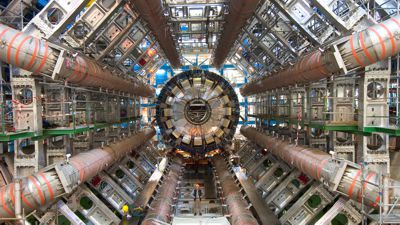 Is the universe more complex than we realize? Many people think that scientists understand how it was formed and how it works. But even the most brilliant scholars don’t understand this. For example, here’s summary of what they know (and don’t know) about the forces and particles that make up the universe. This shows that the intelligence behind the universe is greater than the intelligence of the human mind.
Fundamental forces
The four fundamental forces of nature are gravity (which holds planets, stars and galaxies together), electromagnetism (which holds atoms together so that electrons are attracted to the nucleus), the strong nuclear force (which holds the atomic nucleus together) and the weak nuclear force (which is involved in radioactive decay). These forces hold together atoms, molecules, planets and galaxies. Gravity is described by Einstein’s general theory of relativity, while the other three forces are part of the Standard Model of particle physics.
How well do we understand these forces? Let’s look at the force of gravity.
Gravity
In the late 16th century Isaac Newton developed three laws of motion, which included a description of gravity. Newton’s laws of motion described the movement of objects. In 1915 Einstein’s theory of general relativity replaced Newtonian mechanics. This theory describes the force of gravity and describes the motions of bodies in our solar system. The general theory of relativity describes an expanding universe, which has been detected by scientists (although some dispute whether the universe is expanding). But observations of distant spiral galaxies defy the predictions of general relativity. To explain this behavior, scientists postulate the existence of dark matter and dark energy. They are named “dark” because they can’t be detected. So they are “fudge factors” to make the mathematical model work. Dark matter and dark energy are theoretical inventions that explain observations we cannot otherwise understand.
On the scale of galaxies, gravity appears to be stronger than can be accounted for using only particles that are able to emit light. So scientists added dark matter as 27% of the mass-energy of the universe. But these particles have never been directly detected! The Hubble Space Telescope found that the expansion of the universe is increasing with time, instead of decreasing as was expected from the force of gravity due to the matter in the universe (whether ordinary or dark matter). So scientists added “dark energy” (a weak anti-gravity force that acts independently of matter) as 68% of the mass-energy of the Universe. Dark matter is an invisible substance that can only be seen through the effects of its gravity, while dark energy is pushing our universe apart. The nature of both remains mysterious.
However, the amount of dark matter and dark energy postulated in the universe is huge. The mass-energy of the universe is assumed to be 68% dark energy, 27% dark matter and 5% observable matter! This means that without the fudge factor, the general theory of relativity only explains 5% of what is observed to exist! So, the universe is so complex that the best mathematical description of gravity needs to be adjusted by a factor of 95%! General relativity is also part of the framework of the standard Big Bang model of cosmology.
So the universe is too complicated for our most brilliant scholars to understand all aspects of the forces that control it. For example, we don’t really know:
– if dark matter exists
– if dark energy exists
– if the universe is really expanding (because it can’t be explained by general relativity without using these fudge factors)
– if Einstein’s theory of gravity is correct (because it can’t explain the universe without using these fudge factors).
This situation is influenced by the fact that astronomy uses remote sensing (measurements made from a distance) to gather its data. Many assumptions are made when interpreting these data and the assumptions have a large influence on the findings. If any of the assumptions are wrong, then the findings are probably also wrong.
These fundamental forces act on atoms, molecules, planets and galaxies. How well do we understand the matter that makes up atoms, molecules, planets and galaxies? Let’s look at the particles that combine to form atoms.
Fundamental particles
 In late 1800s scientists thought that the atom was the smallest building block of nature. But then the electron was discovered in 1897, the proton in 1919 and the neutron in 1932. By the mid-1960’s, it was realized that the understanding that atoms were composed of protons, neutrons, and electrons, was insufficient to explain the many subatomic particles being discovered. Via quantum theory, protons and neutrons were found to contain quarks—now considered elementary particles. Then the Standard Model of particle physics (of fundamental particles and their interactions) was developed to explain the behavior of these subatomic particles. The Standard Model is a mathematical equation that describes the particles and forces that govern quantum physics.
In the Standard Model there are 61 elementary particles (18 quarks, 18 antiquarks, 6 leptons, 6 antileptons, 8 gluons, 4 electroweak bosons, and one higgs boson). This number varies according to what is assumed to be an elementary particle. So in a century the number of fundamental particles has risen from one to 61! That’s a huge increase! The particulate structure of creation was more complex that was imagined. I wonder how many more fundamental particles will be discovered in the next 100 years?
But the Standard Model that describes these particles can’t explain gravity, dark matter or dark energy! The quantum theory used to describe the micro world, and the general theory of relativity used to describe the macro world, are difficult to fit into a single framework. No one has managed to make the two mathematically compatible in the context of the Standard Model.
So the universe is too complicated for our most brilliant scholars to understand all aspects of the fundamental particles that are the building-blocks of the atoms and molecules of matter.
The implications of this complexity
Clearly the forces and particles of the universe are complex. The pattern (design) of the universe is too complex for the human mind to understand. This shows that the intelligence behind the universe is greater than the intelligence of the human mind. Is this evidence of design by a being that is more intelligent than humanity? This is consistent with what the Bible says.
What the Bible says
According to the Bible, Jesus Christ created and sustains the universe.
“Christ is the visible image of the invisible God. He existed before anything was created and is supreme over all creation, for through Him God created everything in the heavenly realms and on earth. He made the things we can see and the things we can’t see—such as thrones, kingdoms, rulers, and authorities in the unseen world. Everything was created through Him and for Him. He existed before anything else, and He holds all creation together” (Col. 1:15-17NLT).
Jesus “existed before anything was created”, including time. As He existed before time was created, Jesus is eternal. In this way, He is different to His creation (the universe). He is “supreme over all creation” because He “created everything”. He created the stars and galaxies (“the heavenly realms”). He not only made the “things we can see” (the visible universe), but He also made “the things we can’t see” (so there is a spiritual unseen dimension to God’s creation which is inhabited by angels). And Jesus “holds all creation together”. This means He controls all the forces of nature including gravity, electromagnetism, the strong nuclear force and the weak nuclear force. Hebrews also says that Jesus “sustains everything by the mighty power of His command” (Heb. 1:3).
Solomon said, “people cannot see the whole scope of God’s work from beginning to end” (Eccl. 3:11). God works in nature, in the spiritual world, in society and in our own lives. This means that no-one can discover the full extent of what God does. Our understanding is limited. Our knowledge is finite, and thus infinitely less than God’s. Some of the wisdom, power, and goodness of God is evident in His creation. But it is so vast and our capacity is so limited and our life is so short that we only understand a miniscule part of what God does. Consequently, there are many mysteries that we don’t understand. For example, when science answers one question usually several replace it. There’s always more to discover.
If complexity requires a creator, who created God?
A common objection to the idea of an intelligent creator is “if all complex things require an intelligent creator, then why is that creator himself not bound to the same rule? Would that complex deity not require an even more complex creator, and so on, for infinity?”.
What this fails to acknowledge is that there are two categories of complex things – those that have a beginning (and so were created) and those that don’t have a beginning (and so were not created). Those that have a beginning (such as the universe and people) do require an even more complex creator. The reason for this is that everything which has a beginning has a cause. This is the law of cause and effect. But as mentioned above God is in a different category. He has no beginning; He is eternal. God, as creator of time, is outside of time. This means He has no beginning in time. As He has always existed, He doesn’t need a cause. So the seemingly endless sequence proposed by the questioner stops at God – He doesn’t have a more complex creator.
Summary
We have seen that the universe is too complicated for our most brilliant scientists to understand all aspects of the forces that control it and all aspects of the fundamental particles that are the building-blocks of the atoms and molecules of matter. This complexity should cause us to be humble before our God who created and sustains the universe. And to praise Him as Paul did when he wrote:
“Oh, how great are God’s riches and wisdom and knowledge! How impossible it is for us to understand His decisions and His ways! For who can know the Lord’s thoughts? Who knows enough to give Him advice? And who has given Him so much that He needs to pay it back? For everything comes from Him and exists by His power and is intended for His glory. All glory to Him forever! Amen” (Rom. 11:33-36).
Written, August 2017
Also see: How the universe is held together
Share this:

Evidence of Noah’s flood

 After some Australian motorists drowned when their cars were swept away by floodwaters in June 2016, university researchers investigated how much force it takes to wash cars away from the road. A 1 tonne vehicle was moved by water 15 centimeters deep flowing at 3.6 km/hr. It was carried away in 60 centimeters of water. A 2.5 tonne vehicle was moved by 45 centimeters of water and began floating in 95 centimeters of water. The cars were moved so easily partly because even shallow water can be deceptively strong, and partly because modern cars are so air-tight that instead of taking on water they get pushed along by it. Even slow-moving water is powerful because water is heavy: each cubic metre weighs 1 tonne. They concluded that vehicles became vulnerable to moving floodwaters once the depth reached the floor of the vehicle. This is consistent with Queensland advice that “Water deeper than the bottom of your car door is enough to float your vehicle away, or splash the engine and cause it to stall”.
If a shallow river can be so powerful, a global flood would be an enormous catastrophic disaster. If this happened about 4,350 years ago, surely there would be some evidence of it still visible today. This blogpost is a summary of eight main points that were made by Dr Tasman Walker in a presentation on “Evidence of Noah’s flood in Australia”.
What would we expect to find on earth if there was a global flood as described in Genesis chapters 6-8 in the Bible?
Fractures in the earth’s crust
The two main sources of the water for the flood are described as “all the underground waters erupted from the earth, and the rain fell in mighty torrents from the sky” (Gen. 7:11-12NLT). Subterranean water burst from beneath the earth and there was torrential rain for 40 days. The flood waters rose to cover the highest mountains of the pre-flood world by 8 meters (Gen. 7:17-20). By the way, Mt Everest didn’t exist before the flood because there are sedimentary rocks with marine fossils on its summit.
If underground water was erupting from the earth on a global scale you would expect that the earth’s crust would be fractured. Today major fractures are seen in the earth’s crust around the edges of the continental plates. When these continental tectonic plates move against each other there are earthquakes and volcanic activity. Such geological activity around the Pacific Ocean is called the “ring of fire”.
So we would expect to find fractures in the earth’s crust and we do. These fractures are evidence of Noah’s flood.
Billions of dead things
If a catastrophic flood covered the earth for six months you would expect to find billions of dead things all over the earth. “Everything (except those on the ark) that breathed and lived on dry land died” (Gen. 7:22NLT). Because such a flood would transport huge amounts of sediment across the earth, most of the creatures that drowned would be buried in the sediments. Because such a flood would also transport huge amounts of sediment into the ocean and cause a depletion in oxygen levels, many marine creatures would die and be buried as well.
 At Winton in Queensland, there are many well-preserved fossils of dinosaurs and marine creatures. Dinosaur fossils have also been found at Muttaburra (Queensland). These fossil-bearing sediments extend across the Great Artesian Basin into New South Wales, South Australia, and the Northern Territory, while marine fossils are found in other parts of Central Australia.
So we would expect to find billions of dead things (fossils) in sedimentary rocks and we do. These fossils are evidence of Noah’s flood.
Evidence of rapid burial
If a catastrophic flood covered the earth for six months you would expect to find evidence of rapid burial.
At Richmond in Queensland an exceptionally well-preserved marine reptile fossil was discovered in 1990. It’s a plesiosaur that’s over 4 meters long. In order to be preserved so well it must have been buried rapidly. Fossils of land animals are also found in this region, such as the ankylosaur (an armored dinosaur).
So we would expect to find evidence of rapid burial and we do. These fossils of creatures that were buried rapidly are evidence of Noah’s flood.
Sediment covering huge areas
 If a catastrophic flood covered the earth for six months you would expect to find evidence of sediment covering huge areas.
Geologists find that layers of sedimentary rocks extend across large areas called sedimentary basins. They can contain coal, oil and gas that’s used as fossil fuels. For example, the Great Artesian Basin and the Sydney Basin. There are also examples in other continents. And there are also offshore sedimentary basins on the continental shelf of countries around the world.
So we would expect to find evidence of sediment covering huge areas and we do. These layers of sedimentary rock across huge areas are evidence of Noah’s flood.
Evidence of raging waters
If a catastrophic flood covered the earth for six months you would expect to find evidence of raging waters. As these flood waters would have been highly energetic, they would have transported material along with the flow.
 The Three Sisters rock formation at Katoomba is composed of sandstone, which was laid down by water. This layer extends across the Sydney sedimentary basin. An examination of the sedimentary layers evident in road cuttings shows layers 1-2 meters thick, which indicates that a lot a water was involved in transporting and depositing this sediment. This water must have been continually rising (to enable continual deposition). There are many cross-beds that go at an angle across the strata. They are formed when the sediment layer builds sideways.
 Uluru (Ayers Rock) in the Northern Territory is made of sandstone and the layers have been tipped up so they are almost vertical. These strata are visible as parallel lines on Uluru. This shows that there hasn’t been any significant erosion between the deposition of the strata. So there was rapid deposition – one layer was laid upon the other quite quickly. When we look at a geological cross-section through Uluru it is evident that a lot of sandstone has been eroded from above Uluru. The grains that comprise Uluru are angular, poorly sorted (a large range of particle sizes) and well-preserved (not weathered) which is consistent with rapid deposition.
 Kata Tjuta (the Olgas) is a group of large, domed rock formations 25km west of Uluru. They are comprised of large boulders (30-50cm in size). These all face in a similar direction, which is the direction of the water flow that transported them to this site. They indicate highly energetic flood waters.
So we would expect to find evidence of raging waters (which transport and deposit lots of sediment) and we do. These cross-beds, parallel sedimentary strata and boulders are evidence of Noah’s flood.
Evidence of massive erosion
If a catastrophic flood covered the earth for six months you would expect to find evidence of massive erosion. After the flood waters peaked and subsided, they would have flowed off the continents and eroded material away as they flowed back into the ocean.
When you stand at Echo Point overlooking the Three Sisters, you see that Jamison valley is cut into a flat plateau. How did it get so flat? As the floodwaters moved across the continent, they eroded the surface flat. That’s how plateaus formed all around Australia and around the world. Jamison valley is much larger than any valley caused by Kedumba River that flows through it (the same is true for the Grand Canyon in USA). Geomorphologists call these overfit valleys – the valley is too big for the river. How did it get to be such a large valley? The valley was carved by a lot of water and not by the current river. As the floodwaters subsided, when hills became exposed, the water carved out large valleys transporting the sediment out of the area.
This is also evident at Carnarvon Gorge in Queensland at the intersection of the Great Artesian Basin and the Bowen Basin. A large valley has been cut into a sandstone plateau that’s capped by basalt. As material has been eroded away, these sedimentary layers originally covered a much larger area.
As a result of such erosion, rivers can flow through mountain ranges rather than around them. For example, the Heavitree Gap in the MacDonnell Ranges near Alice Springs. How did that happen? Many explanations have been proposed, but none of them work. As the floodwaters subsided, the higher parts of the ridge become exposed and the water flows between the gap between them. As the waters continue to drop, they continue to erode through this gap until when the water has all subsided the gap remains and a river flows through this gap today. It’s called an air gap if it doesn’t go down to the level of the adjacent surface.
So we would expect to find evidence of massive erosion and we do. These large overfit valleys are evidence of Noah’s flood.
Evidence of youthfulness
If a catastrophic flood covered the earth for six months about 4,350 years ago, you would expect to find evidence of youthfulness.
At Kata Tjuta there are a few boulders lying around, but not many. And there is a small apron around it, but not a large one as if it had been eroding for millions of years. And there’s very little debris around the base of Uluru or Kata Tjuta. This indicates that it was eroded recently.
So we would expect to find evidence of youthfulness and we do. The lack of erosional debris is evidence of Noah’s flood.
Worldwide memories of the flood
All of the people of the earth are descendants of the eight people on Noah’s ark. As the global flood occurred about 4,350 years ago, you would expect to find memories of Noah’s flood in the different people groups around the world.
Cultures around the world have flood legends (or stories). For example, the Bundaba Flood Story of the Aboriginals at Broome is given in the appendix. Common features in the stories are that there was a moral cause, people were drowned, there were people saved in a boat, and there was a bird.
So we would expect to find worldwide memories of the flood and we do. These flood stories are evidence of Noah’s flood.
Summary
There’s plenty of evidence in Australia of Noah’s flood. Evidence of eight aspects of Noah’s flood show that what we observe is consistent with what the Bible says. This flood is a key to connecting the Bible to the world around us. It explains the sedimentary rocks and the fossils. And it washes away the millions of years that are assumed by evolutionists.
It also helps us understand the world. It makes sense of biblical creation. Death and suffering came after Adam and Eve and not before them because they were a consequence of sin. Whereas according to the idea of evolution, death and suffering over millions of years brought about our existence.
Questions and answers
What is rapid burial?
When animals and fish die today they disintegrate and are recycled. They aren’t fossilized. So, how were the fossils preserved? If they are buried quickly it stops them being scavenged and it affects how bacteria destroys animal’s bodies. So rapid burial is necessary to produce fossils.
What about continental drift?
Like evolutionists, creationists fit the evidence into their world view. There is a creationist model of how the continents were all together before the flood and they broke apart during the flood (catastrophic plate tectonics). The earth’s mantle (beneath the earth’s crust) can suddenly lose its strength under high temperature and high pressure. So the continental movement could have happened very quickly (continental sprint) during Noah’s flood. In the second half of the flood the ocean basins sank and the continents rose: “Mountains rose and valleys sank to the levels you decreed” (Ps. 104:8NLT).
What does “the earth was divided” in the time of Peleg mean (Gen. 10:25)?
This is just before the tower of Babel when God divided the people into different language groups and they dispersed across the earth (Gen. 11:1-9). This is what we believe it means. It couldn’t be the separation of the continents because if it happened a few hundred years after the flood that would be a huge catastrophe and many people would perish and there is no evidence of this in Scripture.
When was Mt Everest formed?
The earth’s crust moved during the flood. The mountain ranges like Mt Everest were elevated towards the end of the flood. The mountians we see today rose up at this time. The shapes of the mountains were carved by the waters of the flood (and any post-flood ice).
Do we know how high the mountains were before the flood?
No. We know there were mountains before the Flood because the Bible speaks of them (Gen. 7:19-20). But we don’t know how high they were. Some creation geologists speculate that they weren’t as high as those today.
What about the ice age?
It happened after the flood. The flood is the only thing that explains the ice age. It was due to warm waters after the flood caused by the addition of hot subterranean water and by heat from volcanic activity. And large amounts of volcanic dust and aerosols in the atmosphere would have reflected solar radiation back into space causing low atmospheric temperatures. Warm oceans evaporate water, which then moves over the land. Cold air over the continents results in this water precipitating as snow. And the snow accumulates forming ice. Because the ice was not fully melted the following summer, the ice built up from year to year. It has been estimated that the ice accumulated for 500 years after the flood and then retreated to where it is today over another 200 years. But evolutionists don’t have an adequate explanation for the ice age.
What about global warming?
Climatic modelers try to include the ice age, but they don’t include Noah’s flood. They think that the earth’s atmosphere is unstable and a little change will tip it over the edge. Whereas the earth’s climate is very stable – after the huge climatic disturbance of the global flood, it took about 700 years to come back to equilibrium.
What about the decrease in longevity?
Before the flood people typically lived over 900 years. After the flood this decreased exponentially towards 100 years (David) and then 70 years. It was probably a genetic change and not an environmental one because after the flood Noah lived 350 years (Gen. 9:28) and Shem lived 500 years.
What about the Behemoth described in Job 40?
We believe it was a brachiosaur (sauropod) dinosaur. The size of its tail is one of the reasons. We believe that dinosaurs and people lived together. They were called dragons and other names because “dinosaur” is a modern name.
Appendix: The Bundaba Flood Story
Long, long ago there was a great flood. It happened because some children found the “winking” owl and plucked out all its feathers. The bird flew without wings, into the heavens and showed himself to Ngowungu, the Great Father. Ngowungu became very angry and decided to drown the people.
Later the people saw a small cloud rising which grew bigger and bigger till it spread all over the sky. The thunder began to roll and crash and the people were greatly afraid. With the rain and thunder was a terrible wind which broke great limbs off trees and rooted up others. During this terrible storm there was a noise above the awful crashes of thunder. This noise was coming from the north. The salt water, the sea, came pouring over the ranges from the north. The flood rose higher and higher till all the land was covered except the tops of two or three mountains.
A bird with a leaf in its mouth flew in front of them showing them the way to Mt. Broome. From further west a man and his wives with a dog were battling their way in a canoe when a bird with a leaf in its mouth flew in front of them showing them the way to Mt. Broome. They eventually reached Mt. Broome and landed there where some other survivors were.
Then Djabalgari, the great left-handed man incised his little finger and let the blood trickle down into the flood waters. The waters began to go down and eventually disappeared off the country. All other people were drowned.
Acknowledgement
This blogpost was sourced from a presentation by Dr Tas Walker (a geologist with Creation Ministries International) on “Evidence of Noah’s flood in Australia”.
Written, July 2016
Also see: Flood stories: Fact or fiction?
Noah: Fact or fiction?
Visiting Noah’s ark
Why was Noah’s family saved while the rest died in the flood?
Global evidence of Noah’s flood
Share this:

In six days

 In March 2016 the NSW Environment Protection Authority served notice requiring a company to conduct a mandatory environmental audit of its waste oil processing facility near Maitland. This followed a pattern of environmental non-compliance at the facility, including serious breaches involving air emissions and water discharges. The audit of site practices and procedures includes assessment of testing waste products, operation and maintenance of pollution control equipment, bunding and spill management, and potential impacts on groundwater. In this post we carry out an audit of the naturalistic explanation of the origin of life.
In 1999 New Holland published a book, ‘In six days: why 50 scientists choose to believe in creation’. The editor, Dr John Aston, noted in the preface that:
‘Why would educated scientists still believe in creation? Why wouldn’t they prefer to believe in Darwinian evolution or even theistic evolution, where an all-powerful intelligence is seen as directing the evolutionary processes? Could scientists believe that life on earth is probably less than 10,000 years old? How would they deal with the evidence from the fossil record and the ages suggested by the radioactive dating of rocks as millions and billions of years old?’
‘During the past century, the biblical story of Genesis was relegated to the status of a religious myth and it was widely held that only those uneducated in science or scientific methods would seriously believe such a myth. However, my experience in organizing this book, is that there is a growing number of highly educated critically thinking scientists who have serious doubts about evidence for Darwinian evolution and who have chosen to believe in the biblical version of Creation.’
The scientists gave their personal response to the question: ‘Why do you believe in a literal six-day biblical Creation as the origin of life on earth?’ The responses were divided into two categories ‘Science and Origins’ (dealing with the scientific critique of evolution as well as the scientific basis for creation) and ‘Religion and Origins’ (dealing with a more philosophical approach to the question of evolution and creation). My contribution was in the latter section (p.322-327).
Introduction
There are two main views about the origin of the universe and the origin of life: those based on naturalism and those based on an intelligent Creator. As these events occurred long ago and are not subject to direct observation or experimental tests, both of these perspectives are mainly philosophical beliefs based on certain assumptions about the physical world.
This fact is ignored or distorted in most modern treatments of the topic of origins. For example, the March 1998 issue of National Geographic included an article titled, ‘The rise of life on earth’. The editor of the magazine wrote concerning this article on the origin of life: ‘Science is the study of testable, observable phenomena’, and religious faith is ‘an unshakeable belief in the unseen’. This ‘straw man argument’ diverts the discussion away from the issues of science and logic to the separate topic of science versus religious faith. It also ignores the fact that there are no obvious ‘testable, observable phenomena’ on the origin of life. Furthermore, the language used in the article demonstrates that naturalism also relies on faith in the unseen.
The naturalistic view of origins is that everything that exists can be explained by physical and chemical processes alone. This differs from the view that matter, energy, physical and chemical processes and life were established by a Creator as revealed in the Holy Bible.
Searching for truth
An environmental auditor relies on two main factors: objective evidence and agreed standards. The outcome of each part of an audit depends on comparing the observable evidence against the relevant standard. Of course, environmental standards change in time and space across the world. Similarly, any explanation of origins should be consistent with the body of ‘observable evidence’ and any relevant ‘standards’. This is complicated by the fact that the evidence is viewed today, a long time after the beginning of the universe and life. Also, in a changing world, it is not immediately obvious which standards are relevant. The Bible is the only reliable and consistent source of truth; it is like a fixed frame of reference. Other authorities, such as science and logic, are not sufficient, as they may change in time and space; they are like a changing frame of reference.
The laws of physics and chemistry are examples of the relative standards of science, which change with time as knowledge develops. They were developed under present conditions and assume that the universe already exists. Two of these fundamental laws are that life always comes from earlier life and that mass/energy is conserved. Applying them to the origin of life assumes that all these conditions were true at that time. To say; then, that naturalism explains the origin of life is ‘circular reasoning’, as the outcome is largely determined by the assumptions made. Although these laws may describe the present world, it would be a gross assumption to extrapolate them back to the unobserved initial conditions. Yet this is done frequently by those with a naturalistic viewpoint, without acknowledgement of the uncertainties involved and the limitations of the scientific method.
The assumptions of both naturalism and biblical creation and the principles of the scientific method are stated clearly in W Gitt’s ‘Did God Use Evolution?’ 1993, CLV Christliche Literatur-Verbreitung e. V.
The Bible is a source of ‘absolute’ truth that has stood the test of time much longer than any other document or philosophy. Of course, as in the case of any literature, it requires interpretation as to what is historical and what is metaphorical or symbolic. Besides obvious literary techniques, the most reliable method is to use the whole message of the Bible to interpret any particular passage. Otherwise, an interpretation may not be consistent with the rest of the Bible.
The Bible contains three clear tests for determining whether a belief, teaching or philosophy is true or false. To be true it must pass each of the three tests:
The Jesus test: This test states that, ‘Every spirit that acknowledges that Jesus Christ has come in the flesh is from God, but every spirit that does not acknowledge Jesus is not from God. This is the spirit of the antichrist … This is how we recognize the Spirit of truth and the spirit of falsehood’ (1 Jn. 4:2-6NIV). The question to be answered in this test is: What does it say about Jesus Christ? The Bible teaches that Christ was unique: divine and human, sinless, eternal and the Creator. It is false to deny that Christ was the divine Son of God. Beliefs that fail this test usually claim that Christ was, at best, a great teacher or a prophet. They may even encourage the view that Christ and other events in the Bible are mythical.
The gospel test: The Bible warns about those promoting a different gospel, ‘If anybody is preaching to you a gospel other than what you accepted, let them be under God’s curse!’ (Gal.1:9). The question to be answered in this test is: What is its gospel? In other words: what is the core belief or hope? The Bible says that the root cause of all our problems is that everyone has sinned and fallen short of God’s requirements—resulting in death. The only means of rescue is salvation by faith in Christ. ‘Different gospels’ are those that differ from this. They either add to it or take away from it. There is a warning against adding to or taking away from the words of the Bible (Rev. 22:18-19). Broader aspects of the gospel include the original creation and the ultimate restoration of all things (Rev. 4:11; 21:1-22:6). We need to be careful when applying this test because a ‘different gospel’ may deceive by using words similar to the true gospel but give them different meanings.
The fruit test: Jesus Christ warned, ‘Watch out for false prophets. They come to you in sheep’s clothing, but inwardly they are ferocious wolves. By their fruit you will recognize them’ (Mt. 7:15-20). The question to be answered in this test is: What kind of fruit is evident? In other words, what type of attitudes and behavior does it encourage? Is the divine nature or the sinful nature most evident? The former is characterised by the fruit of the Spirit: love, joy, peace, patience, kindness, goodness, faithfulness, gentleness and self-control. The sinful nature may involve: idolatry, sexual immorality, selfish ambition, pride, hostility, quarrelling and outbursts of anger (Gal. 5:19-23).
These tests will now be used to assess the naturalistic view of origins.
Testing naturalism
The Jesus test: As naturalism means that nature is all there is, it is associated with atheism. For example, the American Association of Biology Teachers states, that; ‘The diversity of life on earth is the outcome of evolution: an unsupervised, impersonal, unpredictable and natural process of temporal descent with genetic modification that is affected by natural selection, chance, historical contingencies and changing environments.’
This view of origins has no need for a Creator or the divine, and so is consistent with a belief that Jesus Christ was only a human being and not divine. Naturalism clearly fails the Jesus test.
The gospel test: As naturalism assumes there is no God, it accepts no absolute standards of ‘right’ and ‘wrong’, and rejects the existence of ‘sin’ in the sense of falling short of God’s standard. Therefore, it teaches that there is no need of a savior. Its gospel is that nature has made itself and the Genesis account of origins is not true. A biblical consequence of this is that if there was no paradise at the beginning as described in Genesis, then there can be no hope for a future paradise (Acts 3:21). In fact, naturalism rejects all the basic biblical truths, such as: creation, the beginning of evil, the need for salvation and the ultimate destiny of human beings. So, naturalism fails the gospel test.
The fruit test: Naturalism supports and is associated with: materialism, humanism (humanity is self-sufficient, capable of solving all their difficulties) and pantheism (‘nature’ replaces God). Its acceptance leads to: less value on human life (practices such as abortion and euthanasia are more acceptable). Another example from the past is racism; less value on family life (biblical marriage is less important; divorce is more acceptable); less value on morals (truth is now relative, not absolute); a ‘might is right’ attitude that supports the strong, but not the weak (survival of the fittest; a competitive world; compassion involves saving ‘weak genes’). As these are opposite to the values of the Bible, naturalism fails the fruit test.
It is clear from this that the viewpoint of naturalism fails all the three biblical tests for determining what is true. Therefore, it is false and is not consistent with the overall message of the Bible.
Summary
Due to the influence of the above philosophies, claims are often made in the name of ‘science’ that go far beyond the available evidence, and some aspects of modern science have become increasingly tenuous and speculative. In fact, the everyday use of the word ‘science’ has changed from dealing with things that are observable and testable to meaning ‘naturalism’ and so includes conjecture and dubious hypotheses.
Although we live in a ‘cause-and-effect’ universe, ultimate causes, such as origins, are outside the realm of reliable science. Science can only reliably deal with the present world; it cannot reliably deal with the past (such as origins) or the future (such as ultimate destinies), as it cannot directly observe these. I believe all scientists should be wary of their assumptions, as these can largely determine their findings. They should also be wary of extrapolations outside the range of observation. The further the extrapolation, the less reliable the prediction. Changes in the assumptions will change the prediction. This applies in particular to boundary conditions, such as those involving initial conditions (or origins). Therefore, scientists can only speculate, imagine and guess about the origin of life.
The author
Dr Hawke is a Senior Environmental Consultant with an electricity supply company in Sydney, Australia. He holds a BSc with first class honors in Physics from the University of Sydney, and PhD in Air Pollution Meteorology from Macquarie University. Over the past 22 years, Dr Hawke has worked as an environmental scientist and environmental consultant for a state government regulatory authority and the electrical power industry. He is also a Certified Environmental Auditor with the Quality Society of Australasia.
Published in 1999
Also see: Recognizing false teachers
The idol of evolution: Part 1
Share this:

Environmentalism: Idolatry or Stewardship?

 Today there is a national election in Australia. Key election issues include: the economy, jobs, health, education and the environment. The political parties seeking election included the Greens, the Renewable Energy Party, the Animal Justice Party, and the Sustainable Australia Party. This post looks at the foundation of the ethics and morals of the environmental movement.
I gave this message at a conference in 1998. It’s based on the situation over 18 years ago. Although the examples are now historical, most modern examples would be similar in many ways. Many people are still concerned about the natural environment.
Concern for the environment and pollution affects us all: we see and hear about it in the daily news media, it’s taught at all levels of education, it affects all businesses in some way, governments pass more and more laws about it, and in 1996, the first national “State of the Environment” report said that, “Australians are among the most environmentally aware people in the world”.
My background is in science (physics and mathematics) and environmental science. I am a certified environmental auditor, who audits environmental management systems for industry and businesses. In this message I will present the results of an audit of the foundations of the environmental movement and of modern science. So we are looking at basic beliefs, values, viewpoints and assumptions. The findings will be compared to the Bible, which I believe is God’s guidebook for humanity.
Environmentalism involves concern for the physical world, such as advocating protection and conservation of the natural environment. It’s a complex and recent subject that has developed over the past 30 years.
Model of aspects of environmentalism
A schematic diagram of aspects of environmentalism provides a framework for this message. The two main aspects of environmentalism are the principles, which are what we believe, and the practices, which are what we do. Our principles (assumptions and values) have a strong influence on our behavior. That’s why they are sometimes called “guiding principles”. This message is focused on the principles that can drive environmentalism.
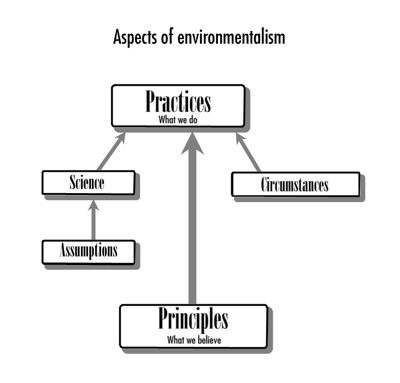 According to the Bruntland Report, “Our common future” (1987), “to achieve the goals of sustainable development, good environment, and decent standards of life for all involves very large changes in attitude”. Where do these attitudes come from? Our minds. If we are consistent, they are the principles that drive our practices. For example, if we believed in the golden rule (treat others as we would like them to treat us), then we would help others. Or, if we are selfish, we may ignore others or exploit them. But other things besides our principles can influence our behavior.
The schematic diagram shows how our assumptions and circumstances can also influence our behavior. For example, in the case of global warming; the principles are our worldview, values and ethics; the science is the mathematical models that predict temperatures and sea levels; the assumptions are those made in the scientific predictions; the circumstances are the technology available and the particular situation in each nation; and the practices are what each nation does in response to this issue.
In environmental auditing we begin by checking compliance with the organisation’s environmental policy because it contains their guiding principles, including philosophy, values, and ethics.
This message is focused on the principles of environmentalism and the assumptions of science. What are they? And, how do they compare with the Bible?
Principles of environmentalism
Environmentalism is based on a viewpoint that nature should be valued and protected. This is a pro-environment/conservation world view. Many world views have been explored in attempts to develop an ethical basis for environmentalism. There is range of viewpoints and philosophies within the environmental movement which overlap and can lead to conflicts. The three main categories of principles are based on the three main parts of our world. They are: human-centered, nature-centered, and God-centered.
Human-centered environmentalism
Nature is our life support system; we depend on it for survival. So people have a self-interest in the preservation of their environments. It’s important because of its impact on people. For example, ozone depletion in the upper atmosphere can increase risk of skin cancer. So we want to protect stratospheric ozone.
The two main ideas in this approach are conservation and preservation. Nature is a resource that needs to be conserved for human needs. So, Government Forestry Services manage forests to maintain productivity. Nature also needs to be protected for the enjoyment of all people. For example, zoos and nature parks.
Sometimes people can have a negative impact on the environment. For example, the exploitation of nature without consideration for sustainability.
Nature-centered environmentalism
This introduces the idea that nature has intrinsic value – it should be preserved unless it conflicts with something of greater value. In this category we will look at two approaches: species centered and ecosystem centered.
The first approach says that species have rights or intrinsic value. For example, animal rights are promoted – as they have a value of their own, we should seek to minimise our impact on animals. This can lead to treating other species as though they were human. Stephen Gould advocates applying the golden rule to nature and the environment, “Do to others as you would have them do to you” (Lk. 6:31NIV). Similar rules exist in other religions as well. This means treating nature as we would want to be treated. But try applying this to an ant! It would be difficult avoiding killing an ant as we walk around.
The second approach acts for the good of all nature, not just human interests. This is more holistic as it involves the whole ecosystem/biosphere. This can lead to reverence for nature and wilderness, such as deep ecology. Here all natural things (ecosystems, life, landscape) have an intrinsic right to exist and there is a feeling of being connected with nature. This in turn can lead to Gaia theory (which is named after the ancient Greek earth goddess), where the earth is viewed as a single organism, like a living thing. It claims that evolution is not random, but is directed by Gaia.
These modern ideas are similar to ancient ones where nature has a spirituality. Animism is the belief that all natural objects and the universe possesses a soul. And pantheism is the belief that: God is not a personality, but a force; the universe exists of itself; all natural happenings are God, and that God is everything and everything is God; and Mother Nature replaces God.
Examples of these principles of environmentalism are given in the Appendix 1.
Problems with these principles of environmentalism
Human-centered environmentalism is not sufficient, as it omits much of the ecosphere. So most environmentalists have stopped using this approach.
Nature-centered environmentalism also has limitations, particularly with regard to species rights, sanctity of life and intrinsic value. For example: How can we determine priority between species? Is there a hierarchy of rights? Catastrophes (e.g. fires, droughts, storms, volcanic eruptions, earthquakes) that kill huge numbers of organisms are a part of nature. So nature can be destructive. It does not act as a perfect God, unless you believe in a God who can be evil. As species are interdependent (can be linked by a chain of dependence), this leads to saying that “all aspects of nature have intrinsic value” – but it is impossible to preserve everything. And it doesn’t help to solve day-to-day environmental problems.
God-centered environmentalism
We now turn to the Biblical viewpoint of the physical environment (values, principles, truths). We need to realize that the Bible contains basic principles which can be applied to all areas of our life. It contains God’s plans for the natural world (its history and its destiny) and how He intends us to live in it.
We will look at three Biblical principles here: creation, the gospel, and stewardship.
Doctrine of creation
This has two parts: God as creator, and God as sustainer. First, God created everything. “God made the world and everything in it” (Acts 17:24-28). “By faith we understand that the universe was formed at God’s command, so that what is seen was not made out of what was visible” (Heb. 11:3). So God is the sole source of all that exists. “Everything God created is good” (1 Tim. 4:4). Jesus is “the author of life” (Acts 3:15), “He made the universe” (Heb. 1:2). “All things were created through Him and for Him” (Col. 1:16). “God saw all that He had made, and it was very good” (Gen 1:31) – Eden was paradise.
Creation is separate to the Creator. “They exchanged the truth of God for a lie, and worshipped and served created things rather than the Creator” (Rom 1:25).
God owns creation. “The earth is the Lord’s, and everything in it, the world, and all who live in it” (Ps. 24:1).
The awe and beauty of nature. “For since the creation of the world God’s invisible qualities–His eternal power and divine nature–have been clearly seen, being understood from what has been made, so that people are without excuse” (Rom. 1:20).
The relationship between God, people and nature can be summarized as follows. God is infinite and personal. People are finite and personal. Animals, plants and machines are finite and impersonal. So humanity has special value, we share personality with God. We were made in God’s image, and people still have some of God’s image (Gen 9:6). Also, God came to earth as a man. So the Bible says that humans are both a part of nature (but not on the basis of biological unity), and apart from nature (like God). Nature is not our Mother, it is our brother and sister (as we are both created things).
“For this is what the LORD says– He who created the heavens, He is God; He who fashioned and made the earth, He founded it; He did not create it to be empty, but formed it to be inhabited” (Isa 45:18). So, creation has value because God made it and owns it.
Second, God sustains everything.
Jesus – “sustaining all things by His powerful word” (Heb. 1:3). “In Him all things hold together” (Col. 1:17). “in Him we live and move and have our being” (Acts 17:28). “Nothing in all creation is hidden from God’s sight” (Heb. 4:13). So the bible teaches that God sustains natural processes. The creation is dependent on the Creator for its continuing existence.
This includes the forces that hold things together (such as nuclear forces and gravity). Without Him all things would fly apart! God also cares for birds and vegetation. “Look at the birds of the air; they do not sow or reap or store away in barns, and yet your heavenly Father feeds them. Are you not much more valuable than they?” (Mt. 6:26). “And why do you worry about clothes? See how the flowers of the field grow. They do not labor or spin.” (Mt.6:28). “If that is how God clothes the grass of the field, which is here today and tomorrow is thrown into the fire, will He not much more clothe you – you of little faith?” (Mt. 6:30).
We can view God’s power and presence in nature, like electricity flows through a wire. The wire is not the electricity, but it can be the vehicle through which the electricity flows. God is not nature and nature is not God. To think that would be a to think like a pantheist and not a Christian. But in this sense, God is in nature.
“Your bodies are temples of the Holy Spirit, who is in you … Therefore, honor God with your bodies” (1 Cor. 6:19-20). Our bodies and senses should be used and appreciated for God. Similarly, all creation has been made by God and He sustains it, therefore, honor God as you interact and appreciate the physical world.
“Do not offer any part of yourself to sin, as an instrument of wickedness, but rather offer yourselves to God, as those who have been brought from death to life; and offer every part of yourself to Him as an instrument of righteousness” (Rom. 6:13). So the body and the physical world can be viewed as an instrument (or tool) which can be used for good or bad. We should honor God in our way of living in the material world – and work out what this means in the various areas of our life.
The gospel
The gospel is the good news, that addresses the bad news. God created a perfect universe, but because of the fall into sin when Adam and Eve disobeyed God, the universe is now flawed. To fix the situation, God sent Jesus to enable redemption and restoration. Those who accept what Jesus did are promised eternal life in the new heaven and new earth, while those who reject it face eternal punishment.
The fall into sin led to suffering, decay and death (Gen. 3; Rom. 8). Genesis 3 is one of the most important chapters in the Bible. God cursed not only people, but also nature, because of human sin. It explains the problem of evil in our world, in both humanity and in nature. It’s the ultimate cause of environmental problems. We live in a fallen world, different to the original condition of “very good”. Nature is abnormal, and it can be destructive. Environmentalists try to stop death in the environment. The fall explains death.
Now looking at redemption and restoration. Christians are seen as being part of a new creation, “Therefore, if anyone is in Christ, the new creation has come: the old has gone, the new is here!” (2 Cor. 5:17). Through Jesus, people can be reconciled to God. The biblical visions of the kingdom of God are visions of people in harmony with nature. The Bible teaches that the effects of the curse on nature will end and nature will be restored to its original splendor (it will be a sinless, deathless paradise, reconciled to God). Nature will also enjoy with Christians the effects of redemption.
“I consider that our present sufferings are not worth comparing with the glory that will be revealed in us. The creation waits in eager expectation for the children of God to be revealed. For the creation was subjected to frustration, not by its own choice, but by the will of the one who subjected it, in hope that the creation itself will be liberated from its bondage to decay and brought into the freedom and glory of the children of God.
We know that the whole creation has been groaning as in the pains of childbirth right up to the present time. Not only so, but we ourselves, who have the firstfruits of the Spirit, groan inwardly as we wait eagerly for our adoption to sonship, the redemption of our bodies. For in this hope we were saved. But hope that is seen is no hope at all. Who hopes for what they already have? But if we hope for what we do not yet have, we wait for it patiently” (Rom. 8:18-25). So all of creation is looking for redemption by God; not by people like us.
Christians share the gospel message with many people, even though they know that probably only a few will respond. Likewise, Christians ought to be willing to care for the created world, even though they know that they can’t bring full restoration.
Our bodies and the physical world will be transformed one day (like Jesus after His resurrection). The restoration will be through Jesus; “to reconcile to Himself (God) all things, whether things on earth or things in heaven” (Col. 1:20). “Heaven must receive Him (Christ) until the time comes for God to restore everything, as He promised long ago through His holy prophets” (Acts 3:21). When God judges the ungodly, the earth will be destroyed by fire and replaced by a new heaven and a new earth (2 Pt. 3:7-13). And we “are looking forward to a new heaven and a new earth, where righteousness dwells”.
God will then live with mankind as in the Garden of Eden, “There will be no more death or mourning or crying or pain, for the old order of things has passed away” (Rev. 21:1-8).
Doctrine of Stewardship
God told Adam and Eve, “Be fruitful and increase in number; fill the earth and subdue it. Rule over the fish in the sea and the birds in the sky and over every living creature that moves on the ground” (Gen 1:28). “Subdue” (“kabask” in Hebrew) means to conquer. “Rule” (“radah” in Hebrew) is generally used to describe the righteous and loving rule of a good and kind king. For example, King Solomon “ruled over all the kingdoms west of the Euphrates River, from Tiphsah to Gaza, and had peace on all sides. During Solomon’s lifetime Judah and Israel, from Dan to Beersheba, lived in safety, everyone under their own vine and under their own fig tree” (1 Ki. 4:24-25).
God told Adam how this rule is to be carried out. “The LORD God took the man and put him in the Garden of Eden to work (“abad” in Hebrew) it and take care (“shama” in Hebrew) of it” (Gen. 2:15). Elsewhere “abad” is translated to “serve” (e.g. “we will serve the Lord”, Josh. 24:15) and “sharma” is translated to “keep”, “watch” or “preserve” (e.g. “The Lord bless you and keep you”, Num. 6:24). God keeps His people in such a way to demonstrate His great love and care. All this was given before the fall of man, so there is no suggestion of evil or exploitation of nature here. So, Adam managed the garden of Eden. Before the fall there was perfect harmony between humanity and the environment.
As God owns the world, Christians can be seen as His stewards (or managers, a delegated authority). A “steward” is a manager of a household (e.g. Lk. 16:1-9). Peter also used it as a metaphor for believers, “Each of you should use whatever gift you have received to serve others, as faithful stewards of God’s grace in its various forms” (1 Pt. 4:10).
Stewardship means caring for creation as God would. And we are accountable to God. For example, in the Old Testament there was a Sabbath rest for animals and a Sabbath year rest for agricultural land (Ex. 20:10; 23:10-11).
The assumptions of modern science
Science provides a useful method for finding out things about the way the world works. The assumptions and boundaries of “science” largely determine the findings of science. Only theories consistent with these are acceptable to science. We will look at three major assumptions of science.
Doctrine of Naturalism
Science assumes a naturalistic world where the physical universe is all that exists. Nature is all there is. So, everything is explained in terms of mechanical processes. God only exists as an idea in the minds of religious believers. Naturalism is associated with: materialism -there is only matter (no unseen world of souls, spirits or deities) and atheism – there is no God. This limits science to naturalistic theories. As science excludes the supernatural (by definition), a model or explanation that incorporates supernatural intervention (e.g. creative intelligence), cannot be called “scientific”. Therefore, “Creation science” is impossible. As a result, science is unable to disprove the spiritual, as whatever it discovers is “natural” by definition.
Doctrine of Evolution
Science assumes an evolving world (mainly because the only alternative is an act of creation by a God). Mutation and selection are assumed to be the driving forces of evolution. As naturalism and evolution are assumptions of science, science cannot be used to prove these.
Examples of these doctrines of science are given in the Appendix 2.
Doctrine of Uniformity
Science usually assumes the present is the key to the past and the future. Sometimes there is immense extrapolation into the past (e.g. speculation on the origin of life) and into the future (e.g. speculation on global warming), without proper consideration of assumptions and uncertainty. I call this speculative science. It fails to recognize that many deep questions are unanswered and will probably never be definitively answered, given the limits of science. For example, how was the universe created?
Consequences for Christianity
Once science was based on what was able to be observed, repeated and tested. But these assumptions have been added in such a way that anything outside this scope is deemed to be unscientific and false. When applied to situations outside the scope of observational science, this approach renders all other viewpoints false. For example, it means that there is no need to prove that evolution happened. Instead they just say that it happened with no need for a rigorous proof. In this way, science has used evolution to destroy Christianity. This is explained below.
Biblical viewpoint of evolution
Putting the doctrine of evolution (one of the assumptions of modern science) to the test. The Bible contains three clear tests for determining what is true and false:
The Jesus test: Who was Jesus Christ?
“This is how you can recognize the Spirit of God: Every spirit that acknowledges that Jesus Christ has come in the flesh is from God, but every spirit that does not acknowledge Jesus is not from God …. This is how we recognize the Spirit of truth and the spirit of falsehood” (1 Jn. 4:2-6).
The gospel test: Is it a different gospel?
“I am astonished that you are so quickly deserting the one who called you by the grace of Christ and are turning to a different gospel–which is really no gospel at all. Evidently some people are throwing you into confusion and are trying to pervert the gospel of Christ. But even if we or an angel from heaven should preach a gospel other than the one we preached to you, let them be under God’s curse!” (Gal. 1:6-8).
The fruit test: What kind of fruit is evident?
“Watch out for false prophets. They come to you in sheep’s clothing, but inwardly they are ferocious wolves. By their fruit you will recognize them. Do people pick grapes from thornbushes, or figs from thistles? Likewise, every good tree bears good fruit, but a bad tree bears bad fruit. A good tree cannot bear bad fruit, and a bad tree cannot bear good fruit. … Thus, by their fruit you will recognize them” (Mt. 7:15-20).
Here’s how evolution goes in these tests.
The Jesus test
According to evolution, there is no need for a Savior. Jesus was only a human being, not divine. He was not the Creator (as there is no need for one), or the “second Adam”, as there was no Adam who disobeyed God in the first place. So, it fails the Jesus test.
The gospel test
 The gospel according to evolution is compared with the gospel according to the Bible in the schematic diagram. This shows they are totally different. And evolution undermines all aspects of the gospel – all basic Biblical truths.
Evolution provides a new creation story, “As a story of creation, the book of Genesis long ago crumbled under the weight of science, notably Darwin’s theory of natural selection“ (Time, 4 Nov. 1996, p80).
If evolution is true, then death and suffering is not the result of sin. “According to Genesis, nature is in essence benign … But according to Darwinism, the evil in nature lies at its very roots, instilled by its creator, natural selection” (Time, 4 Nov. 1996, p81). The biological roots of sin are attributed to impulses that arose by natural selection and that were then inherited as they enhanced the chances of survival and reproduction. This means that sin, death and suffering are an inherent part of nature from the beginning of time.
So there is no need for a Savior and heaven and hell don’t exist. Its message is that “salvation comes through science”.
The fruit test – the fruits of evolution
The idea of evolution supports and is associated with: naturalism, materialism, atheism, humanism (humanity is self-sufficient; capable of solving all his difficulties), and pantheism.
Acceptance of the idea of evolution leads to the following:
Less value on human life (practices such as abortion and euthanasia are more acceptable). Another example from the past is racism (e.g. Australian Aboriginals were considered to be biologically inferior to Europeans. This was justified by biological determinism promoted by evolutionary anthropology).
Less value on family life (marriage less important, divorce is more acceptable)
Less value on morals (truth is now relative, not absolute).
A “might is right” attitude, which supports the strong, but not the weak (survival of the fittest, a competitive world, compassion involves saving “weak genes”).
These are fruits of the sinful nature, not the divine nature. So the doctrine of evolution is a major cause behind many of the problems in our society.
Results of the tests
So the “doctrine of evolution” fails all three Biblical tests. This means it’s a false doctrine, an idol, the creation story and religion of modern science.
Summary
 Secular environmentalism represents a new religion (see schematic diagram). By trying to introduce ethics and morals into a world that has discarded the Bible, most environmentalists adopt ethics which are centered on humanity or nature and they follow the idols of: humanism, atheism or pantheism. These are all justified by belief in evolution (which is also an idol). Idolatry is following ideas that replace the Creator God. Although they claim to be wise, such environmentalists are foolish because their actions are based on a lie (a false idea) (Rom. 1:22, 25). Due to the influence of these philosophies, claims are often made in the name of science that go far beyond the available evidence.
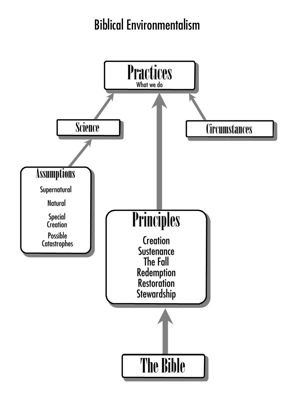 But the Bible gives us a God-centered view of the world, it reveals the Creator, and gives us responsibility to care for the creation as God’s stewards. Biblical environmentalism (see schematic diagram) can be based on Biblical principles and assumptions. The principles include: creation, sustenance, the fall (these three show that in some respects, the past is the key to the present), redemption, restoration and stewardship. Besides the natural world, this assumes the supernatural (there is more than the physical world), special creation (which can’t be explained by current laws), and possible catastrophes (so we need to be careful when extrapolating). Let’s care for creation as God’s stewards (or managers).
Appendix 1
Examples of principles of environmentalism
The Rio declaration on Environment and development (1992) has 27 principles, including:
Principle 1 “Human beings are at the center of concerns for sustainable development. They are entitled to a healthy and productive life in harmony with nature” – Human centered
Principle 3 “The right to development must be fulfilled so as to equitably meet development and environmental needs of present and future generations” – Human centered
Principle 7 “States shall cooperate in a spirit of global partnership to conserve, protect and restore the health and integrity of the earth’s ecosystem” – Ecosystem centered
Agenda 21 is the program to implement the Rio declaration. It proposes a program for action for sustainable development. Its Preamble says:
“Humanity stands at a defining moment in history. We are confronted with a perpetuation of disparities between and within nations, a worsening of poverty, hunger, ill health and illiteracy, and the continuing deterioration of the ecosystems on which we depend for our well-being. However, integration of environment and development concerns and greater attention to them will lead to the fulfilment of basic needs, improved living standards for all, better protected and managed ecosystems and a safer, more prosperous future” – Human centered
The National “State of the Environment” report says, “Preserving Australia’s biodiversity is important for four reasons”. One of these is Ethics which means that “no species and no generation has the right to remove earth’s resources solely for its own benefit” – Nature centered
The objectives of the NSW EPA include:
“reduce the risks to human health and prevent the degradation of the environment” – Human centered, and “achieve Ecologically Sustainable Development by implementing: the precautionary principle (being cautious), intergenerational equity (protect the environment for future generations)” – Human centered, “conservation of biological diversity & ecological integrity” – Species & ecosystem centered and “improved valuation & pricing of environmental resources” (using economics).
Greenpeace’s philosophy is:
“Ecology teaches us that humankind is not the center of life on the planet. Ecology has taught us that the whole earth is part of our body, and that we must learn to respect it as we respect ourselves. As we feel for ourselves, we must feel for all forms of life – the whales, the seals, the forests, the seas. The tremendous beauty of ecological thought is that it shows us a pathway back to an understanding and an appreciation of life itself – and understanding and appreciation that is imperative to that very way of life” – Ecosystem centered, leading to pantheism.
The Australian Conservation Foundation Mission is loaded with evolutionary assumptions:
“The conservation ethic reveres the enormous sweep and splendor of life, through three million millennia of geological time and its spread into many millions of diverse species and habitats. It is conscious that Homo sapiens is but a relative newcomer. From this perspective, it seeks to approach other species and their environments with humility and without arrogance” – Nature centered, reveres evolution
“It seeks to sustain diverse and active living communities in which non-human life can resume, in comparative tranquillity, the ponderous process of evolution which has been so disrupted and confused by the interruption of man” – Nature centered
“Intrinsic to the ethic is the recognition that human life is an integral part of this slow, inexorable and continuing evolutionary process; that our own adaption results from it and our destiny is tied to its continuance; our genes carry chemical messages shared with many other species now living and with many progenitors extending back to the beginning of life. Consequently, conformity with the conservation ethic confers benefits on humanity in terms of greater efficiency and satisfaction in meeting basic human needs and producing more resilient, supportive and fulfilling communities” – link to Human centered via evolution
“Against these threats, conservation seeks to hold the earth in trust for future generations, both human and non-human” – Ecosystem centered,
The UN Environment Program: “Caring for natural resources and promoting their sustainable use is an essential response of the world community to ensure its own survival and well-being” – Human centered
The Director General of UNESCO: “Unlike modern industrial society, many traditional cultures promote not only the need but the sacred duty for people to live in symbiosis with their natural environment … Our greatest need at the present time is perhaps for a global ethic – transcending all other systems of allegiance and belief – rooted in the consciousness of the interrelatedness and sanctify of all life. Such an ethic would tamper humanities acquired knowledge and power with wisdom of the kind found at the heart of the most ancient human traditions and cultures – in Taoism and Zen (Buddhist), in the understandings of the Hopi and the Maya Indians, in the Vedas (Hindu scripture) and the Psalms, in the very origins of human culture itself” – Ecosystem centered, leading to pantheism & other religions
“The theme of Theodore Roszak’s book The Voice of the Earth is our relationship to the natural world … He proposes a new relationship to nature, one based on modern science which regards the world as a living organism, a dynamic system with the capacity to self-regulate … possible solutions which Roszak envisions in an ecologically-grounded form of animism … The motivation for change on a planetary level must rise from deep within. This is where we must hear the voice of the earth, as she expresses herself through us as a genuine person need for a new quality of life. Her voice can bring us in contact with the ecological unconscious, the parts of the soul that we have lost touch with. What are needed are ‘ecological goals that can heal the psyche, psychological values that can heal the planet’” (Habitat May 94, p53) – Pantheism
Appendix 2
Examples the doctrines of science (in the field of ecology)
“Nature in its infinite wisdom gave our animals soft feet so they would be gentle on Australia’s fragile soils” (Habitat, Dec 96, p5).
“Throughout evolution, only two kinds of eyes have ever been invented. One is the vertebrate eye, which works like a single-lens camera; the other is the compound eye of insects and crustaceans” (NA, Winter 97, p34).
“Some animals have evolved to look like other animals or even plants, thereby reducing predator pressure” (NA, Autumn 96, p8).
“We’re the dominant species on the planet; at the top of the food chain; at the top of the evolutionary tree. The way we got there is by being incredibly ruthless and self-centered” (NA, Autumn 96, p47).
“Frogs worldwide have evolved almost 30 different ways of reproducing” (NA, Summer 94-95, p64).
“As a group, spiders have developed an astounding array of techniques to capture and immobilize their prey” (NA, Spring 94, p17).
“The ‘apeman’ – australopithecines – did not die out. We are those apemen, just as living apes are members of the group from which they descended. In the same way, dinosaurs didn’t die out – they are still alive and kicking as birds. All that’s happened is an evolutionary change through time in the shape of the creatures in these long-lasting lineages” (NA, Winter 94, p68).
An academic – Judith Kinnear (Sydney University Gazette, Apr 96, p25)
“The Darwinian model of evolution by natural selection enriches many of my everyday experiences: my walks in the Australian bush make me ponder a unique flora that evolved after the break-up of the Gondwana super-continent; my visits to the zoo reveal the living products of divergent evolution that fall into an orderly pattern; my viewing of a TV program on the appearance of antibiotic resistance in harmless bacteria transforming them into untreatable killers reminds me of the ongoing impact of evolutionary forces”. This shows that the doctrine of evolution is now embedded in our society. Everyone is indoctrinated in it so that it’s a worldview or paradigm and like a religion.
Written, January 1998; Posted, July 2016
Also see: Recognizing false teachers
What about climate change?
Share this:

Clever Nature!

 During a person’s life, the elastin in a blood vessel will go through an estimated two billion cycles of pulsation. Elastin’s flexibility allows skin to stretch and twist, blood vessels to expand and relax with every heartbeat, and lungs to swell and contract with each breath.
An international team of researchers has discovered the molecular motions of elastin, one of the proteins that gives blood vessels and skin their strength and flexibility. They found a hierarchical structure of scissor-shaped molecules that gives elastin its remarkable properties. Elastin tissues are made up of molecules of a protein called tropoelastin, which are strung together in a chain-like structure. First they discovered the shape and structure of the tropoelastin molecules. Then they studied the dynamics of the material as it forms large structures that can stretch and rebound. The dynamics turned out to be complex and surprising,. “It’s almost like a dance the molecule does, with a scissors twist – like a ballerina doing a dance”. Then, the scissors-like appendages of one molecule naturally lock onto the narrow end of another molecule, like one ballerina riding piggyback on top of the next. This process continues, building up long, chain-like structures. These long chains weave together to produce the flexible tissues that our lives depend on – including skin, lungs, and blood vessels. These structures assemble very rapidly. A key part of the puzzle was the movements of the molecule itself, which the team found were controlled by the structure of key local regions and the overall shape of the protein.
A researcher said, “Studying how these materials fail under extreme conditions yields important insights for the design of new materials that replace those in our body, or for materials that we can use in engineering applications in which durable materials are critical. Designing materials that last for many decades without breaking down is a major engineering challenge that nature has beautifully accomplished, and on which we hope to build”.
So the amazing features of elastin are attributed to nature. Isn’t nature clever! Apparently its designed and constructed complex materials that last for many decades without breaking down. If it’s more clever than us, then I think it deserves a capital “N” – Nature.
Maybe they should also research what the Bible says, “Through Him (God the Son, Jesus Christ) all things were made; without Him nothing was made that has been made” (Jn. 1:3NIV).
Written, March 2016
Also see: Evolution is theomorphic
Share this:

Gargoyles and dragons
 Many gargoyles peer down from medieval churches, cathedrals, houses and town halls in Western Europe. They are usually animals, or people, or hybrid animals/people carved in stone. The animals may be real animals or fantastic beasts. Dogs and lions were the most frequent animals used, while dragons were the most frequent fantasy creatures depicted. The dragons usually had a pair of membranous wings, some legs, a long reptilian tail, a long snout with visible teeth, and a fierce expression.
 Before the use of downpipes, waterspouts (which projected out from an upper part of a building or a roof gutter) preserved stonework by diverting the flow of rainwater away from buildings. They prevented rainwater from running down the walls and affecting the foundations. Gargoyles are decorative waterspouts, being carved stone figures with water spouts through their mouths. The figure was often an elongated animal because the length of the gargoyle determines how far water is thrown from the wall. They were usually carved in the form of a grotesque face, figure or frightening creature with wide-opened mouths to enable the water flow.
By the way, the word “gargoyle” shares a common root with the word “gargle”; which comes from “gargouille”, a French word for “throat”.
History of gargoyles
Gargoyles can be traced back thousands of years in Egypt, Italy and Greece. Lion-shaped gargoyles were used by the ancient Egyptians and on Greek temples. During the Roman Empire, lead pipes were added to gargoyles to channel water without eroding the stone. And gargoyle water spouts were found at the ruins of Pompeii.
 There are gargoyles on medieval (Middle aged) church buildings in Western Europe like the Gothic Notre Dame cathedral in Paris. Most were carved out of limestone or marble between the 10th and 15th centuries during the Romanesque and Gothic styles of architecture and decorative arts. Although once lead drainpipes were introduced in the 16th century there was no longer any practical need for gargoyles, they continued to be used for decorative purposes.
A dragon legend
There is a French legend about St. Romanus delivering the village of Rouen from a monster called Gargouille in about 600 AD. The fierce dragon which had a long, reptilian neck, a slender snout, batlike wings and the ability to breathe fire from its mouth, lived in a cave near the river Seine. The dragon caused much fear and destruction with its fiery breath, spouting water and the devouring of ships and men.
There are multiple versions of the story, but when la Gargouille was burned, its head and neck were so well tempered by the heat of its fiery breath that they would not burn. These were then mounted on the walls of the church (or city wall) to scare off evil spirits and used for protection.
Although this legend may be embellished and have changed over time, it’s interesting that dragon stories occur in many cultures, particularly the Chinese and Japanese.
 Is there a link between dragon gargoyles and dinosaurs?
Dragons and dinosaurs
The word “dragon” was used 23 times in the King James Bible (KJB), which was published in 1611, about 400 years ago. It seems as though the original translators of the KJB understood that a “dragon” was a real creature, not one that was legendary or mythical. It appears the “dragons” that were understood to be real animals were probably types of dinosaur which are now extinct. The translators of the KJB didn’t know about dinosaurs as this word was coined 230 years later in 1841. So the word “dragon” is probably an old word for a type of dinosaur.
 Could some of the gargoyle dragons have been carved from the dragons that were known in the 1600s?
Ancient images and dinosaurs
There is also a theory that gargoyles were inspired by early findings of dinosaur fossils such as proceratops. Adrienne Mayor (“The First Fossil Hunters: Paleontology in Greek and Roman Times”) saw a similarity between some Greek and Roman images and dinosaurs. To explain this she hypothesised that these were based on fossil bones discovered in these times.
She said that, “The earliest depictions of griffins looked really gnarly and brutish. It looked as if the artist were trying to portray something real rather than mythological. And then … I realized that they looked like modern reconstructions of dinosaurs in a museum”.
However, as she believed that all the dinosaurs died out millions of years ago, she failed to consider the possibility that the griffins could be based on seeing the actual creatures, not just the bones. After all, it takes modern scientists considerable research to reconstruct the appearance of an unknown animal from its bones.
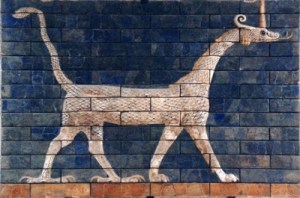 Looking back
As the story of the gargoyles relates to ancient times, some of it has probably been lost from our history. But they remind us of a time when buildings were more decorative and ornate. Some speculate about the symbolism of gargoyles, but I think they show the skill and creativity of the medieval stone masons.
Postscript
It is interesting to note the image of a dragon on the Ishtar gate in Babylon which was constructed about 575 BC.
Written, February 2015
Share this:

Andy arrives!

 Andy, our new grandson, arrived recently. Here are a few things that I am reminded of at a time like this.
Just like you and I, Andy is unique. There is no one else on earth (past, present and future) who is exactly like him. He has a unique genome, which is comprised of about 3 billion DNA base pairs in each cell of his body. He grew from a single cell itself.
God designed and created our world so that, over a period of nine months, the genetic information in a single cell can develop into a child that is ready to be born. It takes a lot of design to build a genome; it’s amazingly complex.
The Bible says that the development of a baby in the womb is an example of God’s power (omnipotence) and skill. King David wrote, “You made all the delicate, inner parts of my body and knit me together in my mother’s womb. Thank you for making me so wonderfully complex! Your workmanship is marvelous—how well I know it. You watched me as I was being formed in utter seclusion, as I was woven together in the dark of the womb. You saw me before I was born” (Ps. 139:13-16NLT). And another psalm says of God the Creator, “You made me; you created me” (Ps. 119:73). Of course God knows all about a baby as it’s growing in the womb (Jer. 1:5; Gal. 1:15).
I think another example of God’s power and skill is life itself. Can anyone explain the origin of life, without referring to God? We see that life always comes from life. Andy’s family tree goes back to Adam and Eve. How did Adam and Eve become alive? The Bible says their life came from God (Gen. 2:7, 22). Only God can create life; scientists can’t manufacture it, they just use it.
Is Andy perfect?
Although Andy is perfect in the eyes of his parents, in two ways he isn’t perfect.
Firstly, just like you and I, Andy’s genome contains mutations inherited from his parents. When parents reproduce, they make a copy of their genome and pass this to their child. From time to time, mistakes occur (called “mutations”), and the next generation does not have a perfect copy of the original genome. Each new generation carries all the mutations of previous generations plus their own. So the mutations accumulate from generation to generation. This means that the human genome is degenerating genetically with time due to the accumulation of mutations. In order to minimize the risk of deformed offspring that can result from shared mutations between genetically close parents, marriage is usually prohibited between close relatives. In fact, such limitations needed to be imposed after about 26 copies of the human genome, which was in the times of Moses’ children (Lev. 18:6-16; 20:11, 17, Dt. 27:22).
Secondly, just like you and I, Andy has a sinful nature. This means that he will have a natural tendency to misbehave. The Bible says that we are all sinners by nature (Rom. 3:23; Eph. 2:1-3). Even when Andy tries to do the right thing, it will be elusive (Rom. 7:14-20). This attitude affects our mind, will and emotions in particular (Jer. 17:9). But according to Andy’s “Beginner’s Bible”, “Jesus knew that he had to die for the sins of all people. It was part of God’s plan. When it was time, Jesus died on the cross for our sins.”
Now we can look forward to seeing Andy grow and develop from a baby to a child, to an adolescent, and then to a man, the way God has planned.
Written, February 2015
Share this:

Big history or little history?

 A pantheistic creation story
“Big History” is a modern origins story that is being developed online for school students and is supported by Bill Gates, one of the world’s richest men. The objective is to develop a framework for learning about anything and everything that includes a deeper awareness of our past. It claims to tell a story that our children need to know. But what will they learn?
History of the universe
“Big History” is based on eight “threshold moments” when the universe increased in complexity:
- Origin of the universe billions of years ago as explained by the big bang theory.
- Stars light up from the remnants of the exploding gases.
- New chemical elements form when stars die and create new types of atoms.
- Rocky planets such as the earth and the solar system form around stars.
- Molecules combine to form single celled living organisms that evolve into multi-celled organisms.
- Human beings appear as a consequence of evolutionary processes.
- After the last ice age about 10,000 years ago, humans develop agriculture.
- The modern revolution, characterized by the use of fossil fuels and global communication.
Although “Big History” is based on humanity’s current scientific and historical understanding, the following questions come to mind.
Big assumptions
Although Big History states these as facts, it assumes that:
- The origin and development of the universe can be explained by the laws of science.
- The early universe was simple.
- The universe has become more complex with time.
Once these are assumed, the rest follows as a consequence. So the course is teaching that these assumptions are facts. Instead they are scientifically unprovable.
As history trumps science when dealing with the past, the Bible surpasses science with regard to the origin of the universe and the nature of the early universe. In particular, the assumption of the uniformity of scientific laws isn’t valid past the creation of the universe about 6,000 years ago. So history shows the first two assumptions are false.
The assumption that “The universe has become more complex with time”, goes against common sense and the law of cause and effect. How can an inanimate object gain increasing complexity and increasing information by using the laws of science alone and not outside intelligence? How can an animal or plant gain increasing complexity and increasing information by using the laws of science alone and not outside intelligence?
Big miracles
This secular origins story is based on miracles than can’t be explained by science. Yet it claims to be scientific!
Before the beginning of time it assumes there was nothing – no time, mass, energy or space. After the beginning of time a tiny particle smaller than an atom appears that contains everything in today’s universe. This means that something appears from nothing, which is not allowed in the laws of physics! In a science where there is no place for miracles, this is certainly a miracle. How was all the mass and energy within the universe created out of absolutely nothing using only the physical forces within the universe? How could the universe create itself?
According to Big History, the universe can create complexity and information. This happens as a series of stages, each of which produces something utterly new. Each of these threshold moments is a miracle as the increase in complexity and information cannot be explained by the laws of science. How could the universe increase complexity and information by itself?
How does the universe create complexity despite the second law of thermodynamics, which says that “The general tendency of the universe is to move from order and structure to lack of order and lack of structure”? This is never explained. There is just a statement that it can create complexity, but with great difficulty! So the universe builds itself, which is pantheism. The universe is god. So intelligence and intent is attributed to inanimate objects or concepts, such as “Life interjects” and “DNA learns”.
It is interesting to note that the example of increasing complexity used in Big History was our modern society and not a biological example such as the DNA molecule or the human mind.
Circular reasoning
Big History is guilty of circular reasoning. It states assumptions and ideas as facts. Its key findings are based on its assumptions and presuppositions. For example, it reveals how complexity slowly evolved. But this is also an assumption.
Big history is speculative. It says, “We can imagine the early universe breaking up into billions of clouds”.
Big history is a product of the secular paradigm or worldview that has rejected the God of the Bible.
Conclusion
Big History is certainly ambitious. It has big assumptions, big miracles, big extrapolation and big imagination. Although it claims to be big on history, it actually includes little recorded history.
As “the story of how the universe creates complexity” and the “unifying story that gives a sense of the whole of history”, it is a pantheistic creation story that replaces the Bible.
Do our children need to know this? How much better if they knew the Bible and accepted its message as the unifying story that gives a sense of the whole of history?
Written, October 2013
Also see – Using history and science to investigate ancient times
– Big history
Share this:

Using history and science to investigate ancient times

 When history trumps science
What happened?
Crime investigation often involves eyewitnesses and forensic science. But when these conflict, which gets precedence? Forensic science uses the evidence to infer what happened in the past and so deduce who committed the crime. Eyewitnesses report what they saw happen and who actually committed the crime. More importance is usually given to a reliable eyewitness than to forensic science, but forensic science can help explain an eyewitness account.
History and science are two main ways to investigate events that occurred in the past. History is like an eyewitness and science is like forensic science. In this article, we use the term “ancient forensic science” to refer to the use of science to investigate ancient times. Let’s look at the relationship between history and ancient forensic science.
How history works
History is the study of past events. Its accuracy depends on the accuracy of the information available to the historian, which is also related to the amount of time between the events studied and the historical investigation. Obviously, all other things being equal, the greater this time gap, the greater the uncertainty in the investigation.
History is more accurate when there are written records available than when these are absent. History can also use other evidence such as oral records and archaeological findings.
As a result of historical research, the historian produces a written account of past events and attempts to put them in chronological order.
How ancient forensic science works
Ancient forensic science uses the scientific method to investigate ancient times. This approach has been used in astronomy, archaeology, biology, chemistry and geology to investigate ancient times. Because it relates to past events that were not observed and the evidence is thousands of years old, ancient forensic science is based on more assumptions than most science. Many assumptions need to be made to interpret the evidence. An example of an assumption made by modern forensic science in that “everyone’s fingerprint is unique”. The assumptions of ancient forensic science include extrapolation from present conditions backwards in time assuming uniformity of scientific laws. If an assumption is incorrect, then the findings of the forensic investigation can be unreliable.
By the way, science can only address situations that are described by scientific laws. This means it can’t address questions such as the ultimate origin of matter and energy in the universe.
As a result of ancient forensic scientific research, the scientist also produces a written account of past events and attempts to put them in chronological order.
The historical record
The Bible is the best record of ancient history we have today. It contains documentary evidence from eyewitnesses which has been accurately preserved over the years. The authors were either eyewitnesses themselves or they spoke with eyewitnesses. In the case of the original creation, the account was given to Moses by God, who was the Creator. God asked Job, “Where were you?” when this happened (Job 8:4-7)! He hadn’t been born yet! Therefore, it is an eyewitness account! Likewise, the question for us today is “Were you there?”. Obviously the answer is “no”! We can only look back thousands of years towards this event.
The Bible says that God created the universe rapidly in six days and that people have existed since the sixth day of creation. The creation was mature and fully functional from the beginning. It didn’t need to develop gradually over time from simple to more complex. This means that at the beginning, the apparent age of things didn’t match the actual age. The Bible also says that Adam lived about 6,000 years ago and the global flood was about 4,500 years ago.
The ancient forensic scientific explanation
Ancient forensic science says that the universe developed slowly over billions of years. During this time, things developed gradually from simple to more complex. First there were stars, then planets, then single-celled organisms, then multi-celled organisms, followed by fish, plants, amphibians, reptiles, birds, mammals and finally human beings.
Much of this explanation relies on the “big bang” theory and the idea of evolution. However, ancient forensic science is unable to answer questions like:
- How did the first life originate?
- Why was there a “big-bang”?
- What happened before the “big-bang”
- How did something come from nothing?
This conflicts with the biblical record as the dates are significantly older, all things developed gradually from simple to more complex instead of being complex from the beginning, and people appear after billions of years of evolution.
How can we resolve this conflict?
Huge extrapolation
Scientists use mathematical methods to make predictions. These mathematical methods (which are called “models”) are developed from measurements (observations) that have been made over a certain period of time and under a certain range of conditions. The predictions are most accurate for circumstances that lie within those under which the model was developed. Predictions made outside these circumstances are less reliable as they are extrapolations outside the realm that was measured and observed.
The ancient forensic scientific explanation of ancient history uses theories and observations made in the past few hundred years to make statements about what happened millions and billions of years ago. In science it is well known that the accuracy of a prediction decreases as it extends outside the region of measurement and observation.
Orders of magnitude are used to compare very large differences between numbers. It this case the difference is expressed as the power of 10. For example, 1,000 is one order of magnitude greater than 100, two orders of magnitude greater than 10, and three orders of magnitude greater than 1.
We will now estimate the degree of extrapolation that is made by ancient forensic science. In order to be conservative, we will assume that the scientific theories and observations have been developed from measurements and observations made in the past 1,000 years. So any prediction that applies greater than 1,000 years ago is an extrapolation outside the range of measurement and observation. Therefore, a prediction of an event 10,000 years ago represents an extrapolation of one order of magnitude. Using the dates taught in the Big History Project, we see that the extrapolations are at least 2 to 7 orders of magnitude. As the degree of uncertainty usually increases with the size of the extrapolation, these enormous extrapolations indicate a huge uncertainty in these predictions. In normal science such extrapolations would be viewed as being speculative guesses.
| Proposed Event | Extrapolation – Orders of magnitude |
| Big bang | 7 (a factor of 107 ) |
| Earth and solar system formed | 6 (a factor of 106) |
| First life on earth | 6 (a factor of 106) |
| First humans | 2 (a factor of 102) |
Resolving the conflict
As eyewitnesses trump forensic science in criminal investigations, we need to see what implications the historical record has for the ancient forensic scientific explanation. The most obvious implication is that it is wrong to extrapolate backwards in time past about 6,000 years because this was when the universe was “stretched out” by God (Jer. 10:12). The creative week was a unique time that can’t be explained by the laws of science. Scientists would call it a “boundary condition” or an “initial condition”. The assumption of the uniformity of scientific laws only applies since this time. Extrapolation backwards past this time is invalid because the current scientific laws may not apply when God was creating the universe.
This means that most of the apparent billions of years in the ancient forensic scientific explanation represent what God did in less than a week. This was the miracle of creation. So the billions of years is related to how far God stretched out the universe, not the age of the universe.
Because it is wrong to extrapolate backwards in time past about 6,000 years, the millions of years of evolution are also incorrect.
So when the ancient forensic scientific explanation is corrected by imposing historical eyewitness boundary conditions, we see that the assumptions behind the “big-bang” theory and the theory of evolution are obviously incorrect.
Does it matter?
Why can’t we accept both ancient forensic science and the Bible? Because the ancient forensic scientific explanation destroys the gospel message in the Bible. It destroys the source of sin and death, removes the need for a Savior, and ruins the possibility of future restoration of the earth when Christ reigns (Acts 3:21). This means removing creation, the Garden of Eden and the fall into sin as real events in real places.
It also moves the source of sin, disease, decay and death away from Adam and Eve’s disobedience. It makes them a normal part of our world. They are not viewed as being abnormal. It puts death before sin, not after it. It means that the created world, which God said was “very good” (Gen. 1:31), was marred by disease and death from the beginning. It takes away the fact that the original sin affected all of God’s creation (Rom. 8:19-23). It takes away the promise that all creation will be liberated from its “bondage to decay” when Christ returns to rule over it.
Conclusion
As a reliable eyewitness is superior to forensic science in the investigation of crime, so reliable history is better than ancient forensic science in investigating ancient times. So reliable history trumps science when dealing with the past.
“reliable history trumps science when dealing with the past”
Let’s follow the reliable history of the Bible, instead of the erroneous assumptions and extrapolations of ancient forensic science.
Written, October 2013
Also see – Big history or little history?
– Big history
– Is the theory of biological evolution science or history?
Share this:

Looking back and looking ahead

 Based on a message given at my mother’s funeral on 3 April 2013
A funeral usually involves memories and reflections of the life of the person who has died. But the funeral of a Christian can also look ahead in anticipation of what lies ahead.
Help from God the Creator
The source of a Christian’s help and protection throughout life is described in Psalm 121NIV.
“I lift up my eyes to the mountains—where does my help come from?
My help comes from the Lord, the Maker of heaven and earth.
He will not let your foot slip—He who watches over you will not slumber;
indeed, He who watches over Israel will neither slumber nor sleep.
The Lord watches over you—the Lord is your shade at your right hand;
the sun will not harm you by day, nor the moon by night.
The Lord will keep you from all harm— He will watch over your life;
the Lord will watch over your coming and going both now and forevermore.”
When this song was written about 3,000 years ago, God’s people knew that the only reliable help and protection comes from the God who made the universe – “the Maker of heaven and earth”. In this context the Hebrew word for “heaven” means the atmosphere and the stars and galaxies. A God with the intelligence and power to create the universe and populate it with living plants, animals and people was surely able to help them! The Bible says He was the source of life on earth whereas all other gods and philosophies are the product of the human imagination.
Unfortunately in our modern world we have largely lost this knowledge and this confidence. We have forgotten about God the Creator. Even though we have wonderful technology, science can’t explain how matter was created from nothing or how life originated, and we often replace God the Creator with the idea that things created themselves.
So when we struggle in life where does our help come from? Some people go to counsellors for help who encourage them to get help from outside themselves. Because people usually can’t solve their own problems, they need to get help from someone else. In a similar way, we all need “outside help” to sustain us and God the Creator is the ultimate outside help!
Psalm 121 ends with, “The Lord will watch your coming and going both now and forevermore”. Here those who trusted God the Creator were promised that God would protect them throughout life and into the future. They could live with assurance and confidence that God would continue to help them. Likewise Christians can have the assurance that God will sustain them during their life and afterwards.
A different world
You may ask if God created everything in the beginning, why is there so much suffering in the world? The world today is very different from the one God made originally. We live in a different world. In the beginning it was a perfect world with harmony between God, people and the natural environment. But when people turned against their Maker, it changed and sin, evil, suffering and death came into the world. This change was caused by people like us. We live in a world with consequences – an act has a consequence and an effect has a cause. Because people turned against God our relationships have been ruined. We ignore God and are separated from Him, we can’t get along with other people, and we exploit the natural environment. Another consequence is that the Bible says we are destined to eternal punishment. Because we are the cause of this problem, we need outside help. Because each of us is guilty, we can’t help each other. The only reliable help available outside humanity is God the Creator.
Help from God the Lifesaver
Fortunately, God didn’t only create the universe and the laws of nature in the beginning, but He also continues to sustain it. He is not only incredibly powerful, but He is also incredibly loving. We remember His special act of love at Christmas and Easter when we celebrate the unique birth and death of Jesus Christ. God knew that mankind was doomed to eternal punishment unless He provided them with outside help. He did this about 2,000 years ago when Jesus Christ lived on earth and died and came alive again. Jesus was unique; He was God living as a human being. He showed His power over our world by the miracles He did. When He died by crucifixion, He took the eternal punishment that we deserve. If we turn towards God by being sorry for our behaviour and accepting the fact that Jesus has taken the penalty for our sin, then He promises eternal joy instead of eternal punishment. This is called eternal life. So Jesus is like a lifesaver – He can rescue us from the eternal consequence of our selfish behaviour. In this way God is making a new creation and He gives us the choice of being a part of it. Although we spoilt God’s original creation, and there is now sin, evil, pain, suffering and death, these will be absent in God’s new creation. Instead we can be reconciled with God, we can love one another and we can look forward to the restoration of creation like it was in the beginning.
Because a Christian has accepted Jesus as their Savior they can have an inner assurance, joy and peace.
 Death
Death
What happens when a person dies? Not only do the lungs stop breathing and the heart stops pumping. The Bible says that at death a person’s invisible soul and spirit is separated from their body. If they trusted in Jesus the Savior, their soul and spirit goes immediately to be with God in heaven. After death they are enjoying a perfect place. That is why Paul could say, “To die is gain” (Phil. 1:21) and that he preferred to be “away from the body and at home with the Lord” (2 Cor. 5:8). So they are in a better place. Their death is a loss for us, but a gain for them.
Resurrection
But there is more! On Easter Sunday we recall that the body of Jesus was raised back to life after being buried in a grave. The Bible describes a coming day when the bodies of believers, who trusted in Christ the Savior will also be raised back to life:
“What I am saying, dear brothers and sisters, is that our physical bodies cannot inherit the kingdom of God. These dying bodies cannot inherit what will last forever. But let me reveal to you a wonderful secret. We will not all die, but we will all be transformed! It will happen in a moment, in the blink of an eye, when the last trumpet is blown. For when the trumpet sounds, those who have died will be raised to live forever. And we who are living will also be transformed. For our dying bodies must be transformed into bodies that will never die; our mortal bodies must be transformed into immortal bodies. Then, when our dying bodies have been transformed into bodies that will never die, this Scripture will be fulfilled, ‘Death is swallowed up in victory. O death, where is your victory? O death, where is your sting?’ For sin is the sting that results in death, and the law gives sin its power. But thank God! He gives us victory over sin and death through our Lord Jesus Christ” (1 Cor. 15:50-57NLT).
This is also described in 1 Thessalonians 4:16-18. As part of God’s new creation they will have new bodies which won’t wear out and die (1 Cor. 15:42-49; Phil. 3:21; 1 Jn. 3:2) and they will be transported to be with God in heaven – spirit, soul and new body. This will be a great victory over the sin, suffering and death of our world. That’s why Christians can look forward confidently to the coming resurrection. There’s victory ahead!
Summary
The hymn, “How great Thou art”, summarises the greatness of God and the reasons for our Christian faith.
The first verse is about God the great Creator and source of life on earth. It says “Your power throughout the universe displayed”. Do we see God’s power in His creation?
The third verse is about Jesus Christ the great Lifesaver and source of eternal life. It says “On the cross, my burden gladly bearing, He bled and died to take away my sin”. When we stand before God, will He be like a lifesaver or like a judge? If we turn towards God by confessing our sins we can be ready to meet Him.
The last verse is about the great resurrection when the bodies of those who have trusted in Christ will be raised and changed to be with Him forever. It says “When Christ shall come with shout of acclamation and take me home – what joy shall fill my heart”. Are you ready to experience this joy?
Written, April 2013
Also see: Where is grannie?
Share this:

 No excuse
Big history

Made to be inhabited
A letter in a newspaper stated that Genesis chapter 1-11 is pre-history and is probably best described as a ”saga”, which is a story. They said it was a different genre to the rest of Genesis, which I assume was considered to be real history which had been verified by archaeology. Well, what does the evidence show us?
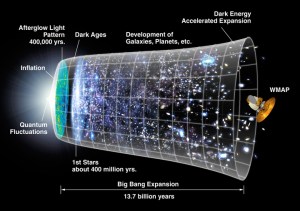 Extra-Biblical account
The history of the universe from the beginning of time according to those who reject the Bible and the God of the Bible is often told as follows:
- About 15 billion years ago – there was a “big bang” and stars like the sun formed from the exploding gases
- Then about 4.6 billion years ago – planets like earth formed around the stars
- 3.5 billion years ago – the first life appeared in deep water when molecules combined to form single-celled organisms
- 1 billion years ago – multi-cellar organisms evolved
- 600 million years ago – invertebrate animals and fish evolved
- 475 million years ago – land plants evolved
- 360 million years ago – amphibians and then the first land animals evolved
- 250 million years ago – reptiles ruled
- 200 million years ago – birds and mammals ruled
- 90 million years ago – flowering plants evolved
- 200 thousand years ago – the first humans evolved
Bill Gates is funding a project to present this information online for high school students. Let’s look at what the Bible says about such “big history”.
According to Jesus
When Jesus was discussing divorce and marriage He went back to Genesis and quoted from Genesis 1:27 and 2:24 “But at the beginning of creation God ‘made them male and female’. ‘For this reason a man will leave his father and mother and be united to his wife …” (Mk. 10:6-7NIV). These verses refer to the first people Adam and Eve. Here He links the “beginning of creation” with the beginning of the human race.
When Jesus was condemning the Pharisees, he quoted the range of martyrs in the Old Testament, “the blood of all the prophets that has been shed since the beginning of the world, from the blood of Abel to the blood of Zechariah” (Lk. 11:50-51). Abel was in the first family (Genesis 4) and Zechariah was mentioned in 2 Chronicles 24, the last book in the Jewish Old Testament. Here He links the “beginning of the world” with the first family.
Clearly Jesus believed that early Genesis was real history, not just a story.
We can also learn something about the beginning of everything from Jesus. It is instructive to consider how Jesus demonstrated God’s power. He did many miracles; more than is recorded in the Bible (Jn. 20:30). For example:
- A storm was calmed straight away (Mk. 4:39)
- 5,000 men plus women and children were fed from five loaves and two fish (Mk. 6:30-44)
- People were healed immediately: the blind could see (Mt. 20:34); the crippled could walk (Lk. 13:13) and the dead stood up (Mk. 5:42; Jn. 11:43-44).
So Jesus could change the physical world instantly. He didn’t need time to do it in gradual steps. Likewise, God can create physical things instantly. He doesn’t need time to do it in gradual steps from the simple to the complex.
According to Paul
When looking at why people who have not heard the gospel still face God’s judgment, Paul wrote “since the creation of the world God’s invisible qualities—His eternal power and divine nature—have been clearly seen, being understood from what has been made, so that people are without excuse” (Rom. 1:21). God’s attributes have been evident to people “since the creation of the world”, not just since people have been on the earth. The implication is that people have been here since the creation of the world. This is consistent with what Jesus said about Adam, Eve and Abel.
Paul also believed in Adam and Eve (Rom. 5:12-14; 1 Cor. 15:21-22, 45; 2 Cor. 11:3; 1 Tim. 2:13-14). For example, He contrasted Adam and Jesus in three passages of the New Testament:
- “If there is a natural body, there is also a spiritual body. So it is written: “The first man Adam became a living being”; the last Adam, a life-giving spirit” (1 Cor. 15:44-45). From Adam we have physical life in a natural body, but from Jesus we can have eternal life now and a redeemed body at the resurrection.
- “sin entered the world through one man, and death through sin … through the disobedience of the one man the many were made sinners, so also through the obedience of the one man the many will be made righteous” (Rom. 5:12-21). So death entered the world because of Adam’s sin, but eternal life is possible through Jesus.
- “For since death came through a man, the resurrection of the dead comes also through a man. For as in Adam all die, so in Christ all will be made alive” (1 Cor. 15:21-22). From Adam we have physical death, but from Jesus people can be resurrected from the dead.
So Paul viewed both Adam and Jesus as true historical characters, not as mythical figures. He saw the creation and fall into sin of early Genesis as historical events that had a significant impact on our world, not as “pre-history” stories.
According to historical records
If there has been a crime or a car accident, the police determine what happened from the evidence and by interviewing witnesses. The Biblical writers witnessed what they wrote about, except for situations such as creation when God was the witness.
History is the study of past events. We don’t use operational science because it’s only reliable for present events – we can’t do experiments on the past or the future unless we make assumptions (then the finding relies on the assumptions made). Documentary evidence is the best form of historical record. Let’s look at what the historical records in the Bible meant for its original readers, the Children of Israel.
Creation
When God gave them the ten commandments, He said “in six days the LORD made the heavens and the earth, the sea, and all that is in them, but He rested on the seventh day” (Ex. 20:11). This was a model for their working week. In this context, the heavens are the stars and galaxies. God took 6 days to create the universe, but could have taken 6 hours, 6 minutes or 6 seconds. After all, God is outside the time of our finite world. He is infinite and all powerful.
God didn’t use a long process to create everything. He commanded and it was done immediately (Ps. 33:6-9; Heb. 11:3). I am not aware of any Scriptures which indicate long ages of time were involved in creation.
This is also supported by the resurrection which is described as “we will all be changed in a flash, in the twinkling of an eye” (1 Cor. 15:51-52). So our resurrection bodies will be created instantly. This is consistent with the original creation taking a short period of time and Christ’s miracles happening instantly. God doesn’t need lots of time to create something new.
The creation was finished on day 6, which was when Adam and Eve were created. So we know that people have been on earth since then.
A mature universe
On the day they were created, Adam named the animals and Adam and Eve were married (Gen. 2:19-20, 24). They were created as mature adults. The universe and the earth that God created were mature. Its complex interacting systems functioned properly from the beginning. The animals and plants lived in mature and functioning ecosystems. So the creation was mature and fully functional from the beginning. It didn’t need to develop gradually over time from simple to more complex.
This means that at that time the apparent age of things didn’t match the actual age. Scientists calculate the age of the universe by assuming that all the stars and galaxies have expanded to their positions after a big explosion. It is an assumption that is also based on using the red- shift of light and the Hubble law to calculate the expansion rates and the distances of galaxies. However, the Bible says that God placed them in their positions on day 4 of creation by stretching them out (Gen. 1:14-19; Ps. 104:2). So the difference between their apparent age of 15 billion years and the Biblical age of thousands of years represents the miracle that God did on day 4.
Genealogies

When did this happen? Is Genesis 1-11 pre-history? It is followed by Genesis 12-25 which is about Abraham. Do we know much about before this time? Yes we do. In Genesis 5 and 11 we have detailed genealogies from Adam to Abraham (Gen 5:1-32; 11:10-26). These are not just lists of ancestors and descendants. Their ages at the birth of their child in the family tree and their death are also given. Some Biblical genealogies have gaps because their purpose is to show their main ancestors (Ezra 7:1-5; Mt. 1:1-16). But these ones are worded in such a way as to exclude omissions and gaps. They are the most comprehensive genealogies in the Bible. Because they cover 19 generations, we know more about these people than our own ancestors!
Besides this, there are two other genealogies that cover this period in the Bible (1 Chron. 1:1-27; Lk. 3:33-38). There are three genealogies in the Bible covering the period back to Adam that some allege is pre-history! So it’s real history. It seems as though in recent times some people call it pre-history to explain the inconsistency with the recent extra-biblical account.
When you add up that dates given in Scripture you find that Adam lived about 6,000 years ago and the global flood was about 4,500 years ago. That’s a long time, thousands of years, but it’s not millions of years. When compared to the extra-biblical timeline, the historical timeline:
- Is documented historically instead of being calculated
- Is shorter (about 6,000 years compared to about 15 billion years)
- Has people appearing near the beginning (people have been here for 99.9998% of the time); instead of near the end (people have been here for 1.3% of the time). People have been here most of the time. After all, God made the world to be inhabited, “For this is what the LORD says—He who created the heavens, He is God; He who fashioned and made the earth, He founded it; He did not create it to be empty, but formed it to be inhabited … I, the LORD, speak the truth; I declare what is right” (Isa. 45:18-19).

Implications
The extra-biblical account is inconsistent with recorded history. As it relies on assumptions of people who were not there when it happened, clearly these assumptions are wrong. What are these incorrect assumptions?
- They rule out a God of miracles. This means they have to rely on current physical processes and forces to explain the past.
- Consequently, they believe that the present is the key to the past, but according to the Bible the past is the key to the present – after all history goes forwards, not backwards!
- They believe that given enough time everything can create itself and organisms always evolve or build up gradually over time from simple to complex. Therefore the biological world has become more complex with time.
- They believe simple organisms are primitive and developed earlier than more complex organisms.
Does it matter if the extra-biblical explanation of the past history of the world is wrong? Yes, because it destroys the gospel message. It destroys the source of sin and death, removes the need for a Savior, and ruins the possibility of future restoration of the earth when Christ reigns (Acts 3:21). That’s what happens if the first three chapters of Genesis are not historical, but a story that isn’t necessarily true. This means removing creation, the Garden of Eden and the fall into sin as real events in real places.
This explanation moves the source of sin, disease, decay and death from Adam and Eve’s disobedience to making it be a part of our world (which Christians call God’s creation). In this case disease, decay and death have always been a part of our world. They are the normal situation; and not viewed as being abnormal. It takes away the lack of disease and death before the fall. It puts death before sin, not after it. It puts evil before sin, not after it. It means that the created world, which God said was “very good” (Gen. 1:31), was marred by disease and death. It takes away the fact that the original sin affected all of God’s creation (Rom. 8:19-23). It takes away the promise that all creation will be liberated from its “bondage to decay” when Christ returns to rule over it.
Lessons for us
As believers, our thoughts and opinions should be controlled by God, not by the views of those who reject God. This means that our thoughts and opinions should be controlled by the Bible, not by the extra-biblical theories which rule out the possibility of divine intervention in the natural world, such as miracles. The Bible says that God has intervened in our big history and He will intervene again. We ignore that at our peril.
Sin, death and salvation are important aspects of the Bible and Christianity. Let’s be aware of the implications of ideas such as extra-biblical big history which are inconsistent with the Biblical record.
Finally, the Bible is not a science book; but it is a history book. It is the best record of ancient history we have today; a supreme example of ancient history; and a big history book. It contains documentary evidence by eyewitnesses which has been accurately preserved over the years. So we can trust the Bible on big history.
Written, June 2012
Also see – Big history or little history?
– Using history and science to investigate ancient times
Share this:

Evolution is theomorphic
 Are animals smarter than people?
Sometimes in movies or children’s stories there are talking animals. This is an example of anthropomorphism where something is given human attributes. The word comes from the Greek word for human (anthropos) and form (morphos). A recent television show titled “Making stuff smarter” described how nature inspired scientists to develop new inventions. For example:
- As sharkskin seems to prevent the growth of algae, material with a similar micro structure may inhibit the spread of bacteria.
- As geckos adhere to a vertical wall by microscopic hairs on their toes, material can mimic this to enable other things to adhere to walls.
- As birds use a flexible, shape-changing wing, this may be mimicked in future aircraft.
These abilities of nature were explained in the television show as follows:
- “In each case, nature has come up with something new just by manipulating the surface of a material on a very small scale”.
- “For billions of years, Mother Nature’s been experimenting, and that’s given living things amazing abilities, like healing, flight and camouflage. What can we learn from nature’s ingenuity?”
- “With all our technology and materials, it’s easy to think we’re the planet’s best inventors, but life has been experimenting with the raw materials of earth for far longer. Billions of years of evolution have created a vast array of plants and animals with amazing abilities of their own. As our understanding of biology and our materials deepens, a new world has opened up, one where nature’s ingenuity and human ingenuity can combine.”
So animals amazing abilities are attributed to: “nature”, “Mother Nature”, and “evolution”. This creative ability is assumed to be an inherent characteristic of animals. Does the fact that scientists are imitating these abilities mean that animals are smarter than people? The answer to this question depends on how the animals were created. If they created themselves, then they developed these characteristics first and so in this aspect they are smarter than the scientists who are investigating them! On the other hand, if the animals didn’t create themselves, then they are not necessarily smarter than people.
Why is “Mother Mature” capitalised? This looks like theomorphism, where something is given the attributes of God or a deity. The word comes from the Greek word for god (theos) and form (morphos). In this case the idea of evolution replaces the need for a creative God. It is theomorphic.
God says …
What does God say about this topic in the Bible?
- God made the original animals and people (Gen. 1:20-27). This means that He invented the amazing abilities of animals and people. So nature is ingenious because God is ingenious, not because of the idea of evolution. Also, scientists are ingenious because God is ingenious. So animals didn’t create themselves, but they do reproduce themselves, as God planned.
- God made people to “rule over the fish in the sea and the birds in the sky, over the livestock and all the wild animals, and over all the creatures that move along the ground” (Gen. 1:26). In this sense, people are smarter than animals and not vice-versa.
So, don’t believe everything you hear and read. Instead test it against what God says.
Written, April 2012
Also see: The idol of evolution: Part 1 (in a new window)
The idol of evolution: Part 2 (in a new window)
Clever nature!
Share this:

Year of the dragon

 Chinese New Year is the main holiday of the year for more than one quarter of the world’s population. Our daughter and her family and Chinese in-laws spent the Chinese New Year in Hong Kong where the streets were decorated colorfully. Chinese holiday traditions include parades, feasts, fireworks, lanterns and giving children money in red envelopes. This is the year of the dragon in the Chinese calendar, which began on 23 January 2012 and will end on 9 February 2013. A surge in births is expected in China during this year as it is regarded as the zodiac sign which will give their offspring the most success and happiness in life.
Chinese calendar
Each year is associated with one of the 12 animals in the Chinese zodiac in the following order: Rat, Ox, Tiger, Rabbit, Dragon, Snake, Horse, Sheep or Goat, Monkey, Rooster, Dog and Pig. So the year of the dragon follows the year of the rabbit and is followed by the year of the snake. The names are repeated every 12 years. Rather than remembering their current age, the Chinese tend to remember the animal of their birth-year. For example, I was born in the year of the Ox.
Nowadays the Chinese calendar is mainly used for traditional festivals that occur on new moons or full moons. As the months are lunar months, it has the feature that the phases of the moon, and astronomical and tidal phenomena associated with them, such as spring and neap tides, fall on approximately the same day in each month.
Today it is considered that the Chinese dragon is a legendary and mythical creature. But what about when the Chinese zodiac was developed thousands of years ago? Clearly the other 11 creatures in the zodiac were not mythical. Why would one be mythical? That would be inconsistent. Was it a creature that was known in ancient times? Could it be extinct?
Dragons in the Bible
Dragons are mentioned in the King James Bible (KJB), which was published about 400 years ago. The KJB is the all-time bestselling book in the English language. In the Old Testament, on 23 occasions the name “dragon(s)” was given to animals that lived on the land and in the sea.
Are these creatures real or mythical? During a drought wild donkeys were said to pant like dragons (Jer. 14:6). The “dragon well” was located near the southern walls of Jerusalem (Neh. 2:13). Also, Jerusalem and Babylon were to be reduced to a heap of ruins and a “den of dragons” (Jer. 9:11; 51:37). Pharaoh king of Egypt was like a “great dragon” lying in the Nile River and Nebuchadnezzar king of Babylon would devour Judah like a dragon swallows people (Ezek. 29:3; Jer. 51:34). It seems as though the original translators of the KJB understood that a “dragon” was a real creature, not one that was legendary or mythical.
It is interesting to note that in more recent editions of the KJB, the word “dragon” has been changed to “jackal” or “serpent” or “sea-monster”, which are clearly real animals.
Dragons and dinosaurs
In the KJB, “dragons” are associated with Leviathan (Ps 74:13-14; Isa. 27:1). Leviathan in turn is associated with Behemoth and their descriptions seem to match those of certain dinosaurs (Job 40:15-24; 41:1-34). Another creature, Rahab, is like Leviathan (Job 9:13; 26:12; Isa. 30:7; 51:9). These creatures were also used as metaphors for powerful nations such as Egypt and Babylonia (Jer. 51:34; Ezek. 29:3).
Therefore, it appears the “dragons” that were understood to be real animals were probably types of dinosaur which are now extinct. The translators of the KJB didn’t know about dinosaurs as this word was coined 230 years later in 1841. So the word “dragon” is an old word for “dinosaur”. The changes to the text of the KJB occurred after the theory of evolution popularised the idea that the dinosaurs died out millions of years before human beings populated the earth. This shows how one’s worldview can be used to reject evidence and to modify history. Unfortunately this aspect of the secular theory of evolution has influenced all Bible translations.
It is interesting that dragon stories occur in many cultures, particularly the Chinese and Japanese. The pictures we see of dragons are often composite drawings that combine the features of different kinds of dinosaurs. They would also be embellished.
Dragons and dinosaurs are massive examples of God’s creation. When Job was reminded of the greatest dragons and dinosaurs he responded, “My ears had heard of You but now my eyes have seen You. Therefore I despise myself and repent in dust and ashes.” He had seen God’s great power and this caused him to turn and go in the opposite direction and follow God (Job 42:5-6NIV). God also wants us to respond to His power and might.
Written, February 2012
Also see: Dinosaurs in the Bible?





 George's Journal
RECENT COMMENTS