
Did Jesus use any of His divine power when He was on earth?
 I have been asked whether Jesus Christ used any of His divine power when He was on earth. Or did He not use this power at all during this time and always function as a human being who is indwelt with the Holy Spirit? Also, as a consequence of this were the disciples able to do whatever Christ did? And does this mean that today Christians can also do whatever Christ did?
The Bible teaches that Jesus was unique. “There is one God and one mediator between God and mankind, the man Christ Jesus, who gave Himself as a ransom for all people” (1 Tim. 2:5-6NIV). He was both human and divine (Jn. 1:1, 14, 18; Rom. 9:5). Because He claimed to be equal with God, the religious leaders wanted to kill Him (Jn. 5:17-18). Biologically, He had a human mother but not a human father. He was sinless.
What do the gospels say?
Several examples of Jesus’ actions in the gospels show His divine power:
• He forgave sins so people were no longer guilty before God, and even those who opposed Him knew that only God can forgive sins in this way (Mt. 9:2-3, 6; Mk. 2:5-7, 10). He also gives eternal life (Jn. 10:28).
• Jesus knew what others were thinking (Mk. 2:8; Lk. 11:7). He knew the Samaritan woman had five husbands and knew everything she had done (Jn. 4:18-19, 29). He knew the future (Mt. 16:21) and He knew everything (Jn. 16:29-30; 21:17).
• Jesus saw Nathanael before Philip told him about Jesus (Jn. 1:48-49). This is divine omniscience.
• He is omnipresent (Mt. 28:20).
• Jesus’ power over nature was clearly divine. People were amazed when the winds and the waves obeyed Him (Mt. 8:26-27). After He walked on water and calmed a storm, the disciples said “truly you are the Son of God” (Mt. 14:25-32). Also, they were amazed when Jesus calmed another storm (Mk. 4:39-41). This is divine omnipotence.
• He had the power to raise Himself from the dead (Jn. 2:19-22; 10:17-18).
• He does what God the Father does (Jn. 5:19).
The disciples had none of these divine powers.
Because Jesus was sent to earth by God the Father, His goal was to do God’s will (Jn. 4:34; 14:24). He lived to please Him (Jn. 6:57). So, He always obeyed the Father and never acted independently (Jn. 5:19, 30; 10:18). Jesus often prayed to the Father and received daily instructions from Him (Mk. 1:35; Lk. 5:16; 6:12; 11:1). Matthew 26:39-44 and John 17 are examples of Christ’s prayers. They had a close relationship; the Father loved the Son (Jn. 10:15; 14:10; 15:10).
The Holy Spirit is mainly mentioned at Christ’s baptism, His temptation and when He visited His hometown Nazareth. It says “the Holy Spirit descended on Him” (when He was anointed with the Holy Spirit), He was “full of the Holy Spirit”, He visited Galilee “in the power of the Holy Spirit” and He drove out demons by the Spirit of God (Mt. 12:28; Lk. 3:22; 4:1, 14, 18). There is no other mention in the gospels of Jesus being empowered by the Holy Spirit. The reason for this is that it seems He did most of His miracles by His own inherent divine power, and not by the power of the Holy Spirit. For example, when two blind men told Jesus “we want our sight”, the Bible says He had compassion on them and touched their eyes and immediately they received their sight (Mt. 20:33-34). The Holy Spirit isn’t mentioned here. Maybe the three members of the trinity (Father, Son and Holy Spirit) all worked together in the life and ministry of Jesus Christ. Of course God the Son and the Holy Spirit are under the authority of God the Father (Jn. 5:19; 16:13). Jesus certainly didn’t always function as a human being who is indwelt with the Holy Spirit, because then He wouldn’t have been unique and He couldn’t reveal Himself or the Father (Jn. 14:9).
Some people “cherry pick” verses to claim that Christ gave up all His divine ability and lived on earth as a person filled with the Holy Spirit so that all He did was done by the power of the Holy Spirit (Jn. 5:19; 14:10; Acts 10:37-38). However, these verses teach that Jesus was closely united with God the Father and did what He did, which means He was omnipotent!
By the way, the purpose of Christ’s miracles was so people would repent (Mt. 11:20-24; Lk. 10:13) and many believed after they saw them (Jn. 2:23; 4:48). The miracles also revealed His divinity (Jn. 5:36; 9:9; 10:37-38) and glory (Jn. 2:11; 11:4, 40).
What does Philippians 2 say?
In Paul’s letter to the Philippians, because of disagreements amongst them he urges them to have unity (Phil. 2:1-11; 4:2-3). In particular, they should “Do nothing out of selfish ambition or vain conceit. Rather, in humility value others above yourselves, not looking to your own interests but each of you to the interests of the others” (Phil. 2:3-4). He then gives an example of humility because humility can end arguments and disunity.
“In your relationships with one another, have the same mindset as Christ Jesus: Who, being in very nature God, did not consider equality with God something to be used to His own advantage; rather, He made Himself nothing by taking the very nature of a servant, being made in human likeness. And being found in appearance as a man, He humbled himself by becoming obedient to death—even death on a cross!” (Phil. 2:5-8).
This passage says that Jesus Christ was fully God; being “in very nature God” and having “equality with God” (Phil. 2:6). This is confirmed by, “God was pleased to have all His fullness dwell in Him” (Col. 1:19), “in Christ all the fullness of the Deity lives in bodily form” (Col. 2:9) and “The Son is the radiance of God’s glory and the exact representation of His being” (Heb. 1:3).
But Jesus Christ was willing to give up His high position in heaven with all its privileges. This is described as, He “made Himself nothing” (or “emptied Himself” ESV, HCSB, NET). This means Christ laid aside aspects of His equality with God or the form of God (Thayer’s Greek Lexicon). The Greek verb here is kenoo (Strongs #2758). Paul used this word figuratively elsewhere in his writings (Rom. 4:14; 1 Cor. 1:17; 9:15; 2 Cor. 9:3). It is also used figuratively here – Jesus didn’t literally empty Himself or make Himself nothing with respect to His divinity (Phil. 2:7). Other translations say that He:
• “stripped Himself (of all privileges and rightful dignity)” AMP
• “stripped himself of all privilege” (PHILLIPS)
• “gave up everything” CEV, ERV
• “gave up His place with God and made Himself nothing” EXB, NCV
• “gave this up” WE
• “of His own free will He gave up all He had” (GNT)
• “put aside everything that belonged to Him” NLV
• “made Himself of no reputation” GNV, NKJV
• “lowed (meeked) Himself” WYC
The meaning of kenoo is given by the rest of the words in verses 7-8, which describe the period between His miraculous conception and His death and burial. This passage says, when He came to earth, Jesus:
• Acted like a slave who obeys their master, not like the ruler of the universe (v.7). He came to serve both God and humanity in God’s plan of redemption (Mt. 20:28).
• Appeared physically as a human being, not as God (v.7-8). He looked like other men and was fully human, but was different to them in that He did not have a sinful nature. He gave up the glory He had with God the Father since before the world began (Jn. 17:5, 24).
• Allowed Himself to be crucified, although He was the eternal omnipotent God (v.8).
What a change! Jesus went from a place of power and glory (ruling in heaven) to a place of humiliation (dying on earth like a criminal). He went from a high position to a low one. Paul summarised it, “For you know the grace of our Lord Jesus Christ, that though He was rich, yet for your sake He became poor, so that you through His poverty might become rich” (2 Cor. 8:9). Then after His death, God restored Jesus to the exalted place (Phil. 2:9). Some of the dazzling splendor of this place was shown at the transfiguration (Mt. 17:2; Mk. 9: 3). The lesson is that Christians are to be humble like Christ and not proud or desiring pre-eminence.
Some examples in the gospels of Jesus’ omniscience, omnipresence, and omnipotence are given above. So, He didn’t completely stop using these divine attributes. But while He was on earth He used them less often. Instead, He chose to limit the use of these unlimited powers. This is also part of what He gave up when He came to earth to live as a human being.
Because Jesus retained His divine nature and didn’t give it up or stop using it completely, He was able to perform miracles by using His divine nature alone. This means that He didn’t need to do them in the power of the Holy Spirit. There is no Scripture suggesting He solely relied on the Spirit.
Because they were human and not divine, the disciples couldn’t duplicate the examples of His divine power given above. This means that they couldn’t do whatever Christ did. Likewise, because people today are not divine we can’t do whatever Christ did.
But what about verses that have been used to claim that Christians can have unlimited power?
What about not knowing the date of the second advent?
Jesus said that “not even the angels in heaven, nor the Son, but only the Father” knows the day or the hour of the second advent (Mt. 24:36; Mk. 13:32). This doesn’t mean that Jesus was a human being with limited knowledge like us or that He emptied Himself of all the attributes of deity when He came to earth as a man. Instead He was both fully God and fully human. When the Bible says that Jesus didn’t know the date of His second advent it is referring to him as a finite human being, not as the divine Son of God. He also came as a Servant that was obedient to God the Father and said that “a servant does not know his master’s business” (Jn. 15:15). Although Jesus often spoke of His second advent, as a Servant He wasn’t given its date for the purpose of revealing it to others. But as God, He knows it.
One example is not sufficient to make a rule, but it is sufficient to disprove one. This is a principle of science. Therefore, one example of Christ’s divine power (and several are given above) disproves the claim that Christ emptied Himself of the attributes of deity when He came to earth as a man.
What about other promises?
The phrase “all things are possible with God” (Mk. 10:27) was spoken in the context of salvation. It means that everything to do with the miracle of salvation is only possible through God’s power. Salvation comes from God’s grace and mercy alone, and human achievement has no role in it. It doesn’t mean that God can do anything; because He can’t sin and He can’t deny who He is (2 Tim. 2:13). Also it has nothing to do with miracles or prayer requests (except prayers of confession and repentance).
What about God’s promises to give believers whatever they ask and move mountains for them? The “mountain” is a figure of speech for the obstacles and difficulties being faced. “You can say to this mountain, ‘Move from here to there,’ and it will move” (Mt. 17:20) means that their prayer will be answered and the obstacles removed if it was in accordance with the conditions for prayer and the commands and promises given in the Bible. It is not an unconditional promise. God’s promises to give believers whatever they ask and move mountains for them are not unconditional. They also rely on the Bible’s conditions for answered prayer being satisfied.
What are the “greater works”?
“Very truly I tell you, whoever believes in me will do the works I have been doing, and they will do even greater things than these, because I am going to the Father” (Jn. 14:12). The Greek word erga (Strongs #2041) translated “works” is mentioned in the two previous verses as well. It means an act, deed or thing done (Thayer’s Greek Lexion). In this context it means acts of Christ, to rouse people to believe in Him and to accomplish their salvation. It says that Jesus did the Father’s work and His followers will also do the Father’s work (Jn. 14:10-12). This message was spoken to the disciples and we know that their “works” are given in the book of Acts where we see more people coming to trust in God than in the gospels. So in the context of evangelism, their works were greater than Christ’s.
The reason the disciples would be able to do greater evangelistic works than Jesus is “because I am going to the Father” (Jn. 14:12c). After Jesus ascended back to heaven, believers were able to pray to the Father in Jesus’ name, and Jesus Himself promised to answer these prayers (Jn. 14:13-14).
Because John 14:12 is not addressing miracles (apart from salvation), the claim that it means we can do “greater miracles” than Jesus is obviously false.
Conclusion
There are many examples in the Bible of Jesus using His divine power when He was on earth. It appears that the three members of the trinity (Father, Son and Holy Spirit) all worked together in the life and ministry of Jesus Christ. As there is no Scripture suggesting He solely relied on the Spirit, there is no evidence that Jesus always functioned as a human being who is indwelt with the Holy Spirit.
Because they were human and not divine, the disciples couldn’t duplicate these examples of Christ’s divine power. This means that they couldn’t do whatever He did. Likewise, because people today are not divine we can’t do whatever Christ did. In particular, although Christians are indwelt by the Holy Spirit, they can’t do whatever Christ did. To claim otherwise destroys the uniqueness and deity of Jesus Christ.
Written, November 2014
Also see: What does all things are possible with God mean?
What about Gods promises to give believers whatever they ask and move mountains for them?
Why didn’t Jesus know the date of His second event?
The miraculous power of Jesus Christ: Where did it come from?
Share this:

What about keeping the Sabbath day?
 Someone has commented on keeping the Sabbath day. The comment is given below in italics and my reply in normal type. Here is a link to the post commented on: “I went to a church service that was held on Saturday instead of Sunday and was told that was when we should worship God. What does the Bible say about this topic?”
The temple and the Mosaic covenant
The tabernacle/temple together with the offerings and priesthood were an essential part of God’s Mosaic covenant with the Israelites (see Exodus – Deuteronomy). At that time God lived on earth in a building and people could only approach Him via an offering made by a priest. God left the first temple because of their gross sinfulness (Ezek. 8-10). This temple was subsequently destroyed by the Babylonians when the Israelites were driven from their homeland. But a new one was built after the Jewish exile in Babylon (Ezra 3-6). And after this fell into disrepair, a new one was built by King Herod.
Why was the inner curtain of Herod’s temple torn in two when Jesus died (Mt. 27:51; Mk. 15:38; Lk. 23:45)? This would have shocked the Jews – their most holy place was no longer hidden by the curtain. They would have repaired or replaced the curtain as soon as possible. The writer of Hebrews says that the curtain was a symbol of Christ’s body (Heb. 10:19-20). Because of Christ’s death and because of His High Priestly role, we can “enter the most Holy Place”. We can approach God without the need of a human priest. Soon after this on the day of Pentecost the Holy Spirit came to live in God’s people. So God left the temple and His presence on earth was taken by the Holy Spirit. This temple was subsequently destroyed in AD 70 when the Romans invaded Jerusalem. The torn curtain, the coming of the Holy Spirit and the fact that the temple has not been rebuilt for a period of over 1,900 years indicates a significant change in God’s relationship with mankind.
Consequently, I have divided the comments according to whether they related to Scriptures dealing with events before or after the day of Pentecost.
Summary
The commentator advocates keeping the Sabbath today as it was kept when Jesus was on earth about 2,000 years ago.
But the Sabbath day is a sign of the Mosaic covenant given to the Israelites about 3,450 years ago (Ex. 31:13-17). They were to keep it until it was fulfilled when Jesus died. Jesus was a Jew who kept the Mosaic law (which included animal sacrifices, male circumcision and keeping the Sabbath) and taught Jews who were living under the Mosaic law. This period under the law of Moses covers Exodus to John (inclusive) in the Bible.
After the day of Pentecost, there was a new way to approach God. This doesn’t involve Jewish laws like male circumcision (or animal sacrifices and keeping the Sabbath) because Paul wrote against this in Galatians. However, 9 of the ten commandments are repeated in this section of the Bible. But the 4th commandment to keep the Sabbath is not repeated. This significant fact is ignored by those that want to impose Sabbath keeping today.
Unfortunately the commentator doesn’t seem to recognise that the Greek word for “law” (nomos) has several meanings, including God’s teaching for the church in the New Testament. Instead he seems to assume it always means the Torah or God’s teaching in the Pentateuch. Also, he fails to use the context when interpreting a passage from the Bible. This context should be deduced from the surrounding Scriptures and not imposed by the reader by selecting verses elsewhere in Scripture (i.e. “cherry picking”).
Overall, the comment seems to be an example of eisegesis (an interpretation that is imposed on the biblical text by the reader – it comes from the reader’s preconceived ideas) rather than exegesis (an interpretation that is obtained/derived from the biblical text).
Share this:

Keep on running

 Today is the Australian National Rugby League (Football) grand final. Some of the games in the finals have been exciting with teams winning by just one point. The aim of the game is to take the ball to the try line. The player with the ball keeps running towards the try line. This isn’t easy, because of obstacles in the form of being tackled by the opposition players. The players try their hardest until the end, because some teams that were behind during the game can turn the score around and finish up the winner. Although they may be tempted to give up when they are weary, they persevere to the end of the game.
What if the player with the ball stopped and refused to run even though they weren’t injured? What if they turned around and ran in the opposite direction?! This would be easier for the player because there would be no opposition, but a huge disappointment to the team, the coach and the supporters. They would think he had a mental breakdown or was a traitor.
In this article we are looking at Hebrews chapters 10-12, where the writer says that following Jesus is like running in a marathon where perseverance is required (which was familiar for his original readers). We will see that, because of the benefits of Jesus’ death and His promised coming again, we can keep following Him even when we feel like giving up.
Context
Hebrews was written to Jewish Christians who were being persecuted for their faith (Heb. 12:4-13; 13:3). Because of their hardship and suffering, they were tired and weak (Heb. 12:3, 12-13). This also impacted their spiritual lives. They were being tempted to give up following Jesus and turn back to their Jewish customs. They were spiritually weak.
As Hebrews was probably written to a church in about AD 67-70, which is well after the early days of the church, we can generally apply the principles in it to us today without needing much consideration of the changes since then.
Hebrews tells them what they needed to know and to do. In the first 10 chapters we saw that Jesus is greater than all the Jewish heroes like the prophets, angels, Moses and Joshua, and the priests. He is also greater than all our heroes, whoever they may be, including scientists, those promoting spiritual experiences, the leaders of nations and religions. Hebrews 1-10 finishes with showing how Jesus’ sacrifice is greater than the Jewish sacrifices and any good works we might think help us get to heaven.
Halfway through chapter 10 there is a change from doctrine to practice. Hebrews 10:19 onwards tells us what to do in view of the fact that Jesus is greater than all our heroes and that His sacrifice is greater than any of ours.
This passage begins with the word “therefore” and says they should persevere in the Christian faith (10:19, 34, 36, 38). Then in chapter 11 many examples are given of those who lived by faith in OT times. This is followed in chapter 12 by the word “therefore” once again and the key passage:
“Therefore, since we are surrounded by such a great cloud of witnesses, let us throw off everything that hinders and the sin that so easily entangles. And let us run with perseverance the race marked out for us, fixing our eyes on Jesus, the pioneer and perfecter of faith. For the joy set before Him He endured the cross, scorning its shame, and sat down at the right hand of the throne of God. Consider Him who endured such opposition from sinners, so that you will not grow weary and lose heart.” (12:1-3NIV)
Running with perseverance (Heb. 12:1-3)
Have you started the race? Have you ever decided to follow Jesus? There are several warnings about this in the book of Hebrews that we will cover in the next article of this series. Today, we are looking at those who have started but are being tempted to give up.
The main message here is to “run with perseverance the race marked out for us”. This metaphor says that our life as a Christian is like a running race. We are to be like an athlete who perseveres and doesn’t quit. The writer uses similar Greek words in:
• “you endured in a great conflict full of suffering” (10:32).
• “you need to persevere” to be rewarded at the end of the race (10:36).
• Jesus “endured the cross” (12:2)
• Jesus endured opposition from sinners (12:3).
• “Endure hardship” (12:7).
So endurance and perseverance is a major theme of these chapters.
The opposite of persevering in a race is to “grow weary and lose heart” and stop running (12:3). Paul said “my only aim is to finish the race and complete the task the Lord Jesus has given me—the task of testifying to the good news of God’s grace” (Acts 20:24). His goal was to encourage others to follow Jesus.
 As we are to run with perseverance and endurance, it is not an easy jog. We must be ready to continue, persist, and keep going.
Eric Moussambani (the eel) from Equatorial Guinea struggled to swim 100m at the Sydney Olympics. The other two swimmers in his heat were disqualified so he swam it alone. He was very slow, but he finished the race. He persisted even though he wasn’t a good swimmer.
Do we give up following Jesus? Do we give up reading the Bible, praying, going to church? Or have we decided there will be “no turning back”, like it says in the song “Christ is enough”:
I have decided to follow Jesus; No turning back, no turning back
Hebrews gives three ways to keep following Jesus.
How to keep on running
By focusing on God & Jesus
Those who were to run with perseverance were to focus on Jesus – “fixing our eyes on Jesus, the pioneer and perfecter of faith” (12:2a). We don’t run in our own strength because Jesus creates and completes our faith. God works in us what is pleasing in His sight through Jesus (13:21). “For it is God who works in you to will and to act in order to fulfill His good purpose” (Phil. 2:13).
Jesus was sustained by the joy of the triumph at the end: “For the joy set before Him He endured the cross, scorning its shame” (12:2b). A runner is sustained by the reward at the end of the race. Our reward is to see God and be free from sin.
The pattern continues, “Consider Him who endured such opposition from sinners, so that you will not grow weary and lose heart” (12:3). Life was difficult for the Lord. As He said, “If they persecuted me, they will persecute you also” (Jn. 15:20), so we will also face hardships. But when we realise that our hardships are small compared to His and He will help us endure, our attitude should be to never give up.
Chapter 10 says “since we have” a great sacrifice in Jesus and “since we have” a great High Priest on Jesus, “let us draw near to God” (10:19-22). There is a similar thought in “Let us then approach God’s throne of grace with confidence, so that we may receive mercy and find grace to help us in our time of need” (4:16).We can walk right up to God and get near to Him with confidence because Jesus has cleared the way. That’s how we can obtain all the help we need.
After all, Jesus came to earth to make a way for us to come to God – “Christ also suffered once for sins, the righteous for the unrighteous, to bring you to God” (1 Pt. 3:18). That’s the good news in the Bible.
We know that God is always with us (Ps. 23:4; 13:5-6), but how can we “draw near” to Him? When we meditate on God’s word the Bible and pray to Him, we realize He is with us and cares for us. Hebrews says we come to Him with sincerity and assurance because we are clean and pure through salvation and holiness (10:19-22). We are urged to be holy because practical holiness is evidence of our positional holiness (12:14).
Then it says, “Let us hold unswervingly to the hope we profess” (10:23). We trust in God’s promises given in the Bible. For example, Jesus promised to return to take us to be with Him eternally in heaven.
Next we see how this hope is to be expressed in our daily lives.
By encouraging one another (10:24-25)
“Let us spur one another on toward love and good deeds” (10:24). We are urged to think about what we can do to stimulate others to love and good deeds. In what we say and do, we should encourage each other to put others above ourselves. This kind of love is expressed by good deeds and not giving up meeting together. It seems that some were deserting and abandoning Christianity and reverting to Judaism. Instead they were to encourage one another when they met together. This is mutual encouragement like in a small group. So the verse is saying to us, “not giving up meeting in small groups, as some are in the habit of doing” (10:25). What is your habit with regard to small groups? Do you attend regularly, intermittently or not at all?
Also, we are to live in peace with each other (12:14). We can’t encourage each other when there is conflict, strife and turmoil.
By removing obstacles
 Chapter 12 says “Let us throw off everything that hinders and the sin that so easily entangles” (12:1). This means throwing off not just sin that entangles us, but “everything that hinders”. How do we spend our time? How do certain people influence us? Ask: does it help me run the race; does it help me follow Jesus; do they help me run the race? Many things can hinder us following Jesus. We can throw them off by establishing boundaries and practicing discipline. Doing this encourages the “lame” who struggle in the Christian faith (12:13). We can be a living example for them.
Bethany Hamilton lost her arm in a shark attack and then leant to ride a surfboard again and competed in surfing competitions. She persevered in her hardship and God used her to encourage others in the Christian faith.
Do we use some of these ways to keep following Jesus when we are tempted to give up? Do we study and meditate on the Scriptures? How often do we pray? Do we trust God’s promises? Are we inspired by how Jesus faced opposition? Do we think about how to stimulate others to love and good deeds? Are we encouraging each other when we meet together? Are we in a small group? Do we know what hinders us following Jesus? Can we do something about it?
Hebrews also gives five reasons to keep following Jesus.
Why keep on running?
Because Jesus is the greatest example
The first 10 chapters showed that Jesus is greater than all our heroes. He is the only way to a relationship with God and has paid the price for access to heaven. He is the greatest example for us to follow (12:2-3). He empowers us (Phil. 4:13).
Because of other Biblical examples (Heb. 11)
Hebrews 11 gives many other examples of people who lived by faith in Old Testament times: Abel, Enoch, Noah, Abraham, Isaac, Jacob, Joseph, Moses, Rahab, Samuel, David and the judges and prophets. They believed God’s promises and acted on them because “without faith it’s impossible to please God” (11: 6). “All these people were living by faith when they died” (11:13, 20-22). They finished the race. Their example is showing we can do it too. They persevered in hardship, persecution and suffering and looked forward to the Messiah and His kingdom. They had a passion for God, believing that He is better than what life can give us and what death can take from us.
The New Testament also has many examples of people who lived by faith like Stephen, Peter, John, Paul, and Timothy and those who taught the word of God in churches (13:7). Near the end of his life Paul said “I have finished the race, I have kept the faith” (2 Tim. 4:7). He persevered to the end and didn’t give up.
Because of our past experience (10:32-34a)
They were told, “Remember those earlier days after you had received the light, when you endured in a great conflict full of suffering. Sometimes you were publicly exposed to insult and persecution; at other times you stood side by side with those who were so treated. You suffered along with those in prison and joyfully accepted the confiscation of your property” (10:32-34a).
Here they are reminded that they had endured persecution and suffering in the past. It’s an example of how they encouraged one another – by visiting their brothers and sisters who were in prison for their Christian faith. Because they had endured in the past, they could endure now. They needed to keep on living by faith. Previous experience can help us.
Because of God’s promises (10:34)
How could they do this? It says they “joyfully accepted the confiscation of your property, because you knew that you yourselves had better and lasting possessions” (10:34b). Their spiritual blessings were more valuable than their physical possessions. They were encouraged to persevere because they will receive God’s promised reward (10:35-37). They were like Enoch who pleased God and not like those who displeased Him (10:37; 11:5-6).
Another promise to look forward to is the coming resurrection. This reason is given before the “therefore” at the beginning of chapter 12. None of the Old Testament heroes of the faith “received what had been promised, since God had planned something better for us so that only together with us would they be made perfect” (11:39-40). God plans to resurrect us together; the believers of the Old Testament and the New Testament periods. We will have new bodies in a glorious new age where sin and its effects are banished. That’s what we can look forward to!
Because adversity develops our character (12:4-11)
Like Jesus, they were suffering persecution. It was “opposition from sinners” that threatened to make them “weary and lose heart” (12:3). It was painful, although none had lost their lives yet (12:4, 11). But they were discouraged.
They are told that the suffering is God’s discipline. “Do not make light of the Lord’s discipline, and do not lose heart when He rebukes you, because the Lord disciplines the one He loves, and He punishes everyone He accepts as His son. Endure hardship as discipline; God is treating you as His children … God disciplines us for our good, in order that we may share in His holiness … it produces a harvest of righteousness and peace for those who have been trained by it” (12: 5-7, 10, 11).
So God moulds our character in times of adversity. It’s because He loves us like a parent loves a child. It helps us, because it’s for our good, our holiness, our peace and our righteousness. It purifies us, refines us, and strengthens our faith (2 Cor. 1:8-9). He promises to bring good from all our hardship and pain. He is teaching us and correcting us and transforming us like a parent trains a child. It trains us like an athlete trains for a race. As a result we become more godly and Christ-like. But we need to persevere and not give up.
 Then it says, “Therefore, strengthen your feeble arms and weak knees. ‘Make level paths for your feet,’ so that the lame may not be disabled, but rather healed” (12:12-13). The explanation of suffering being God’s discipline is to help us keep on running the race. So we don’t give up or detour to an easier path. How we run affects weaker believers (“the lame”). Stronger faith smooths the path for them and helps them recover. To give up roughens their path so they trip and fall and become weaker and more disabled.
In 2002, Steven Bradbury won Australia’s first winter Olympic gold medal. In the 1,000m speed skating final he was the slowest skater. But he persisted and won after the other four skaters crashed. Bradbury’s strategy was to cruise behind his opponents and hope that some of them crashed, as he realised he was slower and could not match their pace.
Do we use some of these reasons to motivate us to keep following Jesus when we are tempted to give up? Are we inspired by the heroes in the Bible who followed God until they died? Are we inspired by Jesus who is the greatest of them all? Can we look back to previous times when we persevered in difficult circumstances? What is our attitude to hardship and suffering? Are we aware that God uses these to mould our character?
Conclusion
We have seen that following Jesus is like running in a marathon or in a rugby league game. Athletes and football players keep running through adversity.
We can keep following Jesus through adversity by: focusing on God and Jesus, encouraging one another, and removing the obstacles that hinder us. The reasons we can keep following Jesus through adversity include: the examples of the heroes of the Bible, particularly Jesus; our past experience; God’s promises; and the fact that adversity develops our character.
So because of the benefits of Jesus’ death and His promised coming again, we can keep following Him even when we are tempted to give up.
Written, October 2014
Also see the next article in this series:
God’s greatest warning for us – Heb. Ch 2-12
Also see summary of the book of Hebrews:
Never give up!
Share this:

Jesus is greater than …

 Did you watch the recent soccer World Cup? One of the close games was the semi-final between the Netherlands and Argentina which went to a penalty shoot-out. There was a great cheer when Sergio Romero stopped the first Dutch shot. Even more when he did it again. He was a hero for the Argentinians.
We all have heroes. We all admire someone and have desires that can influence our behavior. Today we are looking at the highlights of the first 10 chapters of the book of Hebrews where we see that, because Jesus is greater than all our heroes and all our desires, He’s the one to follow and live for.
Context
We don’t know who wrote the book of Hebrews, but we do know that it was written to Jews. That’s why it’s called Hebrews. These Jewish Christians were being persecuted for their faith (Heb. 12:4-13). Other Jews usually persecute those who convert to Christianity. In this instance, Jewish Christians were being tempted to go back to their Jewish customs and maybe force Gentiles to follow them as well (Gal. 2:14). The book answers the question, while the Jews have their heroes and customs, what do Christians have?
Who were the heroes of a devout first century Jew? Their earliest ancestors Abraham, Isaac, Jacob (who was also named Israel) and Joseph (Acts 7:2-16; Heb. 11:8-22). Their leaders such as Moses (Acts 7:20-41; Heb. 11:24-28 and Joshua were also heroes. Their kings such as David and Solomon. Their priests, particularly the High Priest. And their prophets who conveyed messages from God.
They also revered the Mosaic Law given at Mt Sinai which governed their life and the temple in Jerusalem because that was where God lived on earth (Acts 7:44-47).
Hebrews shows that Jesus is better than all their heroes. It’s a bit like a song by Rod Boucher that went:
God is better than football
God is better than beer
God is better than cricket
God’s there all the year!
Greater than the prophets
 The writer of Hebrews jumps straight into his topic: “In the past God spoke to our ancestors through the prophets at many times and in various ways, but in these last days He has spoken to us by His Son” (Heb. 1:1-2).
The Old Testament was written by the prophets and the New by the apostles and their associates. The revelation of God’s truth is added progressively as we move from Genesis through to Revelation. What Jesus taught is summarized in the gospels. His teachings supersede those of the Old Testament prophets. While the prophets predicted the Messiah (Acts 10:43), Jesus was the Messiah. So of course He is greater than the prophets.
Seven more reasons are given for Christ being superior to the prophets, including Jesus made the universe and sustains it. He is the divine God. Through His death, our sins can be forgiven. And after His resurrection and ascension, He now sits on a place of honor and privilege at God’s right hand. None of these apply to the prophets.
Who are equivalent to prophets today? I think that scientists could be because they speak with authority. So an updated principle is that “Jesus is greater than the scientists”.
A British geneticist has published a book titled, “The Serpent’s Promise: The Bible Retold as Science”. He claims the Bible is out of date and that science is a better way to understand the universe than through its doctrine. So he gives the scientific version of parts of the Bible.
What do we do when experts and scientists ridicule the Bible? What about when they make statements that conflict with the Bible? Do we always believe them? Or are we skeptical?
Not only is Jesus greater than the prophets and scientists, He is also greater than the angels.
Greater than the angels
 Straight after this, Hebrews says that Jesus is superior to the angels (Heb. 1:4). The Mosaic Law was given by angels (Acts 7:53; Gal. 3:19; Heb. 2:2). In the Old Testament, angels brought messages from God (Zech. 1:14-17) and protected God’s people (Dan. 6:22). Angels also told Mary and Joseph about Christ’s birth (Mt. 1:20-25; Lk. 2:26-38). That’s why the Jews revered angels.
The Jews thought that Jesus was only a man and therefore He was inferior to the angels (Ps. 8:5; Heb. 2:7). But Hebrews says that Jesus is superior to angels in two ways: as Son of God (Heb. 1:4-14) and as Son of Man (Heb. 2:5-18).
As Son of God, Jesus has a close relationship with God the Father. That’s what this metaphor means. But God never addressed an angel as His Son. The angels praised God at His birth (Lk. 2:13-14) and will worship Christ when He returns to rule over the earth (Heb. 1:6). Another contrast is that Jesus rules while angels serve. Jesus is in a position of honor and power at God’s right hand, while angels serve God’s people (Heb. 11:13-14).
Hebrews stresses “It is not to angels He has subject the world to come” (Heb. 2:5). According to Psalm 8, mankind was to have dominion over the earth, not the angels (Ps. 8:6-8). But this dominion was lost when Adam sinned. Hebrews reminds us “Yet at present we do not see everything subject to them” (Heb. 2:8). This is illustrated by the fact that some people are still killed by animals. But there is hope because he writes, “But we do see Jesus … now crowned with glory and honor”. As Son of Man, in a coming day, Jesus will rule over the earth and restore mankind’s dominion over the rest of God’s creation on earth.
Then Hebrews describes how the effects of the fall into sin are reversed. Jesus became a human being and offered His perfect life as a sacrifice for our sin. It notes that Jesus became a man, not an angel and Jesus saved people, not angels (Heb. 2:16-17). So even as a man, Jesus was greater than the angels. He did what they couldn’t do.
Who are equivalent to angels today? I think that those into dreams and visions, meditation and the new age could be because they involve spiritual experiences and the mystical. So an updated principle is that “Jesus is greater than those promoting spiritual experiences”.
How do we respond when someone claims that John the Baptist was the reincarnation of Elijah? Or if they blame demons for all their ailments and misfortunes? What if they always seek to know God’s will through dreams and visions?
Not only is Jesus greater than the angels and those promoting spiritual experiences, He is also greater than Moses and Joshua.
Greater than Moses and Joshua
 Moses was one of Israel’s greatest national heroes. He led them out of slavery in Egypt and received their law at Mt Sinai.
Next we are told. “Fix your thoughts on Jesus” (Heb. 3:1). He is our Apostle and High Priest. These are figures of speech. An apostle is sent – Jesus was sent to earth by God the Father. Whereas a high priest entered God’s presence to make atonement for the people of God (Heb. 2:17). So Jesus represents God to us and also represents us before God. He is a mediator or go-between.
Then there is another figure of speech – “God’s house” means God’s people – it is explained later as “we are His house” (Heb. 3:6). Moses was a faithful servant in all God’s house, which means that he served the Israelites (Heb. 3:5). But Jesus Christ was the builder of the house and He was God (Heb. 3:3-4. He was also faithful as the Son over God’s house (Heb. 3:6). Being a Son means that He is equal with God. So Jesus is greater than Moses.
Joshua took over from Moses and led the Israelites into Canaan, which was to be a land of rest for them. But most of them died before they reached Canaan and those that entered didn’t find that rest (Heb. 3:1-19). Instead there was conflict in Canaan, and sin, sickness, sorrow, suffering and death. While Joshua was unable to provide rest, it is available through Jesus Christ – “we who believed enter that rest” (Heb. 4:3). So Jesus is greater than Joshua.
Who are equivalent to Moses and Joshua today? I think that Presidents, Prime Ministers, kings and queens could be because they lead nations. So an updated principle is that “Jesus is greater than the leaders of nations”.
What if someone believes that a certain politician is superhuman and can solve all our problems? If they praise them and put them on a pedestal?
Not only is Jesus greater than Moses and Joshua and the leaders of nations, He is also greater than the Jewish high priests.
Greater than the Jewish high priests
 Next Jesus is called “a great high priest” (Heb. 4:14). We have already said that He represents us to God like a high priest did for the Jews. His priesthood was greater than the Jewish one because it was like that of Melchizedek in the Old Testament (Gen. 14:18-20; Heb. 7:1-3). Melchizedek was king of Salem (now called Jerusalem) in the time of Abraham. His priesthood was similar to Jesus’ priesthood because it didn’t depend on his genealogy (he was not a descendant of Aaron like in the Jewish priesthood) and his priesthood continues forever (it didn’t end when he died like in the Jewish priesthood).
Three reasons are given to show that the priesthood of Melchizedek and Jesus is greater than that of Aaron:
- The first involves tithes and blessings (Heb. 7:4-10). Abraham paid Melchizedek a tithe of 10%. The one who collects a tithe has a greater position than the one who pays it. Melchizedek blessed Abraham. The one who blesses has a greater position than the one who is blessed.
- Second, there has been a change in the priesthood (Heb. 7:11-19). The eternal priesthood of Jesus has replaced the temporary priesthood of Aaron. But the Jewish priesthood was established by the Mosaic Law. This means that the law has also changed. Because of Jesus, both the Jewish priesthood and their law have been replaced. When Jesus died this was signified by the tearing apart from top to bottom of the curtain to the Most Holy Place in the temple. (Mt. 27:51; Mk. 15:38; Lk. 23:45).
- Third, the priesthood of Melchizedek and Jesus is perpetual and permanent (Heb. 7:23-28). Jesus lives forever, whereas the Jewish high priests were replaced when they died. Also Jesus is “holy, blameless, pure, set apart from sinners, exalted above the heavens”. He didn’t need to offer sacrifices for His own sins because he was sinless. Also, “He offered Himself”, not an animal.
So the Jewish priesthood was superseded by a divine eternal priesthood.
Who are equivalent to the high priests today? I think that archbishops and popes could be because they are religious leaders. So an updated principle is that “Jesus is greater than the religious leaders”.
What if someone believes that a certain religious leader is always right and can solve all our problems? If they put them on a pedestal?
Not only is Jesus greater than the Jewish high priests and the religious leaders, He also offered a greater sacrifice.
His sacrifice is greater than the Jewish sacrifices
We now come to the writer’s main point – “Now the main point of what we are saying is this: We do have such a high priest, who sat down at the right hand of the throne of the Majesty in heaven” (Heb. 8:1). Here’s his answer to the Jews who say ‘We have the temple, the priests, the offerings, and the ceremonies; but you Christians have nothing like this’. His response is ‘We have such a high priest’ who sits at the right hand of God in heaven! Our high priest is in heaven close to God! He is greater than all your Jewish high priests. We have Jesus Christ. What you have is “a copy and shadow of what is in heaven” (Heb. 8:5). You have the model, we have the full-scale. You have a photo or illustration or copy or shadow or silhouette, we have the real thing (Heb. 8:3; 9:23).
Christ’s ministry as a high priest was superior to that of a Jewish high priest because He worked under a superior covenant (Heb. 8:6). The new covenant, which superseded the old Mosaic covenant has “better promises” because they are unconditional, not conditional on obedience like the old covenant (Heb. 7:22; 8:6b-13). “God found fault with the people” because they were unable to obey the Law of Moses. So it was replaced with the new covenant which depended on God alone. He said:
- “I will put my laws in their minds”
- “I will be their God, and they will be my people”
- “I will forgive their wickedness and will remember their sins no more”
This makes the old covenant and its priests and animal sacrifices obsolete (Heb. 8:13).
Since the writer is going to contrast the offerings of Christ and Judaism, he selects the most important offering – the Day of Atonement (Yom Kippur; Lev. 16) (Heb. 9:7). This is the most important day in the Jewish calendar. On this day the high priest sacrificed an animal to pay for his sins and the sins of the people. He entered the Most Holy place of the temple and sprinkled blood on the mercy seat of the ark. But Jesus put away sins, not merely covered them. And He gave believers a clear conscience, not an annual reminder of sins (Heb. 9:14, 26, 28; 10:3). This shows that Christ’s ministry is greater than that of the Jewish high priest on the Day of Atonement.
But Jesus was not only the high priest, He was also the sacrifice. He was a “better sacrifice” (Heb. 9:23) because He offered Himself as a sacrifice, instead of animals (Heb. 9:25-26). One sacrifice was sufficient – it was “once for all” (Heb. 7:27; 10:10), not again and again (Heb. 9:25). It gave “eternal redemption” (Heb. 9:12). Fortunately the Old Testament system of sacrifices has now been superseded by Christ’s sacrifice (Heb. 10:8-10).
The New Covenant is an unconditional agreement of grace which God will make with the Israelites when the Lord Jesus sets up His kingdom on earth (Jer. 31:33-34). Today Christians enjoy some of the blessings of the New Covenant but its complete fulfilment waits until Israel is restored and redeemed nationally.
What is equivalent to Jewish sacrifices today? I think that good works could be because that is how people generally think they will get to heaven. So an updated principle is that “Jesus’ sacrifice is greater that our good works”.
We get requests to support charities and the needy. Some do volunteer community service. How do we rate such good works against spreading the good news about Christ’s sacrifice?
Lessons for us
Are we tempted like the Jewish Christians to go back to our old heroes? To those who occupied us before we changed to follow the Lord. Those which are popular and followed by the majority.
We have seen that Jesus is greater than all the Jewish heroes like the prophets, angels, Moses and Joshua, and the priests. He is also greater than all our heroes whoever they may be including scientists, those promoting spiritual experiences, and the leaders of nations and religions. Likewise Jesus’ sacrifice is greater than the Jewish sacrifices and our good works.
What about our desires for money and what it can buy? Our desires for recognition, success and popularity? And our desires for recreation, entertainment, leisure and pleasure? Are we placing these temptations above living for Jesus? How do we use our time? How do we spend our money?
Because Jesus is greater than all our heroes and all our desires, He’s the greatest of all. So let’s follow and live for Him.
Written, July 2014
Also see the next article in this series:
Keep on running – Heb. Ch 10-12
Also see summary of the book of Hebrews:
Never give up!
Share this:

Who are we following?

 Have you noticed how many media commentators ridicule God, Christians and the Bible? Their biased comments stir up controversy and attract attention. They promote atheism and ungodly lifestyles. But we can choose to either accept their views or reject them.
When Jesus was on earth people (the Jews) also had a choice between their religious leaders (who He called thieves) and Jesus. Jesus said, “The thief comes only to steal and kill and destroy; I have come that they may have life, and have it to the full” (Jn. 10:10NIV). But what is life to the full? After looking at what this verse means we will see that following Jesus turns an empty spiritual life into a bountiful one.
Context
The book of John is a selective biography of Jesus Christ. In the previous chapter Jesus heals a man who was born blind. As this miracle was done on the Sabbath day, the Pharisees used it to criticize Jesus saying that He was “not from God” and was a sinner (Jn. 9:16, 31). Jesus replied with a figure of speech saying that they were spiritually blind (Jn. 9:39-41). Chapter 10 is a continuation of this conversation as Jesus says, “Very truly I tell you Pharisees …” (Jn. 10:1).
In John 10:1-18 Jesus uses metaphors (v.6). He is the Good Shepherd and the gate. The Pharisees are thieves, robbers and hired hands. The Jewish people are sheep. In the Old Testament kings and leaders were often called shepherds (Ezek. 34:1-10) and God is said to be like a shepherd (Ps. 23:1; Is. 40:10-11; Ezek. 34:11-16). As shepherds lead sheep, leaders lead people. So this imagery should have been familiar to the Jews.
The main point is the contrast between Jesus and the Pharisees. They are selfish and damaging like thieves and robbers and like hired hands they don’t care about the sheep (people) (v.12-13); whereas He sacrificially lays down His life for people (v.11, 15, 17-18) and saves and sustains them (v.9).
The Jews who heard this conversation were divided (Jn. 10:19-39). Some opposed Jesus saying He was demon-passed, raving mad, guilty of blasphemy and tried to seize Him and to kill Him by stoning (v. 20, 31-33, 39). They didn’t believe His words (v.25-26). Others disagreed (v.21).
Contrast
John 10:10 is an example of contrastive parallelism where the second line contrasts with the first line:
“The thief comes only to steal and kill and destroy;
I have come that they may have life, and have it to the full.”
The contrast is between the purpose of the thief and of the Shepherd. One destroys life and the other gives an abundant life. But what does “life” mean, is it physical or spiritual?
The Greek word “zoe” (Strongs #2222) means life, both physical (present) and spiritual (particularly future). It occurs 36 times in the book of John and each time seems to refer to eternal spiritual life. For example:
• Later in the same chapter, “I give them eternal life, and they shall never perish; no one will snatch them out of my hand” (Jn. 10:28), where “life” means God’s gift of spiritual life.
• Other examples of spiritual life in John are, “For God so loved the world that He gave his one and only Son, that whoever believes in Him shall not perish but have eternal life” (Jn. 3:16).
• And, “Jesus answered, ‘I am the way and the truth and the life. No one comes to the Father except through me’” (Jn. 14:6).
This life is given by God upon trust in Jesus Christ (Jn. 5:39-40; 1 Jn. 5:11-12).
So the contrast in John 10:10 is between the presence and absence of spiritual life.
Steal, kill and destroy
John 10:10 says the thief’s purpose is to steal and kill and destroy. These words graphically describe the impact of the lack of spiritual life in the Pharisees. The Greek word “apollumi” (Strongs #622) means permanent destruction or loss. It is translated “perish” in John 10:28 (in the same chapter) and John 3:16. It is eternal death, which is the opposite of eternal life.
If we ignore Jesus, we:
• Are following the thieves, robbers and hired hands of this world that don’t care about people.
• Have an empty spiritual life that leads to eternal punishment.
• Miss out on a bountiful spiritual life that leads to eternal joy.
However, Jesus said with regard to those who follow Him, “I give them eternal life, and they shall never perish; no one will snatch them out of my hand” (Jn. 10:28). Note the contrast, they get eternal life and miss perishing.
Life to the full
John 10:10 says that Jesus gives life to the full. The Greek word “perissos” (Strongs #4053) is an adjective that means over and above, more than is necessary, abundant, and greater. This is the only instance of this word in John’s writings, but he uses the verb, “perisseuo” (Strongs #4052) to describe leftover food after people had eaten (Jn. 6:12-13).
If we follow Jesus, we:
• Are following the One who sacrificially laid down His life for people and saves and sustains them.
• Have a bountiful spiritual life that leads to eternal joy. As we are spiritual-physical beings, spiritual well-being should promote physical well-being.
• Avoid an empty spiritual life that leads to eternal punishment.
So the contrast between Jesus and the Pharisees in John 10:10 is:
• They are spiritually dead and influence others to remain in this state.
• Jesus offers people spiritual life that is so abundant that it is more than people need.
The people had a choice to follow either Jesus or the Pharisees.
Lessons for us
In view of humanity’s sinfulness, John 10:10 teaches us that God is gracious, loving and merciful. From the context, we see that there is conflict when some people believe this and some don’t. As Jesus was opposed strongly, we shouldn’t be surprised when there is opposition to God, Christians and the Bible.
Some use John 10:10 to teach that Christians will be blessed abundantly in their physical lives. But we know from Scripture that this is not the case. For example, Stephen was a godly man who witnessed faithfully to the Jewish Sanhedrin, but he was martyred (Acts 6:8 – 7:60).
Jesus is not on earth today, but the Bible contains a record of His teachings. The Pharisees are not opposing Christ today, but others are, including atheistic commentators who don’t believe the words of Scripture. As there was a contrast between Jesus and the Pharisees, so there is a contrast between Christ’s teachings and those who reject Christianity. Who will you follow?
Jesus cares for our eternal welfare and has provided an abundant spiritual life for those who follow Him. Following Jesus turns an empty spiritual life into a bountiful one.
Written, May 2014
Share this:

What is the unforgivable or unpardonable sin?

 A New Zealand prime minister once said, “New Zealanders who emigrate to Australia raise the IQs of both countries”. That’s slander; a false spoken malicious statement that damages someone’s reputation.
After Jesus healed a demon-possessed man who couldn’t see or speak, the common people were astonished and wondered whether He was the Messiah. This enraged the Pharisees who claimed He did it in the power of “Beelzebul, the prince of demons” (Mt. 12:24). That’s slander because Beelzebub is another word for Satan (Mt. 12:26) and Jesus said that He drove out demons in the power of the Holy Spirit (Mt. 12:28). So they called the Holy Spirit, Satan or a demon! In saying that someone who was good was evil, they were totally wrong. Whereas as Jewish religious leaders, the Pharisees knew about the prophecies concerning the Messiah (Lk. 4:16-21; 7:18-22).
Then Jesus told the Pharisees, “blasphemy against the Spirit will not be forgiven” (Mt. 12:31). He repeated, “anyone who speaks against the Holy Spirit will not be forgiven” (Mt. 12:32). The account is repeated in Mark, “whoever blasphemes against the Holy Spirit will never be forgiven; they are guilty of an eternal sin” (Mk. 3:29). He said that the reason for this was because they were saying, “He has an impure spirit” (Mk. 3:30). Jesus said this because He “knew their thoughts” and their future behavior (Mt. 12:25). He knew they would continue to be hard-hearted, aggressive and persistent in their opposition to the work of the Holy Spirit. They would stubbornly reject all the evidence before them and be blind to the truth. Forgiveness is impossible as long as one continues to reject the work of the Holy Spirit and Jesus Christ. Although the Pharisees observed His powerful miracles, they continued to oppose Christ until they convinced the Romans to crucify Him.
Jesus pointed out the Pharisees inconsistency (Mt. 12:25-29; 33-37). It makes no sense to say He’s a bad tree (demonic) producing good fruit (healings). Using this illustration, blasphemy against the Spirit is saying that Jesus’ good works (by the Spirit) are the fruit of a bad (demonic) tree.
The Greek word translated “blaspheme” (blasphemis, Strong’s #988) means slander; speech that injures another’s good name. The ones who made these accusations were Jewish religious leaders who had travelled all the way from Jerusalem (Mk. 3:22). Because they thought their role was threatened by Jesus, they had plotted how they might kill Him (Mt. 12:14). So they were full of evil intent.
In this context, blasphemy against the Holy Spirit doesn’t mean swearing or bad language. As the Holy Spirit’s mission was to testify about Christ – “He will testify about Me” (Jn. 15:16), it was saying that Jesus performed miracles by the power of Satan rather than by the power of the Holy Spirit, and continuing to reject Christ as the Messiah throughout their lifetime.
Blasphemy against the Holy Spirit is not grieving or quenching the Holy Spirit (Eph. 4:30; 1 Th. 5:19). Also, it doesn’t apply to everyone who openly rejects Christ, because Peter and Paul did this but became leaders in the early church (Jn. 18:15-17; Acts 9:1-2). This sin is not based on a single act, but on someone’s spiritual state.
How does it apply today?
Can this unpardonable sin be committed today? There are two main views on this topic. First, it is not possible in the sense of Jesus being physically on earth performing miracles and being accused of being demon-possessed. Also, it is not mentioned in any of the letters in the Bible written to the church. Furthermore, the accusation of demon possession is rare because today many people reject the idea of a spiritual dimension to life.
Second, the outcome of this sin still occurs today. As long as people reject Christ as Savior, their sins cannot be forgiven and pardoned. Today the only sin that is unforgivable is that of not receiving Jesus Christ as Savior. Permanently rejecting Christ is an unforgivable sin (Jn. 3:18, 36). There is no pardon for a person who dies in unbelief. In this sense, blasphemy against the Holy Spirit is unbelief that persists throughout life. But only God knows in advance if this will be the case.
If a person continues in apostasy (those in the early church who reverted to Judaism; rejection of Christianity by those who had professed to be Christians; false teachers), they are unforgivable – they can’t be brought to repentance while they continue to reject Christ (Heb. 6:4-6; 10:26-31; 1 Jn. 5:16-17). They continue “crucifying the Son of God all over again and subjecting Him to public disgrace”. They trample Christ underfoot, say His death was useless and insult the Holy Spirit. Persistent sin against the trinity leads to spiritual death. Such hard-hearted, aggressive and persistent opposition to the work of the Holy Spirit is similar to the behavior of the Pharisees who blasphemed against the Holy Spirit. As they can repent and be forgiven, apostasy is only unpardonable if it continues to death and only God knows this in advance.
As the Holy Spirit’s mission today includes convicting us of our sins (Jn. 16:7-8), is deliberate, hard-hearted, aggressive and persistent rejection of one’s sinfulness equivalent to blasphemy against the Holy Spirit?
Written, March 2014
Share this:

Why did Jesus tell the paralyzed man, “Your sins are forgiven”?

 Politicians often make sweeping statements. But can we trust them? Because of our doubts, the Australian ABC news features a “Fact Check” which determines the accuracy of claims by politicians, public figures, advocacy groups and institutions. Their verdict often highlights the selective use of statistics.
People often doubt politician’s promises. When Jesus was on earth, many of the Jews doubted God’s promises in the Old Testament. They didn’t live like they were God’s covenant people. We will see that they were challenged by a message from God to consider their spiritual need for the forgiveness of their sins.
The promise
Because He healed many people, crowds of people followed Jesus at Capernaum in Galilee. When He was preaching in a house that was packed full of people, four men brought a paralyzed man to Jesus by lowering him down through a hole in the roof (Mk. 2:1-5)! The preaching was interrupted and “When Jesus saw their faith, He said to the paralyzed man, ‘Son, your sins are forgiven’”. On another occasion Jesus also announced publicly that a woman’s sins were forgiven (Lk. 7:36-50). Later the man was healed instantly, took up his mat and walked home. This amazed everyone because they had never seen anything like it before.
The man and his companion’s faith may have come from the Old Testament or they may have heard the message of John the Baptist or Jesus of confessing and repenting of sins for forgiveness (Mt. 3:6; Mk 1:14-15; Lk. 3:3).
This happened before a crowd of people comprised of people with faith (like the paralytic and his friends), people with no faith (like the religious leaders who saw Jesus as a threat), and people with uncertain and doubtful faith. What did the claim of “your sins are forgiven” mean to each of these groups?
The faithful
The faithful probably knew what the Old Testament says about sin and forgiveness. That is what Jesus would have preached about. For Jews, sin was disobedience of the laws given to Moses (Exodus – Deuteronomy). Sin was serious because it resulted in God’s punishment instead of His blessing. They were given sacrifices to be offered to atone for unintentional sins such as the sin offering, the guilt offering, and the annual day of atonement (Lev. 4:1 – 5:13; 5:14 – 6:7; 16:1-34).
Sin is serious because “you may be sure that your sin will find you out” (Num. 32:23). Our sins separate us from God (Isa. 59:2). Wilful sin was to be punished by execution or banishment (Num. 15:30-31). In the case of unintentional sin, a sacrifice restored their covenant relationship with the Lord.
Sin also has other consequences, for example Moses and Aaron didn’t enter Canaan because of their sin (Num. 20:12). The Old Testament records the sins of the Israelites and their consequences. History teaches that despite their deliverance from Egypt and sustenance in the wilderness journey, “they kept on sinning” (Ps. 78:32). Their sins were listed and Daniel confessed them (Ps. 106:6-46; Dan. 9:4-15). Their persistent sin and rebellion against God resulted in their conquest by the Assyrians and Babylonians (Ps. 79:8).
Like David (Ps. 51:1-10), they were to confess their sins and pray for God’s forgiveness (Ps. 19:12-13; 32:5; Prov. 28:13). When they did this, God promised to forgive them (Ps. 32:5; 99:8; 103:3; 130:3-4). Because the faithful had confessed their sins, when these people heard “your sins are forgiven”, they took it as a message of assurance from God that their sins were forgiven. Their faith was affirmed.
The unfaithful
Like many of the religious leaders, the unfaithful Jews may still have followed the Jewish rituals and sacrifices, but they were selfish and didn’t trust in God. As the news of Jesus’ ministry spread the religious leaders became increasingly hostile. On this occasion they “had come from every village of Galilee and from Judea and Jerusalem” with the purpose of finding some accusation against Him (Lk. 5:17).
When these people heard “your sins are forgiven”, they knew that only God can forgive sins (Mk. 2:7). But they didn’t believe that Jesus had this power. Then Jesus said “But I want you to know that the Son of Man has authority on earth to forgive sins” (Lk. 2:10). His power to heal the man was a visible affirmation of His invisible power to forgive sins. But they continued in unbelief.
When these people heard “your sins are forgiven”, they used it to make accusations against Jesus. While the faithful helped the helpless man, the unfaithful hindered Jesus’ ministry. They remained in their unbelief.
The doubtful and uncertain
What about people between the two previous categories with uncertain and doubtful faith? These would have been impacted by the miraculous healing. Because Jesus linked the physical healing and the spiritual forgiveness, they should have been challenged about their spiritual need and been convicted of their sin and reminded of the Old Testament or the message of John the Baptist or Jesus of confessing and repenting of sins for their forgiveness.
These were the people that Jesus was targeting because they needed to hear this message and respond to it. Because, “everyone who believes in Him (Christ) receives forgiveness of sins through His name” (Acts 10:43).
Conclusion
Because we have the New Testament, we know much more than these people. They didn’t know that Jesus was the promised Messiah (Mt. 9:8) who would give up His life as a sacrifice so that no more sacrifices would be required for their sins. We have the Scriptural evidence that Jesus was the Son of God and not just another prophet. Because Christ died for our sins (past, present and future), God can forgive us (Mt. 26:28). His judicial forgiveness is eternal.
When we hear or read the words of God from the Bible, is our faith affirmed, our unbelief unchanged, or are we moved do something about it? Are we challenged to consider our spiritual need for the forgiveness of sins? The Bible says, “Do not merely listen to the word, and so deceive yourselves. Do what it says” (Jas. 1:22).
Written, March 2014
Share this:

A change of mind

 What does it take to change your mind about something? Did you know that Jesus’ bothers changed their mind about Him? They did a u-turn from opposition to attraction.
Opposition
Jesus had at least four brothers (James, Joseph, Simon and Judas) and at least two sisters (Mt. 13:55-56; Mk. 6:3). They had the same mother, but not the same father. It was a Jewish family, Mary is a shortened form of Miriam, Jesus’ Hebrew name was Joshua, James’ Hebrew name was Jacob, and Judas’ Hebrew name was Judah.
Jesus was popular and many people followed Him, but His brothers thought he was insane and mentally ill (Mk. 3:21-22). This is consistent with others who thought He was demon possessed (Mk. 3:22; Jn. 10:20). After crowds came when he healed many people, His brothers travelled from Nazareth to Capernaum “to take charge of Him” (Mk. 3:21). They may have thought he brought shame and embarrassment to the family. John said that “even His own brothers did not believe in Him” (Jn. 7:5). They didn’t believe He was the promised Messiah. Instead they were deeply offended and refused to believe in Him when He preached (Mt. 13:57; Mk. 6:3-4). So He was rejected in His hometown of Nazareth and in His own home.
Even at His death Jesus entrusted the care of His mother, Mary, to His disciple John instead to His half brothers (Jn.19:26-27). It seems as though the brothers still didn’t believe in Him at this time.
Attraction
The next reference in Scripture to Christ’s brothers is after His resurrection when the believers who gathered together to pray included, “Mary the mother of Jesus, and … His brothers” (Acts 1:14). Here we see that the brothers had changed their mind about Jesus and had joined His disciples. What caused the change?
Look at what happened before this time: Christ had died, was buried, resurrected back to life and ascended to heaven. The Lord had appeared to the disciples twice after His resurrection (Jn. 20:19-23, 26-29). The “disciples” present at this time behind locked doors for fear of the Jewish leaders may have included the women and the Lord’s brothers. Also, a special appearance by Jesus to James would have impacted James (1 Cor. 15:7).
After this the Lord’s brothers were preachers like Paul and the apostles (1 Cor. 9:5). James became an elder in the church at Jerusalem and wrote the book of James (Gal. 1:19; Jas. 1:1) and Judas probably wrote the book of Jude (Jude 1).
So Jesus’ brothers changed their mind radically about Him when they understood who He was and what He had done. Have we?
Written, February 2014
Share this:

What does the Bible say about Mary the mother of Jesus?

 The Pope’s exhortation “On the proclamation of the gospel in today’s world” issued in November 2013 to Roman Catholics makes some claims about Mary the mother of Jesus Christ that seem to be inconsistent with the Bible. Let’s look at some of them.
Don’t exalt, revere or worship Mary
Prayers to Mary?
The exhortation concludes with a long prayer to Mary that asks her to “pray for the church” and “pray for us” (p.216-217). Also a “prayer for help from Mary” is said to be “the manifestation of a theological life nourished by the working of the Holy Spirit” (p. 102). Furthermore, the Pope asks her “to help us proclaim the message of salvation to all and to enable new disciples to become evangelizers in turn” (p.214).
Most prayer in the Bible is addressed to God the Father. There are instances of prayers in the New Testament addressed to the Lord Jesus Christ, which is consistent with the fact that Jesus Christ is the only mediator between God and mankind (Acts 7:59; 1 Tim. 2:5). As Mary is neither divine nor a mediator between God and mankind, the Bible never suggests that people should pray to Mary and it gives no explanation of how Mary could answer such prayers.
Between Christ’s ascension and the day of Pentecost the apostles “all joined together constantly in prayer, along with the women and Mary the mother of Jesus, and with His brothers” (Acts 1:14NIV). Notice that they prayed with Mary, not to her. She was waiting with them to receive the gift of the Holy Spirit. She wasn’t different to the other believers. This is the last mention of Mary in the Bible.
Mary like Jesus and God?
The Pope says, “As mother of all, she is a sign of hope for people’s suffering …” (p.213) and “Many Christian parents ask that their children be baptized in a Marian shrine, as a sign of their faith in her motherhood which brings forth new children for God” (p.213). Also, “Mary offers them maternal comfort and love, and whispers in their ear: ‘Let your heart not be troubled… Am I not here, who am your Mother?’”.
In this instance Mary is given divine attributes like Jesus Christ and God the Father. In the Bible, Jesus is the one who said “Do not let your hearts be troubled” and is a sign of hope (Jn. 14:1; 1 Tim. 1:1NIV). God is the one who “brings forth new children for God”.
But Mary was not divine. When she praised God for what He has done for her, Mary said “My soul glorifies the Lord and my spirit rejoices in God my Savior” (Lk. 1:46-47). Because God was her Savior, she was not sinless. Mary didn’t have the power to do miracles, but she knew that Jesus could. When the wine was used up at the wedding at Cana, Mary told the servants “Do whatever He tells you” (Jn. 2:5).
Mary like the Holy Spirit?
In the Pope’s prayer to Mary he asked her to “Obtain for us now a new ardour … Give us a holy courage … help us to bear radiant witness …” for evangelism (p.216). He also says, “With the Holy Spirit, Mary is always present in the midst of the people” and her prayer “made possible the missionary outburst which took place at Pentecost” (p.211) and “She is the missionary who draws near to us and accompanies us throughout life, opening our hearts to faith by her maternal love … she constantly surrounds us with God’s love” (p.213).
In this instance Mary is given divine attributes like the Holy Spirit. In the Bible, the Holy Spirit lives in each believer and gives power for evangelism (Acts 1:8; Rom. 8:9).
Shrines to Mary?
The Pope endorses shines to Mary (p.213).
When the Magi sought “the one who has been born king of the Jews”, “On coming to the house, they saw the child with His mother Mary, and they bowed down and worshiped Him. Then they opened their treasures and presented Him with gifts of gold, frankincense and myrrh” (Mt. 2:1-2, 10). Here the Magi worshipped Jesus, not Mary.
After John was given great revelations by an angel, twice he fell down to worship him (Rev. 19:10; 22:8-9). Twice he was told, “Don’t do that! I am a fellow servant with you … Worship God!”. He was told to worship God, not the angel. If John had worshipped Mary, he would have been told to worship God, not Mary. The worship of any created being (angelic or human) is a form of idolatry. Christians are not to worship any other god except the one true God (1 Cor. 8:4-6) and not to worship idols (1 Cor. 10:7, 14; 1 Jn. 5:21). This was stated as the first and second commandments in the Old Testament (Ex. 20:3-6).
Mary is not mentioned any of the letters in the Bible that were written to the early church. Instead we read that the apostles and prophets laid the doctrinal foundation of the church in what they taught about Jesus Christ (1 Cor. 3:10-11; Eph. 2:20). Those with the most important spiritual gifts in the early church were the apostles, prophets and teachers (1 Cor. 12:28). They wrote these letters, not Mary. The letters describe their ministry, not Mary’s.
Next we look at some of the titles given to Mary in the Pope’s exhortation.
Don’t give Mary a special title
Mother?
The Pope often gives Mary the title Mother (215):
- “Mother of the church” (p.211). The Pope states that on the cross “Jesus left us his mother to be our mother” and “Christ led us to Mary” (p. 212). The reason given is that “The Lord did not want to leave the Church without this icon of womanhood”.
- “Mother of the living gospel” (p.214).
- “Mother of evangelisation” (p.284).
- “mother of all” (p.213).
None of these titles occur in the Bible. Also Mary is never called “the mother of God” in the Bible, because God has existed eternally.
When Christ was being crucified He said to Mary, “Woman, here is your son,” and to John “Here is your mother” and from that time on, John took her into his home (Jn. 19:26-27). Notice that Jesus didn’t call her “Mother”, but he instructed John to care for Mary as if she was his own mother. Jesus also called Mary “woman” at the wedding at Cana (Jn. 2:4).
When a woman in the crowd called out to Jesus, “Blessed is the mother who gave you birth and nursed you”, He replied, “Blessed rather are those who hear the word of God and obey it” (Lk. 11:27-28). So a believer who hears the word of God and obeys it more blessed than the mother of Jesus. This means that Mary was more blessed as a believer than as the mother of Jesus.
Although the son mentioned in Revelation 12 is Jesus Christ, the mother symbolises Israel, not Mary. She is associated with the sun, the moon and 12 stars like in Joseph’s dream (Gen. 37:11, Rev. 12:1). The stars represent the tribes of Israel. Revelation 12 refers to the end times and is similar to Daniel 12. At that time the angel Michael protects the Jews (Dan. 12:1; Rev. 12:7-9). The woman’s offspring represent those who come to faith in the end times (Rev. 12:17).
Virgin?
The Pope also gives Mary the tile, “The Virgin Mary” (p. 212, 216, 217).
The Bible mentions Mary’s virginity to teach that a man wasn’t involved in Christ’s conception (Mt. 1:20; Lk. 1:31-35). As Jesus had brothers (James, Joseph, Simon and Judas) and sisters (Mt. 12:46-47; 13:55-56; Mk. 3:31-32; 6:3; Lk. 8:20-21; Jn. 2:12; 7:3, 5, 10; Acts 1:14; 1 Cor. 9:5; Gal. 1:19), Mary didn’t remain a virgin after Christ’s birth. This is consistent with Joseph being told “do not be afraid to take Mary home as your wife” (Mt. 1:20).
Other titles
The Pope also gives Mary other titles:
- “Our Lady of help” (p.215).
- “Bride of the eternal wedding feast” (p.217). But at the wedding of the Lamb mentioned in the Bible, the bride is the members of the church, not Mary (Rev. 19:7).
- “Star of the new evangelisation” (p.217).
None of these titles is mentioned in the Bible.
Jesus taught that there is no place amongst believers for distinctive titles which elevate a person above the others; “But you are not to be called ‘Rabbi,’ for you have one Teacher, and you are all brothers. And do not call anyone on earth ‘father,’ for you have one Father, and he is in heaven. Nor are you to be called instructors, for you have one Instructor, the Messiah” (Mt. 23:8-10). Instead our speech should reflect the equality between believers and distinctive titles should be reserved for the Godhead. If we shouldn’t elevate a person as our spiritual father, then we shouldn’t elevate another person as our spiritual mother.
Conclusion
The Pope’s claims about Mary that we have looked at above are inconsistent with the Bible. Presumably they come from extra-biblical traditional sources within the Roman Catholic church. Do they add to or take away from the Bible’s message (Rev. 22:18-19)? Is the different teaching with regard to Mary significant? Is it syncretism (the combination of different or opposing forms of belief or practice)? Is the Pope teaching a different gospel to the Bible’s gospel (Gal. 1:6-9)? That will be the topic of my next post.
Mary was a woman who was given a special role to be the mother who raised Jesus to adulthood. After the day of Pentecost she was a faithful member of the church in Jerusalem. Let’s imitate Mary’s faithfulness.
In the meantime, let’s exalt, revere and worship God the Father and Jesus, not Mary; and pray to God, not Mary.
Written December 2013
Also see – What is the Christian “good news”?
Share this:

Good news that brings great joy

 I went to a funeral yesterday, which had been postponed until after the birth of a baby. The safe arrival of a baby can bring joy amidst despair. It is good news. This was particularly true in the days before modern medicine when some mothers and babies didn’t survive child birth. It’s a significant event that is anticipated by the parents and their family and friends. But the birth we remember at Christmas was unique in bringing joy to both earth and heaven. We see that God changes despair into joy.
Joy on earth
At Christ’s birth the shepherds were told, “I bring you good news that will cause great joy for all the people. Today in the town of David a Savior has been born to you; He is the Messiah, the Lord” (Lk. 2:10-11NIV). This was good news for a nation that despaired for at least 500 years when they were ruled by foreign powers and lacked a proper king (Herod was not a Jew). They were looking for the promised Messiah to lead a rebellion against the Romans and bring them lasting peace and prosperity (Is. 9:6-7; Lk. 23:2-5). They also knew that their Messiah would be born in Bethlehem (Mic. 5:2, 4; Jn. 7:42).
God revealed to two elderly people that baby Jesus was the promised Messiah. Simeon could now die in peace (Lk. 2:29). Anna thanked God and told others who were looking forward to being freed from foreign domination (Lk. 2:38).
But the good news was not restricted to Jews in Israel. Gentile astrologers from east of Israel came to worship “the one who has been born king of the Jews” (Mt. 2:1-2).
On 22 July 2013 a son was born to Prince William and Kate Middleton The birth of an heir to the throne, such as Prince George, brings joy to a nation. Because Christ’s was a royal birth, there was joy in Israel. But what made this event different to the birth of Prince George?
Joy in heaven
Prince George was given a family name. Jesus was also given a family name (the same as Joshua: “Jesus” is from Greek, while “Joshua” is from Hebrew), but it was “because He will save His people from their sins” (Mt. 1:21). The Jews wanted to be delivered from Roman rule. But instead they are promised to be saved from their sins!
There was also joy in heaven at Christ’s birth – the angels praised God, “Glory to God in the highest heaven, and on earth peace to those on whom His favor rests” (Lk. 2:14). They also declare that Christ is the source of peace on earth. This peace is available to those who repent of their sins and receive Jesus Christ as Lord and Savior. That’s how people are saved from their sins. This joy continues today because there is rejoicing in heaven when a sinner repents and turns to God (Lk. 15:7, 10).
From despair to joy
Through the birth of a baby, God changed the Jewish despair into joy. However, Jesus wasn’t only a Savior for the Jews, but for all the people of the world (Jn. 3:16; 4:42). Through Jesus joy is available to those who accept His gift of salvation and this joy extends to heaven.
Do you realise the significance of Christ’s birth? The significance of His life, death, resurrection and ascension? Have you caused rejoicing in heaven? Let’s remember these things at Christmas (Lk. 2:19).
Remember God can change despair into joy.
Written, December 2013
Share this:

Resisting temptation
When you pay at a store or gas (petrol) station, have you been asked if you would like to buy something else with that? Then you see loads of snacks, fast food and sugary drinks. It’s a food temptation called ambush marketing. We also have temptations in supermarkets, in shopping centres, in advertising, in marketing, in our entertainment, in technological hardware and software and even on our Facebook pages! We live in a sea of temptation.
Temptation entices us to do something that is sinful. Fortunately God has provided three ways to resist the temptations we face in life: “No temptation has overtaken you except what is common to mankind. And God is faithful; He will not let you be tempted beyond what you can bear. But when you are tempted, He will also provide a way out so that you can endure it” (1 Cor. 10:13NIV). The Greek word translated “temptation” and “tempted” in this verse can mean either outer trials that test our faith or inner temptations to sin. Here we will apply it to the inner temptations to sin.
Context
Corinth was a wealthy pagan Greek city. Paul wrote this letter to their church to instruct them about problems that they faced. There were divisions in the church, they accepted sexual immorality, they were taking their disputes to pagan courts, they were abusing the Lord’s supper, and there was false teaching about the resurrection of the dead. There were questions about married life, about eating food that had been sacrificed to idols, about church meetings, and about the use of spiritual gifts.
This verse comes from a passage on eating food that had been sacrificed to idols (1 Cor. 8:1-11:1). Paul begins by stating the principle that we shouldn’t stumble a believer with a weak conscience by causing them to act against their conscience with regard to a debatable matter (1 Cor. 8). So Paul would not exercise his right to eat food that had been offered to an idol if there was a Christian present who thought this was sinful. Then he illustrates this principle (1 Cor. 10). First, although as an apostle Paul had the right to be supported financially by the church, he didn’t claim this so that people couldn’t say that he was preaching for money. Second, he followed the customs of those he was preaching to, so they would be more likely to accept the gospel message. Third, like an athlete he exercised self-control and discipline when serving the Lord so as not to miss his reward. Fourth, the Israelites lacked self-control. In the exodus God rescued them from slavery, but they were punished for idolatry, sexual immorality and grumbling to God (1 Cor. 10:1-10).
So this verse was written to a church that was out of control. They lacked self-control. It is Christian teaching on self-control. They needed to learn how to recognise the temptations they faced and how to resist these temptations.
Warning
Then the Bible applies what happed to the Israelites to us today (v.11). They are examples for us. They are warnings for us. The Bible was written for our benefit (Rom. 15:4). It has many lessons for us. The warning of this passage is spelled out “if you think you are standing firm, be careful that you don’t fall!” (v. 12). To think we are “standing firm” against temptation means being confident or complacent about temptation. The warning is to be careful we don’t yield to temptation. We all face temptation on a daily basis. We are all prone to giving in to temptation and sinning against God. We can all lack self-control.
Then three ways are given to resist temptation.
Temptation is normal
The Bible says, “No temptation has overtaken you except what is common to mankind”. So, “The temptations in your life are no different from what others experience” (NLT). Sometimes we think why am I so weak? Why do I always yield to this sinful desire, and give in to that addiction? Why am I always being tempted?
But our temptations are not unique. Every temptation we face is “common to mankind”. We all face temptation. Everyone is tempted. Temptation is normal for humanity. It’s usual. It’s common. So, don’t be surprised when you are tempted. It happens all the time. Expect to be tempted. For example, Paul warns us to beware when helping someone who has been sinful, because we may also be tempted to sin (Gal. 6:1).
Because temptation is normal, it’s not new. It’s been around since the days of Adam and Eve. Temptation is not a modern invention. For this reason, we can learn from the temptations faced in Biblical times and the ways they were resisted.
The normal process of temptation
The normal process of temptation is described by James: “When tempted, no one should say, ‘God is tempting me.’ For God cannot be tempted by evil, nor does He tempt anyone; but each person is tempted when they are dragged away by their own evil desire and enticed. Then, after desire has conceived, it gives birth to sin; and sin, when it is full-grown, gives birth to death” (Jas. 1:13-15).
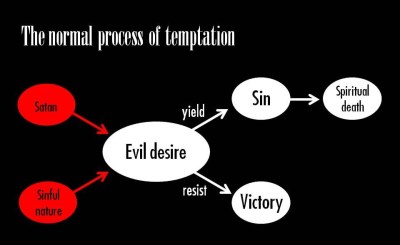 Temptation begins as an “evil desire” in our mind. Jesus said that “evil thoughts” lead to sin (Mt. 15:18-20; Mk. 7:20-23). Since the fall of humanity into sin we have a tendency towards evil desires. We are now self-centred. Given time, the temptation from an evil desire leads to sin and then to spiritual death and other consequences. Even if the spirit is willing, the flesh is weak (Mt. 26:41). The evil desire is influenced by Satan and our sinful nature. The process stops if we resist the temptation and there is victory over the temptation. So there is a choice to yield to or resist the temptation as shown in the diagram.
Satan is called the tempter (Mt. 4:3; 1 Th. 3:5). He tempts us in order to make us fail (1 Cor. 7:5). He entices us like a fisherman entices fish with bait or a lure. Satan is deceitful and seductive. He is our enemy (1 Ti. 5:14; 1 Pt. 5:8).
Temptation is not sinful. We know that Jesus was tempted by Satan, but didn’t sin (2 Cor. 5:21; 1 Pt. 2:22; 1 Jn. 3:5). But yielding to temptation is sinful.
So temptation is like when fish see a fisherman’s bait or lure. If they eat it they are hooked. Otherwise, they can swim on their way. Likewise, if we take the bait when tempted then we are hooked and dragged away into sinful behavior and its consequences. That’s the normal process of temptation. But if we don’t take the bait and resist the temptation, we can continue serving the Lord.
The normal tools of temptation
The normal tools of temptation are described in this warning, “Do not love the world or anything in the world. If anyone loves the world, love for the Father is not in them. For everything in the world—the lust of the flesh, the lust of the eyes, and the pride of life—comes not from the Father but from the world” (1 Jn. 2:15-16).
This describes Satan’s tools, the aspects of the sinful world that he uses as bait to lure us into sin. They are evil desires arising from:
- The lust of the flesh. This is our sinful human nature. Our sinful appetites.
- The lust of the eyes. This is what we see. It can also symbolise our minds. What we think about.
- The pride of life. This is boasting about what we have and what we do. Selfish ambition. Seeking to create a sense of envy, rivalry, and jealousy in others.
For example, the Israelites were tempted to eat, drink, indulge in revelry, indulge in sexual immorality, worship idols and grumble to God (1 Cor. 10:7-10). These are still normal temptations today. Have we ever been tempted to: eat too much, drink too much, party too much, commit sexual sins, let someone or something take the place of God in our lives, or complain to God?
So, temptation is a common experience of all human beings. But temptation is not only normal, it is also bearable.
Temptation is bearable
The Bible says, “And God is faithful; He will not let you be tempted beyond what you can bear”. So, “He will not allow the temptation to be more than you can stand” (NLT) and “He’ll never let you be pushed past your limit” (Message). God doesn’t promise that we won’t be tempted, but He does promise to limit its intensity. Life is tough. Temptation is common. But there is no such thing as an unbearable temptation.
God knows our strength greater than we do. He knows how much we can handle, and how much we cannot. One of the basic principles of sports and athletic training is to strengthen us to do things we don’t think we can do right now, to put more pressure on us than we think we can handle. And we discover we can handle it. This is what God does with us. He allows temptations when the pressure on, but it is controlled pressure. It will never be more than we can handle. Let’s look at some examples of this.
Bearable temptations in the Old Testament
The heroes of faith in Old Testament times are listed in Hebrews 11. They endured much shame and suffering rather that give up on God. They could have avoided this by renouncing God. That would have been a great temptation to them. Instead they resisted this temptation and continued to trust God’s promises.
Here’s what they went through (Heb. 11:33-39). They faced the dangers of lions, fire and swords. They were tortured, flogged, imprisoned, jeered, murdered, homeless, persecuted and mistreated. Because they remained faithful, we know that their temptations were bearable. Also, Job remained faithful after he lost his family, his wealth and his health. His temptations were bearable.
Bearable temptations in the New Testament
Paul is one of the heroes of faith in New Testament. Here’s what he went through.
2 Cor. 11:23-27: “I have worked much harder, been in prison more frequently, been flogged more severely, and been exposed to death again and again. Five times I received from the Jews 39 lashes. Three times I was beaten with rods, once I was pelted with stones, three times I was shipwrecked, I spent a night and a day in the open sea, I have been constantly on the move. I have been in danger from rivers, in danger from bandits, in danger from my fellow Jews, in danger from Gentiles; in danger in the city, in danger in the country, in danger at sea; and in danger from false believers. I have labored and toiled and have often gone without sleep; I have known hunger and thirst and have often gone without food; I have been cold and naked.”
Paul would have been tempted to avoid all this by stopping serving the Lord. Because he remained faithful, we know that his temptations were bearable.
So, the temptations faced by God’s people are bearable. But temptation is not only normal and bearable, it is also escapable.
Temptation is escapable
The Bible says, “But when you are tempted, He will also provide a way out so that you can endure it”. So, “He will also provide a way of escape” (HCSB). Not only does God promise to limit the intensity of our temptations, He promises a way to resist them. God enables us to resist the temptation to sin. He will provide a way out for us.
The Bible says, “God is our refuge and strength, an ever-present help in trouble” (Ps. 46:1). When those heroes of faith faced their troubles, all human support was usually stripped away. They learnt that God alone strengthens us at these times. He gets us through life’s temptations. In this sense, He is the way out. The way of escape. The Message says, “He’ll always be there to help you come through it”.
Joshua was told that God “will never leave you nor forsake you” (Dt. 31:8). David faced trouble without fear because God was with him (Ps. 23:5). God was close beside him. Likewise, God is with us in our temptations. He will not leave us or forsake us. He will provide a way of escape.
So, how did Joseph and Jesus escape temptations?
How Joseph escaped temptations
Joseph was a slave of Potiphar, the captain of Pharaoh’s guard in Egypt. Potiphar put him in charge of his household. Here’s how Joseph responded to temptation.
Gen. 39:6-12 “Now Joseph was well-built and handsome, and after a while his master’s wife took notice of Joseph and said, “Come to bed with me!” But he refused. “With me in charge,” he told her, “my master does not concern himself with anything in the house; everything he owns he has entrusted to my care … My master has withheld nothing from me except you, because you are his wife. How then could I do such a wicked thing and sin against God?” And though she spoke to Joseph day after day, he refused to go to bed with her or even be with her. One day he went into the house to attend to his duties, and none of the household servants was inside. She caught him by his cloak and said, “Come to bed with me!” But he left his cloak in her hand and ran out of the house.”
When Potiphar’s wife tried to seduce him, Joseph “refused to be with her”. He avoided the temptation as much as possible. Unlike Sampson, he didn’t give in to the pressure that went on “day after day” (Jud. 14:17; 16:16-17). So let’s avoid situations where we are likely to be tempted.
When Joseph was confronted again he “ran out of the house”. He had an escape plan. We have fire escape plans, but do we have plans to escape temptations?
How Jesus escaped temptations
At the beginning of His ministry, Jesus was tempted by Satan (Mt. 4:1-11):
- To use His supernatural powers to satisfy his hunger by turning stones into bread.
- To jump from the highest point of the temple to test God’s promise of protection and attract public attention.
- To avoid the suffering of the cross and take an easy shortcut to world domination.
In each case Jesus responded to temptation by quoting from the Bible. He answered, “It is written …”. So Satan can tempt those controlled by the Holy Spirit, but they can resist him with the truths of Scripture. The Israelites knew, “I have hidden your word in my heart that I might not sin against you” (Ps. 119:11). The truths of Scripture in our mind can protect us from yielding to temptation. Bible knowledge can help us to resist temptation.
Our mind is important. Let’s think about “whatever is true, whatever is noble, whatever is right, whatever is pure, whatever is lovely, whatever is admirable—if anything is excellent or praiseworthy—think about such things” (Phil. 4:8). Are the truths of Scripture planted in our mind?
Lessons for us
So let’s be warned by the history of the Israelites of the danger of yielding to temptation. Don’t be hooked and dragged away by Satan. Resisting temptation requires self-control, which is part of the fruit of the Holy Spirit (Gal. 5:22-23). So the Holy Spirit helps us to resist temptation.
Remember the promise: “No temptation has overtaken you except what is common to mankind. And God is faithful; He will not let you be tempted beyond what you can bear. But when you are tempted, He will also provide a way out so that you can endure it” (1 Cor. 10:13).
Because temptation is normal, we can resist it.
Because temptation is bearable, we can resist it.
Because temptation is escapable, we can resist it.
Because temptation is normal and bearable and escapable, we can resist it.
God has given us these reasons to exercise self-control when we face temptations. Let’s remember and use these ways to resist the temptations we face.
Written September 2013
Share this:

Can a person go to heaven if they have not heard about Jesus before they die?

 As there will be people “from every tribe and language and people and nation” in heaven, it seems that some of these would not have heard about Jesus before they died (Rev. 5:9-10). I believe that infants go to heaven when they die because they are not accountable for their sin. We will look at other people in two categories, those who lived before and after Christ.
Before Christ
The Bible says that those who trusted God in Old Testament times go to heaven. Although most of the promises they were given were physical, they also had a heavenly hope. They realised that this earth was not their final home: “admitting that they were foreigners and strangers on earth” (Heb. 11:13NIV). Instead they were looking towards heaven: “they were longing for a better country—a heavenly one” (Heb. 11:16a). We are told that God “has prepared a city for them” (Heb. 11:16b). In particular, Abraham “was looking forward to the city with foundations, whose architect and builder is God” (Heb. 11:10).
These people are commended in Hebrews as those who lived by faith. The Bible says, “Without faith it is impossible to please God, because anyone who comes to Him must believe that He exists and that He rewards those who earnestly seek Him” (Heb. 11:6). The Jews were told, “You will seek me and find me when you seek me with all your heart” (Jer. 29:13). This faith was based on a revelation from God.
“Enoch walked faithfully with God” (Gen. 5:22, 24). So did Noah (Gen. 6:9). This means they obeyed God. “Noah did everything just as God commanded him” (Gen. 6:22). “By faith Abraham, when called to go to a place he would later receive as his inheritance, obeyed and went, even though he did not know where he was going” (Heb. 11:8). Job repented after God revealed His power through nature (Job 38-41; 42:6).
So those who trusted in God’s revelation to them before the formation of the Israelite nation go to heaven. In their case, God usually spoke directly to them.
God spoke to the Israelites “at many times and in various ways” (Heb. 1:1). It is stated that Moses accepted “disgrace for the sake of Christ” (Heb. 11:26). But as Moses lived about 1,450 years before Christ, this seems to be a figure of speech. It means that Moses choose to be loyal to God and to associate with his fellow Israelites. The reason given is that “he was looking ahead to his reward”. As Hebrews was probably written about 65AD, the writer knew that the Messiah was the one through whom God guaranteed their promised future.
So the Israelites who trusted in God’s revelation to them in Old Testament times go to heaven. In their case, the revelation was usually miracles and the law given through Moses.
We know God revealed Himself to the Israelites as they were His people during this period of time. But what about the Gentiles? The Israelites were told to follow the laws that God gave them through Moses so that other nations would come to know God: “Observe them carefully, for this will show your wisdom and understanding to the nations, who will hear about all these decrees and say, ‘Surely this great nation is a wise and understanding people.’ What other nation is so great as to have their gods near them the way the Lord our God is near us whenever we pray to him? And what other nation is so great as to have such righteous decrees and laws as this body of laws I am setting before you today?” (Dt. 4:6-8).
Rahab is a Gentile who trusted God (Heb. 11:31). She told the Israelite spies, “I know that the Lord has given you this land … for the Lord your God is God in heaven above and on the earth below” (Josh. 2:9-11). Because of what she had heard of the Exodus and the defeat of the Amorites, she realised that the God of the Israelites was greater than the Canaanite gods. So she rejected the Canaanite gods to follow the God of the Israelites.
Also Ruth the Moabite told her Israelite mother-in-law, “Where you go I will go, and where you stay I will stay. Your people will be my people and your God my God” (Ruth 1:16). Likewise, she rejected the gods of the Moabites to follow the God of the Israelites. God’s interest in the Gentiles is shown in the book of Jonah where Jonah was sent to Nineveh with a message of God’s judgment and the people repented of their sin (Jon. 3:1-10).
So the Gentiles who trusted in God’s revelation to them in Old Testament times go to heaven. God revealed Himself to them through the Israelites when they heard about their law and the miraculous preservation of their nation.
All the above are examples of people who go to heaven without hearing about Jesus. But the Bible says the following about Jesus, “There is salvation in no one else! God has given no other name under heaven by which we must be saved” (Acts 4:12NLT). And Jesus said, “No one comes to the Father except through me” (Jn. 14:6). This means that the only way to get into heaven is through Christ’s sacrifice on the cross. Before Christ’s death people were saved according to their acceptance of God’s revelation to them. It was based on the future work of Christ. So those who trusted in God’s revelation in Old Testament times go to heaven because their faith in God was equivalent to faith in Jesus Christ. They were saved on credit. “God presented Christ as a sacrifice of atonement, through the shedding of His blood—to be received by faith. He did this to demonstrate His righteousness, because in His forbearance He had left the sins committed beforehand unpunished” (Rom. 3:25). In this way God overlooked the sins of those who trusted in Him before Christ’s death and resurrection.
After Christ
In Romans, God reveals that we are all sinners (Rom. 3:23) and we can only get to heaven through trusting in Christ’s sacrifice for us (Rom. 3:22-26). But it also says that people are judged according to God’s revelation to them: “All who sin apart from the law (Gentiles) will also perish apart from the law, and all who sin under the law (Jews) will be judged by the law” (Rom 2:12). The two main ways that God reveals himself to people who haven’t heard about Jesus are creation and conscience.
Firstly, the physical world demands a Creator. Its design requires a Designer. The laws of nature require a Lawmaker. By looking at our universe, anyone can know that there is a creator God. “The truth about God is known instinctively. God has put this knowledge in their hearts. From the time the world was created, people have seen the earth and sky and all that God made. They can clearly see His invisible qualities—His eternal power and divine nature. So they have no excuse whatsoever for not knowing God” (Rom. 1:19-20NLT). Enough of God is revealed in His creation that there is no excuse for not believing in Him. Those who reject this revelation follow idols and practice sinful behavior and suffer God’s judgment (Rom. 1:18-32).
Nature is a testimony of God. “The heavens declare the glory of God; the skies proclaim the work of His hands. Day after day they pour forth speech; night after night they reveal knowledge. They have no speech, they use no words; no sound is heard from them. Yet their voice goes out into all the earth, their words to the ends of the world” (Ps. 19:1-4). Also, Paul said “We are bringing you good news, telling you to turn from these worthless things to the living God, who made the heavens and the earth and the sea and everything in them. In the past, He let all nations go their own way. Yet He has not left himself without testimony: He has shown kindness by giving you rain from heaven and crops in their seasons; He provides you with plenty of food and fills your hearts with joy.” (Acts 14:15-17).
So if people haven’t heard about Jesus, they can be judged according to their response to the revelation of God in creation. If they turn from idolatry and seek the true God, then God may give them additional revelation. For example, Cornelius was a Gentile who sought God. So God sent Peter to tell him about Jesus and salvation (Acts 11:14). God can appear to people in many ways throughout their lives. He can send people to inform them (Rom. 10:14-15). Because God doesn’t want anyone to perish in hell and wants everyone to repent of their sin, we must trust that He has made a way for those people (2 Pt. 3:9).
Secondly, everyone is born with a conscience. We all have an instinctive knowledge of right and wrong. For example, most people know it is wrong to lie, steal, and commit adultery and murder. The Bible gives God’s standards for humanity. But for those who are ignorant of this it says: “They demonstrate that God’s law is written in their hearts, for their own conscience and thoughts either accuse them or tell them they are doing right” (Rom. 2:15NLT). Anyone who has not heard about what the Bible says will be judged according to their conscience. God will say, “What did you think was right and wrong?” The next question is, “Did you always do the right and not the wrong?” By that standard, of course, everyone fails. The conscience proves that we are sinners like the law does for the Jew.
The issue is their response to a guilty conscience. If they were sorry for their behavior and would repent then they would probably go to heaven. This reasoning is based on the fact that God is just and wants all to be saved. He has made a way for all, but few accept it.
Like those who lived before Christ, the issue is whether they responded to God’s revelation to them. So through the creation and our conscience, God gives everyone the opportunity to turn to Him and be saved from the penalty of their sinfulness and go to heaven.
Lessons for us
Like the Israelites, a Christian’s behavior can influence an unbeliever to repent and follow God and go to heaven. “Live such good lives among the pagans (your unbelieving neighbors, NLT) that, though they accuse you of doing wrong, they may see your good deeds and glorify God on the day he visits us” (1 Pt. 2:12).
Although people can to be saved without hearing about Jesus, it isn’t likely to occur in very many instances. The usual way to go to heaven is to respond to hearing about Jesus. “How, then, can they call on the one they have not believed in? And how can they believe in the one of whom they have not heard? And how can they hear without someone preaching to them? And how can anyone preach unless they are sent?” (Rom. 10:14). That’s why it’s important to tell people about Jesus as much as possible and support others in this work.
Share this:

Looking back and looking ahead

 Based on a message given at my mother’s funeral on 3 April 2013
A funeral usually involves memories and reflections of the life of the person who has died. But the funeral of a Christian can also look ahead in anticipation of what lies ahead.
Help from God the Creator
The source of a Christian’s help and protection throughout life is described in Psalm 121NIV.
“I lift up my eyes to the mountains—where does my help come from?
My help comes from the Lord, the Maker of heaven and earth.
He will not let your foot slip—He who watches over you will not slumber;
indeed, He who watches over Israel will neither slumber nor sleep.
The Lord watches over you—the Lord is your shade at your right hand;
the sun will not harm you by day, nor the moon by night.
The Lord will keep you from all harm— He will watch over your life;
the Lord will watch over your coming and going both now and forevermore.”
When this song was written about 3,000 years ago, God’s people knew that the only reliable help and protection comes from the God who made the universe – “the Maker of heaven and earth”. In this context the Hebrew word for “heaven” means the atmosphere and the stars and galaxies. A God with the intelligence and power to create the universe and populate it with living plants, animals and people was surely able to help them! The Bible says He was the source of life on earth whereas all other gods and philosophies are the product of the human imagination.
Unfortunately in our modern world we have largely lost this knowledge and this confidence. We have forgotten about God the Creator. Even though we have wonderful technology, science can’t explain how matter was created from nothing or how life originated, and we often replace God the Creator with the idea that things created themselves.
So when we struggle in life where does our help come from? Some people go to counsellors for help who encourage them to get help from outside themselves. Because people usually can’t solve their own problems, they need to get help from someone else. In a similar way, we all need “outside help” to sustain us and God the Creator is the ultimate outside help!
Psalm 121 ends with, “The Lord will watch your coming and going both now and forevermore”. Here those who trusted God the Creator were promised that God would protect them throughout life and into the future. They could live with assurance and confidence that God would continue to help them. Likewise Christians can have the assurance that God will sustain them during their life and afterwards.
A different world
You may ask if God created everything in the beginning, why is there so much suffering in the world? The world today is very different from the one God made originally. We live in a different world. In the beginning it was a perfect world with harmony between God, people and the natural environment. But when people turned against their Maker, it changed and sin, evil, suffering and death came into the world. This change was caused by people like us. We live in a world with consequences – an act has a consequence and an effect has a cause. Because people turned against God our relationships have been ruined. We ignore God and are separated from Him, we can’t get along with other people, and we exploit the natural environment. Another consequence is that the Bible says we are destined to eternal punishment. Because we are the cause of this problem, we need outside help. Because each of us is guilty, we can’t help each other. The only reliable help available outside humanity is God the Creator.
Help from God the Lifesaver
Fortunately, God didn’t only create the universe and the laws of nature in the beginning, but He also continues to sustain it. He is not only incredibly powerful, but He is also incredibly loving. We remember His special act of love at Christmas and Easter when we celebrate the unique birth and death of Jesus Christ. God knew that mankind was doomed to eternal punishment unless He provided them with outside help. He did this about 2,000 years ago when Jesus Christ lived on earth and died and came alive again. Jesus was unique; He was God living as a human being. He showed His power over our world by the miracles He did. When He died by crucifixion, He took the eternal punishment that we deserve. If we turn towards God by being sorry for our behaviour and accepting the fact that Jesus has taken the penalty for our sin, then He promises eternal joy instead of eternal punishment. This is called eternal life. So Jesus is like a lifesaver – He can rescue us from the eternal consequence of our selfish behaviour. In this way God is making a new creation and He gives us the choice of being a part of it. Although we spoilt God’s original creation, and there is now sin, evil, pain, suffering and death, these will be absent in God’s new creation. Instead we can be reconciled with God, we can love one another and we can look forward to the restoration of creation like it was in the beginning.
Because a Christian has accepted Jesus as their Savior they can have an inner assurance, joy and peace.
 Death
Death
What happens when a person dies? Not only do the lungs stop breathing and the heart stops pumping. The Bible says that at death a person’s invisible soul and spirit is separated from their body. If they trusted in Jesus the Savior, their soul and spirit goes immediately to be with God in heaven. After death they are enjoying a perfect place. That is why Paul could say, “To die is gain” (Phil. 1:21) and that he preferred to be “away from the body and at home with the Lord” (2 Cor. 5:8). So they are in a better place. Their death is a loss for us, but a gain for them.
Resurrection
But there is more! On Easter Sunday we recall that the body of Jesus was raised back to life after being buried in a grave. The Bible describes a coming day when the bodies of believers, who trusted in Christ the Savior will also be raised back to life:
“What I am saying, dear brothers and sisters, is that our physical bodies cannot inherit the kingdom of God. These dying bodies cannot inherit what will last forever. But let me reveal to you a wonderful secret. We will not all die, but we will all be transformed! It will happen in a moment, in the blink of an eye, when the last trumpet is blown. For when the trumpet sounds, those who have died will be raised to live forever. And we who are living will also be transformed. For our dying bodies must be transformed into bodies that will never die; our mortal bodies must be transformed into immortal bodies. Then, when our dying bodies have been transformed into bodies that will never die, this Scripture will be fulfilled, ‘Death is swallowed up in victory. O death, where is your victory? O death, where is your sting?’ For sin is the sting that results in death, and the law gives sin its power. But thank God! He gives us victory over sin and death through our Lord Jesus Christ” (1 Cor. 15:50-57NLT).
This is also described in 1 Thessalonians 4:16-18. As part of God’s new creation they will have new bodies which won’t wear out and die (1 Cor. 15:42-49; Phil. 3:21; 1 Jn. 3:2) and they will be transported to be with God in heaven – spirit, soul and new body. This will be a great victory over the sin, suffering and death of our world. That’s why Christians can look forward confidently to the coming resurrection. There’s victory ahead!
Summary
The hymn, “How great Thou art”, summarises the greatness of God and the reasons for our Christian faith.
The first verse is about God the great Creator and source of life on earth. It says “Your power throughout the universe displayed”. Do we see God’s power in His creation?
The third verse is about Jesus Christ the great Lifesaver and source of eternal life. It says “On the cross, my burden gladly bearing, He bled and died to take away my sin”. When we stand before God, will He be like a lifesaver or like a judge? If we turn towards God by confessing our sins we can be ready to meet Him.
The last verse is about the great resurrection when the bodies of those who have trusted in Christ will be raised and changed to be with Him forever. It says “When Christ shall come with shout of acclamation and take me home – what joy shall fill my heart”. Are you ready to experience this joy?
Written, April 2013
Also see: Where is grannie?
Share this:

What did Jesus mean when He said He would not eat the Passover again until it was fulfilled in the kingdom of God (Lk. 22:16)?

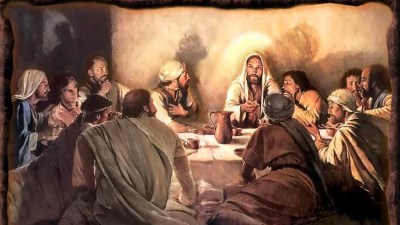 This statement is included in a description of how Jesus celebrated the Jewish Passover festival with His disciples just before He was executed.
When the hour came, Jesus and His apostles reclined at the table. And He said to them, “I have eagerly desired to eat this Passover with you before I suffer. For I tell you, I will not eat it again until it finds fulfillment in the kingdom of God”. After taking the cup, He gave thanks and said, “Take this and divide it among you. For I tell you I will not drink again from the fruit of the vine until the kingdom of God comes.” (Lk. 22:14-18NIV).
The Lord looked forward to this occasion because it was the last Passover that He would share with His disciples and the last Passover of His first advent on earth. He also looked ahead to the kingdom of God. The previous mention of the “kingdom of God” in the book of Luke is associated with a description of Christ’s second advent (Lk. 21:25-31). This means that the next time He would be on earth to celebrate such a Jewish festival would be during His millennial kingdom, after His second advent on earth (Rev. 20:1-6). Jesus would eat no more Passover meals until this time.
Link to outline of events associated with the second advent.
As He is talking about a physical meal (v.15-16) and a physical drink (v.17-18), the Lord is addressing a future physical kingdom and not a spiritual one. At this time, the temple will be rebuilt, the Jewish priesthood restored and the Israelites will occupy their promised land (Ezek. Ch. 40-48). They will also resume Jewish festivals like the Passover (Ezek. 45:21). So, the future Passover is also physical like it was in the Old Testament (OT) times.
In the New Testament Jesus is referred to as “the Lamb of God who takes away the sin of the world” and “our Passover lamb” who “has been sacrificed” (Jn. 1:29, 1 Cor. 5:7). Through His sacrificial death on the cross He paid the penalty for our sin. In this way, Jesus was like the Passover lamb, which died as a substitute (Ex. 12:21-30). Furthermore, He was crucified on Passover day. But the fact that Christ has delivered sinners from hell and been victorious over Satan and the forces of evil will not be evident until He returns in great power to establish His kingdom on earth.
How is the Passover “fulfilled in the kingdom of God”? As the Israelites escape from slavery wasn’t realised until the Egyptians drowned in the Red Sea, so Christ’s victory over Satan will not be complete until Satan’s forces are defeated at the triumphant second advent (Rev. 19:11-21). The purpose of the Passover was so the Israelites could settle in Canaan as God’s people, living according to His commands. But because they disobeyed and rebelled against God over many years, God allowed them to be invaded and scattered to foreign countries. After this God predicted the Gentile kingdoms that would rule over the Jews, culminating with a promise to establish His eternal kingdom on earth (Dan. 2:44). So the victory that began with the first Passover in Egypt and was remembered whenever the Jewish Passover festival was celebrated will be ultimately finalised when Christ’s millennial kingdom is established on earth.
Soon after this passage in Luke, Jesus referred to the “kingdom of God” once again when He promised that the disciples would reign over the earth in the coming kingdom (Lk. 22:29-30; Rev. 5:9-10). So at this Passover, Christ looked ahead to the fulfilment of God’s purposes. Likewise, at the Lord’s Supper believers today look back to the Lord’s death and ahead to His coming again (1 Cor. 11:23-26).
At the Passover the OT Jews remembered their rescue from slavery in Egypt, whereas in the coming kingdom Jewish believers will remember that through the death of Christ, they have been rescued from the penalty of their sin.
In summary, Jesus hasn’t eaten the Passover since He ascended into heaven. Only after He returns to the earth as king to establish the kingdom of God on earth will He be able to celebrate the Passover again. The rescue mission that began with the Passover, which was a foretaste of Christ’s death, will be completed and evident to the universe at the second advent of Christ and in His subsequent kingdom.
Written, February 2013
Also see: An outline of future events
Share this:

Final words

 Perseverance or backsliding?
The Bible records many of the words spoken and written by people in ancient times. In this article we look at what we can learn from some of the words spoken by six godly men near the end of their lives. The men are: Joseph, Moses and Joshua from the Old Testament and Jesus, Stephen and Paul from the New Testament.
Joseph
Joseph was the 11th son of Jacob. As Jacob’s name was changed to Israel, Joseph was one of the original children of Israel! Jacob’s descendants were God’s special people in the Old Testament times. Joseph was sold as a slave in Egypt and rose to second in command under Pharaoh king of Egypt. God used him to save his family and the Egyptians from a 7-year drought – in this sense he was their savior. During this time his father’s household also moved to Egypt.
Final words. At the age of 110 years, “Joseph said to his brothers, ‘I am about to die. But God will surely come to your aid and take you up out of this land to the land He promised on oath to Abraham, Isaac and Jacob.’ And Joseph made the Israelites swear an oath and said, ‘God will surely come to your aid, and then you must carry my bones up from this place’” (Gen. 50:24-25NIV). As he knew that God had promised the land of Canaan to the Israelites and trusted that God would take them from Egypt to Canaan, he made them promise to take his mummy (embalmed body) with them so it could be buried in Canaan.
Lesson for us. Joseph’s faith is an example for us to follow, “By faith Joseph, when his end was near, spoke about the exodus of the Israelites from Egypt and gave instructions concerning the burial of his bones” (Heb. 11:22). “Faith is confidence in what we hope for and assurance about what we do not see” (Heb. 1:1). So up to the end of his life Joseph trusted that God’s promises would be fulfilled. He didn’t backslide from when he trusted God in his youth.
Moses
Moses was an Israelite born in Egypt in the third generation after Joseph. God used him to rescue the Israelites from slavery in Egypt – in this sense He was their savior. In the exodus about 2 million Israelites miraculously crossed the Red Sea and travelled towards Canaan. He took Joseph’s mummy with him (Ex. 13:19).
Final words. Before his death at the age of 120 years Moses transferred leadership of the Israelites to Joshua and told him, “Be strong and courageous, for you must go with this people into the land that the LORD swore to their ancestors to give them, and you must divide it among them as their inheritance. The LORD Himself goes before you and will be with you; He will never leave you nor forsake you. Do not be afraid; do not be discouraged “(Dt. 31:7-8). He encouraged Joshua to continue leading the people by reminding him of God’s continual presence. Then he taught them a new song and gave a farewell message in which he assured them of God’s protection and support, “The eternal God is your refuge, and underneath are the everlasting arms” (Dt. 33:27).
Lesson for us. Christians should appreciate God’s continual presence, protection and support via the indwelling Holy Spirit. We should be encouraged by this, whatever our role may be. This also helps us to be contented and avoid the love of money or possessions (Heb. 13:5). Also, are we training the next generation in God’s ways like Moses trained Joshua?
Joshua
As one of the faithful spies, Joshua didn’t die in the desert like the rest of the Israelites who rebelled against God. After the death of Moses he led the Israelites into Canaan.
Final words. In a farewell message before he died at the age of 110 years Joshua said, “Now fear the LORD and serve Him with all faithfulness. Throw away the gods your ancestors worshiped beyond the Euphrates River and in Egypt, and serve the LORD. But if serving the LORD seems undesirable to you, then choose for yourselves this day whom you will serve, whether the gods your ancestors served beyond the Euphrates, or the gods of the Amorites, in whose land you are living. But as for me and my household, we will serve the LORD.” (Josh. 24:14-15). He urged them to worship God instead of idols. At this time they buried Joseph’s mummy in Canaan in accordance with his request (Josh. 24:32). The Israelites followed the Lord throughout the lifetime of Joshua, but turned to idolatry soon afterwards (Josh. 24:31; Judges 2:7, 10-13).
Lesson for us. Godly people like Joshua can have a great influence on others. They are faithful to the end of life and don’t backslide like the others who died before reaching Canaan and so didn’t enjoy their inheritance on earth.
Jesus
According to Luke’s genealogy, Jesus Christ was in the 52rd generation after Joseph (Lk. 3:23-37). Jesus was unique as He was not only a person like us, but He was also the Son of God who made the universe (Lk. 1:35)! Because He was divine, Jesus lived a perfect life and did no wrong. But He was executed and then came back to life and later returned to heaven. When Jesus died He took all the punishment that we deserve so that we can go to heaven if we trust in Him. In this sense He is a Savior for all humanity.
Final words. At the age of about 33 years, after the three hours of darkness when He was suffering crucifixion, Jesus said “It is finished” (Jn. 19:30). This meant that he had finished what He came to do, which was to suffer and die on our behalf. The way had been provided for sinners like us to be saved from eternal punishment and go to heaven instead. Before His ascension into heaven, Jesus told His followers, “…you will be my witnesses in Jerusalem, and in all Judea and Samaria, and to the ends of the earth” (Acts 1:8b). They would tell others living across the known world about Jesus.
Lesson for us. First, we need to accept Christ’s gift of salvation, because we can’t do anything else to deserve heaven. Second, once we follow Jesus we need to share the good news about Him to others.
Stephen
Stephen was one of the seven men chosen to serve in the first church at Jerusalem. He was “full of faith and of the Holy Spirit”. Because Stephen preached powerfully about Jesus, the Jews made false accusations about him. In a long speech he listed the failures of the Jewish people, which made the Jews so furious that they stoned him to death.
Final words. “While they were stoning him, Stephen prayed, ‘Lord Jesus, receive my spirit.’ Then he fell on his knees and cried out, ‘Lord, do not hold this sin against them.’” (Acts 7:59-60). Jesus made similar statements before He died (Lk. 23:34, 46).
Lesson for us. The more we focus on Jesus and what he has done for us, the more we become like Him.
Paul
Paul was a young Jewish leader who persecuted Christians and was associated with the stoning of Stephen. But God changed his life in a spectacular way and he became a follower of Jesus who spread across the Roman Empire the good news of Jesus had done.
Final words. In his last letter Paul wrote, “… The time for my departure is near. I have fought the good fight, I have finished the race, I have kept the faith. Now there is in store for me the crown of righteousness, which the Lord, the righteous Judge, will award to me on that day—and not only to me, but also to all who have longed for His appearing” (2 Tim. 4:6-8). He continued to trust God even though life had been difficult and the end of his service was near. He had obeyed the doctrines of the Christian faith and passed them on to others such as Timothy. Like the winner of a Greek athletic race was awarded a wreath (1 Cor. 9:25), his faithful service would be rewarded at the Judgment Seat of Christ.
Lesson for us. Godly people like Paul remain faithful to the end of life and don’t backslide like Demas who “loved this world” and deserted Paul (2 Tim. 4:10).
Summary
Until our final day, let’s imitate these godly men by having:
- The faith of Joseph that God keeps His promises
- The assurance of Moses that God is always with us as His Holy Spirit, who provides security and contentment.
- The godly influence of Joshua who didn’t backslide
- The message of reconciliation with God through Jesus Christ
- The Christ-like life of Stephen
- The perseverance of Paul who didn’t backslide
Because of the examples of these final words, “let us throw off everything that hinders and the sin that so easily entangles. And let us run with perseverance the race marked out for us, fixing our eyes on Jesus, the pioneer and perfecter of faith. For the joy set before him He endured the cross, scorning its shame, and sat down at the right hand of the throne of God. Consider Him who endured such opposition from sinners, so that you will not grow weary and lose heart” (Heb. 13:1-3). If we pay careful attention to these examples “we do not drift away” from an active faith in Christ (Heb. 2:1).
Written, December 2012
Share this:

How many witnesses does it take to bust a myth?

 The Bible is Not a Myth
MythBusters is a TV show on the Discovery Channel that sorts out myths and facts in an entertaining way. Did you know that the Bible is written in a way to show that it is not a myth?
The Bible teaches that the truth of a matter should be established on the testimony of at least two or three eye-witnesses (Dt. 17:6; 19:15; Mt. 18:16; 2 Cor. 13:1; 1 Ti. 5:19; Heb. 10:28). This is also the case in law courts.
The resurrection
Paul emphasised that the resurrection was a proven fact and not a myth because afterwards Christ “appeared to more than five hundred of the brothers and sisters at the same time, most of whom are still living, though some have fallen asleep (died). Then He appeared to James, then to all the apostles, and last of all He appeared to me also” (1 Cor. 15:6-8NIV). There were many more than two or three eye-witnesses! As most of these were still alive, they could be questioned by anyone who doubted Paul’s account.
The life of Christ
The most comprehensive record of the life of Christ is given in the books of the Bible written by Matthew, Mark, Luke and John. These are obviously four accounts of the same events, which satisfy the requirement of at least two or three witnesses. Who were these authors?
Matthew and John were two of the twelve disciples who accompanied Christ during His public ministry (Mt. 4: 21-22; 9:9; 10:2-4; Mk. 1:19-20; 2:14; Lk. 5:10-11; 27-28). They were there and saw the events they recorded. They were part of the twelve apostles who were Christ’s witnesses (Acts 1:8). When Judas was replaced by Matthias, Peter said that an apostle was a man who had “been with us the whole time the Lord Jesus was living among us, beginning from John’s baptism to the time when Jesus was taken up from us”, who was “a witness with us of His resurrection” (Acts 1:21-22).
As a tax collector, Mathew was skilled in writing and keeping records. John’s testimony is reliable: “This is the disciple who testifies to these things and who wrote them down. We know that his testimony is true” (Jn. 21:24). John was one of the three apostles that were closest to Jesus, the others were Peter and James (Mt. 17:1; Mk. 14:33). Also, he may have been a cousin of Jesus (Mt. 27:56; Mk. 15:40).
Mark lived in Jerusalem during Christ’s public ministry and was a cousin of Barnabas (Col. 4:10). Mark may have been at the garden of Gethsemane when Jesus was arrested as he wrote; “A young man, wearing nothing but a linen garment, was following Jesus. When they seized him, he fled naked, leaving his garment behind” (Mk. 14:51-52).
Tradition says that Mark was Peter’s interpreter and wrote down Peter’s account of the life of Jesus. This is supported by the fact that he was with Peter when 1 Peter was written (1 Pt. 5:13). Also, when Peter escaped from prison, he went to Mark’s mother’s house (Acts 12:12-17).
Luke was a historian. His record begins: “Many have undertaken to draw up an account of the things that have been fulfilled among us, just as they were handed down to us by those who from the first were eyewitnesses and servants of the word. With this in mind, since I myself have carefully investigated everything from the beginning, I too decided to write an orderly account for you, most excellent Theophilus, so that you may know the certainty of the things you have been taught” (Lk. 1:1-5). He interviewed eye-witnesses of the life of Christ, including Mary as he gives the best account of Christ’s early years.
Luke was a Gentile medical doctor who travelled with Paul and was one of his fellow workers (Col. 4:14; Phile. 24). He was well educated and had an outstanding command of the Greek language. He also wrote the book of Acts and witnessed many of the events recorded in Acts.
Confirmed and busted
As documented history always trumps science with regard to past events, we don’t need the MythBusters to test the truth of the Bible. Instead, because of multiple eye-witnesses the resurrection of Christ and the Biblical account of the life of Christ are confirmed to be proven facts and not myths. So the viewpoint that the Bible is myth is busted!
Postscript – The rest of the New Testament
The other New Testament writers were also eye-witnesses of the events they documented.
Peter was a disciple and apostle like Matthew and John. He was present during the public ministry of Christ and the life of the early church. He witnessed everything that Jesus did, including His death and resurrection (Acts 10:39-41; 1 Pt. 5:1). Silas may have helped Peter write his first letter (1 Pt. 5:12).
James and Jude were half-brothers of Jesus: they had the same mother, but different fathers (Mt. 13:55; Mk. 6:3). Although they didn’t follow Jesus at the time, they grew up with Him and were aware of His public ministry. The Lord appeared to James after the resurrection (1 Cor. 15:7). James and Jude became believers after the resurrection and were part of the life of the early church (Jn. 7:5; Acts 1:14; Gal. 1:19).
Paul was different to the other apostles as he became an apostle by special revelation. Instead of living with Christ during His three years of public ministry, Paul saw the Lord in a vision (1 Cor. 9:1; Gal. 1:16). He wrote that in this sense he was inferior to the others, like a premature birth compared to a normal one (1 Cor. 15:8). Nevertheless, he was to be a witness who told others about what he had seen (Acts 22:15; 26:16).
Paul was a Pharisee and the son of a Pharisee (Acts 23:6; 26:4-5). As he studied under Gamaliel at Jerusalem, he was well educated (Acts 22:3; Gal. 1:14). Paul established churches in Asia Minor and Europe and was part of the life of the early church.
Written, September 2012
Share this:

Big history

Made to be inhabited
A letter in a newspaper stated that Genesis chapter 1-11 is pre-history and is probably best described as a ”saga”, which is a story. They said it was a different genre to the rest of Genesis, which I assume was considered to be real history which had been verified by archaeology. Well, what does the evidence show us?
 Extra-Biblical account
The history of the universe from the beginning of time according to those who reject the Bible and the God of the Bible is often told as follows:
- About 15 billion years ago – there was a “big bang” and stars like the sun formed from the exploding gases
- Then about 4.6 billion years ago – planets like earth formed around the stars
- 3.5 billion years ago – the first life appeared in deep water when molecules combined to form single-celled organisms
- 1 billion years ago – multi-cellar organisms evolved
- 600 million years ago – invertebrate animals and fish evolved
- 475 million years ago – land plants evolved
- 360 million years ago – amphibians and then the first land animals evolved
- 250 million years ago – reptiles ruled
- 200 million years ago – birds and mammals ruled
- 90 million years ago – flowering plants evolved
- 200 thousand years ago – the first humans evolved
Bill Gates is funding a project to present this information online for high school students. Let’s look at what the Bible says about such “big history”.
According to Jesus
When Jesus was discussing divorce and marriage He went back to Genesis and quoted from Genesis 1:27 and 2:24 “But at the beginning of creation God ‘made them male and female’. ‘For this reason a man will leave his father and mother and be united to his wife …” (Mk. 10:6-7NIV). These verses refer to the first people Adam and Eve. Here He links the “beginning of creation” with the beginning of the human race.
When Jesus was condemning the Pharisees, he quoted the range of martyrs in the Old Testament, “the blood of all the prophets that has been shed since the beginning of the world, from the blood of Abel to the blood of Zechariah” (Lk. 11:50-51). Abel was in the first family (Genesis 4) and Zechariah was mentioned in 2 Chronicles 24, the last book in the Jewish Old Testament. Here He links the “beginning of the world” with the first family.
Clearly Jesus believed that early Genesis was real history, not just a story.
We can also learn something about the beginning of everything from Jesus. It is instructive to consider how Jesus demonstrated God’s power. He did many miracles; more than is recorded in the Bible (Jn. 20:30). For example:
- A storm was calmed straight away (Mk. 4:39)
- 5,000 men plus women and children were fed from five loaves and two fish (Mk. 6:30-44)
- People were healed immediately: the blind could see (Mt. 20:34); the crippled could walk (Lk. 13:13) and the dead stood up (Mk. 5:42; Jn. 11:43-44).
So Jesus could change the physical world instantly. He didn’t need time to do it in gradual steps. Likewise, God can create physical things instantly. He doesn’t need time to do it in gradual steps from the simple to the complex.
According to Paul
When looking at why people who have not heard the gospel still face God’s judgment, Paul wrote “since the creation of the world God’s invisible qualities—His eternal power and divine nature—have been clearly seen, being understood from what has been made, so that people are without excuse” (Rom. 1:21). God’s attributes have been evident to people “since the creation of the world”, not just since people have been on the earth. The implication is that people have been here since the creation of the world. This is consistent with what Jesus said about Adam, Eve and Abel.
Paul also believed in Adam and Eve (Rom. 5:12-14; 1 Cor. 15:21-22, 45; 2 Cor. 11:3; 1 Tim. 2:13-14). For example, He contrasted Adam and Jesus in three passages of the New Testament:
- “If there is a natural body, there is also a spiritual body. So it is written: “The first man Adam became a living being”; the last Adam, a life-giving spirit” (1 Cor. 15:44-45). From Adam we have physical life in a natural body, but from Jesus we can have eternal life now and a redeemed body at the resurrection.
- “sin entered the world through one man, and death through sin … through the disobedience of the one man the many were made sinners, so also through the obedience of the one man the many will be made righteous” (Rom. 5:12-21). So death entered the world because of Adam’s sin, but eternal life is possible through Jesus.
- “For since death came through a man, the resurrection of the dead comes also through a man. For as in Adam all die, so in Christ all will be made alive” (1 Cor. 15:21-22). From Adam we have physical death, but from Jesus people can be resurrected from the dead.
So Paul viewed both Adam and Jesus as true historical characters, not as mythical figures. He saw the creation and fall into sin of early Genesis as historical events that had a significant impact on our world, not as “pre-history” stories.
According to historical records
If there has been a crime or a car accident, the police determine what happened from the evidence and by interviewing witnesses. The Biblical writers witnessed what they wrote about, except for situations such as creation when God was the witness.
History is the study of past events. We don’t use operational science because it’s only reliable for present events – we can’t do experiments on the past or the future unless we make assumptions (then the finding relies on the assumptions made). Documentary evidence is the best form of historical record. Let’s look at what the historical records in the Bible meant for its original readers, the Children of Israel.
Creation
When God gave them the ten commandments, He said “in six days the LORD made the heavens and the earth, the sea, and all that is in them, but He rested on the seventh day” (Ex. 20:11). This was a model for their working week. In this context, the heavens are the stars and galaxies. God took 6 days to create the universe, but could have taken 6 hours, 6 minutes or 6 seconds. After all, God is outside the time of our finite world. He is infinite and all powerful.
God didn’t use a long process to create everything. He commanded and it was done immediately (Ps. 33:6-9; Heb. 11:3). I am not aware of any Scriptures which indicate long ages of time were involved in creation.
This is also supported by the resurrection which is described as “we will all be changed in a flash, in the twinkling of an eye” (1 Cor. 15:51-52). So our resurrection bodies will be created instantly. This is consistent with the original creation taking a short period of time and Christ’s miracles happening instantly. God doesn’t need lots of time to create something new.
The creation was finished on day 6, which was when Adam and Eve were created. So we know that people have been on earth since then.
A mature universe
On the day they were created, Adam named the animals and Adam and Eve were married (Gen. 2:19-20, 24). They were created as mature adults. The universe and the earth that God created were mature. Its complex interacting systems functioned properly from the beginning. The animals and plants lived in mature and functioning ecosystems. So the creation was mature and fully functional from the beginning. It didn’t need to develop gradually over time from simple to more complex.
This means that at that time the apparent age of things didn’t match the actual age. Scientists calculate the age of the universe by assuming that all the stars and galaxies have expanded to their positions after a big explosion. It is an assumption that is also based on using the red- shift of light and the Hubble law to calculate the expansion rates and the distances of galaxies. However, the Bible says that God placed them in their positions on day 4 of creation by stretching them out (Gen. 1:14-19; Ps. 104:2). So the difference between their apparent age of 15 billion years and the Biblical age of thousands of years represents the miracle that God did on day 4.
Genealogies

When did this happen? Is Genesis 1-11 pre-history? It is followed by Genesis 12-25 which is about Abraham. Do we know much about before this time? Yes we do. In Genesis 5 and 11 we have detailed genealogies from Adam to Abraham (Gen 5:1-32; 11:10-26). These are not just lists of ancestors and descendants. Their ages at the birth of their child in the family tree and their death are also given. Some Biblical genealogies have gaps because their purpose is to show their main ancestors (Ezra 7:1-5; Mt. 1:1-16). But these ones are worded in such a way as to exclude omissions and gaps. They are the most comprehensive genealogies in the Bible. Because they cover 19 generations, we know more about these people than our own ancestors!
Besides this, there are two other genealogies that cover this period in the Bible (1 Chron. 1:1-27; Lk. 3:33-38). There are three genealogies in the Bible covering the period back to Adam that some allege is pre-history! So it’s real history. It seems as though in recent times some people call it pre-history to explain the inconsistency with the recent extra-biblical account.
When you add up that dates given in Scripture you find that Adam lived about 6,000 years ago and the global flood was about 4,500 years ago. That’s a long time, thousands of years, but it’s not millions of years. When compared to the extra-biblical timeline, the historical timeline:
- Is documented historically instead of being calculated
- Is shorter (about 6,000 years compared to about 15 billion years)
- Has people appearing near the beginning (people have been here for 99.9998% of the time); instead of near the end (people have been here for 1.3% of the time). People have been here most of the time. After all, God made the world to be inhabited, “For this is what the LORD says—He who created the heavens, He is God; He who fashioned and made the earth, He founded it; He did not create it to be empty, but formed it to be inhabited … I, the LORD, speak the truth; I declare what is right” (Isa. 45:18-19).

Implications
The extra-biblical account is inconsistent with recorded history. As it relies on assumptions of people who were not there when it happened, clearly these assumptions are wrong. What are these incorrect assumptions?
- They rule out a God of miracles. This means they have to rely on current physical processes and forces to explain the past.
- Consequently, they believe that the present is the key to the past, but according to the Bible the past is the key to the present – after all history goes forwards, not backwards!
- They believe that given enough time everything can create itself and organisms always evolve or build up gradually over time from simple to complex. Therefore the biological world has become more complex with time.
- They believe simple organisms are primitive and developed earlier than more complex organisms.
Does it matter if the extra-biblical explanation of the past history of the world is wrong? Yes, because it destroys the gospel message. It destroys the source of sin and death, removes the need for a Savior, and ruins the possibility of future restoration of the earth when Christ reigns (Acts 3:21). That’s what happens if the first three chapters of Genesis are not historical, but a story that isn’t necessarily true. This means removing creation, the Garden of Eden and the fall into sin as real events in real places.
This explanation moves the source of sin, disease, decay and death from Adam and Eve’s disobedience to making it be a part of our world (which Christians call God’s creation). In this case disease, decay and death have always been a part of our world. They are the normal situation; and not viewed as being abnormal. It takes away the lack of disease and death before the fall. It puts death before sin, not after it. It puts evil before sin, not after it. It means that the created world, which God said was “very good” (Gen. 1:31), was marred by disease and death. It takes away the fact that the original sin affected all of God’s creation (Rom. 8:19-23). It takes away the promise that all creation will be liberated from its “bondage to decay” when Christ returns to rule over it.
Lessons for us
As believers, our thoughts and opinions should be controlled by God, not by the views of those who reject God. This means that our thoughts and opinions should be controlled by the Bible, not by the extra-biblical theories which rule out the possibility of divine intervention in the natural world, such as miracles. The Bible says that God has intervened in our big history and He will intervene again. We ignore that at our peril.
Sin, death and salvation are important aspects of the Bible and Christianity. Let’s be aware of the implications of ideas such as extra-biblical big history which are inconsistent with the Biblical record.
Finally, the Bible is not a science book; but it is a history book. It is the best record of ancient history we have today; a supreme example of ancient history; and a big history book. It contains documentary evidence by eyewitnesses which has been accurately preserved over the years. So we can trust the Bible on big history.
Written, June 2012
Also see – Big history or little history?
– Using history and science to investigate ancient times
Share this:

From the Alpha to the Omega
 Jesus spans time and history
On January 1 we celebrate the beginning of a new year. One of the titles of God and Jesus Christ is “the Alpha and the Omega”, which reminds me of beginnings and endings (Rev. 1:8; 21:6; 22:13NIV). As alpha is the first letter of the Greek alphabet and omega is the last, this title means “first and last” or “beginning and end” and everything in between. It signifies the whole alphabet, “A to Z”, or completeness. An equivalent analogy in time would be “24/7” with regard to a week or “1 January to 31 December” with regard to a year. So “Alpha and Omega” is a poetic way to say that God and Jesus are eternal.
This interpretation is confirmed by the related titles which Jesus used to refer to Himself–“the first and the last” (Rev. 1:17; 2:8; 22:13) and “the beginning and the end” (Rev. 21:6; 22:13). This truth is introduced in the Old Testament where God is said to be with the first generation of mankind and with the last and the Creator and Sustainer of the universe (Is. 41:4; 48:12-13). In this regard He is unique (Is. 44:6). He exists in the distant past, the present and the distant future as the One “who is, and who was, and who is to come, the Almighty” (Rev. 1:8). He alone knows everything, including the future.
Jesus spans all time and all history. He was there at the very beginning of time and history and He will be there at the end of time and history. When all of God’s purposes on earth are achieved and His salvation is completed, Jesus will say “It is done” (Rev. 21:6). This is consistent with the fact that He created time, He controls history and He is eternal.
When John was afraid, being exiled on the isle of Patmos, Jesus said to him: “Do not be afraid. I am the First and the Last. I am the Living One; I was dead, and now look, I am alive for ever and ever! And I hold the keys of death and Hades” (Rev. 1:17-18). He was assured that his destiny was controlled by the living God. Later Jesus encouraged John by the prospect of rewards for faithful service: “Look, I am coming soon! My reward is with me, and I will give to each person according to what they have done. I am the Alpha and the Omega, the First and the Last, the Beginning and the End” (Rev. 22:12-13).
Jesus is also described as “the pioneer and perfecter of faith” (Heb. 12:2), which also conveys a sense of beginning and ending. Besides being the founder and originator of the Christian faith, He also finished His work of salvation and is a perfect example of the life a faith.
As we face the end of one year and the beginning of another let’s remember that Jesus Christ is the Alpha and the Omega. Whatever He says in the Bible about the past, present and the future is trustworthy. Let’s trust Him and allow Him to reign in our lives.
Written, January 2012
Share this:

Why Jesus was sent?
Jesus as ambassador, lifesaver and gift
 At this time of the year we remember the incarnation when Jesus Christ was born into the world. Scripture teaches that He was sent into the world by God the Father. Let’s look at why Jesus was sent. What was His mission and purpose?
God sent His Son
In the Old Testament times God spoke to mankind through people such as Noah, Abraham, Moses, the judges and the prophets. They were divinely inspired spokesmen for God. We read in Hebrews, “In the past God spoke to our ancestors through the prophets at many times and in various ways, but in these last days He has spoken to us by His Son” (Heb. 1:1-2NIV).
It reminds me of the parable of the wicked tenants where a landowner rented his vineyard to some farmers. When he sent his servants to collect the harvest, they were killed. Then he sent his son to them, but they killed him as well (Mt. 21:33-46). In this parable, the landowner is like God, the servants are like the prophets and the son is like Jesus. First God sent the prophets and then He sent His Son.
Paul wrote, “When the set time had fully come, God sent His Son, born of a woman, born under the law, to redeem those under the law, that we might receive adoption to sonship” (Gal. 4:4). Who set the time? God the Father. He is the one who did the sending. It was His idea. At Christmas we remember how, “God sent His son”. Although Mary was His earthly mother, God was His Father. This means that Jesus is the Son of God, which shows that He is divine; a part of the trinity. Jesus is unique in this aspect. Jesus was “born of a woman”, which is the usual way that people enter the world. It shows that Jesus was also a man. What an amazing way for God’s Son to enter the world!
The New Testament gives three reasons why Jesus was sent: to be an ambassador, a lifesaver, and a gift from God.
To be an ambassador
Jesus was sent to be an ambassador. What does an ambassador do? They represent whoever sent them. They are authorised representatives that are usually sent to a foreign country. The prophets were God’s ambassadors, although they represented Him in their own countries. However, their message came from a different country; it was from heaven.
Jesus was God’s ambassador. But He was a different kind of ambassador. How was Jesus’ ambassadorship different? He was sent to be born in a foreign country (earth) as a baby and not as a mature adult. This means that He wasn’t a foreigner. He grew up on earth and didn’t just arrive as an adult. So God sent an ambassador who wasn’t a foreigner. To all appearances He was a normal person like you or I. He lived in Palestine and was not seen as a foreigner. He spoke the same language, wore the same clothes, and had a similar appearance to his fellow countrymen. In this regard, He was like the prophets.
What does the Bible say about Jesus as an ambassador?
Jesus spoke for God
We have already seen in Hebrews that God “has spoken to us by His Son” (Heb. 1:2). John wrote, “the one whom God has sent speaks the words of God” (Jn. 3:34). Jesus said, “My teaching is not my own. It comes from the one who sent me” (Jn. 7:16; 8:26) and “For I did not speak on my own, but the Father who sent me commanded me to say all that I have spoken … So whatever I say is just what the Father has told me to say” (Jn. 12:49-50).
So Jesus was an ambassador whose message came from God the Father. He spoke on God’s behalf.
Jesus acted for God
But Jesus not only spoke for God, He lived for God. Jesus said, “For I have come down from heaven not to do my will but to do the will of Him who sent me” (Jn. 6:38-39). Also, “my food is to do the will of Him who sent me and to finish His work” (Jn. 4:34) and “I seek not to please myself but Him who sent me” (Jn. 5:30).
The Lord Jesus is the most complete revelation of God to humanity. He has made God known and said “anyone who has seen me has seen the Father” (Jn. 1:18; 14:9). Jesus reveals God’s character. He said, “the one who looks at me is seeing the one who sent me” (Jn. 12:45). After all, one of His names was Immanuel, which means “God with us” (Mt. 1:23).
So Jesus was an ambassador who acted in accordance with God’s will.
Jesus showed God’s kindness and love
In living for God, Jesus showed God’s kindness and love in a new way. After describing one’s sinfulness before salvation, Paul wrote “But when the kindness and love of God our Savior appeared, He saved us, not because of righteous things we had done, but because of His mercy. He saved us through the washing of rebirth and renewal by the Holy Spirit, whom He poured out on us generously through Jesus Christ our Savior, so that, having been justified by His grace, we might become heirs having the hope of eternal life” (Ti. 3:4-7). When did “the kindness and love of God our Savior” appear? It was when Christ arrived on earth. At Christmas we remember this event.
John wrote, “This is how God showed His love among us: He sent His one and only Son into the world” (1 Jn. 4:9). And the well known verse, “For God so loved the world that He gave His one and only Son, that whoever believes in Him shall not perish but have eternal life” (Jn. 3:16).
So Jesus was an ambassador who showed God’s kindness and love. We learn more about this in the next illustration.
 To be a lifesaver
Jesus was also sent to be a lifesaver. What does a lifesaver do? They rescue those who are drowning. At the beach they watch the surfers and give warnings when there is danger such as sharks, rips or rough waves.
Jesus was God’s lifesaver. God sent Jesus on a rescue mission to save us from the lake of fire. Like a lifesaver rescues those who are drowning, Jesus can rescue us from God’s eternal judgment. His name reflects the fact that He is the most important part of God’s rescue plan. The name “Jesus” is the Greek form of “Joshua” which means “God saves”. Joseph was told that Mary “will give birth to a son, and you are to give Him the name Jesus, because He will save His people from their sins” (Mt. 1:21).
But He was a different kind of lifesaver. How was Jesus’ lifesaving different? First, His was a rescue of our spirit, soul and body; not just a physical one. Second, He took the place of the victim and died in the process. Third, when it is accepted, Christ’s lifesaving is effective forever. We have heard of people who died when saving someone else, but the person who was rescued could drown later. In fact they will eventually die later unless the Lord comes in the meantime and they are believers.
What does the Bible say about Jesus as a lifesaver?
Jesus paid the penalty for our sin
All the world’s problems come from the sinful nature we inherited from Adam and Eve. Humanity’s sinfulness was the target of God’s rescue plan. “The reason the Son of God appeared was to destroy the devil’s work” (1 Jn. 3:8). What is the devil’s work? Sin, because “the devil has been sinning from the beginning”. Satan specialises in sinning.
The Bible says that Jesus “appeared so that He might take away our sins” (1 Jn. 3:5). “The Son of Man came to seek and to save the lost” (Lk. 19:10). “Christ Jesus came into the world to save sinners” (1 Tim. 1:15). “The Father has sent His Son to be the Savior of the world” (1 Jn. 4:14). “For God did not send His Son into the world to condemn the world, but to save the world through Him” (Jn. 3:17; 12:47).
God did this by sending Jesus to the earth to die on the cross (Jn. 12:27). God “loved us and sent His Son as an atoning sacrifice for our sins” (1 Jn. 4:10). Then He was buried and rose from the grave and ascended back to heaven. So the baby born in Bethlehem died at Calvary for our sins.
By confessing our sinfulness and accepting that Jesus died as our substitute there is liberation from sin and its consequences: Jesus was sent to proclaim good news to the poor, freedom for the prisoners, recovery of sight for the blind, and to set the oppressed free (Lk. 4:18-21). Jesus is the answer to the world’s problems. He is the greatest lifesaver.
Jesus enables eternal life in heaven
Not only can we be rescued from eternal punishment, but we can be eternally in God’s presence. “God sent His Son … that we might receive adoption to sonship” (Gal. 4:4). The change described in this passage is from being slaves to being sons. The Jews were under the bondage of the law and the Gentiles were under the bondage of idolatry. Through Christ’s sacrifice, both can be changed from slaves to heirs as sons of God.
To be a gift
Jesus was also sent to be a gift. God’s salvation is like a gift: “For it is by grace you have been saved, through faith—and this is not from yourselves, it is the gift of God” (Eph. 2:8). Besides being God’s ambassador and lifesaver, Jesus is God’s gift to us: “the gift of God is eternal life in Christ Jesus our Lord” (Jn. 4:10; Rom. 6:23; 2 Cor. 9:15). Paul wrote, “Thanks be to God for His indescribable gift!” 2 Cor. 9:15). So God is the greatest giver and Jesus is the greatest gift.
Have you accepted His gift of salvation or has it been discarded or forgotten? This is important because the next time Jesus is sent to earth it will not be as an ambassador or a lifesaver or a gift but as a judge.
Here’s how to accept God’s gift. We can’t escape hell and get to heaven by good works. When people asked Jesus “What must we do to do the works God requires?” He answered, “The work of God is this: to believe in the one He has sent.”’ (Jn. 6:28-29). Instead of good works we need to confess our sins and trust in Christ’s work of salvation on our behalf.
Here’s the result of accepting God’s gift: those who accept God’s rescue plan have a new life in Christ which is a spiritual life. “He sent His one and only Son into the world that we might live through Him” (1 Jn. 4:9). Without Jesus in our life we are spiritually dead, with Him in our lives we are spiritually alive. He said, “whoever hears my word and believes Him who sent me has eternal life and will not be judged but has crossed over from death to life” and “I have come that they may have life, and have it to the full” (Jn. 5:24; 10:10). Anyone alive has physical life, But Jesus is talking about spiritual life here. Believers have been born into a spiritual life; they have changed from being spiritually dead to being spiritually alive. Paul calls it a new creation (2 Cor. 5:17).
The disciples were an example of those who accepted God’s gift. Jesus prayed, “I gave them the words you gave me and they accepted them (they accepted that He was God’s ambassador). They knew with certainty that I came from You, and they believed that You sent me (they accepted that He was God’s lifesaver)” (v.8, 25). He also prayed for unity between Christians so “that the world may believe that You have sent me” (Jn. 17:21, 23). Let’s display the character of God and Christ so that others will see Christ in us as the Father is seen in Christ.
God sends us
Jesus continued to pray for the disciples “As You sent me into the world, I have sent them into the world” and “As the Father has sent me, I am sending you” (Jn. 17:18; 20:21). As God sent His Son to earth, Jesus sent His disciples to proclaim the gospel message. Those of us who trust in Christ are also His disciples and are also sent to be God’s ambassadors to proclaim the gospel message in our part of the world. As Paul wrote, “We are therefore Christ’s ambassadors, as though God were making His appeal through us” (2 Cor. 5:20). In this case the message was to be reconciled to God.
Conclusion
As we give gifts to each other at Christmas let’s remember that God the Father sent His Son as an ambassador so we can learn more about God, as a lifesaver who we can trust in for eternal life and as a gift for us to accept and share with others.
Written, December 2011
Share this:

I’ve been told that Christians should keep the ten commandments as they were God’s law and not the law of Moses. Is this true?
 Based on their interpretation of the Bible, some people believe that the ‘ten commandments’ and the ‘law of Moses’ are two completely separate laws; the latter being no longer applying today as it was temporary, but the former being God’s law that is eternal. One of the passages used to support this belief is part of Daniel’s prayer: “We have not obeyed the LORD our God or kept the laws He gave us through His servants the prophets. All Israel has transgressed Your law and turned away, refusing to obey You. Therefore the curses and sworn judgments written in the Law of Moses, the servant of God, have been poured out on us, because we have sinned against You” (Dan. 9:10-11NIV). Daniel says that God gave the Jews laws, including the ten commandments, through prophets such as Moses. Clearly, in this passage, “the laws He gave us through His servants the prophets”, “Your law” and the Law of Moses” are synonymous. The sins that Daniel was confessing included, “We have been wicked and have rebelled; we have turned away from Your commands and laws. We have not listened to Your servants the prophets” (Dan. 9:5b-6a). I can see no justification in claiming that “Your law” is restricted to the ten commandments and “the Law of Moses” does not include the ten commandments.
Because the people were terrified when God gave them the ten commandments at Mt Sinai, they asked if they could receive future messages via Moses (Dt. 5:23-31). As God granted this request, the other commandments were given to Moses and he taught them to the Israelites. So, all the commandments in the Pentateuch came from God.
Before the Israelites entered Canaan, Moses reminded them to “keep the commands of the LORD your God that I give you” (Dt. 4:2). They were especially instructed to remember the giving of the ten commandments (Dt. 4:9-13). Then in between two references to the ten commandments (Dt. 4:10-13; 5:1-22), the Bible says “This is the law Moses set before the Israelites” (Dt. 4:44). So the ten commandments are part of the law of Moses: Moses communicated the ten commandments to the Israelites (Dt. 5:4-5) and he recorded them in the Pentateuch.
When Jesus was asked which was the greatest commandment, He said, “Love the Lord your God with all your heart and with all your soul and with all your mind.’ This is the first and greatest commandment. And the second is like it: ‘Love your neighbor as yourself.’ All the Law and the Prophets hang on these two commandments” (Deut. 6:5; Lev. 19:18; Mt. 22:37-40). This statement seems to be a summary of the ten commandments as duties towards God (Deut. 6:5 and the first 4 commandments) and towards people (Lev. 19:18 and the other 6 commandments). The ten commandments give the basic principles of Jewish law whereas their application to particular situations is given in the detailed laws in the Pentateuch.
Today the people of God comprise the church, which is made up of all true Christians. As the church commenced on the day of Pentecost, the part of the Bible that is specifically addressed to the church are the books from Acts to Revelation. Prior to this time (Genesis 12 to John); the Jews were God’s people on earth. What does Acts to Revelation of the Bible say about Christians keeping the ten commandments?
Christians are no longer under the Jewish law and are freed from its condemnation because Christ has fulfilled the law by paying the penalty of death (Mt. 5:17; Rom. 6:14-15; 7:1-6; Gal. 3:19, 24-25). The Mosaic Covenant under which the law was given is now obsolete (Heb. 8:13). Instead, God’s commandment to us is “to believe in the name of His Son, Jesus Christ, and to love one another” (1 Jn 3:23). Our love for Christ will result in obeying His commands (Jn. 14:15; 1 Jn. 5:1-3; 2 Jn. 6)
Christians seek to live holy lives, not by following the ten commandments, but by allowing Christ to live through them (Gal. 2:19-20). They seek to please the Lord Jesus by following His teachings and those of the apostles (1 Cor. 9:21).
Paul doesn’t distinguish between the ten commandments and the other laws that were given to Moses: he says that the ten commandments, “which was engraved in letters on stone”, were transitory like the other laws (2 Cor. 3:7-11). They were not permanent, whereas the gospel is permanent. Since Christ’s death, the Jewish law has been replaced with the Christian faith and the Jews have been replaced by the church as God’s people on earth (Gal. 3:23-25).
Nine of the ten commandments are given between Acts to Revelation as God’s principles for holy living for Christians:
- Don’t worship any other god except the one true God (1 Cor. 8:4-6)
- Don’t worship idols (1 Cor. 10:7,14; 1 Jn. 5:21)
- Don’t misuse God’s name (Jas. 2:7)
- Keep the Sabbath day – This instruction is not mentioned in Acts to Revelation, and Christians shouldn’t be condemned for failing to keep it (Col. 2:16) – see separate post on this topic
- Honor your parents (Eph. 6:1-3)
- Don’t murder (Jas. 2:11)
- Don’t commit adultery (Jas. 2:11)
- Don’t steal (Eph.4:8)
- Don’t give false testimony (Col. 3:10)
- Don’t covet (Eph. 5:3)
The last six commandments have been summarized as “love your neighbour as yourself” (Rom. 13:8-10).
So, because Christians relate to God via Jesus Christ and not via keeping Jewish laws, they are under no obligation to keep the ten commandments. Instead, they seek to please the Lord by obeying the teachings of Christ and the apostles.
Written, October 2011
Also see: What about keeping the Sabbath day?
What does the New Testament say about the Sabbath?
I went to a church service that was held on Saturday instead of Sunday and was told that was when we should worship God. What does the Bible say about this topic?
The Sabbath day difference between Jesus and Paul
Why the new covenant is better
Is insistence on Sabbath-keeping legalism?
Share this:

What makes the Bible so great?
 The Bible is a collection of books which were written over a period of over 1,500 years with unique origin and content.
Unique origin
We will look at three statements about the source of the Bible. “All Scripture is God-breathed” (2 Tim. 3:16NIV). When written in ~67AD by Paul, this statement mainly applied to the Old Testament as not all the New Testament books had been written. But when Paul quoted from the book of Luke, he called it Scripture (1 Tim. 5:18) and Peter referred to Paul’s letters as Scripture (2 Pet. 3:16). So today we can apply the statement to the whole Bible. This means that God is the source of every verse in the Bible.
“Above all, you must understand that no prophecy of Scripture came about by the prophet’s own interpretation of things (mind). For prophecy never had its origin in the human will, but prophets, though human, spoke from God as they were carried along by the Holy Spirit” (2 Pet. 1:20-21). The men who were given the message were called prophets. This passage emphasises that the words of Scripture were given by God via the Holy Spirit; and they didn’t originate from the prophet’s mind.
“This is what we speak, not in words taught us by human wisdom but in words taught by the Spirit, explaining spiritual realities with Spirit-taught words” (1 Cor. 2:13). Once again, the Bible contains God’s wisdom, not human wisdom (1 Cor. 2:6-15). It’s “the thoughts of God” and the amazing things that “God has prepared for those who love Him”, which can only be understood with the help of the Holy Spirit.
As the Bible is the only book with God as the author, it is unique. The Bible is God’s message to us. The supreme God who created the universe and continues to sustain it has communicated with us. This also means that:
- The Bible has authority – coming from the ruler of the visible and invisible universe.
- The Bible is infallible. It is “completely reliable” as the source of truth, being absolutely true (2 Pet.1:19). The original text was without error and only minor copyist errors have occurred over the passage of time. When interpreted correctly, it never deceives us, never contradicts itself and can be trusted.
- The Bible is profitable. God has told us what we need to know. It’s like our instruction manual for life.
Unique content
The Bible tells us the history of the universe from beginning to end. It begins with the creation of the universe and contains a history of mankind from Adam and Eve to the end of history. It describes the global flood that has shaped the earth and gives a detailed history of the Jewish nation, which is confirmed by archaeology. There is also a history of God’s dealing with mankind, a history of human failures, an accurate record of human behaviour and information about heaven and hell.
The Bible answers difficult questions, such as the following. Why do we exist? Why does anything exist? What can we hope for in the future? What is our destiny? Where has humanity come from? Why are we male and female? Where does marriage come from? Why is there suffering?
The Bible deals with our greatest problem (being God’s enemy instead of His friend) and our greatest need (to be reconciled with God) and how that was addressed by Jesus. God’s plan of salvation through Jesus is the theme of Scripture. We learn the way of salvation through the Bible (2 Tim. 3:15). It also provides assurance of salvation.
The Bible tells us what to know about the unseen world, including: God, angels, Satan, and demons. It describes the interaction between the unseen and seen parts of our world. It reveals what is God like; what has God done; God the Father, Jesus Christ, and the Holy Spirit. It also reveals that humans are comprised of spirit, soul and body.
As the Bible is the only reliable source of this information, it is unique (Eccl. 3:11).
Powerful
The Bible uses the following powerful images to describe itself:
- A sharp sword that penetrates and judges our thoughts and attitudes (Heb. 4:12-13). It is the sword of the Spirit (Eph. 6:17).
- A light that shines in darkness (Ps. 119:105; 2 Pet. 1:19). It illuminates the way ahead and guides us.
- A mirror that shows our true condition (Jas. 1:22-25).
- Food (milk and solid food) that sustains us (1 Cor. 3:1-2; Heb. 5:12-14).
- Water that purifies us as we obey Scripture (Eph. 5:25).
- More precious than gold (Ps. 19:10).
- Sweeter than honey (Ps. 19:10).
So, the Bible is not just another book, it’s God’s unique powerful message to us. Let’s read it, study it, memorise it and obey it.
Written, September 2011
Also see: Read the Bible in one year
Share this:

Three Steps to Spiritual Revival

God’s Word is the Key
 In Old Testament times the Jews were God’s special people. He promised them many things, but some of these were conditional on their obedience (Ex. 15:25-26; 23:25-26; Dt. 7:12-16). If they worshipped idols, they were told: “The LORD will scatter you among the peoples, and only a few of you will survive among the nations to which the LORD will drive you” (Deut. 4:27NIV). Because the Jews were unfaithful and followed idols instead of the true God, they were overrun by the Assyrians and Babylonians and Jerusalem was plundered and destroyed.
However, after 70 years of captivity in Babylon, some returned to their homeland. This journey of about 1500 km took them 4 months to travel (Ezra 7:8). They returned in three phases: Zerabbabel rebuilt the temple, 80 years later Ezra led a spiritual revival, and 13 years later Nehemiah rebuilt the walls of Jerusalem. Although there was opposition from the surrounding nations, they persisted and there was a spiritual revival when they turned back to worshipping the only true God. Let’s look at the key steps in their revival.
The main character is Ezra, who was a devoted student and a teacher of the Scriptures (Ezra 7:10). He was instrumental in a spiritual revival after Nehemiah rebuilt the city walls. One day all the Israelite men and women gathered together and Ezra “read it (the books of Moses) aloud from daybreak till noon” (Neh. 8:3). The people listened for 5-6 hours! That’s a long time! Thirteen Levites helped by “making it clear and giving the meaning so that the people understood what was being read” (Neh. 8:8). As Aramaic was the language at the time, they probably translated it from Hebrew into Aramaic. On the next day Ezra taught the leaders, priests and Levites from the Scripture (Neh. 8:13). When they discovered that they had not been celebrating the Festival of Shelters, they celebrated it with joy. On every day of this 7-day festival, Ezra read from the Scripture (Neh. 8:18).
Three days later the people gathered together to confess their sinful ways. They “read from the Book of the Law of the LORD their God for 3 hours, and spent another 3 hours in confession and in worshiping the LORD their God” (Ezra 9:3). They prayed one of the longest prayers in the Bible, which traces God’s faithfulness across history despite the Jews unfaithfulness (Neh. 9:6-37). After this they wrote a binding agreement that they would obey the Lord and follow the Scriptures (Neh. 9:38 – 10:39). So the sequence of events was: they read the Bible (Neh. 8), they confessed their sins (Neh. 9), and they obeyed the Lord (Neh. 10).
This pattern is similar to the Jewish revival under king Josiah. After he was informed of God’s message in Scripture, “he tore his robes” and wept in anger and sorrow acknowledging their disobedience, and then promised “to follow the LORD and keep His commands” and acted to remove all the idols in the land of Israel (2 Ki. 22:8 – 23:20; 2 Chr. 34:14-33).
Read the Bible
What can we learn from this? Revival begins with God’s word. Did you notice how often they read the Scripture? The Bible showed them how they had failed. The bible is our spiritual food: “All Scripture is God-breathed and is useful for teaching, rebuking, correcting and training in righteousness, so that the servant of God may be thoroughly equipped for every good work” (2 Tim. 3:16). It helps us learn God’s perspective on our world including what is right and what is wrong (“teaching”); where we are on the wrong track (“rebuking”); how to get back onto the right track (“correcting”); and how to live a godly life (“training in righteousness”).
Confess our sins
After they read the Bible, they felt guilt and shame. This led to confession of sin in prayer to the Lord; they were honest with God. After God speaks to us in Scripture, we need to respond in prayer. This is necessary to keep in touch with God: “If we confess our sins, He is faithful and just and will forgive us our sins and purify us from all unrighteousness” (1 Jn. 1:9). Although the penalty of our sins has already been paid, they affect our relationships in the family of God. If we confess our sins to the Lord, He promises to forgive them and enable these relationships to be restored. If the sin is against another person, we should confess to them so that they in turn can forgive us (Lk. 17: 3-4; Jas. 5:16).
Follow the Lord
After they confessed their sin, there was repentance and obedience; they acted to get back on track. Signs of being in fellowship with the Lord and with believers in the family of God are that we “keep His commands”, obey “His word”, and “live as Jesus did” (1 Jn. 2:3-6). This means obeying Christ’s teachings, doing what pleases Him, and letting Him live His life through us. Paul said, “I follow the example of Christ” (1 Cor. 11:1). Christ left an example for us to follow, and said “learn from me” and “Whoever wants to be my disciple must deny themselves and take up their cross and follow me” (Mt. 11:29; 16:24; 1 Pt. 2:21).
Lessons for us
So let’s read and meditate on the Bible and apply it to our lives. This is the key to the three steps of spiritual revival: read the Bible, confess our sins, and follow the Lord.
Written, June 2011
Share this:

Where was Jesus between His death and resurrection? He told them He had “not yet returned to His father in heaven” (Jn. 20:17NIV1984) and He could not have gone to hell, so where was He?
 The Bible indicates that Christ’s spirit went to heaven when He died. He told the thief on the cross, “today you will be with me in paradise” (Lk. 23:43NIV). Paradise (“paradeisos” in Greek; Strong’s reference number 3857) is the same place as the “third heaven” (2 Cor. 12:2,4) and means the dwelling place of God (Mt. 6:9). In Biblical times there was a concept of three heavens: the first heaven was the atmosphere (Heb. 4:14) and the second heaven the stars and galaxies. This means that He went to heaven after He died. This is consistent with the fact that just before He died Jesus called out, “Father, into your hands I commit my spirit” (Lk. 23:46).
As the Greek word translated “returned” in Jn. 20:17NIV (“anabaino”; Strong’s reference number 305), means “to ascend” (NIV Study Notes); it has been changed to “ascended” in the most recent translation of the NIV Bible (2010). The context of this verse is that Mary Magdalene was probably worried that she would not be blessed when Jesus was no longer with her physically. He responded “Do not hold on to me, for I have not yet ascended to the Father. Go instead to my brothers and tell them, ‘I am ascending to my Father and your Father, to my God and your God’” (Jn. 20:17NIV2010). She didn’t need to cling to Him as He would be around for another 40 days before He ascended back to heaven (Lk. 24:50-51; Acts 1:3, 9-11).
The idea that Jesus went to hell between His death and resurrection comes from Article 5 of the so-called “Apostles’ creed”: “… He suffered under Pontius Pilate, was crucified, died, and was buried. He descended into hell. The third day He arose again from the dead[i] …”. The creed was apparently used as a summary of Christian doctrine for baptismal candidates in the churches of Rome. Presumably Article 5 was derived from interpretations of Psalm 16:10, Acts 2:27,31, Eph. 4:9 and 1 Peter 3:19. It has been stated that the purpose of Article 5 was to declare that Christ had a human soul that departed from His body when He died[ii]. Also, in the Middle Ages, the words “hell” and “hades” become confused. Consequently, the King James Bible incorrectly used “hell” instead of “hades” in Psalm 16:10 and Acts 2:27,31. “Hell” (“genna”; Strong’s #1067) is the place or state of everlasting punishment. “Hades” (“hades”; Strong’s #86) is the place or state of the spirits of unbelievers after death—it is also a place of torment (Lk. 16:23-31).
Before Jesus’ ascension, the spirits of all people went to Hades (“Sheol” in Hebrew) (Ps. 89:48). After His ascension, only the spirits of unbelievers go to Hades, while the spirits of believers go directly to be with the Lord (2 Cor. 5:1-8). After the final judgment, those in Hades will be cast into hell, which is also known as the “lake of fire” (Rev. 20:14).
Ephesians 4:9 states: “What does ‘He ascended’ mean except that He also descended to the lower, earthly regions?”. This means that the Lord’s ascension necessitated a previous descent from heaven to earth, but not to hell. The word “lower” refers to the fact that the earth is beneath the heavens. A similar thought is given in: “Sing for joy, O heavens, for the LORD has done this; shout aloud, O earth beneath” (Is. 44:23).
According to 1 Peter 3:18-20, “He was put to death in the body but made alive by the Spirit, through whom also He went and preached to the spirits in prison who disobeyed long ago when God waited patiently in the days of Noah while the ark was being built.” This passage is difficult to understand. The interpretation that best fits the context is that by the Holy Spirit, Christ preached through Noah (Gen. 6:3; 1 Pt. 1:10-11; 2 Pt.2:5) to people who were now spirits in hades because they had rejected Noah’s message. The Bible teaches that there is no second chance for salvation after death—“Just as man is destined to die once, and after that to face judgment” (Heb. 9:27). So Christ didn’t preach to spirits in hades. Furthermore, there is no evidence in the Bible of “purgatory”: a place or condition of temporal punishment before one goes to heaven. Therefore, there is no benefit of prayer for the dead or baptism of the dead—these are merely human traditions with no Biblical basis.
So Jesus did not go to Hell between His death and resurrection. Instead, His spirit was with the Father in heaven.
Written, August 2006
[i] <www.reformed.org/documents/apostles_creed.html; 28 July 2006>
[ii] <www.reformed.org/documents/apostles_creed_dodds.html#ARTICLE_5; 28 July 2006>
Share this:

A touch of heaven on earth
What a difference a touch makes!
About two thousand years ago God became a human in the form of Jesus Christ and lived on earth amongst us (Jn. 1:14). Jesus had a body like ours so He could help us (Heb. 2:14-18). His relationships and contacts with humanity may be illustrated by those He touched and what He allowed to touch Him. Touch is one of the five senses we use in our world. It involves physical contact, which can range from comfort to confrontation.
Touched By Jesus: Remembered Forever
A healing touch: Although Jesus could heal with a spoken word, He often touched the person He healed. This was not the investigative touch of the paramedic or the medical practitioner, but a touch of compassion.
When Simon Peter’s mother-in-law was seriously ill with a fever, Jesus took her by the hand and helped her up (Mk. 1:30-31). He also put his hands on and healed a crippled woman (Lk. 13:10-13). When others who were sick were brought to Jesus at Capernaum, He put His hands on each one and healed them (Lk. 4:40).
Jesus had compassion on the blind and touched them and restored their sight (Mt. 9:27-30; 20:30-34; Mk. 8:22-25). He also touched a man who was deaf and dumb and restored his hearing and speech (Mk. 7:32-35). Even when Jesus was arrested, He touched the ear of Malchus and healed it (Lk. 22:50-51; Jn. 18:10).
Filled with compassion, Jesus reached out his hand and touched a leper and healed him. After He commanded an evil spirit to come out of a boy, He took the boy by the hand and lifted him to his feet (Mk. 1:40-42; 9:17-27).
In His compassion Jesus even touched the dead. He took Jairus’ daughter by the hand and raised her from the dead and touched the coffin of the son of the widow of Nain and he came back to life (Mk. 5:22-42; Lk. 7:11-15).
A touch of comfort: When Peter, James and John were terrified of a bright cloud and God’s voice, “Jesus came and touched them” and told them to get up and not be afraid (Mt. 17:5-7). This was a touch of comfort and encouragement. Although many people were urged by the religious leaders to reject Jesus, He had compassion for people and longed to protect them like a hen cares for her chickens (Mt. 23:37).
A touch of blessing: Parents brought their little children to Jesus so He could touch them and pray seeking divine protection (Mk. 10:13,16; Lk. 18:15). This was a touch of blessing.
On two occasions Jesus fed multitudes of people. Firstly, five loaves and two fish fed over 5,000 people and secondly, seven loaves and a few fish, fed over 4,000 people (Mt. 14:15-21; 15:32-38). This was done by offering a prayer of thanks and blessing and breaking the loaves before they were used miraculously to feed the crowd.
A touch of authority: In another instance Jesus showed His power when he drove the merchants and money changers from the temple (Mt. 21:12-13). This was a touch of authority from the one “whom God appointed as judge of the living and the dead” (Acts 10:42).
What Touched Jesus?
Sinners touched Him: When Jesus sat down to eat dinner with Simon the Pharisee, a sinful woman knelt behind Him at His feet and cried washing His feet with her tears and drying them with her hair. The woman then kissed His feet and poured expensive perfume over them (Lk. 7:36-39). This was an amazing act of admiration and sacrifice from a person who was despised by many.
Although he was “without sin,” Jesus ate with dishonest tax collectors and notorious sinners (Heb. 4:15; Mt. 9:10-11; Mk. 2:15-16). Of course, He always ate with sinners while here on earth, otherwise He would have eaten alone (Rom. 3:23).
 A touch of faith: After Jesus had healed many people at Galilee, the other sick people were pushing forward to touch Him (Mk. 3:10). One woman was instantly healed when she touched His clothes; her faith in Christ’s healing power had made her well (Lk. 8:42-48). In fact, all who touched His clothes at Gennesaret were healed (Mt. 14:36). Of course, this healing was not due to the clothes but to the person wearing them. The people correctly realized that it was Jesus who did the miracles.
A submissive touch: As Son of God, Jesus had great power and could ask for the help of thousands of angels (Mt. 26:53). For example, when the crowd wanted to push Him off a cliff, He walked right through them and went on His way (Lk. 4:29-30). Another time they tried to arrest Jesus, but no one laid a hand on Him because His time had not yet come (Jn. 7:30).
Rather than acting like a powerful leader, Jesus often took the role of a humble servant. For example, He washed the disciples’ feet and said they should behave this way to each other (Jn. 13:4-5,14-17). This was a touch of humility and submission.
Later He gave a piece of bread to Judas and allowed Judas to betray Him with a kiss (Jn. 13:21-26; Mt. 26:48-49). So what was usually a touch of hospitality and affection was used by Judas for treachery.
Christ’s greatest act of submission was His cruel death by crucifixion (Phil. 2:8). Jesus allowed men to arrest Him and when questioned by the Jewish religious leaders, He allowed men to spit in His face and strike His face with their fists (Mt. 26:50,67; Jn. 18:22). Later the Roman governor had Him flogged with a lead-tipped whip (Mt. 27:26). At the hands of the Roman soldiers He was touched by thorns on His head, spat on again, struck on the head repeatedly, had nails driven through His hands and His feet to hold Him to the cross between two criminals, and had His side pierced with a spear (Mt. 27:29-30; Lk. 23:33; Jn. 19:34). Finally, He was wrapped in burial clothes and placed in a stony tomb.
What Are You Touching?
A touch of heaven on earth can help you and others. Do you touch the Bible to grow in faith? Do you touch the bread and wine to remember Christ?
Believers are Christ’s hands today. Do you serve others humbly and allow them to serve you (1 Tim. 5:10)? Do you have contact with sinners so you can lead them to the friend of sinners (Mt. 11:19)?
Published, November 2001





 George's Journal
RECENT COMMENTS