
Pattern of persecution

 There’s a widespread government crackdown on religion in China (including Christians and Muslims). Church leaders have been arrested on subversion charges and taken away. But this isn’t new or surprising because there’s a pattern of persecution of God’s people across the past 3,500 years of history.
The Hebrews
The Hebrews were God’s special people in Old Testament times. God gave their ancestor Abraham some great promises. But before these were fulfilled, his descendants were persecuted in Egypt. Slave masters oppressed them with forced labor (Ex. 1:11-14). The Egyptians worked them ruthlessly with harsh labor. And Pharaoh commanded that all Hebrew male babies be put to death; they were to be drowned in the Nile River (Ex. 1:15-22).
But God saw their misery, heard them crying out and groaning because of their slave drivers, and was concerned about their suffering. (Ex. 3:7; 6:5). The oppression increased when they were commanded to gather the straw for brick making (Ex. 5:6-21). This continued until God used Moses to rescue them from slavery in Egypt so they could travel back to Canaan. (more…)
Share this:

God’s good news

 The news in the daily news media is usually bad news. It’s often about disasters and tragedies like accidents, fires, floods, earthquakes and tsunamis. Fortunately in a world where bad news dominates, God has given us good news.
When Paul wrote to the Christians at Corinth, he addressed those who denied the possibility of the resurrection of the body after death. He corrected them by saying that Jesus died and was resurrected: “For what I received I passed on to you as of first importance: that Christ died for our sins according to the Scriptures, that He was buried, that He was raised on the third day according to the Scriptures” (1 Cor. 15:3-4). (more…)
Share this:

God’s gift
 Walmart in the United States stays open 24 hours of every day of every year … except for Christmas day. It’s an example of how, all over the world, Christmas is so much bigger than Easter. It’s estimated, this year, Australians will spend $11 billion on Christmas presents – and that’s just the presents – not the food or travel. So, why is Christmas so much bigger than Easter? Surely part of the answer has to do with whether we prefer a beautiful little baby or the horrible murder of an itinerant preacher. Where’s the contest? Babies are cute and cuddly! Fresh and innocent… full of promise and potential. While Easter is all about the awful thing that happened to that little baby when he grew up and became a man.
So, can’t we just focus on the Christmas story? Can we not marvel and dwell on the miracle of childbirth and especially… especially the wonder of God coming amongst us in human form?
No. Jesus didn’t come to be a perpetual baby. His mission was not to be the cutest or the most cuddly. When He grew up Jesus spoke most clearly about His mission to His disciples. This is what He told them. He “…came not to be served but to serve others, and to give His life as a ransom for many” (Matthew 20:28).
What happened at the cross was an intervention by God on behalf of the human race. The shedding of Jesus’s innocent blood was a payment or ‘ransom’ to satisfy God’s requirement that blood be shed for sin. Jesus’s death on the cross allows us to escape that payment. And it’s the reason why people everywhere can have peace with God. Is it any wonder the cross is the universal Christian symbol.
Back when Jesus was born, an angel said to shepherds at night nearby,
“Fear not, for behold, I bring you good news of great joy that will be for all the people. For unto you is born this day in the city of David a Savior, who is Christ the Lord (Luke 2:10-11).
When those shepherds went to gaze on the baby held in the arms of Mary, His mother, they knew He was their ‘savior’. What they couldn’t have known is how His death on a cross would be the solution and how generations to come would find there, comfort and joy.
Bible Verse: Luke 2:11 For unto you is born this day in the city of David a Savior, who is Christ the Lord.
Prayer: Dear God, I praise you for sending Jesus my savior.
Acknowledgement: This article was sourced from Outreach Media, Sydney, Australia.
Images and text © Outreach Media 2018
Posted December 2018
Share this:

Santa with us

 Some of the houses in our city are decorated for Christmas. Many more feature Santa than Jesus. There are more jolly Santas than baby Jesuses. And more Santas on chimneys than Jesuses in nativity scenes. Christmas is when Christians remember the birth of Jesus Christ. Matthew wrote that one of His names is Immanuel, which means “God with us” (Mt. 1:22). But is seems that people think that “Santa with us” is more important than “God with us”.
 Here’s the words of a song by Bob Bennett titled “God with us”.
Make wide the way and straight the path
God with us
He comes in mercy, not in wrath
God with us
Behold an ancient mystery
God stepping into history
Hail the incarnate deity
God with us
 Good will to men and peace on earth
God with us
He comes to us by humble birth
God with us
Clothed alike in flesh and bone
He comes to make His Father known
His Spirit says we’re not alone
God with us
God with us
Because we fell
Yeshua Hamashiach
[Hebrew for “Jesus the Messiah”]
Emmanuel
[Hebrew for “God with us”]
God with us
It was always meant to be
God with us
With you, with me
Innocent as a newborn child
God with us
The souls of sinners reconciled
God with us
From Bethlehem to Calvary
Come to set the captives free
That every grave might empty be
God with us
God with us
What a story to tell
Jesus Christ
Our Emmanuel
The lame will dance
The blind will see
God with us
With you, with me
Not by merit do we proclaim
He is fully God and fully man
Blessed be His Name
For the Eternal One
Has surely kept His vow
To be God with us
Here and now
So light the lights and trim the tree
God with us
A holiday with a mongrel pedigree
God with us
But at the heart of why we’re here
The morning after midnight clear
Reverence replaces fear
God with us
God with us
Our hearts compel
Our worship of the Living God
Emmanuel
May His Spirit give
Open eyes to see
God with us
With you, with me
God with us!
Although “Santa with us” is prevalent, let’s remember that since the birth of Jesus Christ God has been with us. But are we with Him? His constant presence is available to all who accept His gift of eternal (spiritual) life available through Jesus.

Acknowledgement
The song, “God with us“, was written by Bob Bennett
© 2009 Bright Avenue Songs (ASCAP)
Written, December 2018
Share this:

Incredible stories

 Bob writes incredible science-fiction stories. He knows how to capture the reader’s attention with intriguing characters and surprising plots. Let’s imagine that Bob told these two stories.
The first story
Last night, while my wife and I were watching TV, a UFO landed in our back yard. A green alien got out of the UFO and asked us to join him. So my wife and I got into his UFO, and he took us to his home planet, Jupiter. There he showed us around his home city. We had dinner with his family. Afterward, we got into the UFO and returned to earth. But when we got back, because of the space-time continuum, we went through a time portal, and only one second of earth time had passed.
The second story
Two thousand years ago, God sent us his Son, Jesus. This man Jesus was 100% God and 100% human at the same time. He was born from a virgin! While he was on earth, he healed sick people and raised dead people back to life. And then he died on a cross. If you believe this, he will take away all your sins and forgive you. But he didn’t stay dead. He rose again to life and is now in heaven. If you trust in him, God’s Spirit lives in you right now. When you die, your soul will leave your dead body to be with Jesus in heaven. And one day (the rapture) he will resurrect your dead body to be reunited with your soul. After this you will return with Jesus at his second advent when he comes to set up a kingdom on earth.
The difference
What’s the difference be these two stories? They are both incredible. Will the first story be told in 2,000 years time? Probably not. Will it change people’s lives? Probably not. Will people be willing to die for it? Probably not.
But the second story has been told for about 2,000 years. It has changed people’s lives. And people are still willing to die for it (Phil. 1:20-23).
Whether or not we believe a story, is influenced by our community (family and friends), our experience and the evidence. Our community is a major influence because it also shapes how we interpret our experiences and how we interpret the evidence. So our community has a powerful role in forming our beliefs. Different communities with the same experiences will interpret them in different ways. And different communities with the same facts, evidence and data will interpret them in different ways. People will find a story more believable if more people in the community (family and friends) also believe the story. For example, the fact that over 500 people saw Jesus alive makes His resurrection more believable (1 Cor. 15:3-8).
Lessons for us
All stories are not the same. Although they may be interesting and entertaining, most stories won’t endure like the story of Jesus.
A Christian’s beliefs are supported if they attend a church (which becomes part of their community). And if they attend a small church it’s good to attend a larger gathering of Christians (like conferences) sometimes so they can experience a larger Christian community.
Evangelism (telling others about Jesus) is more effective if it includes a group of Christians than if it is done by a solo Christian.
Acknowledgement:
This blogpost was sourced from the following book,
Chan S (2018) “Evangelism in a skeptical world”, Zondervan, p. 40-43.
Written, November 2018
Share this:


 Gospel metaphors
 Shame and dishonor
Sydney’s biggest billboard

 Apparently, around the world, the Sydney Opera House is more famous than Australia itself. Whether in sparkling sunshine or on a luminescent night, the vision of the Opera House, with its brilliant harbor setting, has come to represent both a spirit of unflinching boldness and a quest for architectural purity. It features regularly, along with the Pyramids of Giza, the Taj Mahal and the Empire State building, in top ten lists of the most important and famous buildings of all time.
Recently, Australia’s new Prime Minister, Scott Morrison, with his background in marketing, said it was, “the biggest billboard Sydney has”. His insight came amidst a public furore over whether a new horse racing event should have its ‘barrier draw’ splashed across the buildings sails.
The issue really ignited when radio shock jock, Alan Jones, got involved. With interests in the racing industry reportedly in excess of $20 million, Jones threatened and bullied the Opera House CEO, Louise Herron, declaring he’d get the Premier to overrule her that day if she didn’t agree to the display. That same day, the New South Wales Premier did just that.
Sydney has always been a venal city of jostling egos where confected outrage masks vested interests. In Sydney big gambling happily feeds on the suffering of failing families addicted to pokies and ponies. The taxes and donations reaped from both are so huge that Governments dare not reign them in. Indeed, successive governments have been thoroughly compromised and cowed.
So, despite the sparkling lure of Sydney Harbor and its world famous, world heritage listed Opera House, Sydney is a place that desperately needs God. Whether by day or by night, it needs God in its soul. And the most precious, important thing that God can give – indeed has given, is His dear Son Jesus.
Jesus came to die on the cross so that sinners might get a fresh start… even bullies and those who profit from the misery of others, or those who accept bribes and inducements… or those who fail their families by gambling away the grocery money. Really, anyone can get a fresh start by believing in Jesus.
If the Opera House truly is a billboard to the world, then how fitting that God’s offer of a fresh start be writ large on its sails.
Bible verse: John 3:16, “For God so loved the world, that He gave His only Son, that whoever believes in Him should not perish but have eternal life”.
Prayer: Dear God, thank you for being willing to forgive anyone for anything. Help us to realize just how great the gift of eternal life is that’s available through your Son.
Acknowledgement: This article was sourced from Outreach Media, Sydney, Australia.
Images and text © Outreach Media 2018
Posted, October 2018
Share this:

Making a difference

 Last week I assisted with “Made to make a difference”, a Holiday Camp for children with difficult family situations. The children were encouraged to reach beyond their situation to help others. To change the world! They were taught that they were to make a difference and that they have unique gifts and abilities that can be used to help others. That’s what God created them for. And they were encouraged to be all that God created them to be. Is this post we look at the vision and culture that set the tone of this Holiday Camp.
The vision
God says, “It’s in Christ that we find out who we are and what we are living for” (Eph. 1:11Message). Our vision is to see people eternally saved, free in Christ, and inspired and empowered to be all that God has created them to be. We want children to have a relationship with Jesus Christ and to realize that they are loved, believed in and created for a purpose. God has given them gifts, talents and abilities to change the world.
We want children to be able to declare: I am a nation changer! I have been designed and created to change the world. God is my wisdom, courage and strength. He has given me gifts, talents and abilities to use to glorify Him. I am loved. I am saved. I have a purpose. It’s in Jesus Christ that I find out who I am and what I am living for. I am a child of the most High King and it’s in Him that I find my worth. Because of this, I will aim to make good choices in life.
The culture
Those caring for the children at the Holiday Camp were encouraged to behave according to the following culture.
Can do attitude. I will be a part of the solution, never the problem. “I can do everything through Christ, who gives me strength” (Phil. 4:13NLT).
This is not a job, it’s a calling. “For I know the plans I have for you,” says the Lord. “They are plans for good and not for disaster, to give you a future and a hope” (Jer. 29:11).
Serving the Lord with gladness. Not being ruled by our minimum, think answers not problems. “Always be joyful. Never stop praying. Be thankful in all circumstances, for this is God’s will for you who belong to Christ Jesus” (1 Th. 5:16-18).
Empowerment starts with me. Being uncomplicated, avoiding I don’t knows, pulling people up, not down. “And Nehemiah continued, ‘Go and celebrate with a feast of rich foods and sweet drinks, and share gifts of food with people who have nothing prepared. This is a sacred day before our Lord. Don’t be dejected and sad, for the joy of the Lord is your strength!’” (Neh. 8:10).
Gossip is ugly. Keep it light. “But the wisdom from above is first of all pure. It is also peace loving, gentle at all times, and willing to yield to others. It is full of mercy and the fruit of good deeds. It shows no favoritism and is always sincere. And those who are peacemakers will plant seeds of peace and reap a harvest of righteousness” (Jas. 3:17-28).
Bringing people around you on the journey. Bad reflections bite you in the butt, be careful where you dump. If you want to be honored, be honoring. “The tongue can bring death or life; those who love to talk will reap the consequences” (Prov. 18:21).
I am the culture. I am the atmosphere. We all affect the spiritual culture at Camp. “Work willingly at whatever you do, as though you were working for the Lord rather than for people” (Col. 3:23).
My tone of voice is not whiny. Not playing emotional games of silence, speaking words of life and encouragement. “Serve the Lord with gladness; Come before Him with joyful singing” (Ps. 100:2NASB).
I delegate but I don’t dump. Being aware of the real worlds that people work in. “Don’t be misled—you cannot mock the justice of God. You will always harvest what you plant. Those who live only to satisfy their own sinful nature will harvest decay and death from that sinful nature. But those who live to please the Spirit will harvest everlasting life from the Spirit. So let’s not get tired of doing what is good. At just the right time we will reap a harvest of blessing if we don’t give up” (Gal. 6:7-9NLT).
My spirituality is attractive. Loving Jesus, sensitive to the Holy Spirit, forming a deliberate family. “Three things will last forever—faith, hope, and love—and the greatest of these is love” (1 Cor. 13:13).
I demonstrate Christ’s love in every situation. I love like Jesus. “Christ’s love controls us” (2 Cor. 5:14). “Dear children, let’s not merely say that we love each other; let us show the truth by our actions” (1 Jn. 3:18).
I welcome children. I affirm their worth, dignity and significance. “One day some parents brought their children to Jesus so He could touch and bless them. But the disciples scolded the parents for bothering Him. When Jesus saw what was happening, He was angry with His disciples. He said to them, “Let the children come to me. Don’t stop them! For the Kingdom of God belongs to those who are like these children. I tell you the truth, anyone who doesn’t receive the Kingdom of God like a child will never enter it.” Then He took the children in His arms and placed His hands on their heads and blessed them” (Mk. 10:13-16).
Summary
Although this vision and culture applied to a children’s Holiday Camp, it can apply elsewhere as well. We were all made to make a difference. So let’s practice our purpose by developing a relationship with Jesus Christ, realizing that we are loved, helping the needy, and encouraging others to do the same.
Acknowledgement: The content of this blogpost was sourced from Inspiring Hope, a humanitarian organization which exists to inspire the hope of Jesus to a hurting world.
Written, October 2018
Share this:

Leadership that lasts

 Over ten years, Australia has had seven prime ministers. ‘Madness’ said Malcolm Turnbull, the last prime minister to ‘get rolled’. Meanwhile, the media in other countries are describing us as the ‘coup capital of the world’. Here in Australia, voters are wondering exactly who and what they voted for.
The problem with changing leaders so often is that it’s hard for Prime Ministers and governments to implement a long-term vision. It takes time to build trust and relationships. It takes time to develop big ideas and work through obstacles to achieve them. But if leaders are being ‘rolled’ on a regular basis then the general public are entitled to think none of those good things are happening.
Although we Australians feel a little embarrassed about our leadership changes, it’s worth noting that political instability is commonplace in every country. And it’s always for the same reasons. We have a revolving door of Prime Ministers because political parties and the wider general public can’t agree about what the future should look like. Add jealous, personal rivalries and prejudice and you get instability.
But the Bible speaks about a leader whose vision stretches beyond the borders of this country into all of eternity. It speaks about a government where everyone who belongs will be happy and united – including people from all races and tribes.
That leader is Jesus. Here is how two prophets writing thousands of years ago described His rule. The great prophet Isaiah said,
“… The government will rest on his shoulders … his government and its peace
will never end” (Is. 9:6-7)
While the prophet Daniel spoke not just of an endless rule, but of a safe place open to every tribe and people group,
“He was given authority, honor, and sovereignty over all the nations of the world, so that people of every race and nation and language would obey him. His rule is eternal—it will never end. His kingdom will never be destroyed” (Daniel 7:14).
If you’re cynical and jaded about leaders then Jesus is a reason to start believing again. If politics have burned you badly then know that Jesus won’t let you down. He’s the true King, the real messiah, a leader you can be genuinely excited about!
Bible verse: Daniel 7:14, “… His kingdom will never be destroyed”.
Prayer: Dear God, thank you that Jesus is a leader we can trust and who will lead us home to heaven.
Acknowledgement: This article was sourced from Outreach Media, Sydney, Australia.
Images and text © Outreach Media 2018
Posted, September 2018
Share this:

Jesus is like royalty

 When Megan Markle married Prince Harry, she was given the royal title (Her Royal Highness) the Duchess of Sussex. Did you know that Jesus Christ is given royal titles in the Bible like “Lord”, “King”, “Lord of lords” and “King of kings”?
In the New Testament, the Greek noun kurios (Strongs #2962) is translated “Lord” when it is used for deity. It is a title of God the Father (Mt. 1:20; 9:38; 11:25; Acts 17:24; Rev. 4:11) and of Jesus Christ (Lk. 2:11; Jn. 20:28; Acts 10:36; 1 Cor. 2:8; Phil. 2:11; Jas. 2:1; Rev. 19:16). And in some instances, it is uncertain as to whether God Father or God the Son is meant (Acts 9:31; 13:10-12; 20:19). Likewise, in the Bible, the title “Lord of lords” is given to God the Father (Dt. 10:17; Ps. 136:3; 1 Ti. 6:15) and to Jesus Christ (Rev. 17:14; 19:16). It refers to someone who has absolute dominion over all their realm. A supreme ruler.
A lord is a master, or ruler who has authority, control, or power over others. They are an important person like, a boss, a chief or an owner. After the resurrection, when the apostles said “Jesus is Lord”, they meant “Jesus is God”. Thomas said, “My Lord and my God!” (Jn. 20:28). Peter said Jesus was “both Lord and Messiah” and “Lord of all” (Acts 2:36; 10:36).
The Roman soldiers mocked Jesus as the “king of the Jews” (Mt. 27:27-31). They didn’t realize that as the Creator, Sustainer and Savior, He was the King of the earth and the King of the universe. But are we any better? What’s our opinion of Jesus?
Today believers have the privilege of voluntarily acknowledging that Jesus is Lord. They praise and worship God individually and corporately for what He has done for us through Jesus Christ. In particular, through Christ’s sacrificial death we can have our sins forgiven by God. There is no other way to heaven and peace with God.
But in the future, everyone else will be compelled to “acknowledge that Jesus Christ is Lord” (Phil. 2:9-11NIV). It’s much better to avoid this by accepting the good news now and believing that Jesus died for your sins and recognizing Him as Lord of your life.
The statement “Jesus is Lord” means that Jesus is God. Like God the Father, He owns everything. If Jesus is Lord, then He owns us; and He has the right to tell us what to do. Are we obedient to the commands given in the Bible to His church?
Reference
Erickson M J (2013) “Christian Theology”, 3rd Ed. Baker Academic, p. 631
Written, July 2018
Share this:

As the Bible says

 The World Cup is being played in Russia under the FIFA Regulations and the International Football Association’s laws of the game. Disobeying the laws can result in a yellow card or a red card. So far there have been three red cards in the 2018 World Cup. The Bible contains God’s laws for humanity. It tells us about our world and shows us the best way to live. And it tells us what God has done for us.
Paul summarized the good news in the Bible about Jesus as:
“For what I received I passed on to you as of first importance: that Christ died for (because of) our sins according to the Scriptures, that He was buried, that He was raised on the third day according to the Scriptures” (1 Cor. 15:3-4NIV). He says that Christ’s death, burial and resurrection occurred in the way they were foretold in the Old Testament. Likewise, we will see that believers are to follow the New Testament.
Christ’s death
In Isaiah 52:12 – 53:12 the prophet Isaiah describes a righteous suffering servant who will bear people’s sins so they can be spiritually healed. It’s clear that the servant will die:
“By oppression and judgment he was taken away (an unjust death).
Yet who of his generation protested?
For he was cut off from the land of the living (a death before reaching old age);
for the transgression of my people he was punished …
though he had done no violence,
nor was any deceit in his mouth” (Isa. 53:8, 9b).
It will be an unjust death administered as punishment for an alleged crime.
The reason for his death is given as:
“But he was pierced for our transgressions,
he was crushed for our iniquities;
the punishment that brought us peace was on him,
and by his wounds we are healed (spiritually).
We all, like sheep, have gone astray,
each of us has turned to our own way;
and the Lord has laid on him
the iniquity of us all” (Isa. 53:5-6).
The servant dies so that people can receive spiritual healing and peace because he takes the punishment for their sins, iniquities and transgressions.
These predictions were fulfilled when Jesus was crucified. His alleged crimes were blaspheme (Mt. 26:65), subversion and opposing Caesar (Lk. 23:2). Clearly, Jesus died for (because of) our sins. And His death was confirmed by His burial.
Christ’s burial
The servant’s burial is described as:
“He was assigned a grave with the wicked,
and with the rich in his death” (Isa. 53:9a).
These predictions were fulfilled when Jesus was crucified together with two criminals. And He was buried in a new tomb by Joseph, “a rich man from Arimathea” (Mt. 27:57). The Jewish religious leaders planned to have Him buried as a criminal, but God over-ruled and He was buried in a tomb prepared by “a prominent member of the Council (the Jewish Sanhedrin)” (Mk. 15:43).
In our experience death is terminal and permanent. But the Bible says that Christ’s death was temporary. It was interrupted by His resurrection, which is the reversal of death.
Christ’s resurrection
In a song expressing his trust in God for safety when he faced death, David said:
“Therefore my heart is glad and my tongue rejoices;
my body also will rest secure,
because you will not abandon me to the realm of the dead,
nor will you let your faithful one see decay” (Ps. 16:9-10).
Peter explained that David was referring to the resurrection of Jesus:
“Fellow Israelites, I can tell you confidently that the patriarch David died and was buried, and his tomb is here to this day. But he was a prophet and knew that God had promised him on oath that he would place one of his descendants on his throne. Seeing what was to come, he spoke of the resurrection of the Messiah, that he was not abandoned to the realm of the dead, nor did his body see decay. God has raised this Jesus to life, and we are all witnesses of it. Exalted to the right hand of God, he has received from the Father the promised Holy Spirit and has poured out what you now see and hear. For David did not ascend to heaven …” (Acts 2:29-34).
Jesus also said that Jonah’s three days in the belly of a huge fish was sign that He would be in the grave for three days (Mt. 12:40). So Jonah’s near-death experience symbolized Christ’s death and resurrection, including the time frame involved.
These predictions were fulfilled when Jesus was raised back to life. Paul says that people could verify this with eyewitnesses because Jesus appeared to the apostles and to more than 500 people at the same time (1 Cor. 15:5-6).
According to Jesus
Jesus also said that His life was a fulfilment of the Old Testament. He told the Jewish leaders, “These are the very Scriptures (the Old Testament) that testify about me” (Jn. 5:39). Before His death He told the disciples, “It is written (in the Old Testament): ‘And he was numbered with the transgressors’; and I tell you that this must be fulfilled in me. Yes, what is written about me (in the Old Testament) is reaching its fulfillment” (Lk. 22:37). This is a quotation from Isaiah 53:12.
And after His resurrection He told the two on the way to Emmaus, ‘”How foolish you are, and how slow to believe all that the prophets have spoken! Did not the Messiah have to suffer these things and then enter His glory?” And beginning with Moses and all the Prophets, He explained to them what was said in all the Scriptures (the Old Testament) concerning Himself’ (Lk. 24:25-27).
And He told the disciples, ‘”This is what I told you while I was still with you: Everything must be fulfilled that is written about me in the Law of Moses, the Prophets and the Psalms.” Then He opened their minds so they could understand the Scriptures. He told them, “This is what is written (in the Old Testament): The Messiah will suffer and rise from the dead on the third day, and repentance for the forgiveness of sins will be preached in his name to all nations, beginning at Jerusalem. You are witnesses of these things” (Lk. 24:44-48). In this passage, “the Law of Moses, the Prophets and the Psalms” means all the old Testament as Psalms was the first book in the writings category of the Jewish Scriptures.
Discussion
There are three aspects to the good news about Jesus: the death of Christ for our sins, His burial that confirms His death, and His resurrection that shows His victory over death and that God accepted Christ’s sacrifice for sin. We have seen that each of these happened as the Old Testament predicted. The phrase “according to the Scriptures” occurs twice in this short passage, indicating the importance of these Old Testament prophecies (1 Cor. 15:3-4). They are mentioned before the eyewitnesses (v.5-7). So what the Bible says is more important than what someone else says.
The Old Testament prophecies are also important because they show that Christ’s work for us was planned long ago. Likewise, God’s plan for us was recorded in the New Testament many years ago. Because we are under the new covenant instead of the law of Moses, the Scriptures that we are to follow are those written to the church (Acts to Revelation).
The other instance of “according to the Scriptures” in the Bible is, ‘If you really fulfill the royal law according to the Scripture, “You shall love your neighbor as yourself,” you are doing well’ (Jas. 2:8ESV). This is the fourth reason that James gives for condemning favoritism. If we really loved our neighbors as ourselves, we would treat them as we want to be treated. We learn from the parable of the Good Samaritan that our neighbor is anyone who has a need which we can help to meet (Lk. 10:29-37). And this is “according to the Scripture” because it’s a quotation from Leviticus 19:18.
Lessons for us
What the Bible says is more important than the laws of football. Jesus lived, died, was buried and rose again “according to the Scriptures” or as the Bible predicted. What about us? Do we live as the Bible (God) says we should? Do we believe Jesus Christ is who the Bible says He is? Do we trust and rely on Him for our salvation? Do we recognize our sinfulness and separation from God? Have we confessed our sinfulness to God? Are we living for God or just for ourselves?
Written, June 2018
Share this:

Adam and Eve: Fact or fiction?

 Fake news is influencing aspects of our lives as important as our political viewpoints, our relationships with the environment and our life expectancies. But fake news can be extremely hard to identify. Fake news articles often lack sources. People aren’t directly quoted, and source material for statistics may not be provided. Social media and the ease of accessing information has given rise to incidences of news being distributed that is inaccurate, skewed, biased, or completely fabricated. A Google search is often used to source information, but since anyone with access to a computer can publish anything online, it’s crucial that we evaluate the information we find. That means distinguishing fact from fiction. Does the Bible contain fake news?
Some claim that the early chapters of Genesis are more poetic and theological than factual by suggesting they are a creation myth or exalted prose or semi-poetic or a defence of monotheism. And Wikipedia says that Adam and Eve “are symbolic rather than real”. Others say it’s a story that points toward a larger symbolic truth or a metaphor of the relation of God and humanity.
In this post, we will evaluate this claim by looking at what the Bible says about Adam and Eve. Were they actual people or are they symbolic or mythical? Did they live on earth or did they come from someone’s imagination? Are they literal or literary?
Old Testament
The Bible says that Adam was the first man on earth whose wife was Eve and whose oldest sons were Cain, Abel, and Seth (Gen. 2-5). He also had many other sons and daughters (Gen. 5:4). These people differed from animals because they were made “in the image of God” (Gen. 1:27NIV; Ps. 8:5-8). An Israelite named Moses edited these records about Adam when he compiled Genesis about 1450BC (Lk. 24:27, 44).
Adam is also mentioned elsewhere in the Old Testament. In 1 Chronicles 1, the genealogy of Abraham begins, “Adam, Seth, Enosh, Kenan, Mahalalel, Jared, Enoch, Methuselah, Lamech, Noah” (1 Chron. 1:1-3). This means that the Jews who compiled this book in about 450BC (about 1,000 years after Moses) considered Adam to be the earliest ancestor of Abraham. So they confirmed that the account about Adam in Genesis was factual.
New Testament
Adam is mentioned in six passages in the New Testament – once each by Luke and Jude and four times by Paul. Luke confirms that Adam is the earliest ancestor of Abraham, “the son of Enosh, the son of Seth, the son of Adam, the son of God” (Lk. 3:38). Here Adam is called “the son of God” because he had no human parents. This was written about 1,500 years after Moses.
In Romans 5 Paul gives a comparison between Adam and Jesus Christ. “Therefore, just as sin entered the world through one man (Adam), and death through sin, and in this way death came to all people, because all sinned—To be sure, sin was in the world before the law was given, but sin is not charged against anyone’s account where there is no law. Nevertheless, death reigned from the time of Adam to the time of Moses, even over those who did not sin by breaking a command, as did Adam, who is a pattern of the one to come (Jesus).
But the gift is not like the trespass. For if the many died by the trespass of the one man (Adam), how much more did God’s grace and the gift that came by the grace of the one man, Jesus Christ, overflow to the many! Nor can the gift of God be compared with the result of one man’s (Adam’s) sin: The judgment followed one sin and brought condemnation, but the gift followed many trespasses and brought justification. For if, by the trespass of the one man (Adam), death reigned through that one man (Adam), how much more will those who receive God’s abundant provision of grace and of the gift of righteousness reign in life through the one man, Jesus Christ!
Consequently, just as one trespass (Adam’s sin) resulted in condemnation for all people, so also one righteous act (Christ’s death) resulted in justification and life for all people. For just as through the disobedience of the one man (Adam) the many were made sinners, so also through the obedience of the one man (Jesus) the many will be made righteous” (Rom. 5:12-19). The difference was that Adam’s sin was the reason there is sin and death in the world, whereas the gift of eternal life came through Jesus Christ.
In 1 Corinthians 15 Paul gives a comparison between Adam and Jesus Christ. “For since death came through a man (Adam), the resurrection of the dead comes also through a man (Jesus). For as in Adam all die, so in Christ all will be made alive” (1 Cor. 15:21-22). The difference is that the descendants of Adam all die, whereas those who have faith in Christ will be resurrected from death to life.
In 1 Corinthians 15 Paul gives another comparison between Adam and Jesus Christ. “So it is written: ‘The first man Adam became a living being’; the last Adam (Jesus), a life-giving spirit. The spiritual did not come first, but the natural, and after that the spiritual. The first man (Adam) was of the dust of the earth; the second man (Jesus) is of heaven. As was the earthly man (Adam), so are those who are of the earth; and as is the heavenly man (Jesus), so also are those who are of heaven. And just as we have borne the image of the earthly man (Adam), so shall we bear the image of the heavenly man (Jesus)” (1 Cor. 15:45-49). The difference is that the descendants of Adam all have a natural body, whereas those who have faith in Christ will be resurrected to have a spiritual body.
In 1 Timothy 2 Paul refers to events in Genesis 2-3. “For Adam was formed first, then Eve. And Adam was not the one deceived; it was the woman who was deceived and became a sinner” (1 Tim. 2:13-14). He recounts that Adam was created before Eve and implies that Eve sinned before Adam.
Jude refers to a prophecy of Enoch against the ungodly, “Enoch, the seventh from Adam, prophesied about them: See, the Lord is coming with thousands upon thousands of His holy ones to judge everyone, and to convict all of them of all the ungodly acts they have committed in their ungodliness, and of all the defiant words ungodly sinners have spoken against Him’” (Jude 14-15). So Jude confirms the genealogy of Genesis 5.
When the Pharisees asked Jesus about divorce, He replied, “Haven’t you read, that at the beginning the Creator ‘made them male (Adam) and female (Eve),’ and said, ‘For this reason a man will leave his father and mother and be united to his wife, and the two will become one flesh’? So they are no longer two, but one flesh. Therefore what God has joined together, let no one separate.” ‘Why then,’ they asked, ‘did Moses command that a man give his wife a certificate of divorce and send her away?’ Jesus replied, “Moses permitted you to divorce your wives because your hearts were hard. But it was not this way from the beginning (from the time of Adam and Eve). I tell you that anyone who divorces his wife, except for sexual immorality, and marries another woman commits adultery” (Mt. 19:4-9). In this passage Jesus quotes from Genesis 1:27 and Genesis 2:24, which in turn describe Adam and Eve as real people.
When Paul preached in Athens, he said, “The God who made the world and everything in it is the Lord of heaven and earth and does not live in temples built by human hands. And He is not served by human hands, as if He needed anything. Rather, He himself gives everyone life and breath and everything else. From one man (Adam) He made all the nations, that they should inhabit the whole earth; and He marked out their appointed times in history and the boundaries of their lands” (Acts 17:24-26). Paul referred to the creation of the world from Genesis 1, the creation of humanity from Genesis 2 and the nations from Genesis 10. He obviously believed that Adam was the first man and that these were real events.
Paul also mentions Eve in 2 Corinthians 11, “But I am afraid that just as Eve was deceived by the serpent’s cunning, your minds may somehow be led astray from your sincere and pure devotion to Christ” (2 Cor. 11:3). He was concerned that they would be deceived by false teachers like Eve was deceived in the Garden of Eden. He obviously believed that Eve was the first woman and that these were real events.
Discussion
The method I have used to investigate whether Adam and Eve were actual people or just a mythical story to convey a message differs from the one used most commonly. I have studied what the Bible says about this topic, whereas others usually rely on scholarship outside the Bible. The problem with scholarship that is based outside the Bible (including literature and non-experimental historic science) is that it can change from year to year. What is claimed to be true now, will probably be discredited by future generations. Such knowledge is transient and changeable. And the interpretation of literary genres is very subjective. I prefer a more objective and robust approach that is based on Scriptural facts (the text of the Bible which is unchanging). The best way to interpret a Biblical passage is to investigate the text, the context, what the author says elsewhere and what other Bible authors say about the topic. This is the approach I have used in this post.
Depending on your worldview, you may not agree with my approach. But I think that a worldview based on revelation by the Creator of the universe is more reliable than one based on naturalistic human scholarship.
We have seen that the Old Testament Jews who complied scripture believed that Adam and Eve were real people (1 Ch. 1:1). As they lived over 2,400 years closer to these events, their interpretation of Genesis will be more accurate than any modern scholar.
And the writers of the New Testament believed that Adam and Eve were real people. In particular, Jesus and Paul believed Adam and Eve were real people, and they based key doctrines on what Genesis tells us about Adam and Eve. As they lived over 1,950 years closer to these events, their interpretation of Genesis will be more accurate than any modern scholar.
Implications
The fact that Adam and Eve are historical people helps us understand our world. The Bible says that in the beginning God made a good creation which was spoilt by Adam and Eve’s sin. This resulted in suffering and death, which was followed by God’s offer of redemption and restoration. If we deny the cause of sin, then we deny the explanation of suffering and the need of salvation. Then sin and suffering are God’s fault and there is no prospect of relief.
Because Adam and Eve are historical people we are all their descendants and there is no biological basis for racism. We are all related. Paul said, “From one man (Adam) He (God) made all the nations” (Acts 17:26).
Paul sees Adam and Christ as history’s two most important figures. If Adam wasn’t historic, then there could be a tendency to think that Jesus wasn’t historic.
Conclusion
The Old Testament Jews believed that Adam was a real person and that the account about him in Genesis 1-5 describes real events. Also Jesus, Luke, Paul, and Jude all believed that Adam and Eve were real people and that the account about them in Genesis 1-5 describes real events.
Therefore, we should also believe that Adam and Eve were real people and that the account about them in Genesis 1-5 describes real events. So Adam and Eve were actual people that lived on earth, and they were not symbolic or mythical nor did they come from someone’s imagination. They are literal and not literary.
Written, May 2018
Also see: Noah: Fact or fiction?
Genesis 1-11: Fact or fiction
In six days?
Share this:

Teamwork

 Why do more than five million people a year in the US pay money to run several miles over an obstacle course where they must ascend vertical walls, slog through mud, and climb up inside a vertical pipe with water pouring down on them? Some see it as a personal challenge to push their limit of endurance or conquer their fears. For others, the attraction is teamwork where competitors help and support each other. One person called it “a no-judgment zone” where people who are strangers will reach out to help each other finish the race.
The Bible urges us to pursue teamwork as a model of living out our faith in Jesus. “Let us think of ways to motivate one another to acts of love and good works. And let us not neglect our meeting together, as some people do, but encourage one another, especially now that the day of His (Christ’s) return is drawing near” (Heb. 10:24–25NLT). We are to encourage and motivate each other and not give up meeting together.
Our goal is not to “finish first” in the race of faith, but to encourage others by setting an example and lending a helping hand along the way. We should run together (not individually) in the race of faith. God urges us to spur each other on, be ready to help, and keep working together every day.
Examples of teamwork
A good example of teamwork is found in rebuilding the wall and gates of Jerusalem (Nehemiah 3). Forty-two teams of workers each repaired a section of the wall. It wasn’t just done by the servants. The high priest, priests, levites, rulers, nobles, city officials, craftsmen, and women worked on the project. Everyone who was able to worked on the project. They worked alongside each other – the word “next” is mentioned 26 times in this chapter.
Jesus used teams. He trained a team of 12 men (the apostles) to lead the church in Jerusalem after He returned to heaven. He sent these and the seventy-two out “two by two” (Mk. 6:7; Lk. 10:1). They worked in two-man teams. And a team of women supported Jesus (Lk. 8:1-3; 19:25).
Paul used teams on his missionary journeys. Barnabas was on the first journey. Silas and Timothy were on the second journey. And Luke was on the third journey (Acts 20:5 – 21:17).
In the early churches that Paul established, a team of men (elders) provided the leadership and a team of people (deacons) served (1 Tim. 3:1-13).
Other examples
Others biblical verses that support the idea of teamwork are given below.
Peter urged Christians to love each other, share resources with those in need and serve one another. “Continue to show deep love for each other, for love covers a multitude of sins. Cheerfully share your home with those who need a meal or a place to stay. God has given each of you a gift from his great variety of spiritual gifts. Use them well to serve one another” (1 Pt. 4:8-10).
Paul says that like in a human body (or a sports team) each Christian has a different role but we are to combine together harmoniously. As the body is comprised of many parts that work together, the church is to be comprised of many Christians working together and dependent on each other. “Just as our bodies have many parts and each part has a special function, so it is with Christ’s body (the church). We are many parts of one body, and we all belong to each other” (Rom. 12:4-5). “If the whole body were an eye, how would you hear? Or if your whole body were an ear, how would you smell anything? But our bodies have many parts, and God has put each part just where he wants it. How strange a body would be if it had only one part! Yes, there are many parts, but only one body.” (1 Cor. 12:17-20).
Proverbs says that we benefit when we interact with others by sharing opinions and asking questions. “As iron sharpens iron, so a friend sharpens a friend” (Prov. 27:17).
Solomon also notes the advantages of working together, rather than individually. This enables people to work more efficiently, rescue one another, and defend one another against attack. A team is stronger than an individual. “Two people are better off than one, for they can help each other succeed. If one person falls, the other can reach out and help. But someone who falls alone is in real trouble … A person standing alone can be attacked and defeated, but two can stand back-to-back and conquer. Three are even better, for a triple-braided cord is not easily broken” (Eccl. 4:9-12).
Conclusion
We need teamwork in our marriage, in our family, in our church and in our ministries. That’s the best way to negotiate the obstacles and complete the projects.
Reference
This post is based on “Our Daily Bread” 13 March 2018.
Written, April 2018
Share this:

Housing crisis?

 Australia has a housing crisis. Tonight, on average, 44,000 homeless young people will sleep rough. Meanwhile Anglicare Sydney reports, “almost 1 in 10 people aged 55 years and over supported through [our] Emergency Relief program are experiencing insecure housing including sleeping rough, in tents, couch surfing and using their family car as a form of shelter”.
Why, in a wealthy modern economy like Australia, is a widowed grandmother being forced out of her home to live on the streets? Yet this is happening. And why are rents so high? In 1960 less than 8% of our income was spent on housing – today it’s closer to 21% on average. And in the major capital cities it’s a lot higher (in Sydney, it’s nearly 40%!).
This is not the place to address the reasons we’re in such stress. But if you’re one of those many people struggling to cope then know this… God is aware of your situation. And, in the Bible, Jesus speaks of a future where God will provide permanent and free accommodation in heaven for all eternity.
2,000 years ago, at a time when things were even more uncertain than ours, Jesus told His followers, “Do not let your hearts be troubled. You believe in God; believe also in me. My Father’s house has many rooms; if that were not so, would I have told you that I am going there to prepare a place for you? And if I go and prepare a place for you, I will come back and take you to be with me that you also may be where I am” (The Bible – John 14:1-3).
When Jesus speaks of heaven as a house, He’s reassuring us that God is well and truly able to look after us. His words are so enormously comforting. No matter how dire our situation is now – even if we’re on the street or worse, Jesus promises heavenly security for those who trust in Him. In this bright future God promises to let us live with Him in close friendship and fellowship.
And not just in any old house. It will be a place where, “He will wipe every tear … and there will be no more death or sorrow or crying or pain. All these things are gone forever” (The Bible – Revelation 21:4).
You know that old real estate cliché about ‘Great potential’? Well that’s you and God. So, trust in Jesus now to secure your place.
Bible verse: John 14:2, Jesus: “My Father’s house (heaven) has many rooms”.
Prayer: Dear God, grant me the faith to trust Jesus’ promise that I am welcome in your house forever.
Acknowledgement: This blogpost was sourced from Outreach Media, Sydney, Australia.
Images and text © Outreach Media 2018
Share this:

When God uses evil for good

 Evil is a difficult topic to think about objectively at the best of times. If you’ve only recently struggled with something terrible then you may be feeling raw and angry with God and wondering why He’s allowed your life to take the path it has. But please try and put your feelings aside to consider freshly both the goodness and wisdom of God. Both these qualities are things the Bible asserts repeatedly.
The Bible has much to say about evil. It reassures us that God abhors it and promises us that, for those who trust in Jesus, a time is coming where there will be no more sadness or evil.
Yet, the difficult truth, repeated throughout the pages of the Bible, is that God uses evil to bring about good. When you’re struggling with depression or a relationship breakup or the loss of a loved one then this is hard to hear. But it doesn’t make it any less true. Surely, if God were good He would eradicate all evil? Surely, He would allow people to live happy lives at all times?
One day that wish will be fulfilled in a place we think of as heaven. But, in the meantime, God’s plan is to use evil as a teacher leading us to wisdom. This is not such a strange idea. We’ve all had the experience (or at least heard) of something dreadful producing something good. For example, a wild fire or flood ravaging a community and drawing them together. Where previously there was alienation and grudge bearing, now there is love and forgiveness.
Paradoxically, the greatest evil in all history was the murder of God’s only son, Jesus. When He came amongst us, Jesus was without sin. Yet mere human creatures, made of clay, murdered the creator of the whole universe! This monstrous act was always part of God’s plan to save humanity from judgment. The evil intent of Jesus’s murderers was within that plan – yet they were still responsible for their evil. From this greatest of all evils, came the greatest possible good for humanity. Jesus gave His life to pay for our sin at the cross.
When times are good it’s easy to ignore our Creator. But when things are difficult we’re prompted to think. God’s strongest desire is that adversity and struggle teach us the wisdom to want to draw close to Him. Thankfully, Jesus’s death makes that possible.
If you’d like to spend more time teasing out the ideas in this difficult topic then head to this link.
Bible verse: Isaiah 45:7, “I (God) create the light and make the darkness. I send good times and bad times. I, the Lord, am the one who does these things”.
Prayer: Dear God, thank you that Jesus suffered such terrible evil for my sake. Thank you for those tests and trials that lead me to trust you more.
Acknowledgement: This blogpost was sourced from Outreach Media, Sydney, Australia.
Images and text © Outreach Media 2018
Also see: Unexpected good
Share this:

Basic Christianity

 Who do you follow on social media? We can choose between lots of people and causes to follow. And everyone follows something: friends, popular culture, family, selfish desires, or God. As Bob Dylan sang, “You’re gonna have to serve somebody. It may be the Devil or it may be the Lord. But You’re gonna have to serve somebody”. Christians follow Jesus Christ.
Christianity is the largest religion in the world. It is the predominant religion in Europe, Russia, North America, South America, the Philippines, East Timor, Southern Africa, Central Africa, East Africa, and Oceania. It is declining in developed countries and growing in under-developed countries.
This post is one in a series on major religions. It shows that Christianity is a way of life that involves beliefs and practices that are taught by Jesus and His apostles as recorded in the Bible.
Definitions
The largest branches of Christianity are the Roman Catholic church, the Orthodox church, and the Protestant churches.
Roman Catholic churches believe that scripture must be interpreted within the tradition of the church. Their Bible includes an extra 7 deuterocanonical books. And Mary the mother of Jesus is considered an object of devotion and veneration. And the Pope may pronounce dogma (doctrine required to be obeyed by all members) infallibly. Seven sacraments are believed to convey saving grace. And baptism and communion are believed to be necessary to gain eternal life.
Orthodox churches believe that scripture must be interpreted by sacred tradition. Their Bible includes an extra 10 deuterocanonical books. Icons (images of Christ, Mary, or the saints) are objects of veneration through which God is to be worshipped.
Protestant churches believe in scripture alone (and not tradition), justification by faith alone (and not works) and the universal priesthood of believers (because Christ mediates like a high priest).
The “Old Covenant” is God’s agreement or treaty made with the nation of Israel about 3,500 years ago.
History
Christianity is named after Jesus Christ. It began in Jerusalem (on the Day of Pentecost) after Christ’s death. The first Christians were mainly Jews. It developed under the leadership of the apostles. Christianity is based on the teaching of Christ and the apostles, which is recorded in the Bible. As a result of persecution, Christians moved away from the Middle East across the Roman Empire.
The early followers of Jesus were called “disciples” and followers of “the Way” and “Christians” (Acts 9:2; 11:26; 19:9, 23; 22:4, 14; 1 Pt. 4:16). His followers are now known as Christians.
Armenia was the first nation to accept Christianity in AD 301. And in AD 380, Christianity was made the religion of the Roman Empire. Since this time, Christianity has played a prominent role in the shaping of Western civilization.
In the 11th century AD, there was a division between the Roman Catholic Church in the west and the Orthodox church in the east. In the 16th century the Protestant churches separated from the Roman Catholic church.
Here are some of the major Christian beliefs according to the Bible. They are core beliefs of Christianity.
Seven major beliefs
The Bible
We learn about Jesus in the Bible, which is God’s special revelation to humanity. The Old Testament describes history up to the time of Christ and the New Testament describes the time of Christ (in the Gospels) and then the early church. In fact, Jesus is the key person in the Bible.
Creation shows that God is intelligent, powerful and supernatural. But the clearest way that God has revealed Himself to us is in the Bible. It’s God’s record of history because He miraculously guided the authors of Scripture to correctly record His message to humanity (2 Pt. 1:21). “All Scripture is God-breathed and is useful for teaching, rebuking, correcting and training in righteousness, so that the servant of God may be thoroughly equipped for every good work” (2 Tim. 3:16-17NIV). Because the Bible is “God-breathed”, it’s completely reliable.
Paul said, “faith comes from hearing the message, and the message is heard through the word about Christ” (Rom. 10:17). Christian faith is based on the message about Jesus Christ which is recorded in the Bible. It gives us everything we need for a godly life (2 Pt. 1:3).
When many followers were deserting Jesus, He asked His disciples “Are you also going to leave?”. Peter replied, “Lord, to whom would we go? You have the words that give eternal life” (Jn. 6:67-68NLT). The Bible contains words that give eternal life. That’s what makes it different to other books and other messages.
Hebrews says, “The word of God is active and alive … it judges the thoughts and attitudes of the heart” (Heb. 4:12). The Bible judges us. We need to respond faithfully to its message, because the Bible exposes unbelief.
So, the Bible is our authority for belief (faith) and practice. And it’s the best source of our knowledge about God. That’s why we are looking at Christianity according to the Bible and not according to a particular church. All the beliefs and practices described below come from the Bible.
 Overall history
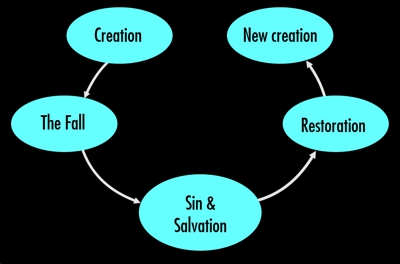
Overall history is visualized in this schematic diagram. In the beginning God created a perfect world where there was no sin. But this world was changed and spoiled when humanity sinned. From that time there is sin, suffering and death. But God promised deliverance and salvation from this. When this is finalized in the future, God’s perfect world will be restored. We now live under the curse of sin between the Fall and the restoration.
History is linear. It’s sequential from a beginning to an end. The end is the new creation where Jesus rules in the kingdom of God. Here’s the events in the previous diagram rearranged in a line.

God’s plan of salvation has two parts, the Old Covenant and the New Covenant. Jesus fulfilled the Old Covenant and introduced the New Covenant. That’s why His name appears between them in the diagram. He marks the center and turning point in history. The purpose of the Old Covenant was to accomplish a rescue plan for the world: God becoming a Jewish man and dying for humanity’s crimes against God. The Old Covenant no longer applies because its purpose was achieved. It has been replaced by the New Covenant. Christians are those who have trusted in God’s rescue plan and they live under the New Covenant. They are part of His coming new creation.
So we live in a world where there is tension between sin and salvation, between the past fall and the future restoration, and between following Satan and following Jesus.
The triune God
The Bible teaches that there is only one God, yet it calls three Persons “God” – the Father, the Son, and Holy Spirit. The word “trinity” explains the eternal relationship between them. This form of monotheism is indicated in the diagram by the green circle.
 Other beliefs (or worldviews), such as those indicated in the diagram by a blue circle, differ from the Bible. These are:
– There is no God (atheism). There is no spiritual world – it’s only physical. Like humanism and naturalism.
– There is one God (monotheism), but no trinity.
Jesus was a great teacher, but he wasn’t divine. Like lslam.
– There are many gods (polytheism). Like Hinduism, and the ancient Egyptians, Greeks, and Romans.
– Everything is god (pantheism). Like New Age spirituality, and animism.
These are different worldviews. Christianity is the Biblical worldview. It teaches that God is a spiritual being without a physical body who is eternal (has no beginning or end). God is great – He created the universe out of nothing. And God is good – although we rebelled against Him, He offered salvation to humanity. He is personal and involved with people.
How do we get to know God? Only through a relationship with Jesus Christ that involves believing and following Him.
The problem
Are people basically good or evil? Adam and Eve were created good in the beginning, and in the image of God, but they disobeyed God. Because of this, humanity and the rest of creation were cursed with sin, suffering and death (Rom. 5:12-15). The Bible says we are all sinners who are spiritually dead and separated from God (Isa. 59:2; Rom. 3:23, 5:12). And Satan is a spiritual being who tempts us to sin. Humanity now has a fatal flaw. We need help. Unless we do something about it we face eternal punishment in hell (Mt. 25:41, 46; Rev. 19:20). It’s more important than global warming or poverty or inequality or terrorism or the Middle East conflict or anything else you can think of. So, we have a big problem. And only God can fix it. We need outside help. That’s where Jesus comes into history.
Jesus
Jesus is fully God and fully human (1 Jn. 4:1-3). As God, He always existed and was never created. And He created the universe (Col. 1:16). His conception was unique. He lived a sinless life. He was executed on a cross, was buried, but He rose back to life and is spiritually and physically immortal. When He ascended to heaven, He promised to return to earth again.
Christians believe that Jesus is the Son of God and the Savior of humanity as described in the New Testament, whose coming as the Messiah (the Christ) was prophesized in the Old Testament.
Jesus was sent to earth to solve the big problem of our hopeless situation of sinfulness and separation from God
The solution
God had a plan to forgive sinful people like us. Because God is loving and just, His plan was loving and just. The idea was that Jesus would be our substitute. He would take our punishment (that’s justice), and we would be offered forgiveness (that’s loving). So, Jesus died as the sacrifice and payment for our sins.
God’s plan of salvation was offered to people as a gift (Eph. 2:8-9) that could be accepted by acknowledging our sin and the fact that it separates us from God, and believing that Jesus died for our sins and physically rose again. We just need to trust in Jesus alone as the way of salvation because He has done all the work for us. There’s two aspects:
– Admit you are a sinner – that’s the problem (Rom. 3:23; 1 Jn. 1:9)
– Believe that Jesus died for you – that’s the solution (Acts 16:31).
 Jesus is like the bridge to eternal life in this diagram. Unbelievers are separated from God and on the road to hell. If they trust in what Jesus has done for them, they cross over the bridge to the road to heaven. That’s the only solution. The only rescue plan.
That’s how God made a way for people to have a relationship with Him. Paul said, “Be reconciled to God. God made Him who had no sin (Jesus) to be sin for us, so that in Him (Jesus) we might become the righteousness of God” (2 Cor. 5:20). What a great exchange of our sin for Christ’s righteousness!
Jesus is the only way to God (John 14:6). Peter preached, “Salvation is found in no one else, for there is no other name under heaven given to mankind by which we must be saved” (Acts. 4:12). That’s why Christians follow and worship Jesus and not someone else who is a sinner like us.
The future
Those who follow Jesus are promised a wonderful future. At death their invisible soul is separated from the body. That’s when believers go to be with Jesus. Later at the rapture their bodies are resurrected and reunited with their souls. So believers will live with Jesus for eternity (Jn. 11:25, 26; 2 Cor. 5:6). They will also reign with Jesus in His coming kingdom.
If you want to drive a car in Australia you need to pass a knowledge test to get a learner licence. Then you need to pass a driving test for a provisional licence. You can’t get a learner licence without passing the knowledge test. And you can’t get a provisional licence without passing a driving test. There’s information to know and things you need to be able to do. Likewise to follow Jesus, there are both beliefs to know and practices to do.
Now we have looked at the major beliefs of those who follow Jesus, here are some of their major practices. All these practices can be applied in a Christian’s individual life, in their family life, and in their corporate life (as in the church). And they were practiced by the early church (Acts 2:42; 4:33).
Five major practices
Bible reading
It’s important to connect with the Bible every day as it is God’s main message to us. Christians read it to understand the message and to apply it to their daily lives.
Regularly reading the Bible is one of the most important things they can do. It can influence their lives and help them develop godly attitudes and behavior. And they can learn more about God and draw nearer to God. Victory over sin comes from the Bible (Mt. 4:4). As physical food gives us energy, the words of scripture give us spiritual energy and power. Devotions like “Our Daily Bread” and Bible Apps can help.
Christians should study the Bible because there is so much false teaching around. Test any teaching against what the Bible says (Acts 17:11). Be careful to correctly interpret scripture (2 Tim. 2:15). There are many poor interpretations on the internet. Some things that can help to keep you on the right track are – Study Bibles and the “Believer’s Bible commentary” by William MacDonald.
Prayer
Christians are commanded to pray regularly and when facing trouble (Col. 4:2; 1 Th. 5:17; Heb. 5:13). It’s important to connect with God every day. Jesus prayed regularly and not just on special occasions (Mt. 14:23; Mk. 1:35; Lk. 11:1). He “often withdrew to lonely places and prayed” (Lk. 5:16).
Many of Paul’s prayers are recorded in the New Testament. He prayed for things like godly living, his ministry, strengthening, increased knowledge, more love, grace and peace, Israel’s salvation, Christ to dwell in our hearts through faith, more hope and for the fullness of God. A Christian’s prayers are offered to the Father through Jesus because Jesus is the only mediator between people and God the Father (1 Tim. 2:5).
James said, “Come near to God and He will come near to you” (Jas. 4:8). If Christians come to God in prayer with humility, He will answer their prayers. God is accessible to those in fellowship with Him. They can stay right with God by confessing our sins (1 Jn. 1:9).
People are encouraged by knowing that others are praying for them. Peace is another benefit of prayer, “Do not be anxious about anything, but in every situation, by prayer and petition, with thanksgiving, present your requests to God. And the peace of God, which transcends all understanding, will guard your hearts and your minds in Christ Jesus” (Phil. 4:6-7).
Praise and worship
God alone is worthy of our devotion, praise and worship. He is our Creator and our Savior. Praise is linked with thanksgiving, while worship is linked to surrender.
Christians should praise God for His goodness even when life is difficult. “Through Jesus, therefore, let us continually offer to God a sacrifice of praise—the fruit of lips that openly profess His name” (Heb. 13:15). The joy of salvation can be expressed in songs of praise (Acts 16:25; Eph. 5:19; Col. 3:16; Heb. 5:13). Their praise is offered to the Father through Jesus.
Jesus said that His followers should “worship the Father in spirit and in truth” (Jn. 4:23-24). Worship is different under the New Covenant. The location isn’t important anymore. But who and how Christians worship is important. They worship the Father for sending the Son and Jesus for carrying out God’s plan of salvation. Its God centered. One’s attitude needs to be right (in spirit; engaging our hearts). And it needs to be consistent with Scripture and the kind of God we worship (in truth; engaging our minds).
Serving God is a form of individual worship (Rom. 12:1). It’s a response to all that God has done for them. And the Lord’s Supper is an expression of corporate worship.
Sharing the good news about Jesus
Before Jesus ascended back to heaven He told the apostles to “go and make disciples of all nations, baptizing them in the name of the Father and of the Son and of the Holy Spirit, and teaching them to obey everything I have commanded you” (Mt. 28:19-20). He also told them, “you will be my witnesses in Jerusalem, and in all Judea and Samaria, and to the ends of the earth” (Acts 1:8).
In the book of Acts there are many accounts of people sharing the good news of God’s plan of salvation though Jesus. This began in Jerusalem and extended to elsewhere in the Middle East and across the Roman Empire to Rome. Paul and Silas were so passionate about telling people about Jesus that they continued sharing even when they were imprisoned.
Godly attitudes and behavior
Children grow up to be like their parents in many ways. Christians are called “children of God” (Jn. 1:12)
The Bible says, “His (God’s) divine power has given us everything we need for a godly life through our knowledge of Him who called us by His own glory and goodness. Through these He has given us His very great and precious promises, so that through them you may participate in the divine nature, having escaped the corruption in the world caused by evil desires” (2 Pt. 1:3-4).
The power of God gives Christians new life (Col. 2:12-13; Ti. 3:4-5) and the power of God gives them the ability to live godly lives (Phil. 2:12-13; 4:13). The better they know God’s Word the better they can apply God’s principles in their lives. The Christian lives by the promises of God in Christ.
Christians have two natures. A selfish sinful nature like unbelievers and a new divine nature, which transforms them to become more like Christ (Rom. 8:29; 2 Cor. 3:18). This process isn’t complete until they get to heaven when they “see Him (Jesus) as He is” (1 Jn. 3:2). The divine nature is God’s provision to counteract the sinful nature.
Paul said, “Follow my example, as I follow the example of Christ” (1 Cor. 10:31 – 11:1). He put the welfare of others first. God should be glorified in all that Christians do. He didn’t want to stumble anyone so that unbelievers may be saved.
Following Jesus is a transformation from within. Paul changed from being self-centered to being Christ-centered (Phil. 3:4-16). His mind was set on heavenly things, not earthly things (Phil. 3:17-20).
The godly attitudes and behavior mentioned in the New Testament include:
| Active Bold Compassionate Considerate Consistent Contented Dedicated Encouraging Enthusiastic Evangelistic Faithful |
Forgiving Generous Gentle Good Gracious Helpful Holy Honest Hospitable Humble Impartial |
Joyful Liberty Longsuffering Loving Obedient Opposed to sin Patient Peaceful Persevering Praising Prayerful |
Reconciling Repentant Respectful Reverent Self-controlled Submissive Thankful Unifying Visionary Wise Wonderful |
What a wonderful list of attributes! Wouldn’t it be great to be more like this?
Culture
The Bible encourages Christians to meet together regularly for mutual encouragement (Heb. 10:24-25). Collective worship and service is one of the characteristics of Christianity. This is difficult in countries where Christians are persecuted. Groups of people that meet together are referred to as a local church and the building they meet in can also be called a “church”. Since the middle ages some grand churches have been constructed, particularly in Europe. These were significant landmarks because of their great size and splendor. Cathedrals are impressive church buildings that symbolize the glory of God. In an age when the vast majority of the people were illiterate, the images on the stained-glass windows were like an illustrated Bible.
Christianity had a significant impact on education, science and medicine. And it has also had an impact on art, music and literature. The contents of the Bible influenced artists such as Michelanglo and Leonardo da Vinci, composers such as Bach and Handel, and writers such as Shakespeare and CS Lewis.
Christians usually celebrate Christ’s birth at Christmas and Christ’s death and resurrection at Easter. These are cultural and traditional events as neither of them is mentioned in the Bible.
Comparison with Judaism
Jesus, the apostles and the majority of the early church were Jewish. As Judaism is based on the Old Covenant (Old Testament), it’s a precursor of Christianity. Because Jesus fulfilled the purpose of the Old Testament about 2000 years ago, Christianity is the successor of Judaism.
The Jewish faith is monotheistic, but not trinitarian – they don’t accept that Jesus Christ was the Son of God. Christians believe that Jesus Christ is the Messiah awaited by the Jews, while the Jews believe that the Messiah will come in the future. The Jewish Messiah is a person (who isn’t divine) who will restore the physical kingdom of Israel, rebuild the temple in Jerusalem and bring earthly peace.
Both Judaism and Christianity teach that God has a special plan for the nation of Israel and the Jewish people. But Christianity does not accept that Mosaic Law has any authority over Christians, while Judaism does not accept that the New Testament has any religious authority over Jews. Besides the Old Testament, Judaism also considers the Oral Torah (written in the Mishnah and the Talmuds) to be a sacred text. Christians generally worship collectively of Sunday while Saturday is the day of worship in Judaism.
Conclusion
Christianity is a way of life that involves beliefs and practices that are taught by Jesus and His apostles as recorded in the Bible. This post has summarized aspects of the history, major beliefs, major practices and culture of the Christian faith. These beliefs, practices and culture impact everyday life for about 2 billion people across the world.
Written, January 2017
Also see: Basic Islam
Basic Hinduism
Basic Buddhism
Participating in the divine nature
Share this:

Who are you following in 2018?

 We can follow people on social media like Facebook. And we are influenced by the people we follow and listen to. For example, social media influences our relationships, shopping, and education.
Like most people living in the post Christian 21st Century Joe had heard of Jesus. But he didn’t know much about him. So, deciding to educate himself, he Googled some answers. Here’s what Joe said afterwards.
“He’s probably Scandinavian… from Norway or Denmark. You can tell by his pale skin, long blonde hair and blue eyes. But he’s definitely not a Viking. He’s more like a guru. In all the movies and old paintings he looks really chilled. In fact, ‘Chilled Nordic Jesus’ seems to be the most popular kind of Jesus.
“But there were others. I also found, ‘Religious Jesus’ or ‘Church Jesus’. He’s in paintings and stained glass windows everywhere. And he loves medieval Gothic churches. He’s closely related to, ‘Out of this world Jesus’ or ‘Ethereal Jesus’ who you can also find in churches – usually looking right past you. It’s hard to tell if he’s super focused or stoned or just not very interested.
“When I read articles I came across different reasons for why Jesus came. So, ‘Great moral teacher Jesus’ joins a succession of teachers down through the ages who taught us how to live better lives. On the other hand, ‘Killjoy Jesus’ is always watching and ready to condemn us when we stuff up. But ‘Genie Jesus’ is really great. He’s available for party tricks and special rescues – unfortunately only prayers from the super spiritual seem to work.
“The last Jesus I found was ‘Political Jesus’ – he was a bit of a failure. He wanted to cut a better deal for poor people with the Roman and Jewish leaders. But he didn’t succeed. Instead he was killed. There really does seem to be a lot of confusion about why Jesus died.
If only Joe had listened to what Jesus said about himself instead of the opinions of others. If he’d only looked in the Bible instead of online he could have skipped the clichés and found the real, authentic Jesus of history… born in Palestine… who probably had brown skin… who lived well before stained glass and gothic church architecture and who challenged religious hierarchies. Joe could have heard Jesus say that he “came to seek and to save the lost” and that his plan was to give his life, “as a ransom for many”. And he could have read these immortal words…
“I am the light of the world. If you follow me, you won’t have to walk in darkness, because you will have the light that leads to life” (John 8:12).
So, don’t follow a cliché. Follow the Christ revealed in the Bible.
Bible Verse: John 8:12 “I am the light of the world. If you follow me, you won’t have to walk in darkness, because you will have the light that leads to life”.
Prayer: Dear God, please help me to follow Jesus in 2018 and to understand more about Him as I read about Him in the Bible. Amen.
Images and text © Outreach Media 2018
Posted, January 2018
Share this:

The strange sign

 At a recent wedding the bridal party arrived at the church in a Lamborghini and stretch limousine. And they arrived at the Reception to fireworks and frenetic music and drumming. It was a grand entry. In contrast, although Jesus was announced by angels, His was a humble entry.
At Christmas we remember the coming of Jesus Christ into the world. This was announced when an angel told some shepherds that the Jewish Messiah had been born in Bethlehem. That’s amazing because shepherds were near the bottom of the social ladder. And Bethlehem was only a small town. But how would the shepherds find him? And how would they recognize him? So they were given a sign from God to help them.
What’s a sign?
The Greek word semeion (Strongs #4592) means a “sign”. In this context it’s the means by which a person is distinguished from someone else. For example, Judas Iscariot identified Jesus by kissing him (Mt. 26:48). And circumcision was a sign of the covenant between God and the Israelites (Rom. 4:11). Miracles signified an apostle (2 Cor. 12:12). And Paul’s handwriting showed that his letters were authentic (2 Th. 3:17).
The sign
They were given an unusual sign to identify the Messiah. Important people like royalty, and a President or Prime Minister are usually characterized by pomp, ceremony, security and publicity. That’s the kind of sign we would expect for the Messiah.
But the angel said, “This will be a sign to you: You will find a baby wrapped in cloths and lying in a manger” (Lk. 2:12NIV). So the sign was a baby lying in a cattle feeding-trough! What a humble birth.
So the shepherds were to look for a baby lying in a cattle feeding-trough. Although there would have been other babies in Bethlehem, it would be unusual for one to be lying in a cattle feeding-trough. It was a strange sign.
A baby
Jesus was born into the world just like all of us. It was a normal birth (following a supernatural conception). He was a tiny helpless baby. Nothing would have seemed supernatural. Why did God choose to enter the human race like this? So that He could provide for our salvation. Jesus had to be fully human so He could die for our sins (Heb. 2:14-17). He had to become like us in order to save us.
 A baby lying in a cattle feed trough
The reason that baby Jesus was lying in a manger was “because there was no guest room available for them” (Lk. 2:7). The last supper was held in the guest room of a house in Jerusalem (Mk. 14:14; Lk. 22:11). According to scholars, the most likely place for a manger in Bethlehem was in a one-roomed peasant house with two levels. People occupied the upper level (Arab. mastaba) and animals the lower one (ka’ al-bet). The animals are housed overnight and fed from mangers built into the floor of the upper terrace or mounted to the walls near the lower level. Presumably there was no cradle in the house, but a manger could perform the same function.
The shepherds were told that they would find the baby in a manger. Shepherds were near the bottom of the social ladder and in many homes they would feel their poverty and be ashamed of their low position in society. But in this case, they faced no humiliation because it was probably a simple peasant house like their own with mangers for the animals. That’s why they said, “Let’s go to Bethlehem and see this thing that has happened, which the Lord has told us about” (Lk. 2:15). And they hurried off to find Joseph, Mary and baby Jesus.
What a strange way for a Messiah and Savior to enter the world. Even the poorest child would not be found in a manger.
Lessons for us
The Bible says that Jesus gave up His divine glory when He came to earth “by taking the very nature of a servant (slave), being made in human likeness” (Phil. 2:7). And “that though He was rich (in heaven), yet for your sake He became poor (on earth)” (2 Cor. 8:9). He did this (was born, lived, died and rose again) in order to die the death that we deserve. Through what Jesus has done, we “might become rich”. The promise is not for physical earthly riches, but spiritual heavenly riches. It’s forgiveness of our sins, reconciliation with God, and eternal life. What Jesus did was like an “indescribable gift” (2 Cor. 9:15). As a gift, it has not benefit to us unless we accept it. That’s why the Bible says. “might become rich”, not “will become rich”. Have you accepted God’s gift? Not many Jews recognized that Jesus was the Messiah. Why not recognize Him as your Savior?
Those who follow Jesus are to imitate His humility (Phil. 2:1-8). Our attitude is to be one of unity. mutual love, harmony, humility, sacrifice, and service, rather than being self-centered. Saul was recognized for being tall, Zacchaeus for being short and Jesus for being humble (1 Sam. 9:2; Lk. 19:1-4). But what is our characteristic attitude?
Share this:

When Santa learned the gospel

 A poem by Simon Camilleri
When Santa learned the gospel, he first heard it from an elf.
This tiny Santa’s helper had just learnt of it himself.
A child had asked for Christmas to receive a Bible book.
This elf had made one in the shop, then paused to have a look.
He read all about Jesus and the call to follow Him.
He learned how Jesus lived and taught and died to pay for sin.
He learned how Jesus rose again and how He will return
And then this elf read how he should respond to all he’d learned.
He shut the book, put down his tools, then closed his eyes and prayed.
Right there and then this little elf trusted in Christ that day.
The next day he told Santa. It was awkward, unprepared.
He knew he didn’t know that much, but what he knew he shared.
He told Santa the gospel. It was simple. It was short.
But a seed was sown in Santa’s heart, which grew into a thought.
Santa reflected on his life and the message he supported,
Then compared it to the gospel that the elf had just reported.
He’d always thought that everyone was naughty or was nice.
He had them all on two big lists. He even checked it twice.
He’d always thought that you got gifts only if you’d been good.
The naughty kids got lumps of coal. That’s what he understood.
They’d all line up in shopping malls and sit upon his knee
And claim that they were always nice. As nice as nice can be.
Of course, he saw them when they slept and knew when they awoke.
He also knew their nice attempts were pretty much a joke.
Their heads were filled not with nice thoughts of kindness, peace and joy,
But with the never-ending list of their desired toys.
He knew their hearts, but he had thought, “They’re trying to be good.
That’s good enough to make the list. Otherwise no one would!”
So every year their “good enough” with toys would be rewarded.
And every year (he realized) this message he supported:
THE “GOOD” WILL GET THE PRESENTS.
THE “BAD” WILL GET THE COAL.
AND TRYING TO BE GOOD ENOUGH
IS GOOD ENOUGH A GOAL.
That was the message that he knew, but now he knew another.
He had just heard the gospel. So he compared them to each other.
The message of the gospel turned his message upside down.
The good, the bad, naughty and nice, it switched it all around.
“There’s no one good but God alone” he’d heard Jesus concluded.
And those who claim they’re “good enough” are simply just deluded.
If there’s a list of who is “good”, the standard we’ve all missed.
And Santa saw that even he was on the naughty list.
That shook his world. That rocked his boat. That gripped him in his soul.
To think that even Santa Claus deserved a lump of coal.
But that was only half of what the gospel message said.
It also flipped what happened to the naughty on its head.
Instead of being written off as just not good enough.
The message to the naughty list was one of grace and love.
The gospel offered mercy to all those deserving coal.
The gospel offered forgiveness and cleansing of your soul.
The gospel told how Jesus died our death to pay the price
To reconcile us all to God – both naughty and the nice.
This offer was a real gift, unlike presents ‘neath the tree.
It was not earned by being good. It was offered for free.
For all his life Santa had claimed that if you had been bad
Then you would not get presents and your Christmas would be sad.
Santa compared his message with this new one he had learned.
His message said you get the presents your good deeds had earned.
The message of the gospel offered something so much greater…
Jesus had come to reconcile the world to their Creator.
When Santa grasped the gospel, he did not know what to do
And so the elf said nervously, “How ’bout I pray with you?”
Then that night at the North Pole, by the fire in his den,
With a simple prayer led by an elf, Santa was born again.
And now, in Christ, forgiven, free – his new life had begun
and Santa had a new message to share with everyone.
© Simon Camelleri
Posted, December 2017
Share this:

What Jesus wants for Christmas

 What a precious thing is a baby! The news that a little tiny human has safely made its way into the world is such a miracle, such a cause for celebration. Even when there is mourning or hardship, a new baby can bring hope.
On the first Christmas when baby Jesus arrived there was the usual joy and celebration. But there was so much more than that. Angels sang in the sky, shepherds dropped everything and came, wise men followed a star… all to honor and worship this new baby.
When God sent His Son into the world, in the form of a baby boy, He did it for us. In John’s gospel it says,
“For this is how God loved the world: He gave His one and only Son, so that everyone who believes in Him will not perish but have eternal life“.
This is one of the most famous verses in the Bible, perhaps because it states so simply the most important things. God loves us so much that He sent His only Son to help us. This is why Christmas is special! It’s a time to celebrate the gift God gave to us long ago that shows how much He wants us to join His family. What we need to do is believe in Him.
There is a beautiful Christmas poem by Christina Rossetti that was put to music and became the carol, “In the Bleak Midwinter”. It tells of the unlikely and difficult place where the baby Jesus was born, of angels singing praises to welcome the new King, and of shepherds visiting and bowing down and of wise men who traveled a great distance to honor Him.
The author wonders what she could give to Him as a tribute.
“What can I give Him,
Poor as I am?
If I were a Shepherd
I would bring a lamb;
If I were a Wise Man
I would do my part,
Yet what can I give Him,
Give my heart.”
The Wise Men brought gifts fit for a King to honor the newborn Jesus, but there is nothing that we can give that is enough. All Jesus wants for Christmas is YOU!
Bible Verse: John 3:16 “For this is how God loved the world: He gave His one and only Son, so that everyone who believes in Him will not perish but have eternal life”.
Prayer: Dear God, thank you for loving me so much. Thank you for the precious gift of your Son. Please forgive me and help me to worship and honor you all year long. Amen.
Acknowledgement: This blogpost was sourced from Outreach Media, Sydney, Australia.
Images and text © Outreach Media 2017
Share this:

Who and how to worship

 The book of Revelation was written during a time when emperor-worship unified the Roman Empire. The emperor was viewed as a divine figure, to whom temples, altars and priesthoods were dedicated. Emperors were worshipped, honored, respected and served at any cost. Because he rejected emperor worship, John was banished to the island of Patmos (Rev. 1:9-11). From Patmos John urged first century Christians to worship the true God and not the emperor, and he recorded this message in the book of Revelation.
The Greek verb to worship, proskuneo (Strongs #4352), occurs 60 times in the New Testament and 24 (40%) of these are in the book of Revelation. It’s the main book about worship in the New Testament. In this way, the book of Revelation is like the book of Psalms, which is the main book about worship in the Old Testament. In Revelation, worship describes homage or reverence towards God, or a person or an idol or an angel. This shows that if we don’t worship God, then we will worship someone else or something else. Who will we worship? The true God or Satan who is the power behind all false gods? This is important because it determines our eternal destiny.
The book of Revelation is framed with worship – it’s in the first and last chapters. After John sees a vision of the glorified Christ, he “fell at His feet as though dead” (Rev. 1:17NIV). This was an act of worship. After the final vison, John “fell down at the feet of the angel who had been showing” the visions to him (22:8). But the angel tells him to “Worship God” instead (22:9).
In Revelation, worshippers serve (7:15; 22:3), praise (19:5), and offer thanks (4:9; 7:12; 11:17). And they fall down (in worship) before God (4:10; 5:14; 7:11; 11:16; 19:4) and Christ (1:17; 5:8, 14).
The book of Revelation shows us who to worship and who not to worship.
Don’t worship angels
Angels are messengers from God. On two occasions when John received visions, he bowed down to the angel associated with them (19:10; 22:8). But he was told not to worship the angel. Jesus is superior to angels (Heb. 1-14). And Christians at Colossae were warned not to worship angels (Col. 2:18). So, don’t worship angels.
It is evident in the book of Revelation that there is a cosmic battle for our allegiance and worship. The true God and the victorious Lamb of God (Jesus Christ) continually reign and are being worshipped behind the scenes by angels and the redeemed in heaven, even during times when Satan seems to have his greatest impact. But Satan deceives the world into worshipping false gods and idols (12;9; 13:2-4; 20:2-3). 46% of the instances of The Greek verb to worship proskuneo in the book of Revelation refer to false forms of worship. In the end, Satan and his followers will be judged and cast into eternal punishment (20:1-4, 15). So, don’t worship Satan, who is an angel who rebelled against God.
Don’t worship heroes
Revelation describes political and religious leaders that oppose God’s people and God’s purposes (13:1-18). They are called beasts. And they deceive many people into worshipping them (13:4, 8, 12, 15; 14:9, 11; 19:20; 20:4). Paul also warned about worshipping and serving created things rather than the Creator (Rom. 1:25). We are not to worship saints, prophets, political leaders, religious leaders, or Mary, the mother of Jesus. So, don’t worship human heroes, no matter how great they are.
Don’t worship idols
An idol is anything we worship instead of the true God. Anything we want more than God. Anything we rely on more than God. Anything we give a higher priority than God. And anything we look to for greater fulfillment than God. In Revelation idols are described as “the work of their hands” and “idols that cannot see or hear or walk” (9:20). In those days it referred to images and statues, which people were urged to worship. It was like when some of the Jews (Shadrach, Meshach and Abednego) told the king of Babylonia, “we will not serve your gods or worship the image of gold you have set up“ (Dan. 3:18).
Idolatry also refers to false gods such as materialism, naturalism, wealth, power, selfish ambition, self-indulgence, self-esteem (pride), recreation, and pleasure. And Paul said that it includes, “sexual immorality, impurity, lust, evil desires and greed” (Col. 3:5). Idols can also be “good” things that we’ve elevated in importance. For example, our children, spouse, physical attractiveness, money, job, or friendships. And technology.
Revelation also says that worshipping idols is equivalent to worshipping demons (9:20). This means that Satan is the influence behind idolatry. So, don’t worship idols. Instead let’s turn away from idols “to serve the living and true God” (1 Th. 1:9).
So the book of Revelation says not to worship angels, Satan, heroes or idols. These are false (counterfeit) gods. But what does it say about worshipping the true God?
Worship the true God
In Revelation we learn about what worship is like in heaven. It’s mostly corporate (the redeemed and angels), not individual. Vast numbers of people and angels worship God together (5:11-12; 19:1, 6). And it’s God-centered – directed to God and Jesus Christ. Here’s three examples of this worship.
First, “You are worthy, our Lord and God, to receive glory and honor and power, for you created all things, and by your will they were created and have their being” (4:11). So, let’s praise and worship our God as the great Creator.
Second, “You are worthy to take the scroll and to open its seals, because you were slain, and with your blood you purchased for God persons from every tribe and language and people and nation. You have made them to be a kingdom and priests to serve our God, and they will reign on the earth” (5:9-10).
And at this time the angels said, “Worthy is the Lamb, who was slain, to receive power and wealth and wisdom and strength and honor and glory and praise” (5:12)!
So, let’s praise and worship Jesus as the great Redeemer/Saviour/Rescuer. His death and resurrection enabled people from around the world to have their sins forgiven so they could be reconciled with God. This is the greatest example of unconditional love.
Third, “Great and marvelous are your deeds, Lord God Almighty. Just and true are your ways, King of the nations. Who will not fear you, Lord, and bring glory to your name? For you alone are holy. All nations will come and worship before you, for your righteous acts have been revealed” (15:3-4).
The context of this passage is God’s judgement of the ungodly. So, let’s praise and worship God as Judge of all. He is pure, holy and just. He’s the one who will right all the wrongs. He judges rebels and rewards His servants. And He is to be praised for His righteous judgements.
The book of Revelation is full of corporate praise and worship like, “Hallelujah! For our Lord God Almighty reigns. Let us rejoice and be glad and give Him glory” (19:6-7)! And, “To Him who sits on the throne and to the Lamb be praise and honor and glory and power, for ever and ever” (5:13)!
The redeemed will worship God throughout eternity. They “are before the throne of God and serve Him day and night in His temple” (7:14). And they will worship and serve God forever (22:1-5).
Summary
People were made to worship. Bob Dylan sang, “you’re gonna have to serve somebody”. We worship either the true God or we worship a counterfeit. So, let’s worship the true God and not false gods. Let’s worship Him based on the patterns of heavenly worship depicted in Revelation. He’s the great creator, the great redeemer and the great judge.
Written, December 2017
Share this:

Marriage equality

 On Sunday morning Sydneysiders could not miss “Vote No” sprawled across the sky. A skywriting Cessna plane wrote these words high over the city. The sky message attracted a lot of attention on social media both for and against the No campaign. Who would have thought that the act of saying that you were going to vote NO (and paying a skywriter to write that message in the sky) was so radical, even subversive!
Australian marriage law
This month Australia faces a postal survey on same-sex marriage. The current marriage law says that marriage is between a man and a woman. A typical church marriage rite says, “Marriage is the God ordained covenantal union of a man and a woman to the exclusion of all others, voluntarily entered into for life”. There are three main parts. It’s “God ordained”. God designed marriage for humanity. It’s a “covenantal union”. Malachi criticized the Jews for being unfaithful to “the wife of your marriage covenant” (Mal.2:14NIV). A covenant is a binding agreement. But it’s not merely a human contract, because Jesus says that God joins husband and wife together (Mt. 19:6; Mk. 10:9). In this case it’s a promise to be faithful to one another for life, regardless of what the future may hold. It’s a special relationship between the genders. A one-on-one, male-female, relationship; which was the case with Adam and Eve at the beginning of creation. And it’s for a lifetime (“for life”).
This blogpost differs from many others on this topic because it’s based on the Bible and not on reason. Let’s begin with what Jesus says about marriage.
What Jesus said about marriage
When the Pharisees asked Jesus about divorce, He told them about God’s plan for marriage, “at the beginning of creation God ‘made them (people) male and female.’ ‘For this reason a man will leave his father and mother and be united to his wife, and the two will become one flesh.’ So they are no longer two, but one flesh. Therefore what God has joined together (in marriage), let no one separate (in divorce)” (Mt. 19:4-6; Mk. 10:6-9). Jesus goes back to the time before sin came into the world to show God’s original intention for marriage. Then He says that humanity was created in two genders: male and female (Gen. 1:27). That should be obvious to us. When a baby is born, it’s announced as being either a boy or a girl. There’s no gender ambiguity at birth! Our gender is determined by our genome and we can’t change that. But Facebook has at least 50 gender options! How confusing. Then the two genders are given as the reason (“For this reason”) why marriage is between a man and a woman. It’s easy to understand. In this way, marriage is linked to God’s creation. “United” means that there is a strong bond between husband and wife. “One flesh” means sharing all of life together, like a body that doesn’t separate until death. God designed husband and wife to complement each other. Jesus recognizes that the first marriage was between Adam (a man) and Eve (a woman). It wasn’t between Adam and Steve or between Madam and Eve! The pattern of marriage was established in the Garden of Eden, “That is why a man leaves his father and mother and is united to his wife, and they become one flesh” (Gen. 2:24). So according to the Bible, marriage is the union of a man and a woman. Jesus quotes this verse and adds that because God has joined the couple together in marriage, it’s meant to be a lifelong union (“let no one separate”). Jesus showed that God’s original intention for marriage still applied in a sinful world. And it applies everywhere because it was instituted in the Garden of Eden before cultures began. In fact, marriage and gender exist until we go to heaven (Mt. 22:29-30; Mk. 12:24-25; Lk. 20:34-36). So, Jesus answers the question on divorce in the context of marriage being heterosexual, not homosexual.
God’s plan for mankind is that sexual relationships are so important that they are protected by the marriage covenant. God places a boundary around these sexual relationships where any sexual relationships outside heterosexual marriage are prohibited. This means that sexual intimacy is designed to be between a husband and a wife. According to God, that’s the only “safe sex”! Any other sexual activity (hetero or homo or pornographic) is a corruption of God’s design. It’s “dangerous sex”. And if we ignore God’s design there will be consequences.
This is Jesus’ definition of marriage. And same-sex marriage isn’t included. Jesus never discussed same-sex marriage because the way He defined marriage already excluded it! So, according to Jesus, the term “same-sex marriage” is a contradiction, an oxymoron. The words “same-sex” and “marriage” don’t go together. Biblical marriage combines both genders, and it’s not a single gender relationship.
Notice that the word ”love” isn’t mentioned in this definition of marriage. This means that any loving relationship isn’t necessarily marriage.
Adam and Eve were commanded to “be fruitful and increase in number” (Gen. 1:28). One of the important functions of the first marriage was to produce and nurture children. This is the example of marriage that Jesus tells those in the first century AD to follow. Of course, it only makes sense in the case of heterosexual marriage. There was no way to produce children from homosexual relationships.
What Paul said about marriage
Paul’s main instructions for marriage are given in Ephesians 5:22-33. And a short summary of these is given in Colossians 3:19-19, Titus 2:4-5 and 1 Peter 3:1-7. He commands husbands to lead and love their wives, and wives to respect and submit to their husbands. These are commands for heterosexual marriage between a husband and a wife.
Husbands are to care for their wives like Christ cares for the church (v.29). As Christians are like Christ’s body, a wife is like a husband’s body (v.28,30). These are close relationships. Then Paul, like Jesus, connects back to the origin of marriage in Genesis 2:24. “For this reason a man will leave his father and mother and be united to his wife, and the two will become one flesh” (Eph. 5:31). Marriage is the formation of a new family. The bond between husband and wife should be the closest of all bonds between human beings.
Marriage also reflects the union between Christ (symbolized as the bridegroom) and the church (symbolized as the bride)(v.32). The bond between Christ and the church should be the closest in all human relationships. This union culminates in the wedding of the Lamb (Rev. 19:7-9). So heaven begins with a wedding! The Bible begins in Genesis with a marriage and ends in Revelation with a marriage. At the wedding in heaven, two different types of people are united (Jesus and the church). In the Bible they are likened to husband and wife, man and woman; and not man and man or woman and woman. The illustration only works for heterosexual marriage, and not for homosexual marriage (as there is no “husband” or “wife”, just “partners”).
Lifelong marriage between a man and a woman guarantees children their biological birthright to a mother and a father and has a proven track record of providing them with protection, education, welfare, support and nurture. No other arrangement has improved upon the benefits of biblical marriage.
Trajectory of marriage in the Bible
We have seen that God’s design for marriage involved one man and one woman. On a graph of marriage practice through the ages, this is near the top of the graph. This is the “safe sex” line that represents protection by the marriage covenant. In the Old Testament, Lamech had two wives (Gen. 4:19, 23). He was part of the 7th generation on earth. Polygamy occurs from this time onwards in the Old Testament. This even included Jacob, David and Solomon. So the graph goes downwards. These marriages were not according to God’s design. They are reported and described in the Bible, but they were not prescribed by God. They caused social chaos in families and societies. Solomon’s foreign wives lead him into idolatry. So polygamy wasn’t an example to follow. In the 5th century BC when the Jews returned to Judea after their exile, Ezra, Nehemiah and Malachi commanded them to get rid of their foreign wives (Ezra Ch 9-10; Neh. 13:23-27; Mal. 2:10-12). Malachi also denounced them divorcing their wives (Mal. 2:13-17). They had been unfaithful to their wives and breaking their marriage covenants. So the graph moves upwards because the Jews in Judea improved their marriage practice at this time. In the New Testament Jesus restored the original design for marriage of one man and one woman and this continued in the early church. So, the graph moves up to the top once again.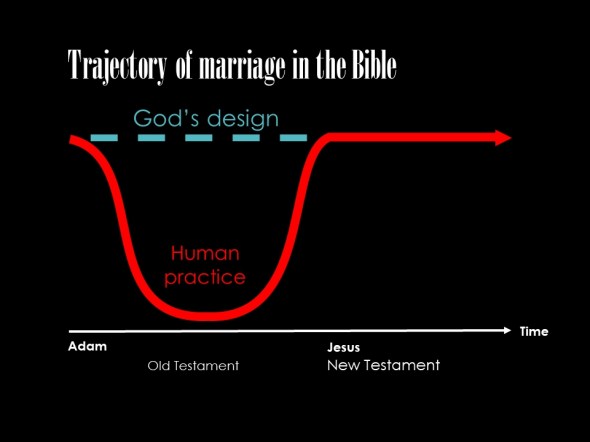 How does the same-sex marriage proposal compare to this trajectory? It’s not on the line! Adding a new category to marriage works against the Bible’s trajectory on marriage. It’s like in the Old Testament when polygamy was added as a new category to marriage and the curve goes down. In the Old Testament, God let people deviate from His marriage design, but there were serious consequences. Likewise, today God will let people deviate from His marriage design, and the curve will go down again, and there will be serious consequences.
What Jesus said about homosexuality
How do we know what Jesus thought of same-sex marriage (or homosexuality) when it’s not mentioned specifically in the gospels? We can find out from the Old Testament because it describes the principles and practices of Judaism. Jesus was a faithful Jew who lived under the Old Testament law. He obeyed the law of Moses (Jn. 8:29,55) and He didn’t sin in any way (Heb. 4:15; 1 Pt. 2:22). So, He would have followed the laws of Moses about unlawful sexual relations, such as: “Do not have sexual relations with a man as one does with a woman; that is detestable” (Lev. 18:22). And, “If a man has sexual relations with a man as one does with a woman, both of them have done what is detestable” (Lev. 20:13). So Jesus would have prohibited any homosexual sexual activity as it was against the laws of Moses for sexual relationships. As this was accepted by the Jews that He came to teach, He didn’t need to discuss this topic.
What Paul said about homosexuality
Paul describes the behavior of those who reject God’s revelation in creation, “Therefore God gave them over in the sinful desires of their hearts to sexual impurity for the degrading of their bodies with one another (sexual immorality) … Because of this, God gave them over to shameful lusts. Even their women exchanged natural sexual relations (heterosexual marriage) for unnatural ones (homosexual sexual activity). In the same way, the men also abandoned natural relations with women (heterosexual marriage) and were inflamed with lust for one another (homosexual sexual activity). Men committed shameful acts with other men (homosexual sexual activity), and received in themselves the due penalty for their error…. Although they know God’s righteous decree that those who do such things deserve death, they not only continue to do these very things but also approve of those who practice them” (Rom. 1:24-27, 32).
Losing a proper view of God (v. 23) leads to sexual immorality (v.24), including homosexuality (v.26-27). In particular, homosexual sexual activity is described as “shameful lusts”, “unnatural” and “shameful acts”. That’s God’s view. But ignoring it leads to a society without shame. It’s an unnatural sexual activity because it’s an abnormal sexual activity. Natural (normal) sexual activity is in heterosexual marriage, which is fruitful (can produce new life). This was God’s order in creation (Adam and Eve were the first husband and wife). If Adam or Eve was homosexual, there would be no humanity!
This passage says that homosexual sexual activity (which was prevalent in the Roman Empire) was one of the characteristics of an ungodly lifestyle. The other characteristics of an ungodly lifestyle were idol worship (v.23, 25), other sexual immorality (v.24) and “every kind of wickedness, evil, greed and depravity. They are full of envy, murder, strife, deceit and malice. They are gossips, slanderers, God-haters, insolent, arrogant and boastful; they invent ways of doing evil; they disobey their parents; they have no understanding, no fidelity, no love, no mercy” (v. 29-31). This list of sins identifies those who were not Christians.
God’s judgement for these people who reject His revelation is given in v.32 as eternal separation from God (spiritual “death”). What a sad outcome of going one’s own way. So rejecting God’s truth has eternal consequences. The only way for such people to avoid God’s judgment is to repent (stop this behavior) and turn to God.
So what did this passage mean in the 1st century AD? The characteristics of ungodly behavior are given and idolatry and homosexual sexual activity are condemned in particular. It meant that anyone who practiced idolatry was under God’s judgment. And anyone who practiced homosexual sexual activity was under God’s judgment. And the same applied to the other behaviors listed in v.29-31. There are similar lists elsewhere (1 Cor. 6:8-10; 1 Tim. 1:8-11). Everyone was condemned! All were sinners who deserved eternal punishment in hell. The only way to avoid this punishment was to accept the good news about Jesus.
So homosexual sexual activity was one of the characteristics of the flesh (sinful nature; Gal. 5:19-21). It was a human invention, and not God’s intention. This means that the Bible condemned homosexual sexual activity in the 1st century AD. As there are no qualifications given, any and all homosexual sexual activity was condemned. They were all sinful.
The biblical principles for the church to follow haven’t changed since the1st century AD. And people still reject God’s revelation in creation. So human rebellion against God hasn’t changed. And idolatry, sexual immorality, homosexual sexual activity, wickedness, greed, envy, murder, strife, deceit, malice, gossip, and slander still occur. And people are still God-haters, insolent, arrogant, boastful, contrivers of all sorts of evil, disobedient to parents, senseless, promise-breakers, cruel, and ruthless. So human nature hasn’t changed, although history, society and technology have changed. Given these similarities, the application of this passage is like what it was in the first century. Any and all homosexual sexual activity is unnatural and against God’s order of creation.
What about same-sex attraction? This passage is addressing homosexual sexual behavior and not just homosexual attraction. There is a difference between being a practicing homosexual and having a homosexual tendency. Adam and Eve were created with an opposite sex attraction. But same-sex attraction is a result of the fall into sin. The temptation isn’t sinful. It is the sexual practice that the Bible condemns, not the orientation. The Holy Spirit gives believers the power to resist temptation (1 Cor.10:13). There are many who have an attraction to their own gender but refuse to give in to it. By the power of the Spirit, they have disciplined themselves to resist the temptation and to live in purity.
Trajectory of homosexuality in the Bible
We have seen that homosexual sexual activity is condemned by the laws of Moses about unlawful sexual relations. These applied throughout the Old Testament up to the time of Jesus. On a graph of homosexuality through the ages, this is near the bottom of the graph. As Paul also condemned homosexual sexual activity, the graph stays down during the church age. God consistently disapproves it. Every biblical text on this topic is negative. This leaves no scope for homosexual sexual activity to be approved by the church as acceptable behavior.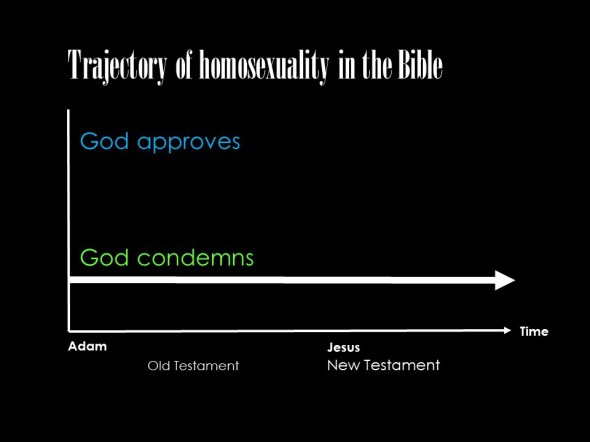 This graph isn’t unique to homosexuality. The same graph applies to adultery, divorce, incest, and any other sexual activity outside heterosexual marriage. It’s the “dangerous sex” line that represents corruption of God’s good design.
Marriage law postal survey
The Australian marriage survey, which is being mailed out now, asks the question: “Should the law be changed to allow same-sex couples to marry?” It’s a simple question with big implications. The idea is to redefine marriage by making gender irrelevant to marriage and by making the procreation of children irrelevant to marriage. This is a massive change in social policy and shouldn’t happen without thorough consideration of the consequences of such a change.
If we plan a new project, under the planning legislation, we are required to undertake an environmental impact assessment. And organizations have risk management procedures to ensure their activities are safe. These include risk assessment. Yet there’s no mention anywhere of the risks of this change in social policy. The possible consequences include loss of freedom of speech, loss of religious freedom, forced acceptance of same-sex marriage, loss of parental rights, children not being raised by their birth parents, children conceived by IVF who won’t know who their biological parents are, and surrogate mothers. If the law changes, Christians who follow the Bible will out of step with the law of the land. Christianity will become a counter-culture.
If the law changes then it will be used to silence dissent. It will impact Christian participation in education, charity and welfare. How will the law treat those disobedient citizens who hold to a Biblical understanding of marriage? It seems as though there will be negative social and religious impacts. And we will move closer to secular society, where people write their own Bible. We should vote “no”, because it’s against the Bible and there has been no disclosure or discussion of the likely impacts. We do a social impact assessment of a new shopping center, but not for a new marriage law!
“Marriage equality” is a catchy slogan for same-sex marriage. How could anyone oppose equality in marriage? It’s very deceptive. Of course, what we should be asking is what the slogan means and how it will be put into practice.
The unmarried
What about those who aren’t married? This is a larger fraction of the population than those having same-sex attraction. Jesus wasn’t married and Paul was unmarried when he wrote his letters to Christians. Paul gives advice to the unmarried in 1 Corinthians 7:7-9, 25-38. His principle was if you are married, don’t get divorced, and if you are unmarried stay that way if you can because you will have more time to serve the Lord and marriage brings extra troubles. Paul is writing to a church where there was immorality and persecution (v2, 26, 28). He says marriage is not God’s will for everyone. Some people have the gift to remain single. It’s good and preferable to remain unmarried if God enables you to control your sexual temptations because you can serve the Lord with less distractions. “But if they cannot control themselves, they should marry, for it is better to marry than to burn with passion” (v.9). So Paul says the only alternative to heterosexual marriage is celibacy (abstaining from sexual relationships). People are free to choose between biblical marriage and celibacy.
Morality
We have looked at what God says in the Bible about marriage and homosexuality. God is our creator and the source of morality. He defines what is right and wrong. People don’t set the standard, God does. We are not autonomous. We need to appreciate the difference between a creator and a created being. God defines gender and marriage. Whatever humanity defines it to be doesn’t matter. We are all accountable to God. Changing the meaning of a term like “marriage” in our culture will not in any way change God’s standards.
God is good and His commands are good. God’s design for marriage is good. And it’s good for everyone. For all of our society. He is our authority on important matters like this. And His words in scripture are our authority.
Our identity in Christ
As Christians, we should find our identity as children of God, not in our achievements or sexuality or any other label. The Holy Spirit lives in us and grows the fruit of the Spirit. We are a new creation. We are citizens of heaven. We are special in God’s sight. We are made in the image of God. And we are God’s handiwork.
Discussion
Paul told the self-righteous, “You, therefore, have no excuse, you who pass judgment on someone else, for at whatever point you judge another, you are condemning yourself, because you who pass judgment do the same (kind of) things” (Rom. 2:1). It’s easy to be a hypocrite. We’re all sinners in one way or another. Paul also challenged the Jews about hypocrisy, “you, then, who teach others, do you not teach yourself? You who preach against stealing, do you steal? You who say that people should not commit adultery, do you commit adultery? You who abhor idols, do you rob temples? You who boast in the law, do you dishonor God by breaking the law” (Rom. 2:21-23)?
Likewise, do we lapse into idolatry (anything that replaces God), or greed, or deceit, or gossiping, or lying? These are all listed alongside homosexuality in Romans 1:29-31. The Bible says that people who practice any of these (and similar) sins are not true Christians. The solution is to confess our failures and repent (change behavior) and turn to follow God once again (1 Jn. 1:9). So let’s always try to honor God and follow His will, be content and generous, and be honest.
 Idolatry is when the “God switch” in our life is turned off. For many people it’s off permanently – that’s why we are having a marriage survey. But what about us? How often do we switch off God and go our own way?
We are Christ’s representatives on earth who are to be like light and salt in society. Let’s speak up for the truth, but do it in a loving way (Eph.4:15). Are we ready to face persecution after marriage is redefined, because the law of the land will be against God’s definition of marriage? Will we be able to say, “Father, forgive them, for they do not know what they are doing” (Lk. 23:34)?
How should we deal with instances of homosexual sexual activity? We can look at how Jesus responded to adultery and how Paul responded to incest (Jn. 8:1-11; 1 Cor. 5:1-13). Jesus didn’t condemn or pardon the adulteress, but He told her to “leave your life of sin” (Jn.8:11). And Paul said that ongoing sexual immorality amongst church members, including homosexual sexual activity, is to be judged by excommunication (1 Cor. 5:9-11). If the offender is sorry and repentant of such a serious sin, they should be lovingly restored to church fellowship (2 Cor. 2:5-11). This means that Christians should not tolerate homosexual sexual activity or same-sex marriage amongst church members.
Also, Paul says that Christians are not to judge the sins of unbelievers because God will judge them at the great white throne (1 Cor. 5:12-13; Rev. 21:11-15). This means that Christians should tolerate homosexual sexual activity and same-sex marriage (if it is legalized) amongst people who aren’t church members. We are not the moral police. Leave it up to God to be the judge. Church should be a safe place for the vulnerable. It should be safe for all kinds of people. Is our church a safe place? Is it a refuge? Are we a welcoming accepting church? Anyone should be free to walk into our church and be welcomed and accepted. After all Jesus came to call sinners to repentance (Mt. 9:13; Mk. 2:17; Lk. 5:32).
Conclusion
We have seen that according to Jesus and Paul, marriage is a lifelong union between one man and one woman. Consequently, the term “same-sex marriage” is an oxymoron.
As the Bible condemns any sexual activity outside marriage as sinful, it condemns any homosexual sexual activity or same-sex marriage as a lifestyle for Christians. But Christians should tolerate unbelievers who follow such a lifestyle. The reason for this is that they are sinners who need to see God’s love. And like the Corinthians, they can turn around to follow Jesus.
Let’s leave the God switch turned “on” and vote “no” in the marriage survey!
Written, September 2017
Also see: Gender and marriage
Same-sex marriage
Jesus and marriage
Share this:

Jesus and marriage

 Thousands rallied at Sydney Town Hall to campaign for same-sex marriage. And there are new laws against hate speech during Australia’s same-sex marriage postal survey. The survey, which is being mailed out now, asks the question: “Should the law be changed to allow same-sex couples to marry?” The current marriage law says that marriage is between a man and a woman. But what did Jesus say about marriage? To investigate this topic, we will look at the books of Matthew to John in the New Testament.
I have previously written a blogpost on what the Bible says about gender and marriage, which shows that the early church taught that marriage is between one man and one woman. We will see that Jesus taught this truth as well.
Husband and wife
The Greek noun translated “man” (aner Strongs #435) means a male human being or a husband or a group of people, with the preference being indicated by the context. According to the ESV, it is translated “husband” or “husbands” in 8 verses in Matthew to John.
The Greek noun translated woman (gune #1135) means a female human being or a wife, with the preference being indicated by the context. According to the ESV, it is translated “wife” or “wife’s” in 37 verses and “wives” in one verse in Matthew to John.
Is heterosexual marriage a command, a model or a report?
The contents of the Bible can be divided into commands, models to follow and reports of events. A command is mandatory (not optional) and prescriptive (not descriptive). A model to follow is a practice that is described that is worth following today. Whereas, a report is a description of events (like in the news media) that is not necessarily worth following today. For this post, all the verses in the ESV that included any of the words, “husband”, “wife”, or “marriage” were examined.
Heterosexual marriage commanded
When Jesus was asked about divorce He replied, “at the beginning of creation God ‘made them (people) male and female.’ ‘For this reason a man will leave his father and mother and be united to his wife, and the two will become one flesh.’ So they are no longer two, but one flesh. Therefore what God has joined together (in marriage), let no one separate (in divorce)” (Mt. 19:4-6; Mk. 10:6-9NIV). Jesus goes back to the time before sin came into the world to show God’s original intention for marriage. Then He says that humanity was created in two genders: male and female (Gen. 1:27). That should be obvious to us. When a baby is born, it’s announced as being either a boy or a girl. There’s no gender ambiguity at birth! Our gender is determined by our genome and we can’t change that. Then the two genders are given as the reason (“For this reason”) why marriage is between a man and a woman. It’s easy to understand. In this way, marriage is linked to God’s creation. “United” means that there is a strong bond between husband and wife. “One flesh” means sharing all of life together, like a body that doesn’t separate until death. God designed husband and wife to complement each other. Jesus recognizes that the first marriage was between Adam (a man) and Eve (a woman). It wasn’t between Adam and Steve or between Madam and Eve! The pattern of marriage was established in the Garden of Eden, “That is why a man leaves his father and mother and is united to his wife, and they become one flesh” (Gen. 2:24). So according to the Bible, marriage is the union of a man and a woman. Jesus quotes this verse and adds that because God has joined the couple together in marriage, it’s meant to be a lifelong union (“let no one separate”). Jesus showed that God’s original intention for marriage still applied in a sinful world. In fact, it applies until we go to heaven (Mt. 22:29-30; Mk. 12:24-25; Lk. 20:34-36). So, Jesus answers the question on divorce in the context of marriage being heterosexual.
This is Jesus’ definition of marriage. And same-sex marriage isn’t included. Jesus never discussed same-sex marriage because the way he defined marriage already excluded it! So the term “same-sex marriage” is a contradiction, an oxymoron.
Adam and Eve were commanded to “be fruitful and increase in number” (Gen. 1:28). This means that one of the important functions of the first marriage was to produce and nurture children. This is the example of marriage that Jesus tells those in the first century AD to follow. Of course, it only makes sense in the case of heterosexual marriage. There was no way to produce children from homosexual relationships.
Whenever Jesus taught about adultery (Lk. 16:18) and divorce (Mt. 5:31-32; 19:3-9; Mk. 10:2-12; Lk. 16:18), He assumed that marriage is between a man and a woman.
But what about models of marriage in the gospels that aren’t commands?

Heterosexual marriage modelled
There are other verses that indicate that the pattern of marriage in the time of Jesus was monogamous and heterosexual and that Jesus approved of this pattern for marriage.
Zechariah and his wife Elizabeth were the parents of John the Baptist (Lk. 1:5-24). And Jesus’ family had a father and mother, Joseph and Mary (Mt. 1:20, 24). One of the woman near the cross was Mary the wife of Clopas (Jn. 19:25). And when Jesus listed a man’s family He included a wife and children (Mt. 19:29; Lk. 14:26; 18:29).
In the parable of the unmerciful servant, Jesus said that the servant had a wife and children (Mt. 18:25). In the parable of the ten virgins, the women were waiting to celebrate a wedding banquet. As a bridegroom is mentioned, the marriage was between a man and a woman (Mt. 25:1-10).
Jesus performed a miracle (turned water into wine) at a wedding feast in Cana (Jn. 2:1-11). As He attended the feast with His mother and disciples, Jesus clearly approved of marriage. Also, because the marriage involved a bridegroom (v.9), it was between a man and a woman. Jesus also used weddings in His parables and metaphors (Mt. 9:15; 22:1-12; 25:1-10; Mk. 2:19-20; Lk. 5:34; 12:36; 14:8). And John the Baptist used a bride, bridegroom and best-man in an illustration (Jn.3:29).
But what about when marriage is reported in the gospels and it isn’t necessarily an example to follow?
Heterosexual marriage reported
The prophetess Anna became a widow after seven years of marriage to her husband (Lk. 2:36). And when Jesus spoke with the Samaritan woman, they both assumed that a woman like her usually had a husband (Jn. 4:16-18).
When they asked Jesus about divorce, the Jewish religious leaders assumed that marriage was between a man and a woman (Mt. 19:3; Mk. 10:2). And the Sadducees asked Jesus a hypothetical question which involved a woman marrying seven brothers in turn under the levirate marriage law (Mt. 22:23-28; Mk. 12:18-23; Lk. 20:27-33). Although this looked like serial monogamy, in each case the woman was widowed before she remarried.
John the Baptist denounced the marriage of Herodias to Herod Antipas, after she had been married to Herod Philip (Mt.14:3; Mk. 6:17-18; Lk. 3:19). Pilate was married (Mt. 27:19). And Chuza, the manager of Herod’s household, was married to Joanna (Lk. 8:3).
These verses indicate that the most common pattern of marriage when Jesus was alive was monogamous and heterosexual, where a man was married to a woman.
Other types of marriage?
I am not aware of any other verses between Matthew and John in the Bible that are related to marriage. So, the Bible doesn’t teach any other pattern for marriage besides a man and a woman. This means that homosexual marriage is a human invention, whereas heterosexual marriage is God-ordained.
Discussion
Clearly, all the marriages referred to above involved the union of one man and one woman. It involved both genders (heterosexual marriage), and not only a single gender (homosexual marriage).
How do we know what Jesus thought of same-sex marriage (or homosexuality) when it’s not mentioned specifically in the gospels? We can find out from the Old Testament because it describes the principles and practices of Judaism. Jesus was a faithful Jew who lived under the Old Testament law. He obeyed the law of Moses (Jn. 8:29,55) and He didn’t sin in any way (Heb. 4:15; 1 Pt. 2:22). So, He would have followed the laws of Moses about unlawful sexual relations, such as:
“Do not have sexual relations with a man as one does with a woman; that is detestable” (Lev. 18:22).
“If a man has sexual relations with a man as one does with a woman, both of them have done what is detestable” (Lev. 20:13).
So Jesus would have prohibited any homosexual sexual activity as it was against the laws of Moses for sexual relationships.
Conclusion
We have seen that according to Jesus, marriage is a lifelong union between one man and one woman. Consequently, the term “same-sex marriage” is an oxymoron.
Written, September 2017
Also see: Gender and marriage
Same-sex marriage
Marriage equality
Share this:

Does God have a sense of humor?

According to the Macquarie dictionary a sense of humor is appreciating what’s amusing, funny or comical. A joke is an amusing or ridiculous circumstance. Laughter is usually normal and healthy, but there are times when it is not. For example, it can mask and trivialize sin (Jas. 4:9).
Of all God’s creatures, human beings alone possess a sense of humor. As they are also made in the image and likeness of God, I suggest that God is capable of humor as well (Gen. 1:26). But of course God doesn’t share all our attributes (such as sinfulness).
Solomon said that there is “a time to weep and a time to laugh” (Eccl. 3:4NIV). For example, we laugh at the things that children do. I wonder whether God (as our Father) laughs at some of the things that we do?
Creation
 God created some funny creatures. For example, the distinctive call of the laughing kookaburra. And it looks like God was having fun when he designed the Australian platypus and bilby. The first English scientists to see a specimen of a duck-billed platypus thought it was a hoax because it had a bill and webbed feet like a duck, which is a bird. They thought the bill of a duck had been attached to the body of an otter, beaver or mole! The bilby is called a “rabbit-eared bandicoot” because it has ears like a rabbit. And its back legs look like those of a kangaroo, but it gallops like a horse!
Recently I went to the zoo with a grandson. We saw lots of God’s creatures. I’m sure God had fun designing all the animals in the web of life. From bacteria to whales. Will they walk, fly or swim? Adding a long neck or stripes. Which would be companions, predators and prey? They are so diverse, but integrated.
Funny incidents in the Bible
 There are some funny incidents in the Bible. As “all-Scripture is God-breathed”, it means that God has caused these to be recorded (2 Tim. 3:16). At Babel the builders constructed a tower “that reaches to the heavens”. Ironically God had to “come down” to see the tower they were building (Gen. 11:4-5)! So it wasn’t very high according to God! Such delusions of grandeur would have made God laugh.
Laban tricked Jacob into marrying Leah instead of Rachael. She was veiled during the wedding and unrecognized in the darkness of the wedding night and the Bible says, “When morning came, there was Leah!” (Gen. 29:25). What a surprise! Did Jacob drink too much wine at the wedding?
God used a talking donkey to warn and rebuke Balaam for planning to curse Israel (Num. 22:21-35)! And he used a fish to get Jonah to Nineveh!
When the Philistines captured the Ark of the Covenant they added it to their gods by placing it in the temple beside the god Dagon. But next day Dagon was flat on the ground before the ark. So they put Dagon upright once again. But the following day the idol was flat on the ground once again with his head and hands broken off (1 Sam. 5:1-5)! It was obvious who was the stronger God.
When Saul was pursuing David, he went into a cave to relieve himself. It happened that David and his followers were also in the cave and David crept up and cut off a corner of Saul’s robe (1 Sam. 24:1-4). Saul looked ridiculously vulnerable!
After being told that Jesus was from Nazareth, Nathaniel says “Can anything good come from there?”. Then Jesus says that Nathaniel was without deceit! And accepts him as a disciple!
The disciples took a metaphor literally. When Jesus said to them, “Be on your guard against the yeast of the Pharisees and Sadducees”, they said, “It is because we didn’t bring any bread” (Mt. 16:5-12)! They were dumb!
Funny sayings in the Old Testament
 When describing a stork, the book of Job says “God did not endow her with wisdom or give her a share of good sense” (Job 39:17). That’s not very flattering!
God used irony and sarcasm when He answered Job. Where were you when I created the earth? Surely you’re old enough to answer my questions about the creation (Job 38:4, 21)? Of course the answer is no! Job wasn’t there in the beginning, but God was.
Jehoram, was an evil king of Judah who lead the nation into idolatry. The Bible says that “He passed away, to no one’s regret”, didn’t have a funeral fire and wasn’t buried in the tombs of the kings (1 Chr. 21:19-20). That’s a colorful way of saying what people thought about Jehoram.
Some of Solomon’s proverbs are funny:
– “Like a gold ring in a pig’s snout is a beautiful woman who shows no discretion” (11:22)
– “Better to live on a corner of the roof than share a house with a quarrelsome wife” (21:9). And “A quarrelsome wife is like the dripping of a leaky roof in a rainstorm” (27:15).
– “The sluggard says, “There’s a lion outside!”” (22:13). That sounds like a good excuse to stay home!
God mocks idols. They had mouths, but can’t speak. Eyes, but can’t see. Ears but can’t hear. And mouths, but can’t breathe. They seem to be useless and dead! And then He adds the punch line: “Those who make them will be like them, and so will all who trust in them” (Ps. 135:15-18)! Idols are a fraud and worthless (Jer. 10:14-15). They were just a dead stone or block of wood (Isa. 44:9-20; Hab. 2:18-10).
God can use wordplay in serious situations. For example, the Lord showed Jeremiah the branch of an almond tree and said “I am watching” (Jer. 1:11). The Hebrew word for almond (saqed) sounds like the word for watching (soqed).
Funny sayings in the New Testament
Jesus used some funny illustrations:
– He said to the hypocrites, “Why do you look at the speck of sawdust in your brother’s eye and pay no attention to the plank in your own eye?” (Mt. 7:3). This hyperbole is hilarious!
– After He spoke with a rich man, Jesus said, “it is easier for a camel to go through the eye of a needle than for someone who is rich to enter the kingdom of God” (Mt. 19:24). This is another exaggeration.
– He said the hypocritical Jewish religious leaders were “like whitewashed tombs, which look beautiful on the outside but on the inside are full of the bones of the dead and everything unclean” (Mt.23:27).
– He said to the hypocritical Jewish religious leaders, “You blind guides! You strain out a gnat but swallow a camel” (Mt. 23:24). They were leading people into danger like blind guides (Lk. 6:39). And by concentrating on minor matters (like gnats), they missed dealing with major matters (like camels). Jesus also used a pun here as the Aramaic word for gnat is galma and for camel is gamla.
– He also mentions lighting a lamp and putting it under a basket, building a house on sand, and a father giving their child stones instead of bread. All of which are ridiculous.
– And He makes a Samaritan behave better than a priest and Levite (Lk. 10:30-35).
The common people would have laughed at these comical images.
Jesus also used puns like saying “on this rock I will build my church” when he was speaking to Peter (whose Greek name meant detached stone) (Mt. 16:18).
When describing Abraham, the writer of Hebrews says, “from this one man, and he as good as dead, came descendants as numerous as the stars in the sky” (Heb. 11:12). That’s a colourful way of saying that he was very old when Isaac was conceived.
There are probably lots of other incidents and sayings in the Bible that would have been shocking or amusing in the culture of the time, but are lost on us today. For example, there is wordplay in the names of people and places in the Old Testament.
God laughs
The Bible says that God laughs when nations rebel against Him (Ps. 2:4; 59:8). He scoffs at them. God also laughs when the wicked plot against the righteous (Ps. 37:12-13). They don’t realize it’s impossible to defeat the omnipotent God. It’s ludicrous because of the great difference in power.
We may say that God has the last laugh. It may be delayed; and evil may appear to have prevailed. But in the end, God will be victorious.
God is happy and joyful
When the Jews are delivered from their enemies in the future, the Bible says that God “will take great delight in you … will rejoice over you with singing” (Zeph. 3:17). This is similar to Paul saying that God is happy (“makariou” is translated as “blessed”) (1 Tim. 1:11; 6:15). This is lasting joy and not just a transient emotion.
Jesus used wordplay
Large crowds of people followed Jesus to hear Him speak and see Him do miracles. Obviously He was a skilled orator. And He would have seen the humor in life – that which is ludicrous or incongruous. He used exaggeration, irony, sarcasm, and satire to help communicate His message. It may have been like street theater with subtle wit and wordplay, but with a serious message.
Jesus also welcomed children and children usually see the funny side of life (Mt. 19:13-14; Mk. 10:13-16; Lk. 18:15-17).
Lessons for us
Humor is cultural and situational and doesn’t always translate into other languages. For this reason, much of the humor in the Bible is probably lost to us today. But we have seen that there is evidence that God has a sense of humor. This is consistent with a God who is personal and who sustains the world.
Coarse jokes are ungodly (Eph. 5:4). And some comedy relates to sinful behavior. This is not part of God’s character. It has been said that:
God is serious because sin is serious. God finds nothing funny about the state of the world. How could a God so holy and righteous be funny in a world where sin is still present? Jesus was a serious person because He was on a serious mission. Our eternal life was a serious issue to Him. Leaving His glory in heaven to come into the world was no fun. The death on the cross was no fun at all. He didn’t come to put people down, but to lift them up.
This is true, but it is clear that God is joyful and Jesus used wordplay. God is serious and He has a sense of humor. He has both attributes, not just one or the other. So, let’s have a balanced view of God.
The joy of the Christian life can be expressed in humor. While worldly humor glorifies sin, puts down others, ridicules righteousness, and hurts the soul – Godly humor encourages others, honors the Lord, and restores the soul. And humor helps us get through life by providing relief from the seriousness of life. So, let’s balance the seriousness and humor of life. And, like Jesus, let’s use appropriate humor to promote our communication with other people.
Summary
Although we are usually unaware of it, God is capable of good humor and there is evidence of this in the Bible and in creation. And the carrying out His plan of salvation and His coming exaltation bring Him much joy. Do we share in this joy?
Written, June 2017





 George's Journal
RECENT COMMENTS